Financial Markets and Institutions, 8e (Mishkin)
1) American firms became less competitive compared to foreign firms during the 1980s because
A) the quality and productivity of American workers declined.
B) foreign firms were younger than American firms and as a result had more modern facilities
that made use of the latest technology.
C) the U.S. dollar became worth more in terms of foreign currencies.
D) the U.S. dollar became worth less in terms of foreign currencies.
2) A spot transaction in the foreign exchange market involves the
A) exchange of exports and imports at a specified future date.
B) exchange of bank deposits at a specified future date.
C) immediate (within two days) exchange of exports and imports.
D) immediate (within two days) exchange of bank deposits.
3) When the value of the British pound changes from $1.50 to $1.25, the pound has ________
and the dollar has ________.
A) appreciated; appreciated
B) depreciated; appreciated
C) appreciated; depreciated
D) depreciated; depreciated
4) When the value of the dollar changes from £0.50 to £0.75, the pound has ________ and the
dollar has ________.
A) appreciated; appreciated
B) depreciated; appreciated
C) appreciated; depreciated
D) depreciated; depreciated
5) When the exchange rate changes from 1.0 euros to the dollar to 1.2 euros to the dollar, the
euro has ________ and the dollar has ________.
A) appreciated; appreciated
B) depreciated; appreciated
C) appreciated; depreciated
D) depreciated; depreciated
6) When the exchange rate changes from 1.0 euros to the dollar to 0.8 euros to the dollar, the
euro has ________ and the dollar has ________.
A) appreciated; appreciated
B) depreciated; appreciated
C) appreciated; depreciated
D) depreciated; depreciated
7) If the dollar ________ from 1.2 euros per dollar to 0.8 euros per dollar, the euro ________
from 0.83 dollars to 1.25 dollars per euro.
A) appreciates; appreciates
B) appreciates; depreciates
C) depreciates; depreciates
D) depreciates; appreciates
8) If the dollar appreciates from 0.8 euros per dollar to 1.2 euros per dollar, the euro depreciates
from ________ dollars to ________ dollars per euro.
A) 1.25; 0.83
B) 0.83; 1.25
C) 0.67; 1.50
D) 1.50; 0.67
9) If the dollar depreciates relative to the Swiss franc,
A) Swiss chocolate will become more expensive in the United States.
B) American computers will become less expensive in Switzerland.
C) Swiss chocolate will become cheaper in the United States.
D) both A and B of the above will happen.
10) If the dollar appreciates relative to the Swiss franc,
A) Swiss chocolate will become more expensive in the United States.
B) American computers will become less expensive in Switzerland.
C) Swiss chocolate will become cheaper in the United States.
D) both A and B of the above will happen.
11) When the exchange rate for the euro changes from $1.00 to $1.20, then, holding everything
else constant, the euro has
A) appreciated and German cars sold in the United States become more expensive.
B) appreciated and German cars sold in the United States become less expensive.
C) depreciated and American wheat sold in Germany becomes more expensive.
D) depreciated and American wheat sold in Germany becomes less expensive.
12) When the exchange rate for the euro changes from $1.20 to $1.00, then, holding everything
else constant, the euro has
A) appreciated and German cars sold in the United States become more expensive.
B) appreciated and German cars sold in the United States become less expensive.
C) depreciated and American wheat sold in Germany becomes more expensive.
D) depreciated and American wheat sold in Germany becomes less expensive.
13) The starting point for understanding how exchange rates are determined is a simple idea
called ________, which states that if two countries produce an identical good, the price of the
good should be the same throughout the world no matter which country produces it.
A) Gresham’s law
B) the law of one price
C) purchasing power parity
D) arbitrage
14) The theory of purchasing power parity is a theory of how exchange rates are determined in
A) the long run.
B) the short run.
C) both A and B of the above.
D) none of the above.
15) The ________ states that exchange rates between any two currencies will adjust to reflect
changes in the price levels of the two countries.
A) theory of purchasing power parity
B) law of one price
C) theory of money neutrality
D) quantity theory of money
16) The theory of purchasing power parity states that exchange rates between any two currencies
will adjust to reflect changes in
A) the trade balances of the two countries.
B) the current account balances of the two countries.
C) fiscal policies of the two countries.
D) the price levels of the two countries.
17) In the long run, a rise in a country’s price level (relative to the foreign price level) causes its
currency to ________, while a rise in the country’s relative productivity causes its currency to
________.
A) appreciate; appreciate
B) appreciate; depreciate
C) depreciate; appreciate
D) depreciate; depreciate
18) If the 2005 inflation rate in Britain is 6 percent, and the inflation rate in the U.S. is 4 percent,
then the theory of purchasing power parity predicts that, during 2005, the value of the British
pound in terms of U.S. dollars will
A) rise by 10 percent.
B) rise by 2 percent.
C) fall by 10 percent.
D) fall by 2 percent.
E) do none of the above.
19) The theory of purchasing power parity cannot fully explain exchange rate movements
because
A) not all goods are identical in different countries.
B) monetary policy differs across countries.
C) some goods are not traded between countries.
D) both A and C of the above.
E) both B and C of the above.
20) The theory of purchasing power parity cannot fully explain exchange rate movements
because
A) all goods are identical even if produced in different countries.
B) monetary policy differs across countries.
C) some goods are not traded between countries.
D) fiscal policy differs across countries.
21) In the short run, the quantity of dollars supplied (deposits, bonds, equities) is
A) fixed with respect to the exchange rate.
B) quite volatile and difficult to model in a supply-demand framework.
C) typically following the business cycle (procyclical).
D) is best represented with a horizontal supply curve.
22) Increased demand for a country’s ________ causes its currency to appreciate in the long run,
while increased demand for ________ causes its currency to depreciate.
A) imports; imports
B) imports; exports
C) exports; imports
D) exports; exports
23) If the demand for ________ goods decreases relative to ________ goods, the domestic
currency will depreciate.
A) foreign; domestic
B) foreign; foreign
C) domestic; domestic
D) domestic; foreign
24) Higher tariffs and quotas cause a country’s currency to ________ in the ________ run.
A) depreciate; short
B) appreciate; short
C) depreciate; long
D) appreciate; long
25) Lower tariffs and quotas cause a country’s currency to ________ in the ________ run.
A) depreciate; short
B) appreciate; short
C) depreciate; long
D) appreciate; long
26) If the inflation rate in the United States is higher than that in Germany and productivity is
growing at a slower rate in the United States than it is in Germany, in the long run,
A) the euro should appreciate relative to the dollar.
B) the euro should depreciate relative to the dollar.
C) there should be no change in the euro price of dollars.
D) it is not clear what will happen to the euro price of dollars.
27) If the French demand for American exports rises at the same time that U.S. productivity rises
relative to French productivity, then, in the long run,
A) the euro should appreciate relative to the dollar.
B) the dollar should depreciate relative to the euro.
C) the dollar should appreciate relative to the euro.
D) it is not clear whether the euro should appreciate or depreciate relative to the dollar.
28) The theory of asset demand suggests that the most important factor affecting the demand for
domestic and foreign deposits is
A) the level of trade and capital flows.
B) the expected return on these assets relative to one another.
C) the liquidity of these assets relative to one another.
D) the riskiness of these assets relative to one another.
29) When François the Foreigner considers the expected return on dollar deposits in terms of
foreign currency, the expected return must be adjusted for
A) any expected appreciation or depreciation of the dollar.
B) the interest rates on foreign deposits.
C) both A and B of the above.
D) neither A nor B of the above.
30) The expected return on dollar deposits in terms of foreign currency is the ________ the
interest rate on dollar deposits and the expected appreciation of the dollar.
A) product of
B) ratio of
C) sum of
D) difference in
31) If the interest rate on foreign deposits increases, holding everything else constant,
A) the expected return on these deposits must also increase.
B) the expected return on domestic deposits must decrease.
C) the expected return on domestic deposits must increase.
D) both A and B of the above.
E) both A and C of the above.
32) If the interest rate on dollar deposits is 10 percent, and the dollar is expected to appreciate by
7 percent over the coming year, the expected return on dollar deposits in terms of the foreign
currency is
A) 3 percent.
B) 10 percent.
C) 13.5 percent.
D) 17 percent.
E) 24 percent.
33) If the interest rate is 7 percent on euro deposits and 5 percent on dollar deposits, and if the
dollar is expected to appreciate at a 4 percent rate,
A) euro deposits have a higher expected return than dollar deposits.
B) the expected return on euro deposits in terms of dollars is 11 percent.
C) the expected return on dollar deposits in terms of euros is 1 percent.
D) the expected return on euro deposits in terms of dollars is 3 percent.
E) the expected return on dollar deposits equals the expected return on euro deposits.
34) If the interest rate is 13 percent on euro deposits and 15 percent on dollar deposits, and if the
euro is expected to appreciate at a 4 percent rate relative to the dollar, then
A) euro deposits have a lower expected return than dollar deposits.
B) the expected return on euro deposits in terms of dollars is 9 percent.
C) the expected return on dollar deposits in terms of euros is 19 percent.
D) both A and B of the above will occur.
E) none of the above will occur.
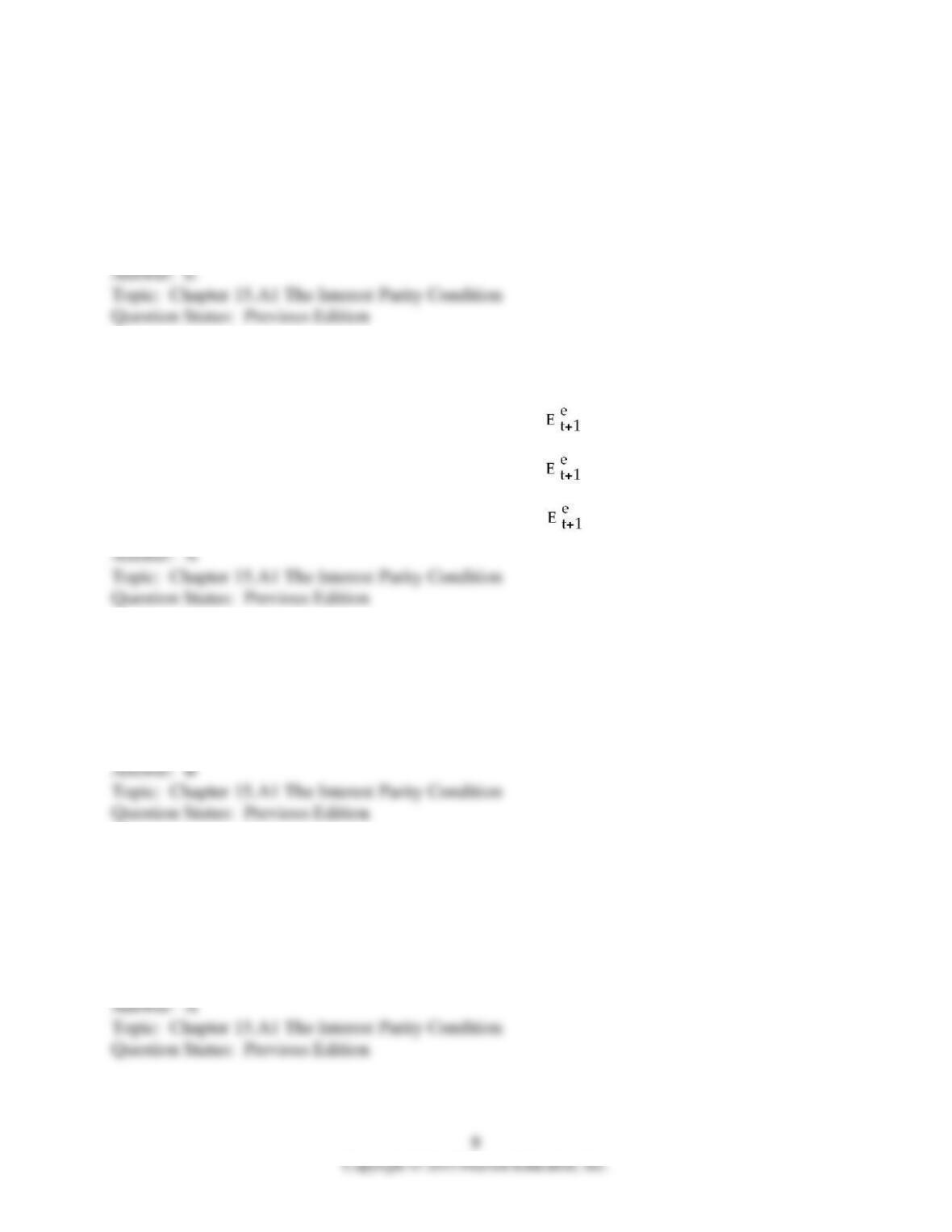
35) The expected return on dollar deposits in terms of dollars, RD, is
A) always the interest rate on dollar deposits, iD, for any exchange rate.
B) the interest rate on dollar deposits, iD, only when Et > .
C) the interest rate on dollar deposits, iD, only when Et < .
D) the interest rate on dollar deposits, iD, only when Et = .
36) The condition which states that the domestic interest rate equals the foreign interest rate
minus the expected appreciation of the domestic currency is called
A) the purchasing power parity condition.
B) the interest parity condition.
C) money neutrality.
D) the theory of foreign capital mobility.
37) In a world with few impediments to capital mobility, the domestic interest rate equals the
sum of the foreign interest rate and the expected depreciation of the domestic currency, a
situation known as the
A) interest parity condition.
B) purchasing power parity condition.
C) exchange rate parity condition.
D) foreign asset parity condition.
38) According to the interest parity condition, the domestic interest rate is equal to the foreign
interest rate
A) plus the expected appreciation of the domestic currency.
B) less the expected appreciation of the domestic currency.
C) less the expected depreciation of the domestic currency.
D) less the expected depreciation of the domestic currency weighted by the domestic interest
rate.
39) According to the interest parity condition, if the domestic interest rate is ________ the
foreign interest rate, then ________.
A) above; there is expected appreciation of the foreign currency
B) above; there is expected depreciation of the foreign currency
C) below; there is expected appreciation of the foreign currency
D) below; the interest parity condition is violated
40) According to the interest parity condition, if the domestic interest rate is 12 percent and the
foreign interest rate is 10 percent, then the expected ________ of the foreign currency must be
________ percent.
A) appreciation; 4
B) appreciation; 2
C) depreciation; 2
D) depreciation; 4
41) According to the interest parity condition, if the domestic interest rate is 10 percent and the
foreign interest rate is 12 percent, then the expected ________ of the foreign currency must be
________ percent.
A) appreciation; 4
B) appreciation; 2
C) depreciation; 2
D) depreciation; 4