
Financial Management, 12e (Titman/Keown/Martin)
Chapter 7 An Introduction to Risk and Return-History of Financial
Market Returns
7.1 Realized and Expected Rates of Return and Risk
1) You purchased the stock of Sargent Motors at a price of $75.75 one year ago today. If
you sell the stock today for $89.00, what is your rate of return?
A) 35.00%
B) 12.50%
C) 17.50%
D) 25.00%
Question Status: Revised
Objective: 7.1 Calculate realized and expected rates of return and risk.
Keywords: risk, return
Principles: Principle 2: There Is a Risk-Return Tradeof
2) You have invested in a project that has the following payof schedule:
Probability of
Payof Occurrence
$40 .15
$50 .20
$60 .30
$70 .30
$80 .05
What is the expected value of the investment’s payof? (Round to the nearest $1.)
A) $60
B) $65
C) $58
D) $70
Question Status: Previous edition
Objective: 7.1 Calculate realized and expected rates of return and risk.
Keywords: risk, return
Principles: Principle 2: There Is a Risk-Return Tradeof
1

3) If there is a 20% chance we will get a 16% return, a 30% chance of getting a 14% return,
a 40% chance of getting a 12% return, and a 10% chance of getting an 8% return, what is
the expected rate of return?
A) 12%
B) 13%
C) 14%
D) 15%
Question Status: Previous edition
Objective: 7.1 Calculate realized and expected rates of return and risk.
Keywords: risk, return
Principles: Principle 2: There Is a Risk-Return Tradeof
4) You are considering investing in a project with the following possible outcomes:
Probability of Investment
States Occurrence Returns
State 1: Economic boom 15% 16%
State 2: Economic growth45% 12%
State 3: Economic decline25% 5%
State 4: Depression 15% -5%
Calculate the expected rate of return for this investment.
A) 9.8%
B) 7.0%
C) 8.3%
D) 6.3%
Question Status: Previous edition
Objective: 7.1 Calculate realized and expected rates of return and risk.
Keywords: risk, return
Principles: Principle 2: There Is a Risk-Return Tradeof
2
5) Spartan Sofas, Inc. is selling for $50.00 per share today. In one year, Spartan will be
selling for $48.00 per share, and the dividend for the year will be $3.00. What is the cash
return on Spartan stock?
A) $51.00
B) $1.00
C) $2.00
D) $3.00
Question Status: Revised
Objective: 7.1 Calculate realized and expected rates of return and risk.
Keywords: risk, return
Principles: Principle 2: There Is a Risk-Return Tradeof
6) What is the standard deviation of an investment that has the following expected
scenario? 18% probability of a recession, 2.0% return; 65% probability of a moderate
economy, 9.5% return; 17% probability of a strong economy, 14.2% return.
A) 3.68%
B) 1.23%
C) 8.47%
D) 6.66%
Question Status: Previous edition
Objective: 7.1 Calculate realized and expected rates of return and risk.
Keywords: risk, return
Principles: Principle 2: There Is a Risk-Return Tradeof
7) You are considering investing in a irm that has the following possible outcomes:
Economic boom: probability of 25%; return of 25%
Economic growth: probability of 60%; return of 15%
Economic decline: probability of 15%; return of -5%
What is the expected rate of return on the investment?
A) 15.0%
B) 11.7%
C) 14.5%
D) 25.0%
Question Status: Previous edition
Objective: 7.1 Calculate realized and expected rates of return and risk.
Keywords: risk, return
Principles: Principle 2: There Is a Risk-Return Tradeof
3
8) Which of the following best measures an asset’s risk?
A) Expected return
B) The standard deviation
C) The probability distribution
D) The cash return
Question Status: Revised
Objective: 7.1 Calculate realized and expected rates of return and risk.
Keywords: risk, return
Principles: Principle 2: There Is a Risk-Return Tradeof
9) The cash return on an investment is calculated as purchase price-selling price.
Question Status: New question
Objective: 7.1 Calculate realized and expected rates of return and risk.
Keywords: risk, return
Principles: Principle 2: There Is a Risk-Return Tradeof
10) Because returns are more certain for the least risky investments, the required return
on these investments should be higher than the required returns on more risky
investments.
Question Status: Previous edition
Objective: 7.1 Calculate realized and expected rates of return and risk.
Keywords: risk, return
Principles: Principle 2: There Is a Risk-Return Tradeof
11) Even though an investor expects a positive rate of return, it is possible that the actual
return will be negative.
Question Status: Previous edition
Objective: 7.1 Calculate realized and expected rates of return and risk.
Keywords: risk, return
Principles: Principle 2: There Is a Risk-Return Tradeof
12) The expected rate of return is the weighted average of the possible returns for an
investment.
Question Status: Previous edition
Objective: 7.1 Calculate realized and expected rates of return and risk.
Keywords: risk, return
Principles: Principle 2: There Is a Risk-Return Tradeof
4
13) The expected rate of return is the sum of each possible return times it likelihood of
occurrence.
Question Status: Previous edition
Objective: 7.1 Calculate realized and expected rates of return and risk.
Keywords: risk, return
Principles: Principle 2: There Is a Risk-Return Tradeof
14) The higher the standard deviation, the less risk the investment has.
Question Status: Previous edition
Objective: 7.1 Calculate realized and expected rates of return and risk.
Keywords: risk, return
Principles: Principle 2: There Is a Risk-Return Tradeof
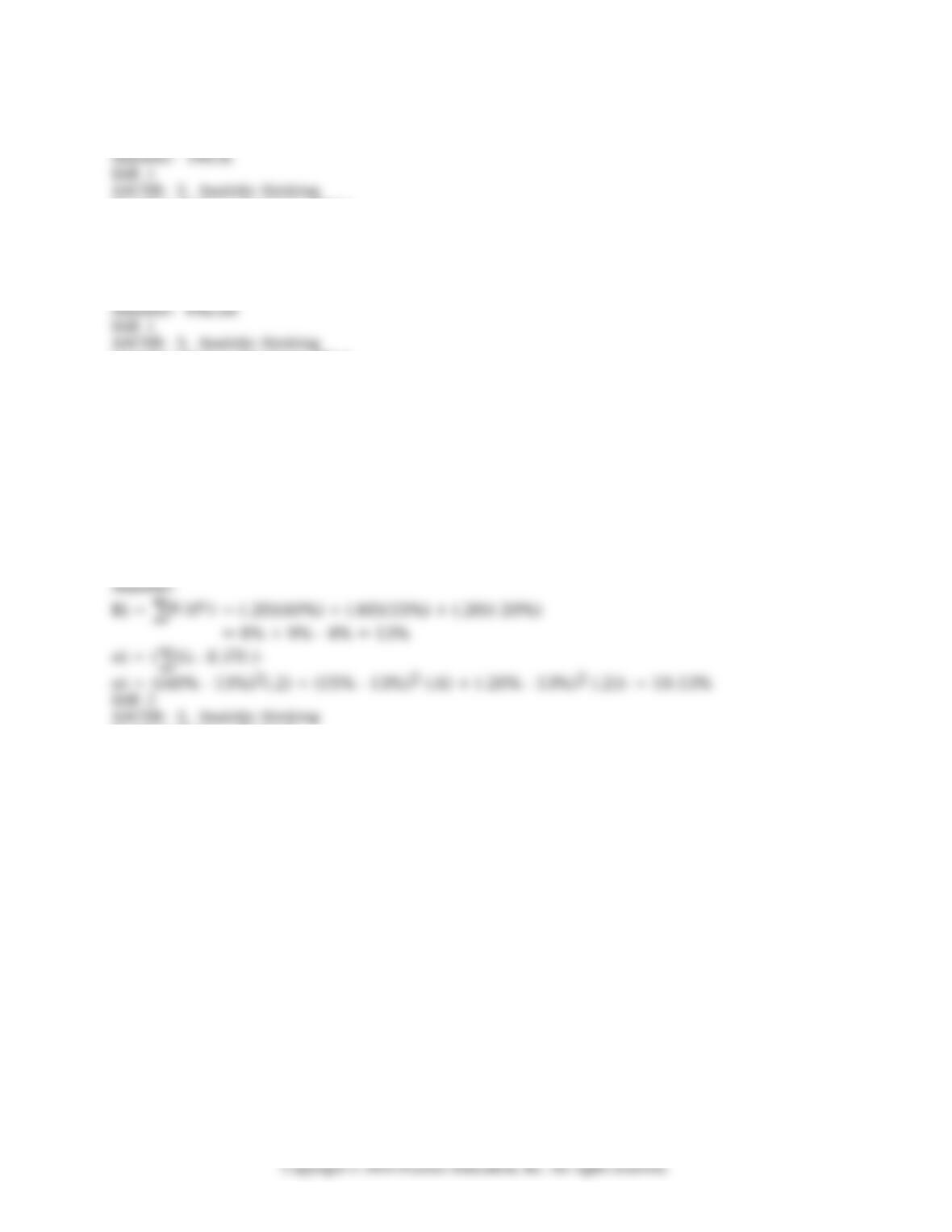
15) Using the following information for McDonovan, Inc.’s stock, calculate their expected
return and standard deviation.
State Probability Return
Boom 20% 40%
Normal 60% 15%
Recession 20% (20%)
Question Status: Revised
Objective: 7.1 Calculate realized and expected rates of return and risk.
Keywords: risk, return
Principles: Principle 2: There Is a Risk-Return Tradeof
5
7.2 A Brief History of Financial Market Returns
1) Which of the following sequences is arranged in the correct order, from highest long-
term returns to lowest?
A) Small stocks, government bonds, large stocks
B) Large stocks, treasury bills, small stocks
C) Small stocks, large stocks, treasury bills
D) Government bonds, large stocks, treasury bills
Question Status: New question
Objective: 7.2 Describe the historical pattern of inancial market returns.
Keywords: risk, return
Principles: Principle 2: There Is a Risk-Return Tradeof
2) Investments that have earned the highest rates of return over time also have
A) the lowest risk.
B) the highest standard deviation of returns.
C) the largest market capitalization.
D) the least sensitivity to inlation.
Question Status: New question
Objective: 7.2 Describe the historical pattern of inancial market returns.
Keywords: risk, return
Principles: Principle 2: There Is a Risk-Return Tradeof
3) The diference between returns on stocks and government bonds is known as
A) the equity risk premium.
B) the risk and return tradeof.
C) the maturity premium.
D) the risk/reward paradox.
Question Status: New question
Objective: 7.2 Describe the historical pattern of inancial market returns.
Keywords: risk, return
Principles: Principle 2: There Is a Risk–Return Tradeof
6
4) An emerging market is
A) a market for small, but rapidly growing companies.
B) market for companies coming out from bankruptcy proceedings.
C) market for promising, but untested technologies.
D) a market located in an economy with low to middle per capita income.
Question Status: New question
Objective: 7.2 Describe the historical pattern of inancial market returns.
Keywords: risk, return
Principles: Principle 2: There Is a Risk–Return Tradeof
5) The risk-return tradeof tells us that expected returns should be higher on investments
that have higher risk.
Question Status: Previous edition
Objective: 7.2 Describe the historical pattern of inancial market returns.
Keywords: risk, return
Principles: Principle 2: There Is a Risk–Return Tradeof
6) Riskier investments have traditionally had lower returns than less risky investments
have had.
Question Status: Previous edition
Objective: 7.2 Describe the historical pattern of inancial market returns.
Keywords: risk, return
Principles: Principle 2: There Is a Risk–Return Tradeof
7) Less risky investments have lower standard deviations than do more risky investments.
Question Status: Previous edition
Objective: 7.2 Describe the historical pattern of inancial market returns.
Keywords: risk, return
Principles: Principle 2: There Is a Risk–Return Tradeof
8) Investments in emerging markets have higher volatility than do U.S. Stocks.
Question Status: Previous edition
Objective: 7.2 Describe the historical pattern of inancial market returns.
Keywords: risk, return
Principles: Principle 2: There Is a Risk–Return Tradeof
7
9) Risky investments have the potential for higher returns, but also larger losses.
Question Status: New question
Objective: 7.2 Describe the historical pattern of inancial market returns.
Keywords: risk, return
Principles: Principle 2: There Is a Risk–Return Tradeof
10) Historically, in the United States stocks have had higher returns and greater volatility
than have government bonds.
Question Status: Previous edition
Objective: 7.2 Describe the historical pattern of inancial market returns.
Keywords: risk, return
Principles: Principle 2: There Is a Risk–Return Tradeof
11) Treasury Bills have less default risk than do Government Bonds.
Question Status: Previous edition
Objective: 7.2 Describe the historical pattern of inancial market returns.
Keywords: risk, return
Principles: Principle 2: There Is a Risk–Return Tradeof
12) Investors are always rewarded for taking higher risk with higher realized returns.
Question Status: Previous edition
Objective: 7.2 Describe the historical pattern of inancial market returns.
Keywords: risk, return
Principles: Principle 2: There Is a Risk–Return Tradeof
13) During the inancial crisis of 2007-2009, returns on real estate investment trusts
(REITS) and stocks moved in opposite directions.
Question Status: New question
Objective: 7.2 Describe the historical pattern of inancial market returns.
Keywords: risk, return
Principles: Principle 2: There Is a Risk–Return Tradeof
8