Financial Management, 12e (Titman/Keown/Martin)
Chapter 5 Time Value of Money-The Basics
5.1 Using Timelines to Visualize Cash Flows
1) Financial managers use the time value of money to
A) make business decisions.
B) compare cash lows of diferent projects.
C) determine the price of common stock.
D) both A and B.
E) all of the above.
Question Status: Previous edition
Objective: 5.1 Construct cash low timelines to organize your analysis of problems involving the time
value of money.
Keywords: time value of money
Principles: Principle 1: Money Has a Time Value
2) The time value of money is created by
A) the existence of proitable investment alternatives and interest rates.
B) the fact that the passing of time increases the value of money.
C) the elimination of the opportunity cost as a consideration.
D) the fact that the value of saving money for tomorrow could be more or less than
spending it today.
Question Status: Previous edition
Objective: 5.1 Construct cash low timelines to organize your analysis of problems involving the time
value of money.
Keywords: time value of money
Principles: Principle 1: Money Has a Time Value
3) Which of the following statements is FALSE?
A) A dollar received one year from now will be worth more than a dollar received today.
B) On monthly compounding loans, the annual percentage yield will be less than the
nominal or quoted rate of interest.
C) Compounding essentially means earning interest on interest on an initial balance.
D) Perpetuities pay an equal payment forever.
Question Status: New question
Objective: 5.1 Construct cash low timelines to organize your analysis of problems involving the time
value of money.
Keywords: time value of money
Principles: Principle 1: Money Has a Time Value
4) An investor will invest $1,000 now and expect to receive $10 for each of the next 10
years plus $1,000 at the end of the 10th year. Her cash low at time period 0 is
A) $1,000
B) -$1,000
C) $-990
D) $1,010
Dif: 2
Question Status: New question
Objective: 5.1 Construct cash low timelines to organize your analysis of problems involving the time
value of money.
Keywords: time value of money
Principles: Principle 1: Money Has a Time Value
5) An investor will invest $1,000 now and expect to receive $10 for each of the next 10
years plus $1,000 at the end of the 10th year. Her cash at time period 10 is
A) $10
B) $1,000
C) $-990
D) $1,010
Question Status: New question
Objective: 5.1 Construct cash low timelines to organize your analysis of problems involving the time
value of money.
Keywords: time value of money
Principles: Principle 1: Money Has a Time Value
6) Should you prefer to receive $100,000 right now or $10,000 at the end of each of the
next 12 years?
A) $100,000 now
B) $10,000 at the end of each of the next 12 years
C) The answer depends on the time value of money.
D) Either alternative is equally valuable.
Question Status: New question
Objective: 5.1 Construct cash low timelines to organize your analysis of problems involving the time
value of money.
Keywords: time value of money
Principles: Principle 1: Money Has a Time Value
2
7) Money has a greater time value time value
A) when rates of return are higher.
B) when rates of return are lower.
C) when the future is uncertain.
D) when investors are willing to assume greater risks.
Question Status: New question
Objective: 5.1 Construct cash low timelines to organize your analysis of problems involving the time
value of money.
Keywords: time value of money
Principles: Principle 1: Money Has a Time Value
8) A diagram for visualizing future cash lows is known as
A) a future value vector.
B) a cash low chart.
C) an FV/PV plot.
D) a timeline.
Question Status: New question
Objective: 5.1 Construct cash low timelines to organize your analysis of problems involving the time
value of money.
Keywords: time value of money
Principles: Principle 1: Money Has a Time Value
9) On timeline, the present is represented as
A) time sub n
B) time zero
C) time sub i
D) time 1
Question Status: New question
Objective: 5.1 Construct cash low timelines to organize your analysis of problems involving the time
value of money.
Keywords: time value of money
Principles: Principle 1: Money Has a Time Value
10) A timeline typically represents cash lows as an exponential growth curve.
Question Status: New question
Objective: 5.1 Construct cash low timelines to organize your analysis of problems involving the time
value of money.
Keywords: time value of money
Principles: Principle 1: Money Has a Time Value
11) A timeline is a linear representation of the timing of cash lows.
Question Status: New question
Objective: 5.1 Construct cash low timelines to organize your analysis of problems involving the time
value of money.
Keywords: time value of money
3
Principles: Principle 1: Money Has a Time Value
12) A timeline represents the value of a sum invested now at the end of a series of time
periods.
Question Status: New question
Objective: 5.1 Construct cash low timelines to organize your analysis of problems involving the time
value of money.
Keywords: time value of money
Principles: Principle 1: Money Has a Time Value
13) The end of one time period and the beginning of the next occupy the same place on a
timeline.
Question Status: New question
Objective: 5.1 Construct cash low timelines to organize your analysis of problems involving the time
value of money.
Keywords: time value of money
Principles: Principle 1: Money Has a Time Value
14) Timelines are always expressed in years.
Question Status: New question
Objective: 5.1 Construct cash low timelines to organize your analysis of problems involving the time
value of money.
Keywords: time value of money
Principles: Principle 1: Money Has a Time Value
15) Timelines used to visualize cash lows normally represent present values on the left and
future values on the right.
Question Status: New question
Objective: 5.1 Construct cash low timelines to organize your analysis of problems involving the time
value of money.
Keywords: time value of money
Principles: Principle 1: Money Has a Time Value
4
16) The last amount shown on a timeline represents the future value of all amounts
invested up to that point.
Question Status: New question
Objective: 5.1 Construct cash low timelines to organize your analysis of problems involving the time
value of money.
Keywords: time value of money
Principles: Principle 1: Money Has a Time Value
17) The irst amount on a timeline represent the present value of all the future amounts at
a given interest rate.
Question Status: Previous edition
Objective: 5.1 Construct cash low timelines to organize your analysis of problems involving the time
value of money.
Keywords: time value of money
Principles: Principle 1: Money Has a Time Value
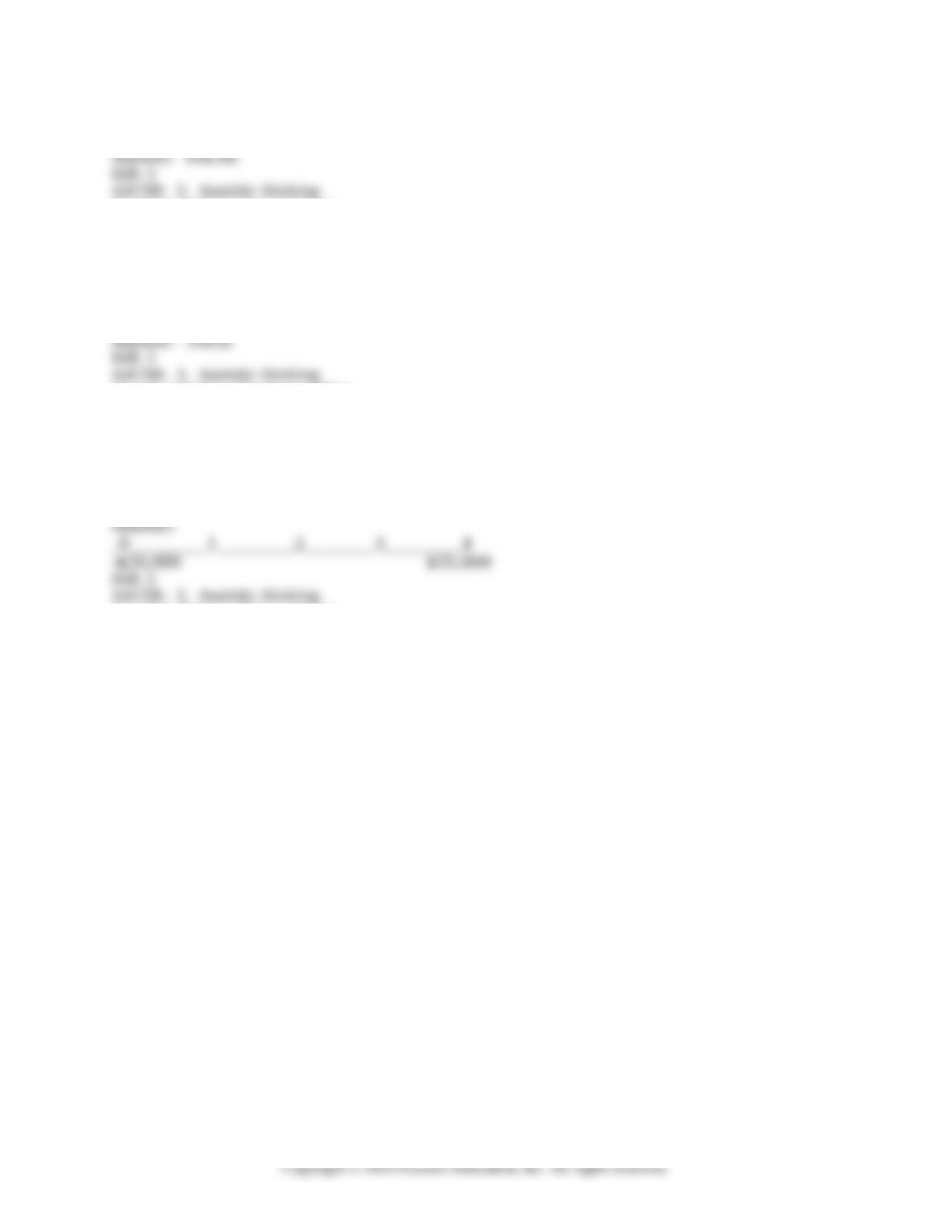
18) Sketch a timeline that represents an immediate investment of $20,000 with $25,000 to
be received at the end of 4 years.
Question Status: New question
Objective: 5.1 Construct cash low timelines to organize your analysis of problems involving the time
value of money.
Keywords: time value of money
Principles: Principle 1: Money Has a Time Value
5
5.2 Compounding and Future Value
1) Which of the following is the formula for compound value?
A) FVn = P(1 + i)n
B) FVn = (1 + i)/P
C) FVn = P/(1 + i)n
D) FVn = P(1 + i)-n
Question Status: Previous edition
Objective: 5.2 Understand compounding and calculate the future value of cash lows using
mathematical formulas, a inancial calculator, and an EXCEL spreadsheet.
Keywords: future value
Principles: Principle 1: Money Has a Time Value
2) At 8% compounded annually, how long will it take $750 to double?
A) 6.5 years
B) 48 months
C) 9 years
D) 12 years
Question Status: Previous edition
Objective: 5.2 Understand compounding and calculate the future value of cash lows using
mathematical formulas, a inancial calculator, and an EXCEL spreadsheet.
Keywords: future value
Principles: Principle 1: Money Has a Time Value
3) At what rate must $400 be compounded annually for it to grow to $716.40 in 10 years?
A) 6%
B) 5%
C) 7%
D) 8%
Question Status: Previous edition
Objective: 5.2 Understand compounding and calculate the future value of cash lows using
mathematical formulas, a inancial calculator, and an EXCEL spreadsheet.
Keywords: future value
Principles: Principle 1: Money Has a Time Value
6
4) An increase in future value can be caused by an increase in the
A) annual interest rate.
B) number of compounding periods.
C) original amount invested.
D) both A and B.
Question Status: Revised
Objective: 5.2 Understand compounding and calculate the future value of cash lows using
mathematical formulas, a inancial calculator, and an EXCEL spreadsheet.
Keywords: future value
Principles: Principle 1: Money Has a Time Value
5) A friend plans to buy a big-screen TV/entertainment system and can aford to set aside
$1,320 toward the purchase today. If your friend can earn 5.0%, compounded yearly, how
much can your friend spend in four years on the purchase? Round of to the nearest $1.
A) $1,444
B) $1,604
C) $1,764
D) $1,283
Question Status: Previous edition
Objective: 5.2 Understand compounding and calculate the future value of cash lows using
mathematical formulas, a inancial calculator, and an EXCEL spreadsheet.
Keywords: future value
Principles: Principle 1: Money Has a Time Value
6) You just purchased a parcel of land for $10,000. If you expect a 12% annual rate of
return on your investment, how much will you sell the land for in 10 years?
A) $25,000
B) $31,060
C) $38,720
D) $34,310
Question Status: Previous edition
Objective: 5.2 Understand compounding and calculate the future value of cash lows using
mathematical formulas, a inancial calculator, and an EXCEL spreadsheet.
Keywords: future value
Principles: Principle 1: Money Has a Time Value
7
7) If you place $50 in a savings account with an interest rate of 7% compounded weekly,
what will the investment be worth at the end of ive years (round to the nearest dollar)?
A) $72
B) $70
C) $71
D) $57
Question Status: Previous edition
Objective: 5.2 Understand compounding and calculate the future value of cash lows using
mathematical formulas, a inancial calculator, and an EXCEL spreadsheet.
Keywords: future value
Principles: Principle 1: Money Has a Time Value
8) If you put $700 in a savings account with a 10% nominal rate of interest compounded
monthly, what will the investment be worth in 21 months (round to the nearest dollar)?
A) $827
B) $833
C) $828
D) $1,176
Question Status: Previous edition
Objective: 5.2 Understand compounding and calculate the future value of cash lows using
mathematical formulas, a inancial calculator, and an EXCEL spreadsheet.
Keywords: future value
Principles: Principle 1: Money Has a Time Value
9) If you put $600 in a savings account that yields an 8% rate of interest compounded
weekly, what will the investment be worth in 37 weeks (round to the nearest dollar)?
A) $648
B) $635
C) $634
D) $645
Question Status: Previous edition
Objective: 5.2 Understand compounding and calculate the future value of cash lows using
mathematical formulas, a inancial calculator, and an EXCEL spreadsheet.
Keywords: future value
Principles: Principle 1: Money Has a Time Value
8
10) Which of the following formulas represents the future value of $500 invested at 8%
compounded quarterly for ive years?
A) 500(1 + .08)5
B) 500(1 + .08)20
C) 500(1 + .02)5
D) 500(1 + .02)20
Question Status: Previous edition
Objective: 5.2 Understand compounding and calculate the future value of cash lows using
mathematical formulas, a inancial calculator, and an EXCEL spreadsheet.
Keywords: future value
Principles: Principle 1: Money Has a Time Value
11) What is the value of $750 invested at 7.5% compounded quarterly for 4.5 years (round
to the nearest $1)?
A) $1,048
B) $1,010
C) $1,038
D) $808
Question Status: Previous edition
Objective: 5.2 Understand compounding and calculate the future value of cash lows using
mathematical formulas, a inancial calculator, and an EXCEL spreadsheet.
Keywords: future value
Principles: Principle 1: Money Has a Time Value
12) Shorty Jones wants to buy a one-way bus ticket to Mule-Snort, Pennsylvania. The ticket
costs $142, but Mr. Jones has only $80. If Shorty puts the money in an account that pays
9% interest compounded monthly, how many months must Shorty wait until he has $142
(round to the nearest month)?
A) 73 months
B) 75 months
C) 77 months
D) 79 months
Question Status: Previous edition
Objective: 5.2 Understand compounding and calculate the future value of cash lows using
mathematical formulas, a inancial calculator, and an EXCEL spreadsheet.
Keywords: future value
Principles: Principle 1: Money Has a Time Value
9
13) If you want to have $10,000 in 10 years, which of the following formulas represents
how much money you must put in a savings account today? Assume that the savings
account pays 6% and it is compounded monthly.
A) 10,000/(1 + .05)10
B) 10,000/(1 + .005)120
C) 10,000/(1 + .06)10
D) 10,000/(1 + .006)120
Question Status: Previous edition
Objective: 5.2 Understand compounding and calculate the future value of cash lows using
mathematical formulas, a inancial calculator, and an EXCEL spreadsheet.
Keywords: future value
Principles: Principle 1: Money Has a Time Value
14) Dawn Swift discovered that 20 years ago, the average tuition for one year at an Ivy
League school was $4,500. Today, the average cost is $29,000. What is the growth rate in
tuition cost over this 20-year period? Round of to the nearest 0.1%.
A) 15.5%
B) 4.2%
C) 9.8%
D) 10.6%
Question Status: Previous edition
Objective: 5.2 Understand compounding and calculate the future value of cash lows using
mathematical formulas, a inancial calculator, and an EXCEL spreadsheet.
Keywords: future value
Principles: Principle 1: Money Has a Time Value
15) If you want to have $1,700 in seven years, how much money must you put in a savings
account today? Assume that the savings account pays 6% and it is compounded quarterly
(round to the nearest $10).
A) $1,120
B) $1,130
C) $1,110
D) $1,140
Question Status: Previous edition
Objective: 5.2 Understand compounding and calculate the future value of cash lows using
mathematical formulas, a inancial calculator, and an EXCEL spreadsheet.
Keywords: future value
Principles: Principle 1: Money Has a Time Value
10