3.4 The Balance Sheet
1) Which of the following is not a current asset?
A) Accounts payable
B) Marketable securities
C) Accounts receivable
D) Inventory
Question Status: Previous edition
Objective: 3.4 Use the balance sheet to describe a irm’s investment in assets and the way it has
inanced them.
Keywords: balance sheet
Principles: Principle 2: There Is a Risk-Return Tradeof
2) Net plant and equipment is
A) plant and equipment purchases less amount borrowed to inance purchases.
B) current year plant and equipment purchases less current year’s depreciation expense.
C) gross plant and equipment less accumulated depreciation.
D) plant and equipment at current market valuations.
Question Status: New question
Objective: 3.4 Use the balance sheet to describe a irm’s investment in assets and the way it has
inanced them.
Keywords: balance sheet
Principles: Principle 2: There Is a Risk-Return Tradeof
3) Your irm has the following balance sheet statement items: total current liabilities of
$805,000; total assets of $2,655,000; ixed and other assets of $1,770,000; and long-term
debt of $200,000. What is the amount of the irm’s total current assets?
A) $885,000
B) $1,550,000
C) $600,000
D) $325,000
Question Status: Previous edition
Objective: 3.4 Use the balance sheet to describe a irm’s investment in assets and the way it has
inanced them.
Keywords: balance sheet
Principles: Principle 2: There Is a Risk-Return Tradeof
21
4) Your irm has the following balance sheet statement items: total current liabilities of
$805,000; total assets of $2,655,000; ixed and other assets of $1,770,000; and long-term
debt of $200,000. What is the amount of the irm’s net working capital?
A) $25,000
B) $325,000
C) $770,000
D) $80,000
Question Status: Previous edition
Objective: 3.4 Use the balance sheet to describe a irm’s investment in assets and the way it has
inanced them.
Keywords: balance sheet
Principles: Principle 2: There Is a Risk-Return Tradeof
5) Which of the following best describes a balance sheet?
A) Reports cash receipts and cash disbursements for a speciic accounting period
B) Reports investment activities for a speciied accounting period
C) Reports revenues and expenses for a speciic accounting period
D) Reports the amount and composition of assets and liabilities at a speciied point in time
Question Status: Previous edition
Objective: 3.4 Use the balance sheet to describe a irm’s investment in assets and the way it has
inanced them.
Keywords: balance sheet
Principles: Principle 2: There Is a Risk-Return Tradeof
6) Which of the following would NOT be included as an asset on a corporate balance sheet?
A) Accounts receivable
B) Common stock
C) Inventory
D) Buildings
Question Status: Previous edition
Objective: 3.4 Use the balance sheet to describe a irm’s investment in assets and the way it has
inanced them.
Keywords: balance sheet
Principles: Principle 2: There Is a Risk-Return Tradeof
22
7) Which of the following would NOT be included as a liability in a corporate balance
sheet?
A) Notes payable
B) Accounts payable
C) Bonds
D) Accumulated Depreciation
Question Status: Revised
Objective: 3.4 Use the balance sheet to describe a irm’s investment in assets and the way it has
inanced them.
Keywords: balance sheet
Principles: Principle 2: There Is a Risk-Return Tradeof
8) Which of the following would NOT be included as equity in a corporate balance sheet?
A) Cash
B) Paid in capital
C) Retained earnings
D) Common stock
Question Status: Revised
Objective: 3.4 Use the balance sheet to describe a irm’s investment in assets and the way it has
inanced them.
Keywords: balance sheet
Principles: Principle 2: There Is a Risk-Return Tradeof
9) Patriot Corporation purchased manufacturing equipment with an expected useful life of
ive years. The purchase of the machinery would be shown as
A) an expense on the balance sheet.
B) an expense on the income statement.
C) an asset on the balance sheet.
D) both an expense and an asset.
Question Status: New question
Objective: 3.4 Use the balance sheet to describe a irm’s investment in assets and the way it has
inanced them.
Keywords: balance sheet
Principles: Principle 2: There Is a Risk-Return Tradeof
23
10) When a company pays a dividend on common stock, it appears as
A) an expense on the income statement.
B) a reduction in the amount of retained earnings.
C) a current liability on the balance sheet.
D) dividend payments have no efect on the inancial statements.
Question Status: New question
Objective: 3.4 Use the balance sheet to describe a irm’s investment in assets and the way it has
inanced them.
Keywords: balance sheet
Principles: Principle 2: There Is a Risk-Return Tradeof
11) Grass Gadgets had sales of $30 million and net income of $2 million in 2008. Grass paid
a dividend of $1.5 million. Assuming that their beginning balance for retained earnings was
$3 million, calculate their ending balance for retained earnings.
A) $2.5 million
B) $3 million
C) $3.5 million
D) $4 million
Question Status: Previous edition
Objective: 3.4 Use the balance sheet to describe a irm’s investment in assets and the way it has
inanced them.
Keywords: balance sheet
Principles: Principle 2: There Is a Risk-Return Tradeof
12) Total equity on the balance sheet increases as dividends paid increases.
Question Status: Previous edition
Objective: 3.4 Use the balance sheet to describe a irm’s investment in assets and the way it has
inanced them.
Keywords: balance sheet
Principles: Principle 2: There Is a Risk-Return Tradeof
13) A balance sheet is a statement of the inancial position of the irm on a given date,
including its asset holdings, liabilities, and equity.
Question Status: Previous edition
Objective: 3.4 Use the balance sheet to describe a irm’s investment in assets and the way it has
inanced them.
Keywords: balance sheet
Principles: Principle 2: There Is a Risk-Return Tradeof
24
14) Under current accounting rules, plant and equipment appear on a company’s balance
sheet valued at replacement value.
Question Status: Previous edition
Objective: 3.4 Use the balance sheet to describe a irm’s investment in assets and the way it has
inanced them.
Keywords: balance sheet
Principles: Principle 2: There Is a Risk-Return Tradeof
15) When a corporation sells common stock to investors, the amount is added to revenue
on the income statement.
Question Status: New question
Objective: 3.4 Use the balance sheet to describe a irm’s investment in assets and the way it has
inanced them.
Keywords: balance sheet
Principles: Principle 2: There Is a Risk-Return Tradeof
16) An advantage of balance sheet numbers is that assets relect current market values.
Question Status: Previous edition
Objective: 3.4 Use the balance sheet to describe a irm’s investment in assets and the way it has
inanced them.
Keywords: balance sheet
Principles: Principle 2: There Is a Risk-Return Tradeof
17) A irm’s balance sheet provides a representation of the current market value of the
company.
Question Status: Previous edition
Objective: 3.4 Use the balance sheet to describe a irm’s investment in assets and the way it has
inanced them.
Keywords: balance sheet
Principles: Principle 2: There Is a Risk-Return Tradeof
18) Gross plant and equipment minus accumulated depreciation represents the fair market
value of a company’s ixed assets.
Question Status: New question
Objective: 3.4 Use the balance sheet to describe a irm’s investment in assets and the way it has
inanced them.
Keywords: balance sheet
Principles: Principle 2: There Is a Risk-Return Tradeof
25
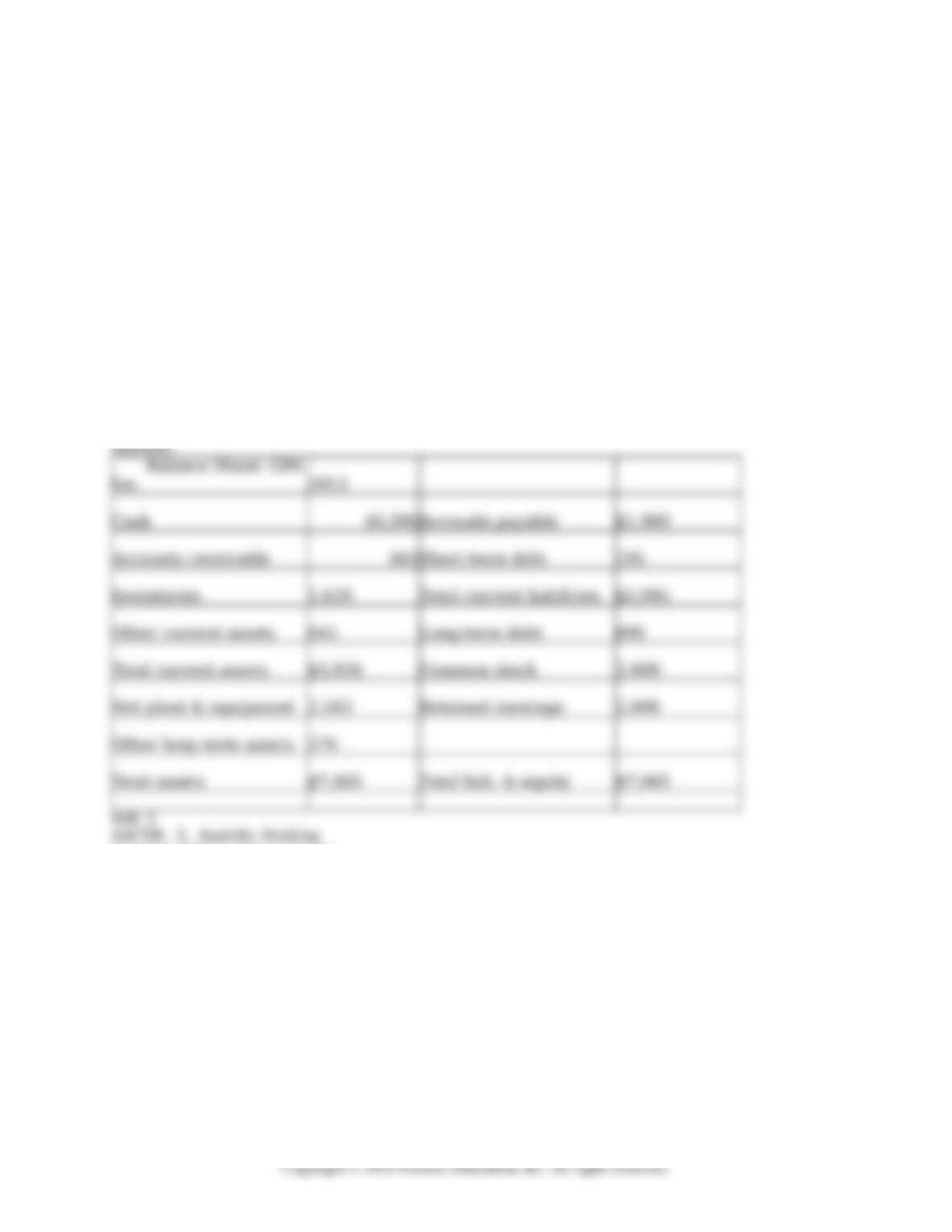
19) Balance sheet and other accounts for GPA are listed below in alphabetical order. Use
these accounts to construct GPA’s balance sheet for 2013. All balance sheet accounts are
shown, but some accounts will not be used. All amounts are in millions of dollars.
Accounts payable $1900
Accounts receivable $661
Cash $1,000
Common stock $2,000
EBIT $1,968
Interest expense $8.00
Inventories $1,620
Long-term debt $890
Net plant & equipment $2,563
Other current assets $645
Other long-term assets $576
Retained earnings $2,080
Short-term debt $195
Taxes $778
Question Status: New question
Objective: 3.4 Use the balance sheet to describe a irm’s investment in assets and the way it has
inanced them.
Keywords: balance sheet
Principles: Principle 2: There Is a Risk-Return Tradeof
26
3.5 The Cash Flow Statement
1) Which of the following represents a source of cash?
A) A decrease in accounts payable
B) A decrease in accounts receivable
C) Payment of dividends
D) An increase in inventories
Question Status: New question
Objective: 3.5 Identify the sources and uses of cash for a irm using the irm’s cash low statement.
Keywords: cash low
Principles: Principle 3: Cash Flows Are the Source of Value
2) The change between a irm’s beginning cash balance and ending cash balance would
equal
A) cash low from operations + cash low from investing activities + cash low from
inancing activities.
B) the change in current assets minus the change in current liabilities.
C) net income plus new borrowing minus asset purchases.
D) total assets minus total liabilities minus total stockholders’ equity.
Question Status: New question
Objective: 3.5 Identify the sources and uses of cash for a irm using the irm’s cash low statement.
Keywords: cash low
Principles: Principle 3: Cash Flows Are the Source of Value
3) Which of the following does NOT represent cash outlows to the irm?
A) Taxes
B) Interest payments
C) Dividends
D) Depreciation
Question Status: Revised
Objective: 3.5 Identify the sources and uses of cash for a irm using the irm’s cash low statement.
Keywords: cash low
Principles: Principle 3: Cash Flows Are the Source of Value
27
4) The ratio of ________ to ________ is an indicator of the quality of a irm’s earnings.
A) cash low from operations, net income
B) liabilities, assets
C) dividends, interest expense
D) cash low from operations, capital expenditures
Question Status: New question
Objective: 3.5 Identify the sources and uses of cash for a irm using the irm’s cash low statement.
Keywords: cash low
Principles: Principle 3: Cash Flows Are the Source of Value
5) Operating cash low will increase with a decrease in
A) inventories.
B) current liabilities.
C) depreciation expense.
D) capital expenditures.
Question Status: New question
Objective: 3.5 Identify the sources and uses of cash for a irm using the irm’s cash low statement.
Keywords: cash low
Principles: Principle 3: Cash Flows Are the Source of Value
6) In a growing business, negative cash low from investing activities is normal.
Question Status: New question
Objective: 3.5 Identify the sources and uses of cash for a irm using the irm’s cash low statement.
Keywords: cash low
Principles: Principle 3: Cash Flows Are the Source of Value
7) Reducing a irm’s debt will increase its cash low.
Question Status: New question
Objective: 3.5 Identify the sources and uses of cash for a irm using the irm’s cash low statement.
Keywords: cash low
Principles: Principle 3: Cash Flows Are the Source of Value
28
8) Beginning cash balance + cash low from operations + cash low from investing
activities + cash low from inancing activities = ending cash balance.
Question Status: New question
Objective: 3.5 Identify the sources and uses of cash for a irm using the irm’s cash low statement.
Keywords: cash low
Principles: Principle 3: Cash Flows Are the Source of Value
29