
Answer: TRUE
Dif: 2
AACSB: 3. Analytic thinking
Question Status: Previous edition
Objective: 17.2 Use the percent of sales method to forecast the inancing requirements of a irm,
including its discretionary inancial needs.
Keywords: percent of sales method
Principles: Principle 2: There Is a Risk-Return Tradeof
49) Pro forma statements are important since they formally report the performance of the
irm during a previous reporting period.
Question Status: Previous edition
Objective: 17.2 Use the percent of sales method to forecast the inancing requirements of a irm,
including its discretionary inancial needs.
Keywords: percent of sales method
Principles: Principle 2: There Is a Risk-Return Tradeof
50) When forecasting statements, assets always increase proportionately to sales
regardless of capacity.
Question Status: Previous edition
Objective: 17.2 Use the percent of sales method to forecast the inancing requirements of a irm,
including its discretionary inancial needs.
Keywords: percent of sales method
Principles: Principle 2: There Is a Risk-Return Tradeof
51) The most commonly used method for making inancial forecasts is the percent-of-sales
method.
Question Status: Previous edition
Objective: 17.2 Use the percent of sales method to forecast the inancing requirements of a irm,
including its discretionary inancial needs.
Keywords: percent of sales method
Principles: Principle 2: There Is a Risk-Return Tradeof
52) It is common practice to develop optimistic and pessimistic scenarios when projecting
inancial statements.
Question Status: Previous edition
Objective: 17.2 Use the percent of sales method to forecast the inancing requirements of a irm,
including its discretionary inancial needs.
Keywords: percent of sales method
Principles: Principle 2: There Is a Risk-Return Tradeof
53) Discretionary sources of inancing are those sources that vary automatically with a
irm’s level of sales.
Question Status: Previous edition
Objective: 17.2 Use the percent of sales method to forecast the inancing requirements of a irm,
21

including its discretionary inancial needs.
Keywords: percent of sales method
Principles: Principle 2: There Is a Risk-Return Tradeof
54) When ixed expenses increase relative to sales, it indicates that there is not enough
productive capacity to absorb an increase in sales.
Question Status: Previous edition
Objective: 17.2 Use the percent of sales method to forecast the inancing requirements of a irm,
including its discretionary inancial needs.
Keywords: percent of sales method
Principles: Principle 2: There Is a Risk-Return Tradeof
55) If the irm’s current ixed assets are suicient to support the projected level of new
sales, then these assets would be projected to remain unchanged for the forecast period.
Question Status: Previous edition
Objective: 17.2 Use the percent of sales method to forecast the inancing requirements of a irm,
including its discretionary inancial needs.
Keywords: percent of sales method
Principles: Principle 2: There Is a Risk-Return Tradeof
22
56) Because accounts payable and accrued expenses increase with sales, they represent
sources of spontaneous inancing.
Question Status: Previous edition
Objective: 17.2 Use the percent of sales method to forecast the inancing requirements of a irm,
including its discretionary inancial needs.
Keywords: percent of sales method
Principles: Principle 2: There Is a Risk-Return Tradeof
57) What is meant by spontaneous inancing?
Question Status: Previous edition
Objective: 17.2 Use the percent of sales method to forecast the inancing requirements of a irm,
including its discretionary inancial needs.
Keywords: percent of sales method
Principles: Principle 2: There Is a Risk-Return Tradeof
58) What is meant by discretionary inancing?
Question Status: Previous edition
Objective: 17.2 Use the percent of sales method to forecast the inancing requirements of a irm,
including its discretionary inancial needs.
Keywords: percent of sales method
Principles: Principle 2: There Is a Risk-Return Tradeof
23
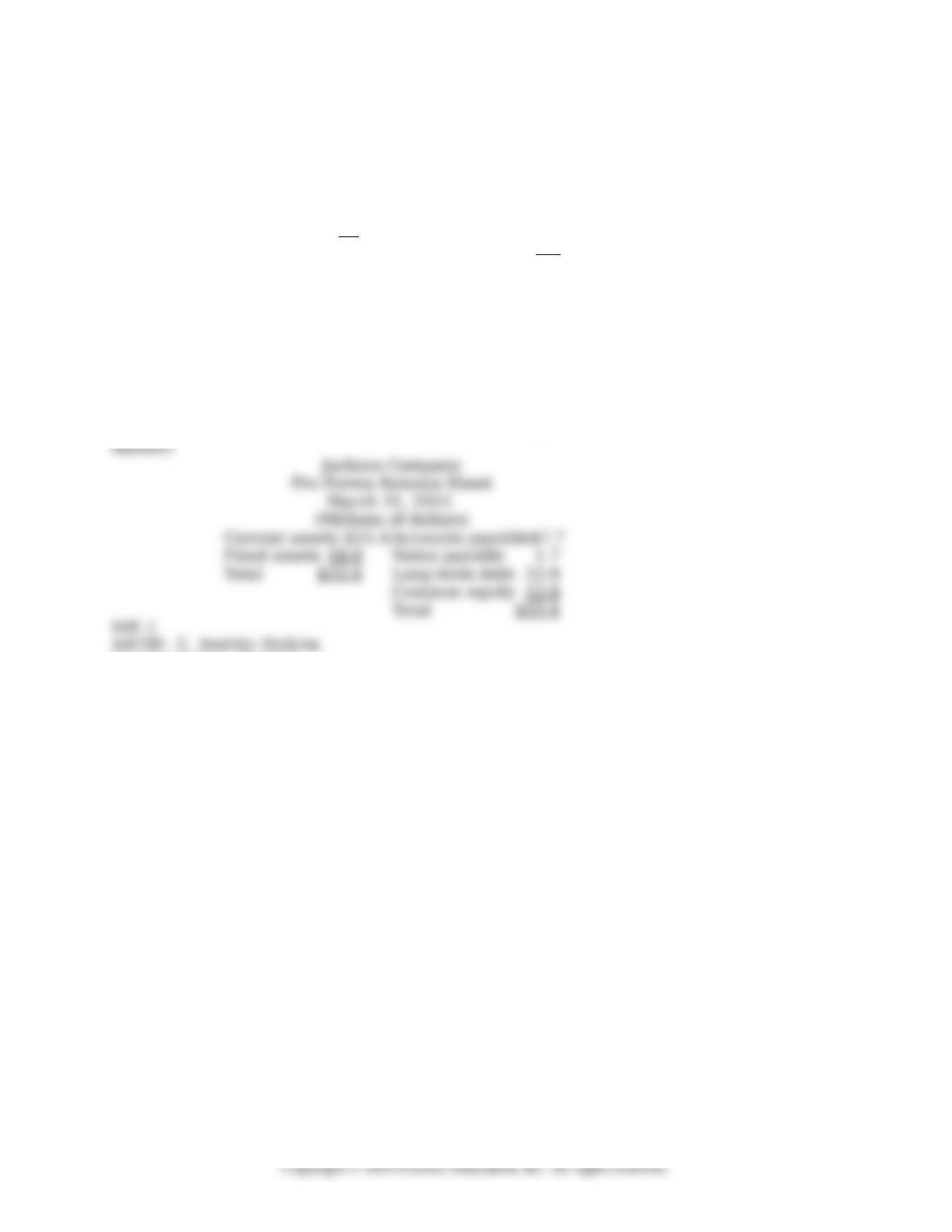
59) The balance sheet of the Jackson Company is presented below:
Jackson Company Balance Sheet
March 31, 2014
(Millions of Dollars)
Current assets $12 Accounts payable $6
Fixed assets 18 Long-term debt 12
Total $30 Common equity 12
Total $30
For the year ending March 31, 2014, Jackson had sales of $35 million. The common
stockholders received all net earnings of the irm in the form of cash dividends, leaving no
funds from earnings available to the irm for expansion (assume that depreciation expense
is just equal to the cost of replacing worn-out assets).
Construct a pro forma balance sheet for March 31, 2015 for an expected level of sales of
$45 million. Assume current assets and accounts payable vary as a percent of sales, and
ixed assets remain at the present level. Use notes payable as a source of discretionary
inancing.
Question Status: Revised
Objective: 17.2 Use the percent of sales method to forecast the inancing requirements of a irm,
including its discretionary inancial needs.
Keywords: percent of sales method
Principles: Principle 2: There Is a Risk-Return Tradeof
24
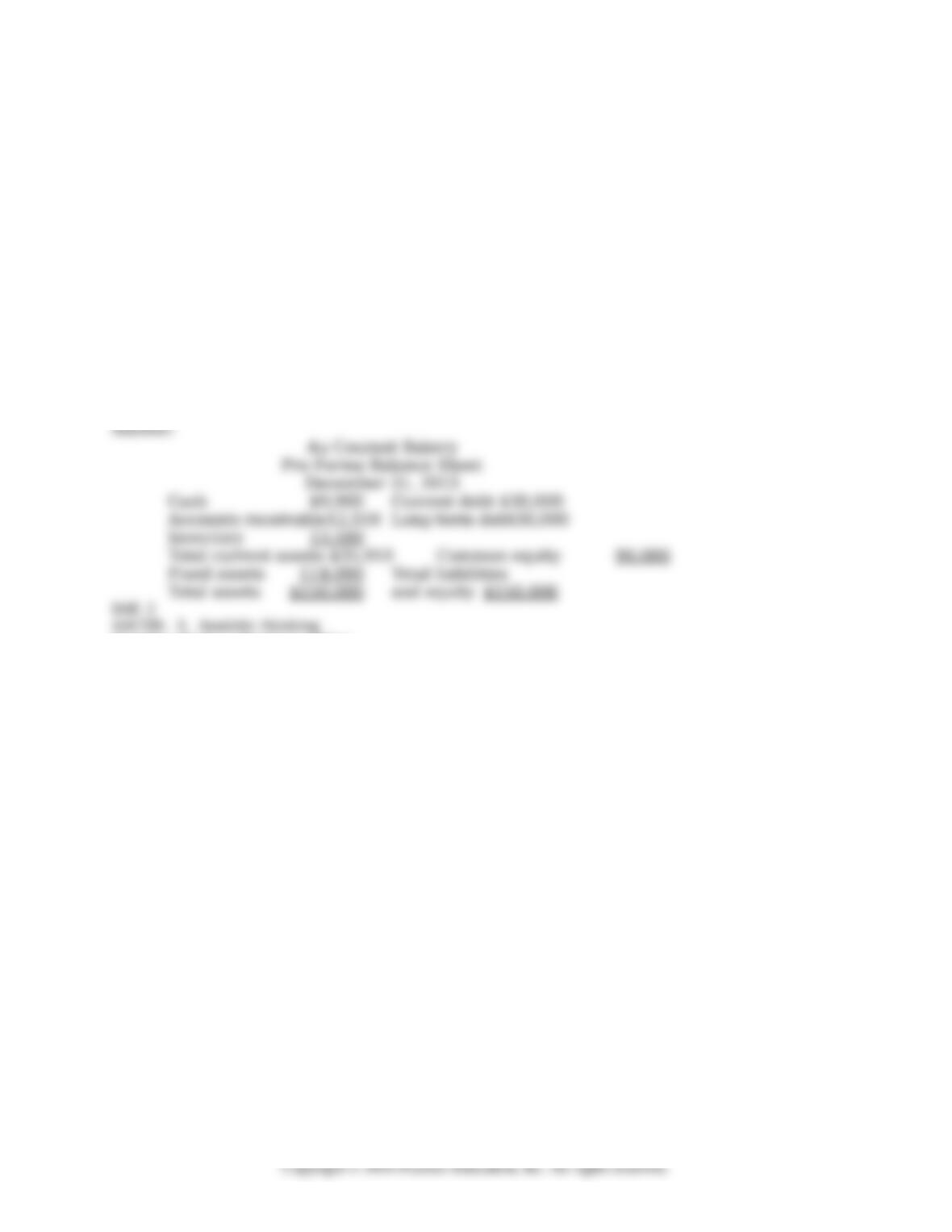
60) Au Courant Bakery is a new irm specializing in gluten free pastry products. In
attempting to determine what the inancial position of the irm should be, the inancial
manager obtained the following average data for the baking industry for 2014. All data is
expressed as a percentage of sales.
Fill in the dollar amounts on Au Courant’s pro forma balance sheet assuming 2015 sales
are $450,000.
Au Courant Bakery
Pro Forma Balance Sheet
December 31, 2015
Cash, 2.22% Accounts payable, 6.67%
Accounts receivable, 2.78% Long-term debt, 6.67%
Inventory, 3%
Total current assets ? Common equity, ?
Fixed assets ? Total liabilities and equity, ?
Total assets, 33%
Question Status: Previous edition
Objective: 17.2 Use the percent of sales method to forecast the inancing requirements of a irm,
including its discretionary inancial needs.
Keywords: percent of sales method
Principles: Principle 2: There Is a Risk-Return Tradeof
25

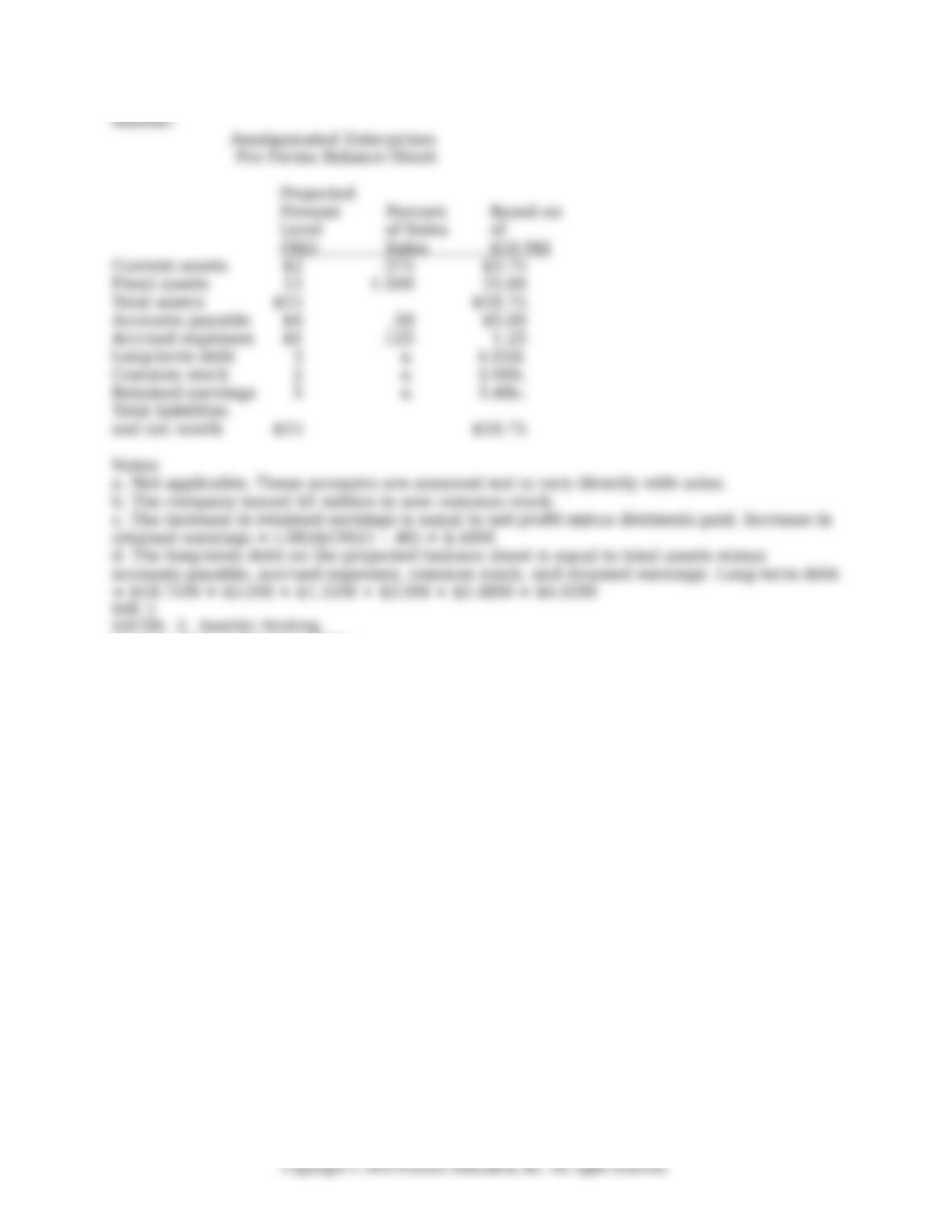
61) Amalgamated Enterprises is planning to purchase some new equipment. With this new
equipment, the company expects sales to increase from $8,000,000 to $10,000,000. A
portion of the inancing for the purchase of the equipment will come from a $1,000,000
new common stock issue. The company knows that current assets, ixed assets, accounts
payable, and accrued expenses increase in direct proportion with sales. The company‘s net
proit margin on sales is 8%, and the company plans to pay 40% of its after-tax earnings in
dividends. A copy of the company’s current balance sheet is given below:
Amalgamated Enterprises Balance Sheet
Current assets $3,000,000
Fixed assets 12,000,000
Total assets $15,000,000
Accounts payable $4,000,000
Accrued expenses 1,000,000
Long-term debt 3,000,000
Common stock 2,000,000
Retained earnings 5,000,000
Total liabilities and net worth $15,000,000
Prepare a pro forma balance sheet for Amalgamated for next year using the percent-of–
sales method and the information provided above.
26
Question Status: Previous edition
Objective: 17.2 Use the percent of sales method to forecast the inancing requirements of a irm,
including its discretionary inancial needs.
Keywords: percent of sales method
Principles: Principle 2: There Is a Risk-Return Tradeof
27
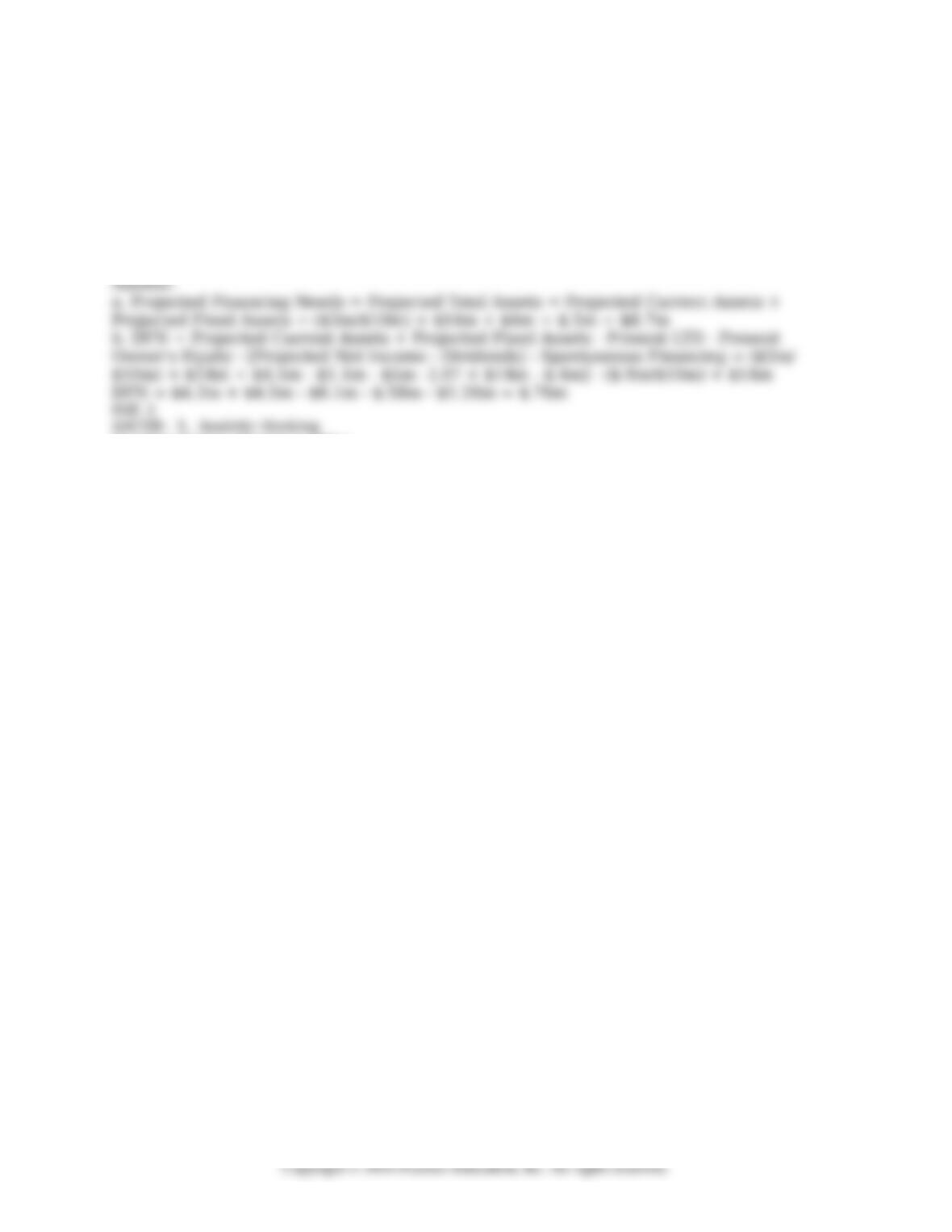
62) Lindsey Insurance Co. has current sales of $10 million and predicts next year’s sales
will grow to $14 million. Current assets are $3 million and ixed assets are $4 million. The
irm’s net proit margin is 7% after taxes. Presently, Lindsey has $900,000 in accounts
payable, $1.1 million in long-term debt, and $5 million (including $2.5 million in retained
earnings) in common equity. Next year, Lindsey projects that current assets will rise in
direct proportion to the forecasted sales, and that ixed assets will rise by $500,000.
Lindsey also plans to pay dividends of $400,000 to common shareholders.
a. What are Lindsey’s total inancing needs for the upcoming year?
b. Given the above information, what are Lindsey’s discretionary inancing needs?
Question Status: Previous edition
Objective: 17.2 Use the percent of sales method to forecast the inancing requirements of a irm,
including its discretionary inancial needs.
Keywords: percent of sales method
Principles: Principle 2: There Is a Risk-Return Tradeof
28

17.3 Developing a Short-Term Financial Plan
1) Which of the following is NOT a basic function of a budget?
A) Budgets indicate the need for future short-term inancing.
B) Budgets provide the basis for corrective action when actual igures difer from the
budgeted igures.
C) Budgets compare historical costs of the irm with its current cost performance.
D) Budgets allow for performance evaluation.
Question Status: Previous edition
Objective: 17.3 Prepare a cash budget and use it to evaluate the amount and timing of a irm’s short-
term inancing requirements.
Keywords: cash budgets
Principles: Principle 3: Cash Flows Are the Source of Value
2) Which of the following will increase cumulative borrowing in the cash budget?
A) Slower collections from customers
B) Slower payments to suppliers
C) Higher interest rates
D) Faster collection of receivables
Question Status: Previous edition
Objective: 17.3 Prepare a cash budget and use it to evaluate the amount and timing of a irm’s short-
term inancing requirements.
Keywords: cash budgets
Principles: Principle 3: Cash Flows Are the Source of Value
3) All of the following are found in the cash budget EXCEPT
A) a net change in cash for the period.
B) inventory.
C) cash disbursements.
D) new inancing needed.
Question Status: Previous edition
Objective: 17.3 Prepare a cash budget and use it to evaluate the amount and timing of a irm’s short-
term inancing requirements.
Keywords: cash budgets
Principles: Principle 3: Cash Flows Are the Source of Value
29

4) Purchases of plant and equipment can be determined from the
A) current cash budget.
B) previous period’s balance sheet.
C) pro forma income statement.
D) use of ratio analysis.
Question Status: Previous edition
Objective: 17.3 Prepare a cash budget and use it to evaluate the amount and timing of a irm’s short-
term inancing requirements.
Keywords: cash budgets
Principles: Principle 3: Cash Flows Are the Source of Value
5) Which of the following is always a non-cash expense?
A) Income taxes
B) Salaries
C) Depreciation
D) None of the above
Question Status: Previous edition
Objective: 17.3 Prepare a cash budget and use it to evaluate the amount and timing of a irm’s short-
term inancing requirements.
Keywords: cash budgets
Principles: Principle 3: Cash Flows Are the Source of Value
6) A company collects 60% of its sales during the month of the sale, 30% one month after
the sale, and 10% two months after the sale. The company expects sales of $10,000 in
August, $20,000 in September, $30,000 in October, and $40,000 in November. How much
money is expected to be collected in October?
A) $25,000
B) $15,000
C) $35,000
D) None of the above
Question Status: Previous edition
Objective: 17.3 Prepare a cash budget and use it to evaluate the amount and timing of a irm’s short-
term inancing requirements.
Keywords: cash budgets
Principles: Principle 3: Cash Flows Are the Source of Value
30