31) The ex-dividend date occurs prior to the declaration date.
Question Status: Previous edition
Objective: 16.1 Distinguish between the use of cash dividends and share repurchases.
Keywords: dividend policy
Principles: Principle 4: Market Prices Relect Information
32) Dividends tend to be higher for irms with stable earnings.
Question Status: Previous edition
Objective: 16.1 Distinguish between the use of cash dividends and share repurchases.
Keywords: dividend policy
Principles: Principle 4: Market Prices Relect Information
33) Dividend payout ratios are generally much lower for small or newly established irms
than for large, publicly owned irms.
Question Status: Previous edition
Objective: 16.1 Distinguish between the use of cash dividends and share repurchases.
Keywords: dividend policy
Principles: Principle 4: Market Prices Relect Information
34) After a stock split of 2-1, each investor will have one-half of the percentage ownership
in the irm that he had before the split.
Question Status: Previous edition
Objective: 16.1 Distinguish between the use of cash dividends and share repurchases.
Keywords: dividend policy
Principles: Principle 4: Market Prices Relect Information
35) A reverse stock split, 1 for 10 for example, should result in a higher price per share.
Question Status: New question
Objective: 16.1 Distinguish between the use of cash dividends and share repurchases.
Keywords: dividend policy
Principles: Principle 4: Market Prices Relect Information
36) Managers avoid cutting dividends even in response to short-term luctuations in
earnings.
Question Status: Previous edition
Objective: 16.1 Distinguish between the use of cash dividends and share repurchases.
Keywords: dividend policy
Principles: Principle 4: Market Prices Relect Information
37) A reasonable conclusion about dividend policy is that management should avoid
surprising investors when it comes to the irm’s dividend decision.
Question Status: Previous edition
Objective: 16.1 Distinguish between the use of cash dividends and share repurchases.
Keywords: dividend policy
Principles: Principle 4: Market Prices Relect Information
38) Due to the strengthening of the stock market over the past 50 years, stock splits and
stock dividends are more common than cash dividends.
Question Status: Previous edition
Objective: 16.1 Distinguish between the use of cash dividends and share repurchases.
Keywords: dividend policy
Principles: Principle 4: Market Prices Relect Information
39) The inancial crisis of 2008-2009 caused an unusually large number of companies to cut
their dividends.
Question Status: New question
Objective: 16.1 Distinguish between the use of cash dividends and share repurchases.
Keywords: dividend policy
Principles: Principle 4: Market Prices Relect Information
40) A stock dividend increases a irm’s retained earnings.
Question Status: Previous edition
Objective: 16.1 Distinguish between the use of cash dividends and share repurchases.
Keywords: dividend policy
Principles: Principle 4: Market Prices Relect Information
41) Kelly owns 10,000 shares in McCormick Spices, which currently has 500,000 shares
outstanding. The stock sells for $86 on the open market. McCormick’s management has
decided on a 2-1 split.
a. Will Kelly‘s inancial position alter after the split, assuming that the stocks will fall
proportionately?
b. Assuming only a 35% fall on each stock, what will be Kelly’s value after the split?
Question Status: Previous edition
Objective: 16.1 Distinguish between the use of cash dividends and share repurchases.
Keywords: dividend policy
Principles: Principle 4: Market Prices Relect Information
42) Why has the popularity of stock repurchases been growing faster than the cash
dividends as a method for companies to distribute cash to their stockholders.
Question Status: Previous edition
Objective: 16.1 Distinguish between the use of cash dividends and share repurchases.
Keywords: dividend policy
Principles: Principle 4: Market Prices Relect Information
43) Explain the signiicance of each of the following:
a. announcement date
b. ex-dividend date
c. record date
d. payment date
Question Status: Previous edition
Objective: 16.1 Distinguish between the use of cash dividends and share repurchases.
Keywords: dividend policy
Principles: Principle 4: Market Prices Relect Information
44) What are the efects of stock splits and stock dividends? Why are they popular?
Question Status: Previous edition
Objective: 16.1 Distinguish between the use of cash dividends and share repurchases.
Keywords: dividend policy
Principles: Principle 4: Market Prices Relect Information
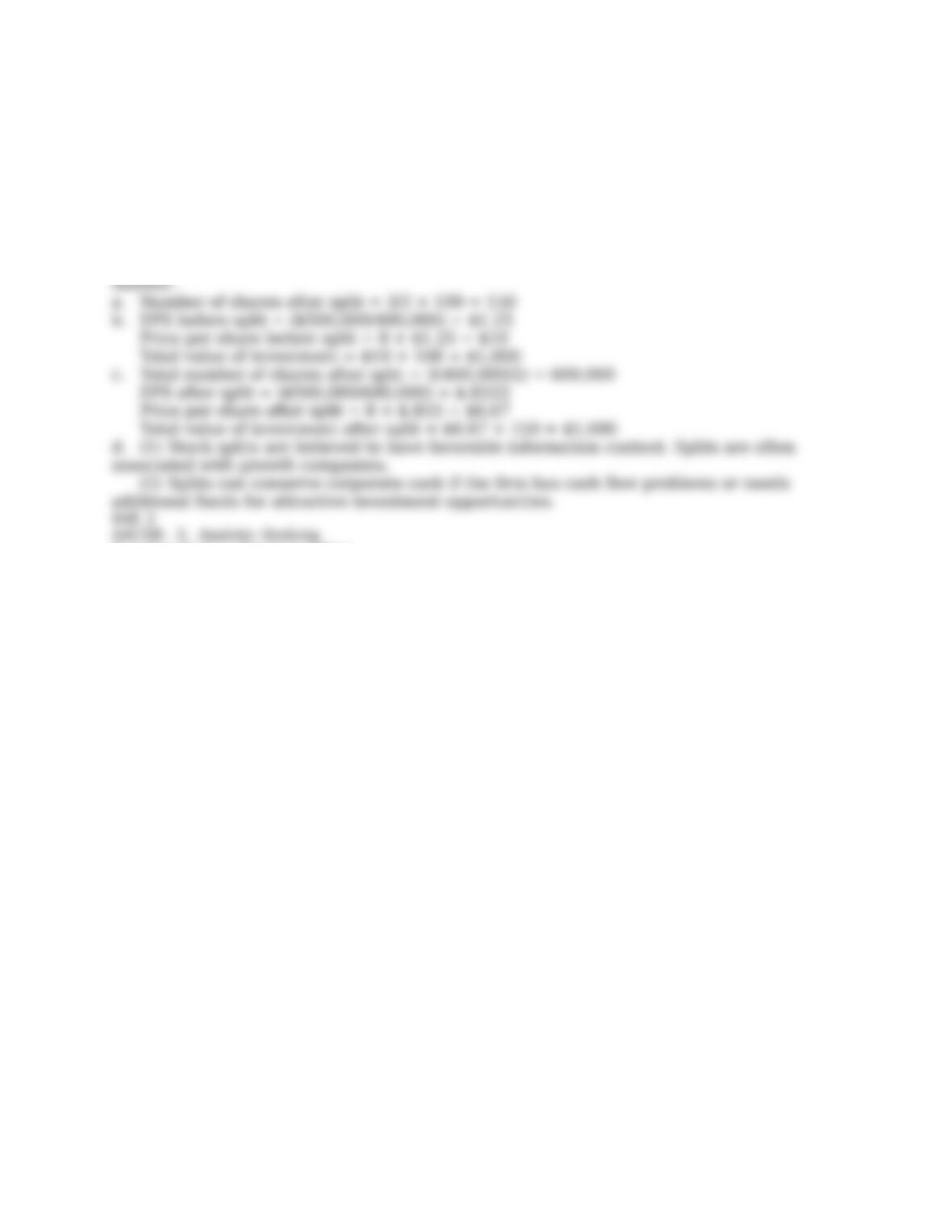
45) XYZ Corporation has 400,000 shares of common stock outstanding, a P/E ratio of 8, and
$500,000 available for common stockholders. The board of directors has just voted a 3-2
stock split.
a. If you had 100 shares of stock before the split, how many shares will you have after the
split?
b. What was the total value of your investment in XYZ stock before the split?
c. What should be the total value of your investment in XYZ stock after the split?
d. In view of your answers to (b) and (c) above, why would a irm’s management want to
have a stock split?
Question Status: Previous edition
Objective: 16.1 Distinguish between the use of cash dividends and share repurchases.
Keywords: dividend policy
Principles: Principle 4: Market Prices Relect Information
16.2 Does Dividend Policy Matter?
1) Which of the following might cause dividend policy to afect shareholder wealth?
A) Taxes
B) Transaction costs
C) Changes in the irm’s investment policies
D) All of the above
Question Status: Revised
Objective: 16.2 Understand the tax treatment of dividends and capital gains, stock dividends and
stock splits, and the conditions under which dividend policy is an important determinant of stock
value.
Keywords: dividend policy
Principles: Principle 3: Cash Flows Are the Source of Value
2) A stock repurchase increases the
A) retention ratio of earnings.
B) number of shares outstanding.
C) EPS.
D) both B and C.
Question Status: Revised
Objective: 16.2 Understand the tax treatment of dividends and capital gains, stock dividends and
stock splits, and the conditions under which dividend policy is an important determinant of stock
value.
Keywords: dividend policy
Principles: Principle 3: Cash Flows Are the Source of Value
3) Transaction costs
A) encourage irms to retain earnings rather than pay dividends.
B) encourage irms to pay large dividends. rather than retain earnings.
C) are encountered whenever a irm pays a dividend.
D) are incurred when investors fail to cash their dividend check.
Question Status: Revised
Objective: 16.2 Understand the tax treatment of dividends and capital gains, stock dividends and
stock splits, and the conditions under which dividend policy is an important determinant of stock
value.
Keywords: dividend policy
Principles: Principle 3: Cash Flows Are the Source of Value
4) The Modigliani and Miller dividend irrelevancy theorem states that
A) dividends are preferable to stock repurchases.
B) the timing of cash distributions is important.
C) the timing of cash distributions is unimportant.
D) stock repurchases are preferable to dividends.
Question Status: Revised
Objective: 16.2 Understand the tax treatment of dividends and capital gains, stock dividends and
stock splits, and the conditions under which dividend policy is an important determinant of stock
value.
Keywords: dividend indiference
Principles: Principle 3: Cash Flows Are the Source of Value
5) Assume that as the result of a irm announcing a large unexpected increase in its
dividend payment, the price of the irm’s common stock rises. This event would be
consistent with which of the following?
A) The dividend irrelevance theory
B) The tax preference theory
C) The information efect
D) The beta efect
Question Status: Revised
Objective: 16.2 Understand the tax treatment of dividends and capital gains, stock dividends and
stock splits, and the conditions under which dividend policy is an important determinant of stock
value.
Keywords: dividend policy
Principles: Principle 3: Cash Flows Are the Source of Value
6) Millbury Gas and Oil’s rate of return on equity is 12%. It can either pay a dividend of
$5.00 today or reinvest the money and pay a dividend of $5.60 at the end of the year. From
a shareholder’s point of view, the value of the dividend paid now is ________ and the value of
the dividend paid a year from now is ________.
A) $5.00, $4.46
B) $5.00, $5.00
C) $4.46, $5.00
D) $5.60, $5.00
Question Status: Revised
Objective: 16.2 Understand the tax treatment of dividends and capital gains, stock dividends and
stock splits, and the conditions under which dividend policy is an important determinant of stock
value.
Keywords: dividend policy
Principles: Principle 3: Cash Flows Are the Source of Value
7) In the absence of taxes, transaction costs, or changes in a irm’s operating or investment
policies
A) the greater the payout ratio, the greater the share price of the irm.
B) the price of a share of stock is not afected by dividend policy.
C) the irm should retain earnings so stockholders will receive a capital gain.
D) the irm should pay a dividend only after current equity inancing needs have been met.
Question Status: Revised
Objective: 16.2 Understand the tax treatment of dividends and capital gains, stock dividends and
stock splits, and the conditions under which dividend policy is an important determinant of stock
value.
Keywords: dividend policy
Principles: Principle 3: Cash Flows Are the Source of Value
8) Assume that investors’ have a 10% required rate of return on MTA stock. According to
the Modigliani and Miller dividend indiference theorem, if investors could choose between
a $1.00 dividend today and $1.10 dividend one year from today
A) they would prefer $1.00 today.
B) they would prefer $1.10 one year from today.
C) neither alternative would satisfy them.
D) they would have no preference.
Question Status: Revised
Objective: 16.2 Understand the tax treatment of dividends and capital gains, stock dividends and
stock splits, and the conditions under which dividend policy is an important determinant of stock
value.
Keywords: dividend policy
Principles: Principle 3: Cash Flows Are the Source of Value
9) What might an investor reasonably expect from a company with excess cash and few
internal investment growth opportunities?
A) The company will buy Treasury bills with all the excess cash.
B) The company will split its stock.
C) The company will declare a stock dividend.
D) The company will pay a cash dividend or repurchase some of its own shares.
Question Status: Revised
Objective: 16.2 Understand the tax treatment of dividends and capital gains, stock dividends and
stock splits, and the conditions under which dividend policy is an important determinant of stock
value.
Keywords: dividend policy
Principles: Principle 3: Cash Flows Are the Source of Value
10) If dividends and capital gains are taxed at the same rate, should investors prefer cash
dividends or stock repurchases?
A) They would prefer to have neither a dividend nor a stock repurchase.
B) It would not matter. Either cash dividends or stock repurchases would result in the same
after-tax cash low.
C) They should prefer cash dividends to stock repurchases.
D) They should prefer stock repurchases to cash dividends.
Question Status: Revised
Objective: 16.2 Understand the tax treatment of dividends and capital gains, stock dividends and
stock splits, and the conditions under which dividend policy is an important determinant of stock
value.
Keywords: dividend policy
Principles: Principle 3: Cash Flows Are the Source of Value
11) Which of the following describes the clientele efect concept of dividend policy?
A) The clientele efect looks at investor preferences for dividends compared to share
repurchase programs.
B) The clientele efect deines the relationship between the shareholder and a stockbroker.
C) The clientele efect focuses entirely on the stability of dividends.
D) Modern corporations do not consider shareholders to be “clients.”
Question Status: Revised
Objective: 16.2 Understand the tax treatment of dividends and capital gains, stock dividends and
stock splits, and the conditions under which dividend policy is an important determinant of stock
value.
Keywords: dividend policy
Principles: Principle 3: Cash Flows Are the Source of Value
12) In the absence of taxes or transaction costs, investors
A) would prefer immediate dividends to future capital gains.
B) who did not want a dividend could use dividends to purchase more shares.
C) could create their own dividends by selling the appropriate number of shares.
D) Both B and C are correct.
Question Status: Revised
Objective: 16.2 Understand the tax treatment of dividends and capital gains, stock dividends and
stock splits, and the conditions under which dividend policy is an important determinant of stock
value.
Keywords: dividend policy
Principles: Principle 3: Cash Flows Are the Source of Value
13) Which of the following statements is most plausible?
A) Increases in stock price associated with a dividend increase are likely due to information
conveyed by the increase.
B) Increases in stock price associated with a dividend increase are likely due to changes in
the company’s capital structure.
C) Increases in stock price associated with a dividend increase are likely due to investors’
preference for dividends over capital gains.
D) Increases in stock price associated with a dividend increase are likely due to the
favorable tax treatment of dividends over capital gains.
Question Status: Revised
Objective: 16.2 Understand the tax treatment of dividends and capital gains, stock dividends and
stock splits, and the conditions under which dividend policy is an important determinant of stock
value.
Keywords: dividend policy
Principles: Principle 3: Cash Flows Are the Source of Value
14) Chandler Corporation has 1 million shares outstanding. The current price per share is
$20. If the company decides to pay a $2 million dollar dividend, the company will have
________ shares outstanding worth approximately ________.
A) 900,000, $20 per share
B) 1,000,000, $20 per share
C) 900,000, $22.22 per share
D) 1,000,000, $18 per share
Question Status: Revised
Objective: 16.2 Understand the tax treatment of dividends and capital gains, stock dividends and
stock splits, and the conditions under which dividend policy is an important determinant of stock
value.
Keywords: dividend policy
Principles: Principle 3: Cash Flows Are the Source of Value
15) Chandler Corporation has 1 million shares outstanding. The current price per share is
$20. If the company decides to use $2 million dollars to repurchase shares at the market
price, the company will have ________ shares outstanding worth approximately ________.
Assume that the price does not change during the repurchase period.
A) 900,000, $20 per share
B) 1,000,000, $20 per share
C) 900,000, $22.22 per share
D) 1,000,000, $18 per share
Question Status: Revised
Objective: 16.2 Understand the tax treatment of dividends and capital gains, stock dividends and
stock splits, and the conditions under which dividend policy is an important determinant of stock
value.
Keywords: dividend policy
Principles: Principle 3: Cash Flows Are the Source of Value