
18) Boulangerie Boufard expects to sell 1 million croissants next year for $1.25 each.
Variable cost of a croissant is $0.75. Fixed costs are $150,000, depreciation $200,000 and
the tax rate is 25%. If the bakery can increase the price of a croissant to $1.50 and all other
variables remain the same, free cash low will increase by
A) $37,500.
B) $150,000.
C) $187,500.
D) $250,000.
Question Status: Previous edition
Objective: 13.2 Use sensitivity, scenario and simulation analyses to investigate the determinants of
project cash lows.
Keywords: sensitivity analysis
Principles: Principle 2: There Is a Risk-Return Tradeof
19) Boulangerie Boufard expects to sell 1.25 million croissants next year for $1.50 each.
Variable cost of a croissant is $0.80. Fixed costs are $150,000, depreciation $200,000 and
the tax rate is 34%. If the bakery can increase the price of a croissant to $1.75 sales will
fall by 50,000 croissants. All other things equal, operating cash low will increase or
decrease
A) $300,000 increase.
B) $148,500 increase.
C) $148,500 decrease.
D) $174,900 increase.
Question Status: Revised
Objective: 13.2 Use sensitivity, scenario and simulation analyses to investigate the determinants of
project cash lows.
Keywords: sensitivity analysis
Principles: Principle 2: There Is a Risk-Return Tradeof
11

Use the following information to answer the following question(s).
Orange Electronics projects sales of its new O-Phones for next year at 10,000 units priced
at $150 each. The variable costs of an O-Phone are expected to be $75. Fixed cash costs
are expected to be $150,000 and depreciation $100,000. The tax rate is 40%. Orange
believes that any of its forecasts including ixed costs, but not depreciation or the tax rate
which are known for certain, could be high or low by as much as 10%.
20) What is the expected net operating proit after tax (NOPAT) for the worst case
scenario?
A) $300,000
B) $223,500
C) $174,000
D) $124,500
Question Status: Previous edition
Objective: 13.2 Use sensitivity, scenario and simulation analyses to investigate the determinants of
project cash lows.
Keywords: scenario analysis
Principles: Principle 2: There Is a Risk–Return Tradeof
21) What is the expected net operating proit after tax (NOPAT) if the most likely estimates
are used?
A) $493,500
B) $330,000
C) $300,000
D) $124,500
Question Status: Previous edition
Objective: 13.2 Use sensitivity, scenario and simulation analyses to investigate the determinants of
project cash lows.
Keywords: scenario analysis
Principles: Principle 2: There Is a Risk–Return Tradeof
22) What is the expected net operating proit after tax (NOPAT) for the best case scenario?
A) $493,500
B) $330,000
C) $394,500
D) $124,500
Question Status: Previous edition
Objective: 13.2 Use sensitivity, scenario and simulation analyses to investigate the determinants of
project cash lows.
Keywords: scenario analysis
Principles: Principle 2: There Is a Risk–Return Tradeof
12

23) An appropriate tool to analyze the interaction of various value drivers for Orange
Electronics would be
A) simulation.
B) sensitivity analysis.
C) scenario analysis.
D) either A or C
Question Status: Previous edition
Objective: 13.2 Use sensitivity, scenario and simulation analyses to investigate the determinants of
project cash lows.
Keywords: scenario analysis
Principles: Principle 2: There Is a Risk–Return Tradeof
Use the following information to answer the following question(s).
Destroya Extermination Services projects next year’s sales of its new X-Ray termite
inspection service at 5,000 inspections priced at $175 each. The variable costs per
inspection are expected to be $87.50 Fixed cash costs are expected to be $90,000 and
depreciation $110,000. The company’s marginal tax rate is 34%. Destroya believes that any
of its forecasts including ixed costs, but not depreciation or the tax rate which are known
for certain, could be high or low by as much as 10%.
24) What is the expected free cash low if the most likely estimates are used?
A) $156,750
B) $266,750
C) $237,500
D) $383,240
Question Status: Previous edition
Objective: 13.2 Use sensitivity, scenario and simulation analyses to investigate the determinants of
project cash lows.
Keywords: scenario analysis
Principles: Principle 2: There Is a Risk–Return Tradeof
25) What is the expected free cash low for the best case scenario?
A) $414,400
B) $330,000
C) $394,500
D) $383,240
Question Status: Previous edition
Objective: 13.2 Use sensitivity, scenario and simulation analyses to investigate the determinants of
project cash lows.
Keywords: scenario analysis
Principles: Principle 2: There Is a Risk–Return Tradeof
26) What is the expected free cash low for the worst case scenario?
A) $153,973
B) $43,972
C) $84,910
D) $383,240

Dif: 2
Question Status: Previous edition
Objective: 13.2 Use sensitivity, scenario and simulation analyses to investigate the determinants of
project cash lows.
Keywords: scenario analysis
Principles: Principle 2: There Is a Risk–Return Tradeof
27) An appropriate tool to analyze the interaction of various value drivers for Destroya
Extermination Services would be
A) simulation.
B) scenario analysis.
C) sensitivity analysis.
D) either A or B
Question Status: Previous edition
Objective: 13.2 Use sensitivity, scenario and simulation analyses to investigate the determinants of
project cash lows.
Keywords: scenario analysis
Principles: Principle 2: There Is a Risk–Return Tradeof
28) The end result of a simulation analysis is
A) a probability distribution of project cash lows.
B) a clear decision on whether or not a project should be accepted.
C) a probability distribution of possible NPV’s.
D) a list of value drivers and their probabilities.
Question Status: Previous edition
Objective: 13.2 Use sensitivity, scenario and simulation analyses to investigate the determinants of
project cash lows.
Keywords: simulation analysis
Principles: Principle 2: There Is a Risk–Return Tradeof
14

29) When using simulation to analyze a large capital project, the decision rule is
A) there is no clear cut decision rule, but the probabilities will produce a more informed
decision.
B) accept the project if the probability of a positive NPV is greater than 50%.
C) reject the project if the probability of a negative NPV is greater than 5%.
D) reject the project if the probability of a negative NPV is greater than 16%
Question Status: Previous edition
Objective: 13.2 Use sensitivity, scenario and simulation analyses to investigate the determinants of
project cash lows.
Keywords: simulation analysis
Principles: Principle 2: There Is a Risk–Return Tradeof
30) Cranston Plastic Packaging Solutions has run a simulation on a large project to produce
eco-friendly packaging for personal hygiene products. The mean NPV is an impressive
$8,000,000, but there is a 16% probability of a negative NPV and a 5% probability of an
NPV worse than ($6,000,000).
A) Cranston should reject the project. It is too risky.
B) Cranston should accept the project. The odds are in their favor.
C) Cranston should explore options to reduce the likelihood of very unfavorable outcomes.
D) Cranston should change the probabilities used in the simulation to reduce the likelihood
of a negative NPV.
Question Status: Previous edition
Objective: 13.2 Use sensitivity, scenario and simulation analyses to investigate the determinants of
project cash lows.
Keywords: simulation analysis
Principles: Principle 2: There Is a Risk–Return Tradeof
31) Natick Nurseries has used scenario analysis to evaluate the purchase of a former dairy
to use for nursery stock. The best case scenario produced a very favorable NPV of
$4,000,000; the NPV of the most likely case was $2,000,000, but the worst case scenario
resulted in an NPV of $(3,000,000) which would bring the company close to bankruptcy.
Natick could improve its decision by
A) using sensitivity analysis.
B) using simulation analysis.
C) simply accepting the best case scenario and rejecting the other outcomes.
D) weighting the favorable scenarios more heavily to increase the expected NPV.
Question Status: Previous edition
Objective: 13.2 Use sensitivity, scenario and simulation analyses to investigate the determinants of
project cash lows.
Keywords: simulation analysis
Principles: Principle 2: There Is a Risk–Return Tradeof
15

32) Using simulation provides the inancial manager with a point estimate of an
investment’s net present value or internal rate of return.
Question Status: New question
Objective: 13.2 Use sensitivity, scenario and simulation analyses to investigate the determinants of
project cash lows.
Keywords: simulation analysis
Principles: Principle 2: There Is a Risk–Return Tradeof
33) In capital-budgeting decisions, simulation analysis gives a probability distribution only
for cash lows.
Question Status: Previous edition
Objective: 13.2 Use sensitivity, scenario and simulation analyses to investigate the determinants of
project cash lows.
Keywords: simulation analysis
Principles: Principle 2: There Is a Risk–Return Tradeof
34) Sensitivity analysis shows how the distribution of possible net present values is afected
by a change in one input variable.
Question Status: Previous edition
Objective: 13.2 Use sensitivity, scenario and simulation analyses to investigate the determinants of
project cash lows.
Keywords: sensitivity analysis
Principles: Principle 2: There Is a Risk–Return Tradeof
35) One advantage of simulation is that it can diferentiate between unsystematic and
systematic risk.
Question Status: Previous edition
Objective: 13.2 Use sensitivity, scenario and simulation analyses to investigate the determinants of
project cash lows.
Keywords: simulation analysis
Principles: Principle 2: There Is a Risk–Return Tradeof
16
36) A company that was most concerned about the impact of price changes in raw
materials would use sensitivity analysis.
Question Status: New question
Objective: 13.2 Use sensitivity, scenario and simulation analyses to investigate the determinants of
project cash lows.
Keywords: simulation analysis
Principles: Principle 2: There Is a Risk–Return Tradeof
37) The expected NPV of a project is simply the NPV calculated using the most likely
estimates for costs and revenues.
Question Status: New question
Objective: 13.2 Use sensitivity, scenario and simulation analyses to investigate the determinants of
project cash lows.
Keywords: simulation analysis
Principles: Principle 2: There Is a Risk–Return Tradeof
38) Briely distinguish between sensitivity analysis, scenario analysis, and simulation.
Question Status: Previous edition
Objective: 13.2 Use sensitivity, scenario and simulation analyses to investigate the determinants of
project cash lows.
Keywords: simulation analysis
Principles: Principle 2: There Is a Risk–Return Tradeof
39) List at least four typical value drivers that could seriously impact the outcome of a
project.
Question Status: Previous edition
Objective: 13.2 Use sensitivity, scenario and simulation analyses to investigate the determinants of
project cash lows.
Keywords: value drivers
Principles: Principle 2: There Is a Risk–Return Tradeof
17
40) Webster Footwear believes that a new line of foul weather footwear they are planning
to introduce this year will result in an NPV of $500,000 if the winter weather is
exceptionally cold and wet, $400,000 if weather is normal, and $200,000 if winter is
relatively warm and dry. The probability of a hard winter is 30%, an average winter is 50%,
and a mild winter 20%. Compute the project‘s expected NPV.
Question Status: Previous edition
Objective: 13.2 Use sensitivity, scenario and simulation analyses to investigate the determinants of
project cash lows.
Keywords: expected value
Principles: Principle 2: There Is a Risk–Return Tradeof
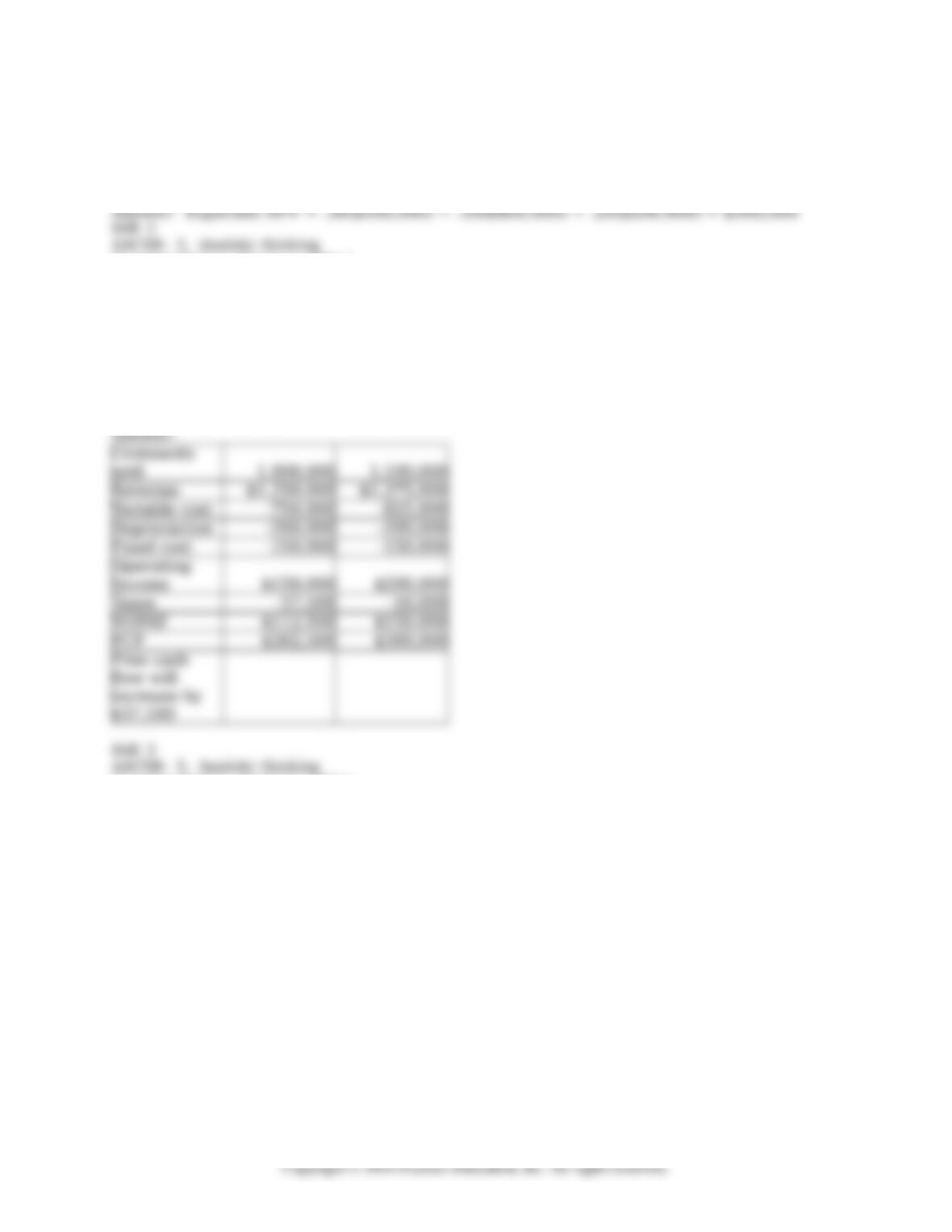
41) Boulangerie Boufard expects to sell 1 million croissants next year for $1.25 each.
Variable cost of a croissant is $0.75. Fixed costs are $150,000, depreciation $200,000 and
the tax rate is 25%. If the number of croissants sold increases by 10%, and all other
variables remain the same, how much will free cash low increase?
Question Status: Previous edition
Objective: 13.2 Use sensitivity, scenario and simulation analyses to investigate the determinants of
project cash lows.
Keywords: scenario analysis
Principles: Principle 2: There Is a Risk–Return Tradeof
18
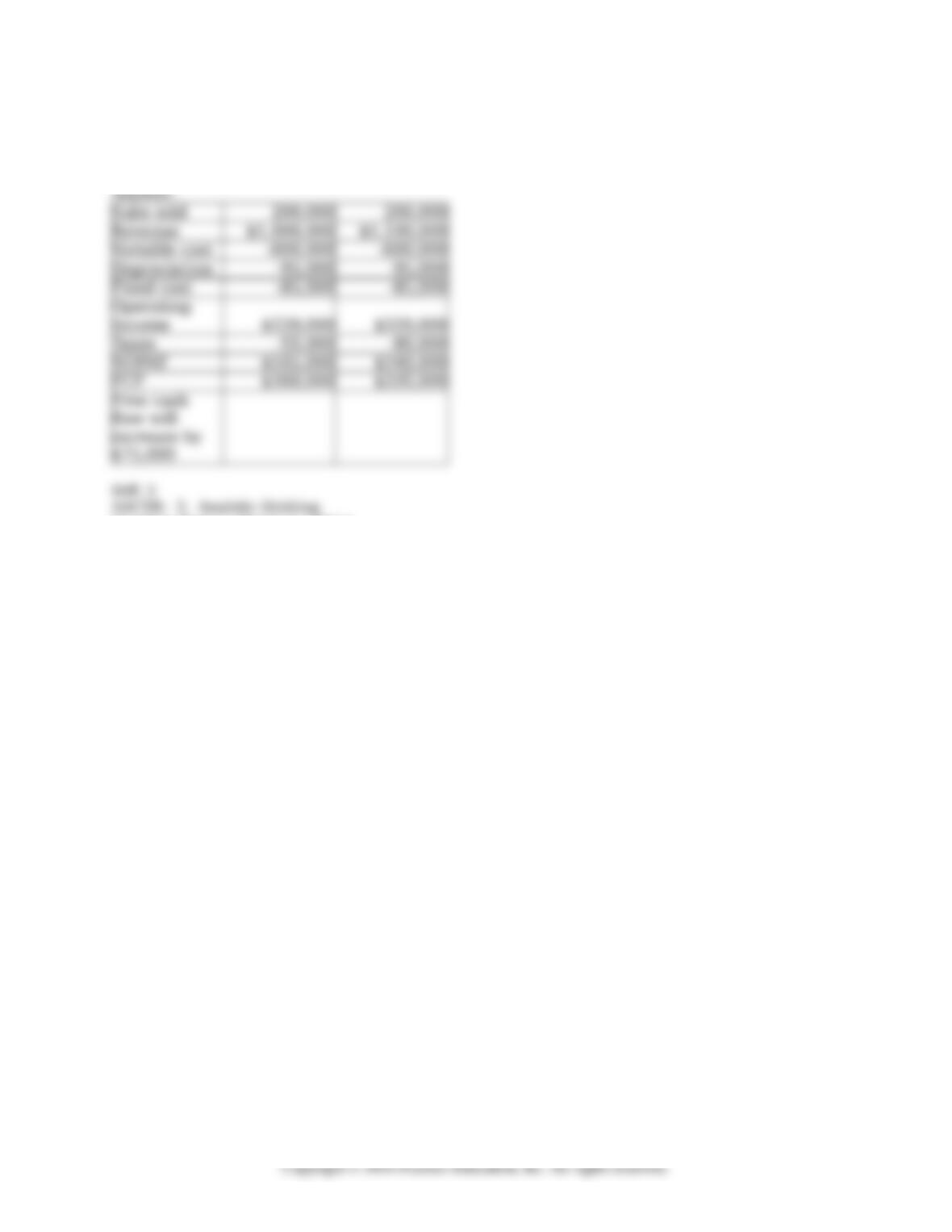
42) Angie’s Sub Shop expects to sell 200,000 subs next year at an average price of $5.00.
Variable cost of a sub is $3.00. Cash ixed costs are $85,000, depreciation $95,000 and the
tax rate is 25%. If the price increases to $5.50 and all other variables remain the same,
how much will free cash low increase?
Question Status: Previous edition
Objective: 13.2 Use sensitivity, scenario and simulation analyses to investigate the determinants of
project cash lows.
Keywords: scenario analysis
Principles: Principle 2: There Is a Risk–Return Tradeof
19

13.3 Break-Even Analysis
1) Which of the following costs is NOT covered in an accounting break-even analysis?
A) Shareholders expected rate of return
B) Variable production costs
C) Interest expense
D) Depreciation expense
Question Status: Previous edition
Objective: 13.3 Use break-even analysis to evaluate project risk.
Keywords: break-even analysis
Principles: Principle 2: There Is a Risk–Return Tradeof
2) The Oviedo Thespians are planning to present performances of their Florida Revue on 2
consecutive nights in January. It will cost them $5,000 per night for theater rental, event
insurance and professional musicians. The theater will also take 10% of gross ticket sales.
How many tickets must they sell at $10.00 per ticket to break even?
A) 1000 tickets
B) 1,112 tickets
C) 1,223 tickets
D) There is not enough information.
Question Status: Previous edition
Objective: 13.3 Use break-even analysis to evaluate project risk.
Keywords: break-even analysis
Principles: Principle 2: There Is a Risk–Return Tradeof
3) Betty Gilmore plans to sell berry pies at a local farmer’s market. The permit and space
rental will cost her $2,000 for the June through August season. The pies will sell for $7.00.
Ingredients and overhead average $4.00 per pie. She also has to pay ive percent of her
gross sales to the market’s organizers. How many pies will she need to sell to cover her
ixed costs?
A) 755 pies with a very small proit on the last pie.
B) 667 pies with a very small proit on the last pie.
C) 301 pies
D) She can never break even.
Question Status: New question
Objective: 13.3 Use break-even analysis to evaluate project risk.
Keywords: break-even analysis
Principles: Principle 2: There Is a Risk–Return Tradeof
20