60) What is the advantage, if any, to using MACRS rather than straight line depreciation?
Question Status: Previous edition
Objective: 12.2 Calculate and forecast project cash lows for expansion type projects.
Keywords: incremental cash lows
Principles: Principle 3: Cash Flows Are the Source of Value
12.3 Inlation and Capital Budgeting
1) In 2013, Sunny Electronics expects to sell 100,000 3-D television sets for an average
price of $1,000. Expected production costs are $600 per unit. In 2014, volume is expected
to increase by 10%, while inlation will increase both the sales price and the cost per unit
by 3%. In nominal dollars, expected gross proit for 2014 is
A) $40 million.
B) $45.32 million.
C) $48.20 million.
D) $50 million.
Question Status: Revised
Objective: 12.3 Evaluate the efect of inlation on project cash lows.
Keywords: inlation
Principles: Principle 1: Money Has a Time Value
2) In 2013, Sunny Electronics expects to sell 100,000 3-D television sets for an average
price of $1,000. Expected production costs are $600 per unit. In 2014, volume is expected
to increase by 10%, while inlation will increase both the sales price and the cost per unit
by 3%. In real dollars, expected gross proit for 2014 is
A) $40 million.
B) $45.32 million.
C) $48.2 0 million.
D) $50 million.
Question Status: Revised
Objective: 12.3 Evaluate the efect of inlation on project cash lows.
Keywords: inlation
Principles: Principle 1: Money Has a Time Value
31
3) In 2013, Sunny Electronics expects to sell 100,000 3-D television sets for an average
price of $1,000. Expected production costs are $600 per unit. In 2014, volume is expected
to increase by 10%, Inlation will increase the cost per unit by 3%, but to attract more
buyers, Sunny will reduce the price to $950. In nominal dollars, expected gross proit for
2014 is
A) $45.32 million.
B) $40 million.
C) $38 million.
D) $36.52 million.
Question Status: Revised
Objective: 12.3 Evaluate the efect of inlation on project cash lows.
Keywords: inlation
Principles: Principle 1: Money Has a Time Value
4) Greenspan Inc. discounts cash lows at a nominal rate of 10%. Inlation over the next few
years is expected to average 3%. Which of the following would be a correct adjustment for
inlation when computing net present value?
A) Discount cash lows at 10%; increase revenues and expenses by 3% each year.
B) Discount cash lows at 13%; increase revenues and expenses by 3% each year.
C) Discount cash lows at 7%; ignore inlation when forecasting revenues and expenses.
D) Either A or C would be acceptable.
Question Status: Previous edition
Objective: 12.3 Evaluate the efect of inlation on project cash lows.
Keywords: inlation
Principles: Principle 1: Money Has a Time Value
5) Nominal cash lows are expressed in terms of their purchasing power in a base year.
Question Status: New question
Objective: 12.3 Evaluate the efect of inlation on project cash lows.
Keywords: inlation
Principles: Principle 1: Money Has a Time Value
6) The real discount rate includes expected inlation.
Question Status: New question
Objective: 12.3 Evaluate the efect of inlation on project cash lows.
Keywords: inlation
Principles: Principle 1: Money Has a Time Value
32
7) When computing the NPV of a project, if cash lows are discounted at the real cost of
capital, then the cash lows should not be adjusted for inlation.
Question Status: New question
Objective: 12.3 Evaluate the efect of inlation on project cash lows.
Keywords: inlation
Principles: Principle 1: Money Has a Time Value
8) When computing the NPV of a project, it is important to consistently use either nominal
dollars and nominal rates or real dollars and real rates.
Question Status: New question
Objective: 12.3 Evaluate the efect of inlation on project cash lows.
Keywords: inlation
Principles: Principle 1: Money Has a Time Value
9) When computing project cash lows, it is necessary to apply the same rate of inlation to
all costs and revenues.
Question Status: New question
Objective: 12.3 Evaluate the efect of inlation on project cash lows.
Keywords: inlation
Principles: Principle 1: Money Has a Time Value
10) What is meant by “real dollars” and the “real” discount rate? How can they be used to
account for inlation when evaluating capital budgeting proposals?
Question Status: Previous edition
Objective: 12.3 Evaluate the efect of inlation on project cash lows.
Keywords: inlation
Principles: Principle 1: Money Has a Time Value
33
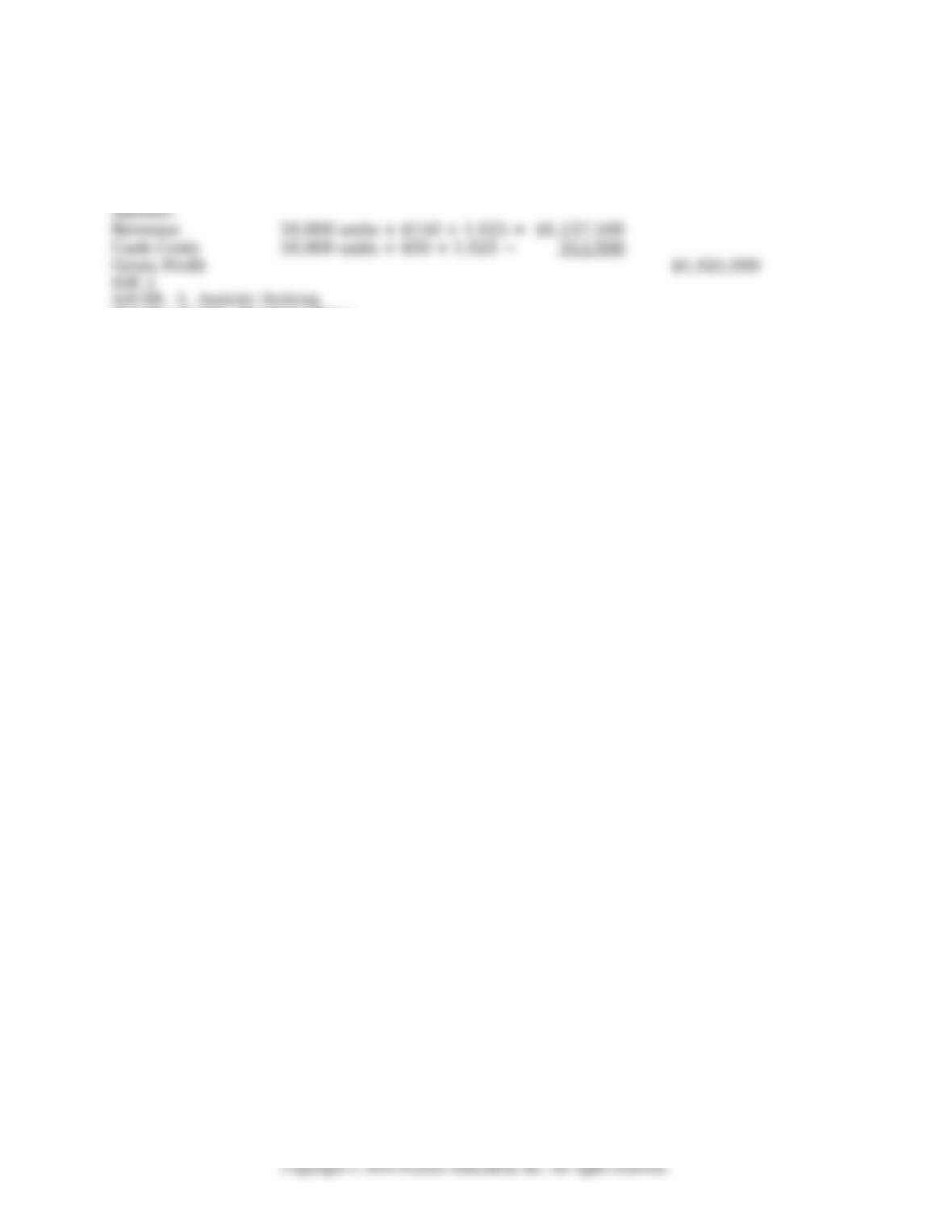
11) Tversky and Co. have devised a new psychological test for investors’ risk tolerance.
They expect to sell 10,000 tests in the irst year at $150 each. Cash costs associated with
producing, administering and scoring the test are $50 per unit. In the second year, volume
is expected to be the same, but both the price and the costs will increase 2.5%. Forecast
gross proit in the second year.
Question Status: Previous edition
Objective: 12.3 Evaluate the efect of inlation on project cash lows.
Keywords: inlation
Principles: Principle 1: Money Has a Time Value
34

12.4 Replacement Project Cash Flows
Use the following information to answer the following question(s).
A irm is trying to determine whether to replace an existing asset. The proposed asset has a
purchase price of $50,000 and has installation costs of $3,000. The asset will be
depreciated over its ive year life using the straight-line method. The new asset is expected
to increase sales by $17,000 and non–depreciation expenses by $2,000 annually over the
life of the asset. Due to the increase in sales, the irm expects an increase in working
capital during the asset’s life of $1,500, and the irm expects to be able to sell the asset for
$6,000 at the end of its life. The existing asset was originally purchased three years ago for
$25,000, has a remaining life of ive years, and is being depreciated using the straight-line
method. The expected salvage value at the end of the asset’s life (i.e., ive years from now)
is $5,000; however, the current sale price of the existing asset is $20,000, and its current
book value is $15,625. The irm’s marginal tax rate is 34 percent and its required rate of
return is 12 percent.
1) If the new machine is purchased, depreciation expense will increase or decrease by
A) increase $8,000.
B) increase $6,900.
C) increase $6,300.
D) decrease $5,000.
Question Status: Previous edition
Objective: 12.4 Calculate the incremental cash lows for replacement type investments.
Keywords: replacement investment
Principles: Principle 3: Cash Flows Are the Source of Value
2) Increased taxes on the sale of the old machine are
A) $1,487.50.
B) $2,500.50.
C) $3,823.50.
D) $4,312.50.
Question Status: Previous edition
Objective: 12.4 Calculate the incremental cash lows for replacement type investments.
Keywords: replacement investment
Principles: Principle 3: Cash Flows Are the Source of Value
35

3) If the new machine is purchased, operating cash low for years 1 through 5 will increase
or decrease by how much?
A) Increase $15,000
B) Decrease $9,900
C) Increase $12,142
D) Increase $5,346
Question Status: Previous edition
Objective: 12.4 Calculate the incremental cash lows for replacement type investments.
Keywords: replacement investment
Principles: Principle 3: Cash Flows Are the Source of Value
4) What would cause the initial cash outlay of an investment decision to be afected by the
sale of an existing asset?
A) If the investment decision is a replacement decision
B) If the asset being purchased is technologically superior
C) If the asset being sold has exceeded its MACR’s recovery allowance period
D) All of the above
Question Status: Revised
Objective: 12.4 Calculate the incremental cash lows for replacement type investments.
Keywords: replacement investment
Principles: Principle 3: Cash Flows Are the Source of Value
5) Al’s Fabrication Shop is purchasing a new rivet machine to replace an existing one. The
new machine costs $8,000 and will require an additional cost of $1,000 for modiication
and training. It will be depreciated using simpliied straight line depreciation over ive
years. The new machine operates much faster than the old machine and with better quality.
Consequently, sales are expected to increase by $2,100 per year for the next ive years.
While it is faster, it is fully automated and will result in increased electricity costs for the
irm by $700 per year. It will, however, save about $850 per year in labor costs. The old
machine is 20 years old and has already been fully depreciated. If the irm’s marginal tax
rate is 28%, compute the after tax incremental cash lows for the new machine for years 1
through 5.
A) $2,698
B) $450
C) $2,124
D) $1,620
Question Status: Previous edition
Objective: 12.4 Calculate the incremental cash lows for replacement type investments.
Keywords: replacement investment
Principles: Principle 3: Cash Flows Are the Source of Value
36