
18) Which of the following is a correct equation to solve for the NPV of the project that has
an initial outlay of $30,000, followed by incremental cash inlows in the next 3 years of
$15,000, $20,000, and $30,000? Assume a discount rate of 10%.
A) NPV = – $30,000 + $15,000(1.10)1 + $20,000(1.10)2 + $30,000(1.10)3
B) NPV = – $30,000 + $15,000/(1.10)1 + $20,000/(1.10)2 + $30,000/(1.10)3
C) NPV = – $30,000 + $15,000/(1.01).10 + $20,000/(1.02).10 + $30,000/(1.03).10
D) NPV = – $30,000 + $15,000/(1.1).10 + $20,000(1.2).10 + $30,000(1.3).10
Question Status: Previous edition
Objective: 11.2 Evaluate investment opportunities using net present value and describe why net
present value is the best measure to use.
Keywords: net present value
Principles: Principle 1: Money Has a Time Value
19) Project EH! requires an initial investment of $50,000, and has a net present value of
$12,000. Project BE requires an initial investment of $100,000, and has a net present value
of $13,000. The projects are mutually exclusive. The irm should accept
A) project EH!.
B) project BE.
C) both projects.
D) neither project.
Question Status: Previous edition
Objective: 11.2 Evaluate investment opportunities using net present value and describe why net
present value is the best measure to use.
Keywords: net present value
Principles: Principle 1: Money Has a Time Value
20) Project Eh! requires an initial investment of $50,000, and has a net present value of
$12,000. Project B requires an initial investment of $100,000, and has a net present value
of $13,000. The projects are proposals for increasing revenue and are not mutually
exclusive. The irm should accept
A) project Eh!.
B) project B.
C) both projects.
D) neither project.
Question Status: Previous edition
Objective: 11.2 Evaluate investment opportunities using net present value and describe why net
present value is the best measure to use.
Keywords: net present value
Principles: Principle 1: Money Has a Time Value
11

21) A machine has a cost of $5,375,000. It will produce cash inlows of $1,825,000 (Year 1);
$1,775,000 (Year 2); $1,630,000 (Year 3); $1,585,000 (Year 4); and $1,650,000 (Year 5). At
a discount rate of 16.25%, what is the NPV?
A) $81,724
B) $257,106
C) $416,912
D) $190,939
Question Status: Previous edition
Objective: 11.2 Evaluate investment opportunities using net present value and describe why net
present value is the best measure to use.
Keywords: net present value
Principles: Principle 1: Money Has a Time Value
22) A machine has a cost of $5,575,000. It will produce cash inlows of $1,825,000 (Year 1);
$1,775,000 (Year 2); $1,630,000 (Year 3); $1,585,000 (Year 4); and $1,650,000 (Year 5). At
a discount rate of 16.25%, the project should be
A) accepted.
B) rejected.
C) discounted at a lower rate.
D) abandoned after the irst year.
Question Status: Previous edition
Objective: 11.2 Evaluate investment opportunities using net present value and describe why net
present value is the best measure to use.
Keywords: net present value
Principles: Principle 1: Money Has a Time Value
23) Which of the following is the correct equation to solve for the NPV of the project that
has an initial outlay of $30,000, followed by three years of $20,000 in incremental cash
inlow? Assume a discount rate of 10%.
A) NPV = -30,000 + (3 × 20,000)/(1.10)3
B) NPV = -$30,000 + $20,000/(1.10)1 + $20,000/(1.10)2 + $20,000/(1.10)3
C) NPV = -$30,000 + $20,000/(1.01).10 + $20,000/(1.02).10 + $20,000/(1.03).10
D) NPV = -$30,000 + $20,000/(1.1).10 + $20,000(1.2).10 + $20,000(1.3).10
Question Status: Previous edition
Objective: 11.2 Evaluate investment opportunities using net present value and describe why net
present value is the best measure to use.
Keywords: net present value
Principles: Principle 1: Money Has a Time Value
12

24) Project Full Moon has an initial outlay of $30,000, followed by positive cash lows of
$10,000 in year 1, $15,000 in year 2, and $15,000 in year 3. The project should be accepted
if the required rate of return is
A) greater than 0.
B) less than 14.6%.
C) less than 16.25%.
D) greater than 12%.
Question Status: Previous edition
Objective: 11.2 Evaluate investment opportunities using net present value and describe why net
present value is the best measure to use.
Keywords: net present value
Principles: Principle 1: Money Has a Time Value
25) Which of the following is a correct EXCEL formula to solve for the net present value of
a project.
A) =NPV (k,CF1, CF2,…CFn)+CF0
B) =NPV (k,CF0,CF1, CF2,…CFn)
C) =NPV (CF0,CF1, CF2,…CFn)
D) =NPV (CF1, CF2,…CFn)+CF0
Question Status: New question
Objective: 11.2 Evaluate investment opportunities using net present value and describe why net
present value is the best measure to use.
Keywords: net present value
Principles: Principle 1: Money Has a Time Value
26) WSU Inc. has various options for replacing a piece of manufacturing equipment. The
present value of costs for option Ell is $84,000. Option Ell has a useful life of 5 years;
annual operating costs were discounted at 9%. What is the equivalent annual cost?
A) $16,800
B) $21,595.77
C) $14,035.77
D) $18,312
Question Status: Previous edition
Objective: 11.2 Evaluate investment opportunities using net present value and describe why net
present value is the best measure to use.
Keywords: net present value
Principles: Principle 1: Money Has a Time Value
13

27) The equivalent annual cost (EAC) method is appropriate for evaluating accessibility
projects mandated by the Americans With Disabilities Act.
Question Status: Revised
Objective: 11.2 Evaluate investment opportunities using net present value and describe why net
present value is the best measure to use.
Keywords: net present value
Principles: Principle 1: Money Has a Time Value
28) The required rate of return represents the cost of capital for a project.
Question Status: Previous edition
Objective: 11.2 Evaluate investment opportunities using net present value and describe why net
present value is the best measure to use.
Keywords: net present value
Principles: Principle 1: Money Has a Time Value
29) The higher the discount rate, the greater the importance of the early cash lows.
Question Status: Previous edition
Objective: 11.2 Evaluate investment opportunities using net present value and describe why net
present value is the best measure to use.
Keywords: net present value
Principles: Principle 1: Money Has a Time Value
30) The equivalent annual cost (EAC) method is helpful for mutually exclusive projects with
unequal economic lives.
Question Status: New question
Objective: 11.2 Evaluate investment opportunities using net present value and describe why net
present value is the best measure to use.
Keywords: net present value
Principles: Principle 1: Money Has a Time Value
14
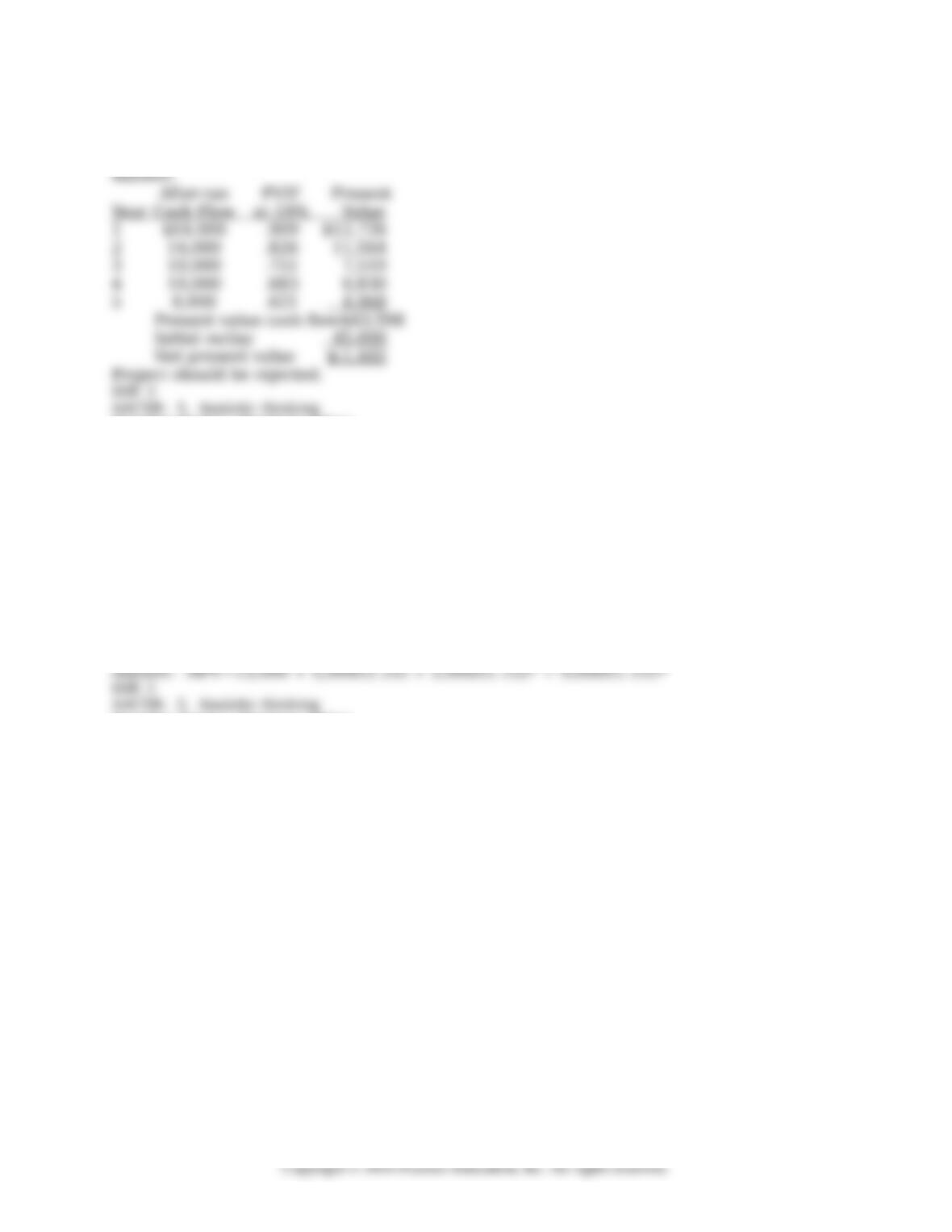
31) What is the NPV of a $45,000 project that is expected to have an after-tax cash low of
$14,000 for the irst two years, $10,000 for the next two years, and $8,000 for the ifth
year? Use a 10% discount rate. Would you accept the project?
Question Status: Previous edition
Objective: 11.2 Evaluate investment opportunities using net present value and describe why net
present value is the best measure to use.
Keywords: net present value
Principles: Principle 1: Money Has a Time Value
32) Dieyard Battery Recyclers is considering a project with the following cash lows:
Initial outlay = $13,000
Cash lows: Year 1 = $5,000
Year 2 = $3,000
Year 3 = $9,000
If the appropriate discount rate is 15%, compute the NPV of this project.
Question Status: Previous edition
Objective: 11.2 Evaluate investment opportunities using net present value and describe why net
present value is the best measure to use.
Keywords: net present value
Principles: Principle 1: Money Has a Time Value
15
33) Two projects are under consideration by the same company at the same time. Project
Alpha has a NPV of $20 million and an estimated useful life of 10 years. Project Beta has a
NPV of $12 million and also an estimated useful life of 10 years. What should the
company’s decision be
a) if the project’s involve unrelated expansion decisions or
b) if the project’s are mutually exclusive because they would have to occupy the same
space?
Question Status: Previous edition
Objective: 11.2 Evaluate investment opportunities using net present value and describe why net
present value is the best measure to use.
Keywords: net present value
Principles: Principle 1: Money Has a Time Value
34) Dudster Manufacturing has 2 options for installing legally required safety equipment.
Option Ex has an initial cost of $25,000 and annual operating costs over 3 years of $5,000,
$5,250, $5,600. Option WYE has an initial cost of $40,000 and annual operating costs of
$4,000, $4,200, $4,450, $4,750, $5,100. Whether Dudster chooses Ex or Wye, the
equipment is always needed and must be replaced at the end of its useful life. Which choice
is least expensive over the long run? Use a discount rate of 9%.
Question Status: Previous edition
Objective: 11.2 Evaluate investment opportunities using net present value and describe why net
present value is the best measure to use.
Keywords: net present value
Principles: Principle 1: Money Has a Time Value
16
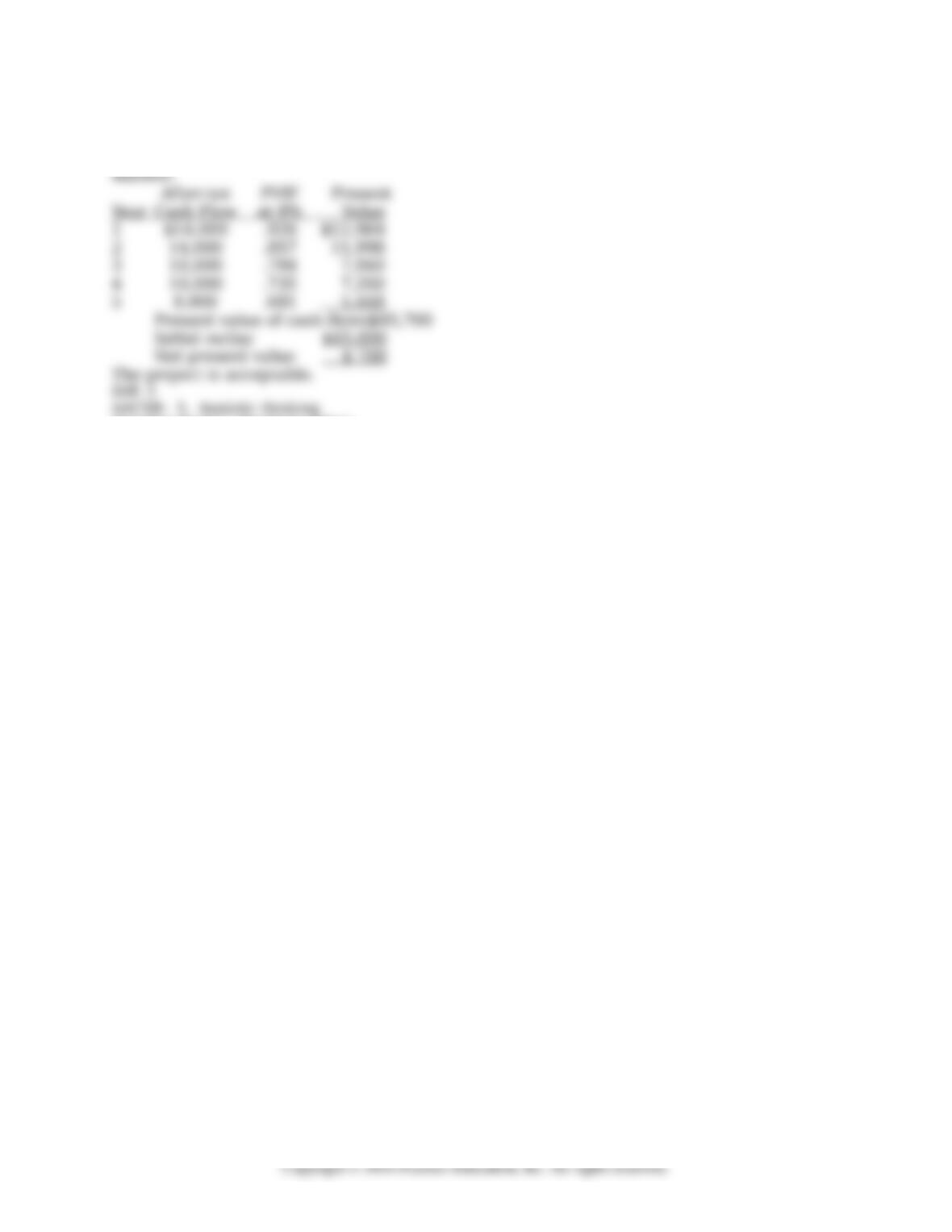
35) What is the NPV of a $45,000 project that is expected to have an after-tax cash low of
$14,000 for the irst two years, $10,000 for the next two years, and $8,000 for the ifth
year? Use a discount rate of 8%. Would you accept or reject the investment?
Question Status: Previous edition
Objective: 11.2 Evaluate investment opportunities using net present value and describe why net
present value is the best measure to use.
Keywords: net present value
Principles: Principle 1: Money Has a Time Value
17

11.3 Other Investment Criteria
1) Webley Corp. is considering two expansion options, but does not have enough capital to
undertake both, Project W requires an investment of $100,000 and has an NPV of $10,000.
Project D requires an investment of $80,000 and has an NPV of $8,200. If Webley uses the
proitability index to decide, it would
A) choose D because it has a higher proitability index.
B) choose W because it has a higher proitability index.
C) choose D because it has a lower proitability index.
D) choose W because it has a lower proitability index.
Question Status: Revised
Objective: 11.3 Use the proitability index, internal rate of return, and payback criteria to evaluate
investment opportunities.
Keywords: proitability index
Principles: Principle 1: Money Has a Time Value
2) If a project has a proitability index greater than 1
A) the npv will also be positive.
B) the irr will be higher than the required rate of return.
C) the present value of future cash lows will exceed the amount invested in the project.
D) all of the above.
Question Status: Previous edition
Objective: 11.3 Use the proitability index, internal rate of return, and payback criteria to evaluate
investment opportunities.
Keywords: proitability index
Principles: Principle 1: Money Has a Time Value
3) A project has an initial outlay of $4,000. It has a single payof at the end of Year 4 of
$6,996.46. What is the IRR for the project (round to the nearest percent)?
A) 16%
B) 13%
C) 21%
D) 15%
Question Status: Previous edition
Objective: 11.3 Use the proitability index, internal rate of return, and payback criteria to evaluate
investment opportunities.
Keywords: internal rate of return
Principles: Principle 1: Money Has a Time Value
18

4) Given the following annual net cash lows, determine the IRR to the nearest whole
percent of a project with an initial outlay of $1,800.
Year Net Cash Flow
1 $1,000
2 $750
3 $500
A) 14%
B) 12%
C) 8%
D) 25%
Question Status: New question
Objective: 11.3 Use the proitability index, internal rate of return, and payback criteria to evaluate
investment opportunities.
Keywords: internal rate of return
Principles: Principle 1: Money Has a Time Value
5) Initial Outlay Cash Flow in Period
1 2 3 4
-$4,000 $1,546.17 $1,546.17 $1,546.17 $1,546.17
The IRR (to the nearest whole percent) is
A) 10%.
B) 18%.
C) 20%.
D) 16%.
Question Status: Previous edition
Objective: 11.3 Use the proitability index, internal rate of return, and payback criteria to evaluate
investment opportunities.
Keywords: internal rate of return
Principles: Principle 1: Money Has a Time Value
19

6) Your company is considering a project with the following cash lows:
Initial outlay = $1,748.80
Cash lows Years 1-6 = $500
Compute the IRR on the project.
A) 9%
B) 11%
C) 18%
D) 24%
Question Status: Previous edition
Objective: 11.3 Use the proitability index, internal rate of return, and payback criteria to evaluate
investment opportunities.
Keywords: internal rate of return
Principles: Principle 1: Money Has a Time Value
7) Project Black Swan requires an initial investment of $115,000. It has positive cash lows
of $140,000 for each of the next two years. Because of major demolition and environmental
clean-up costs, cash low for the third and inal year of the project is $(170,000). If the
company ‘s required rate of return is 12%, the project should be
A) rejected because the IRR is less than 12%.
B) accepted because the NPV is positive at 12%.
C) the project is unacceptable at any discount rate.
D) rejected because there may be more than one IRR.
Question Status: Revised
Objective: 11.3 Use the proitability index, internal rate of return, and payback criteria to evaluate
investment opportunities.
Keywords: internal rate of return
Principles: Principle 1: Money Has a Time Value
20