
22) An issue of preferred stock currently sells for $52.50 per share and pays a constant
annual expected dividend of $2.25 per share. The expected return on this security is
A) 4.29%.
B) 0.04%.
C) 8.33%.
D) 13.33%.
Question Status: Previous edition
Objective: 10.3 Identify the basic features and characteristics and features of preferred stock and
value preferred shares.
Keywords: preferred stock
Principles: Principle 3: Cash Flows Are the Source of Value
23) Expected cash low for a preferred stock primarily consists of
A) dividend payments.
B) changes in the price of the stock.
C) interest payments.
D) both A and B.
Question Status: Previous edition
Objective: 10.3 Identify the basic features and characteristics and features of preferred stock and
value preferred shares.
Keywords: preferred stock
Principles: Principle 3: Cash Flows Are the Source of Value
24) Preferred stock is similar to common stock in that
A) it has no ixed maturity date.
B) the nonpayment of dividends can bring on bankruptcy.
C) dividends are limited in amount.
D) both carry voting rights.
Question Status: Previous edition
Objective: 10.3 Identify the basic features and characteristics and features of preferred stock and
value preferred shares.
Keywords: preferred stock
Principles: Principle 3: Cash Flows Are the Source of Value
30

25) Proitable companies often prefer to issue debt rather than preferred stock because
A) debt creates less risk for the company.
B) interest payments are ixed but preferred shareholders expect dividends to grow.
C) preferred shares dilute the voting rights of common shareholders but bonds do not.
D) interest on debt is deductible for tax purposes, but preferred dividends are not.
Question Status: New question
Objective: 10.3 Identify the basic features and characteristics and features of preferred stock and
value preferred shares.
Keywords: preferred stock
Principles: Principle 3: Cash Flows Are the Source of Value
26) In the event of bankruptcy, preferred stockholders and common stockholders have the
same claim on the irm’s assets.
Question Status: Previous edition
Objective: 10.3 Identify the basic features and characteristics and features of preferred stock and
value preferred shares.
Keywords: preferred stock
Principles: Principle 3: Cash Flows Are the Source of Value
27) A company may issue multiple classes of preferred stock.
Question Status: Previous edition
Objective: 10.3 Identify the basic features and characteristics and features of preferred stock and
value preferred shares.
Keywords: preferred stock
Principles: Principle 3: Cash Flows Are the Source of Value
28) The cumulative dividend feature is necessary to protect the rights of preferred
stockholders.
Question Status: Previous edition
Objective: 10.3 Identify the basic features and characteristics and features of preferred stock and
value preferred shares.
Keywords: preferred stock
Principles: Principle 3: Cash Flows Are the Source of Value
31
29) Preferred stock cannot be retired.
Question Status: Previous edition
Objective: 10.3 Identify the basic features and characteristics and features of preferred stock and
value preferred shares.
Keywords: preferred stock
Principles: Principle 3: Cash Flows Are the Source of Value
30) To determine the value of a share of preferred stock, the discount rate used is the
annual dividend percent.
Question Status: Previous edition
Objective: 10.3 Identify the basic features and characteristics and features of preferred stock and
value preferred shares.
Keywords: preferred stock
Principles: Principle 3: Cash Flows Are the Source of Value
31) The value of preferred shares is afected by changes in interest rates.
Question Status: New question
Objective: 10.3 Identify the basic features and characteristics and features of preferred stock and
value preferred shares.
Keywords: preferred stock
Principles: Principle 3: Cash Flows Are the Source of Value
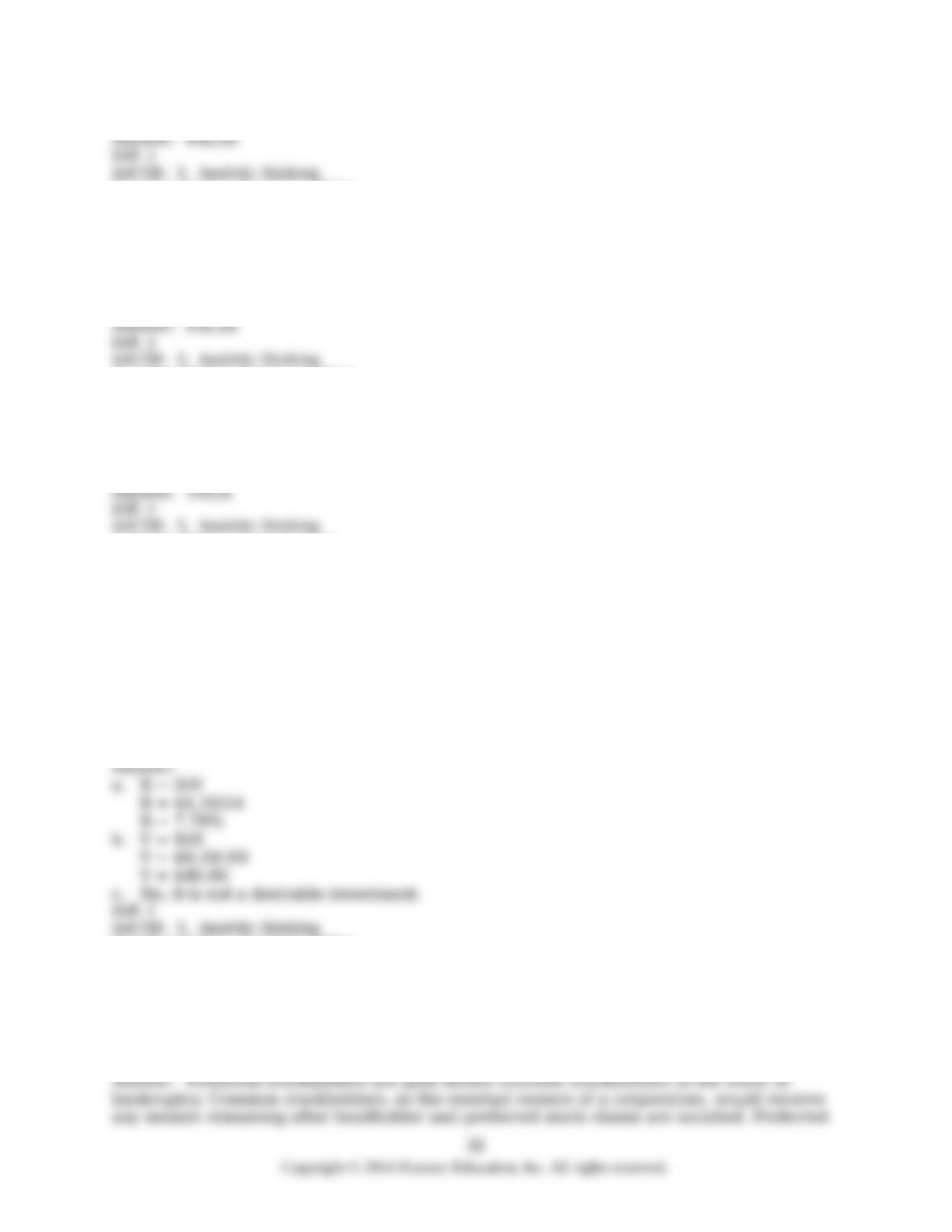
32) Miller/Hershey’s preferred stock is selling at $54 on the market and pays an annual
dividend of $4.20 per share.
a. What is the expected rate of return on the stock?
b. If an investor’s required rate of return is 9%, what is the value of the stock for that
investor?
c. Considering the investor’s required rate of return, does this stock seem to be a
desirable investment?
Question Status: Previous edition
Objective: 10.3 Identify the basic features and characteristics and features of preferred stock and
value preferred shares.
Keywords: preferred stock
Principles: Principle 3: Cash Flows Are the Source of Value
33) Discuss two reasons why preferred stock would be viewed as less risky than common
stock to investors.
dividends are paid before common stock dividends in the normal course of business. In the
event that a preferred dividend is not paid, it accumulates and dividends in arrears must be
paid before any common stock dividends can be declared. Common shareholders take the
risk that they will not receive dividends. The magnitude of the cash lows from preferred is
also known where it is not known for common stock. Because cash lows are more certain,
preferred stock would be considered less risky to the investor.
Dif: 2
Question Status: Previous edition
Objective: 10.3 Identify the basic features and characteristics and features of preferred stock and
value preferred shares.
Keywords: preferred stock
Principles: Principle 3: Cash Flows Are the Source of Value
34) Determine the rate of return on a preferred stock that costs $50 and pays a $6 per
share dividend.
Question Status: Previous edition
Objective: 10.3 Identify the basic features and characteristics and features of preferred stock and
value preferred shares.
Keywords: preferred stock
Principles: Principle 3: Cash Flows Are the Source of Value
33

10.4 The Stock Market
1) An example of a primary market transaction is
A) a new issue of stock by Evergreen Solar.
B) a purchase of Microsoft stock on Nasdaq.
C) Target repurchasing some its own stock from an investor.
D) a sale of IBM stock on the NYSE.
Question Status: Previous edition
Objective: 10.4 List the secondary markets for common stock.
Keywords: stock markets
Principles: Principle 4: Market Prices Relect Information
2) The largest market stock exchange in the U.S. is
A) NYSE.
B) Nasdaq.
C) AMEX.
D) the CBOT.
Question Status: Revised
Objective: 10.4 List the secondary markets for common stock.
Keywords: stock markets
Principles: Principle 4: Market Prices Relect Information
3) Which of the following companies is most likely to trade on the New York Stock
Exchange?
A) Dell
B) Genzyme Transgenics
C) Coca Cola
D) Tata Motors
Question Status: Previous edition
Objective: 10.4 List the secondary markets for common stock.
Keywords: stock markets
Principles: Principle 4: Market Prices Relect Information
34

4) Which of the following exchanges has the strictest listing requirements?
A) AMEX
B) Nasdaq
C) NYSE
D) OTC
Question Status: Previous edition
Objective: 10.4 List the secondary markets for common stock.
Keywords: stock markets
Principles: Principle 4: Market Prices Relect Information
5) A small, newly listed technology company is most likely to be listed on
A) AMEX.
B) NYSE.
C) Nasdaq National Markets.
D) Nasdaq Capital Markets.
Question Status: Previous edition
Objective: 10.4 List the secondary markets for common stock.
Keywords: stock markets
Principles: Principle 4: Market Prices Relect Information
6) Listing requirements for the New York Stock Exchange include
A) proitability.
B) market value.
C) breadth of ownership.
D) all of the above.
Question Status: Previous edition
Objective: 10.4 List the secondary markets for common stock.
Keywords: stock markets
Principles: Principle 4: Market Prices Relect Information
7) A block trade is a trade involving 10,000 or more shares by a single holder.
Question Status: Previous edition
Objective: 10.4 List the secondary markets for common stock.
Keywords: stock markets
Principles: Principle 4: Market Prices Relect Information
35
8) The NASDAQ trading loors are located in New York City.
Question Status: New question
Objective: 10.4 List the secondary markets for common stock.
Keywords: stock markets
Principles: Principle 4: Market Prices Relect Information
9) Large, established technology companies such as Apple, Dell, Intel and Microsoft all
trade on the NYSE.
Question Status: Previous edition
Objective: 10.4 List the secondary markets for common stock.
Keywords: stock markets
Principles: Principle 4: Market Prices Relect Information
10) Trading on the Nasdaq is done electronically and does not require a physical location.
Question Status: Previous edition
Objective: 10.4 List the secondary markets for common stock.
Keywords: stock markets
Principles: Principle 4: Market Prices Relect Information
11) In addition to stocks in individual companies, the AMEX conducts trading in such
securities as ETFs and options.
Question Status: Previous edition
Objective: 10.4 List the secondary markets for common stock.
Keywords: stock markets
Principles: Principle 4: Market Prices Relect Information
36
12) Describe the major diferences between the organized exchanges such as the NYSE and
electronic networks such as Nasdaq.
Question Status: Previous edition
Objective: 10.4 List the secondary markets for common stock.
Keywords: stock markets
Principles: Principle 4: Market Prices Relect Information
13) Distinguish between primary stock market transactions and secondary stock market
transaction.
Question Status: Previous edition
Objective: 10.4 List the secondary markets for common stock.
Keywords: stock markets
Principles: Principle 4: Market Prices Relect Information
37