Exam
Name___________________________________
MULTIPLE CHOICE. Choose the one alternative that best completes the statement or answers the question.
1)
For an n–channel depletion MOSFET IDSS = 8 mA and VP= –6 V. If ID= 0.0095 A, what is the
value of the gate–to–source voltage, VGS?
1)
A)
0.54 V
B)
0.1335 V
C)
–0.54 V
D)
6.54 V
Answer:
A
Explanation:
A)
B)
C)
D)
2)
The region of the JFET drain curve that lies between pinch–off and breakdown is called ________.
2)
A)
the ohmic region
B)
the constant–voltage region
C)
the saturation region
D)
None of the above
Answer:
C
Explanation:
A)
B)
C)
D)
3)
FETs usually ________.
3)
A)
are smaller in construction than BJTs
B)
have a higher input impudence than BJTs
C)
are less sensitive to temperature change than BJTs
D)
All of the above
Answer:
D
Explanation:
A)
B)
C)
D)
4)
Which of the following FETs is the best choice when the gate–source voltage has both positive and
negative swings?
4)
A)
JFET
B)
depletion MOSFET
C)
CMOS
D)
enhancement MOSFET
Answer:
B
Explanation:
A)
B)
C)
D)
1
5)
The depletion–type MOSFET’ has specifications and many characteristics that are similar to the
________.
5)
A)
npn BJT
B)
JFET
C)
pnp BJT
D)
None of the above
Answer:
B
Explanation:
A)
B)
C)
D)
6)
The maximum current in a JFET is defined as IDSS and occurs when VGS is equal to ________.
6)
A)
zero Volts
B)
a voltage greater than the pinch–off voltage
C)
a small positive voltage
D)
pinch–off voltage
Answer:
A
Explanation:
A)
B)
C)
D)
7)
For an n–channel JFET IDSS = 8 mA and Vp = –6 Volts. If ID= 6 mA. What is the value of the
gate–to–source voltage, VGS?
7)
A)
–4.5 V
B)
–1.5 V
C)
0.1335 V
D)
–0.8 V
Answer:
D
Explanation:
A)
B)
C)
D)
8)
In the family of FETs, you can expect to find ________.
8)
A)
an n–channel type
B)
unipolar structure
C)
a p–channel type
D)
All of the above
Answer:
D
Explanation:
A)
B)
C)
D)
9)
A given JFET has values of VP= –10 V and IDSS = 8 mA. What is the value of VGSOFF for the
device?
9)
A)
–5 V
B)
–10 V
C)
+10 V
D)
Cannot be determined from the information given
Answer:
B
Explanation:
A)
B)
C)
D)
2
10)
Many MOSFET devices now contain internal ________ that protect them from static electricity.
10)
A)
p–n junction diodes
B)
capacitors
C)
BJTs
D)
Zener diodes
Answer:
D
Explanation:
A)
B)
C)
D)
11)
The ________ terminal of the JFET is the equivalent of the base terminal of a BJT.
11)
A)
source
B)
drain
C)
anode
D)
gate
Answer:
D
Explanation:
A)
B)
C)
D)
12)
A D–MOSFET’ has values of ID= 15.63 mA, VP= –4 V, and VGS= +1 V. What is the value of IDSS?
12)
A)
5 mA
B)
10 mA
C)
0 mA
D)
None of the above
Answer:
B
Explanation:
A)
B)
C)
D)
13)
The collector current, IC, of a BJT flows through two junctions. The drain current of an FET, ID,
flows through ________ junctions.
13)
A)
1
B)
0
C)
2
D)
3
Answer:
B
Explanation:
A)
B)
C)
D)
14)
D–MOSFETs can operate in ________.
14)
A)
the enhancement mode only
B)
the depletion mode and the enhancement mode
C)
the depletion mode only
D)
All of the above
Answer:
D
Explanation:
A)
B)
C)
D)
3
15)
A CMOS inverter is biased with a +10–V VSS supply. The input to the inverter varies between 0 V
and +10 V. When the input to the inverter is +10 V, the output from the circuit is ________.
15)
A)
zero
B)
+10 V
C)
–10 V
D)
The circuit cannot have an input voltage that is equal to the supply voltage.
Answer:
A
Explanation:
A)
B)
C)
D)
16)
Schokley’s equation defines the ________ of the FET and are unaffected by the network in which
the device is employed.
16)
A)
transfer characteristics
B)
input/output characteristics
C)
VGS characteristics
D)
drain characteristics
Answer:
A
Explanation:
A)
B)
C)
D)
17)
The value of drain current is always ________ the value of the short circuit drain current IDSS for a
given JFET.
17)
A)
less than
B)
less than or equal to
C)
greater than
D)
equal to
Answer:
B
Explanation:
A)
B)
C)
D)
18)
MOSFETs are also referred to as ________.
18)
A)
DEFETs
B)
SiO–FETs
C)
substrates
D)
IGFETs
Answer:
D
Explanation:
A)
B)
C)
D)
19)
Which of the following is true for an n–channel D–MOSFET that is being operated in the depletion
mode?
19)
A)
ID<IDSS and VGS is positive.
B)
ID<IDSS and VGS is negative.
C)
ID>IDSS and VGS is positive.
D)
ID>IDSS and VGS is negative.
Answer:
B
Explanation:
A)
B)
C)
D)
4
20)
For an n–channel depletion MOSFET, IDSS = 8 mA and VP= –6 Volts. If VGS= 0.8 V, what is the
value of the drain current, ID?
20)
A)
6 mA
B)
10.28 mA
C)
10.25 µA
D)
8 mA
Answer:
B
Explanation:
A)
B)
C)
D)
21)
Which of the following is usually used to control the channel width of a given JFET?
21)
A)
the operating frequency
B)
the gate–to–source voltage
C)
the drain current
D)
the source voltage
Answer:
B
Explanation:
A)
B)
C)
D)
22)
The ________ terminal of the JFEI’ is the equivalent of the emitter terminal of a BJT.
22)
A)
source
B)
gate
C)
drain
D)
anode
Answer:
A
Explanation:
A)
B)
C)
D)
23)
For VGS<VTH in an enhancement MOSFET the drain current will be ________.
23)
A)
zero
B)
10.0 µA
C)
1.0 µA
D)
–1.0 µA
Answer:
A
Explanation:
A)
B)
C)
D)
24)
For an n–channel JFFT, IDSS = 8 mA, and VP= –6 V. If VGS= –2 V. What is the value of the drain
current ID?
24)
A)
2.666 mA
B)
3.5 mA
C)
5.33 mA
D)
3.56 mA
Answer:
D
Explanation:
A)
B)
C)
D)
5
25)
Many MOSFET devices now contain internal ________ that protect these devices from static
electricity.
25)
A)
back–to–back zener diodes
B)
BJT transistors to bypass the static charge
C)
capacitors to collect and store the static charge
D)
Nothing can be done to protect these devices from accidental static discharge except very
careful handling.
Answer:
A
Explanation:
A)
B)
C)
D)
26)
As the channel width of a JFET decreases, the source–to–drain resistance ________.
26)
A)
decreases
B)
is not affected
C)
increases
D)
remains constant
Answer:
C
Explanation:
A)
B)
C)
D)
27)
The ________ JFET uses a positive drain supply voltage.
27)
A)
CMOS
B)
n–channel
C)
MDS
D)
p–channel
Answer:
B
Explanation:
A)
B)
C)
D)
28)
The level of drain–to–source voltage where the two depletions regions appear to touch is known as
________.
28)
A)
pinch–off
B)
channel establishment
C)
channel saturation
D)
the depletion zone
Answer:
A
Explanation:
A)
B)
C)
D)
29)
The type of FFT that has the best switching speed performance is the ________.
29)
A)
CMOS
B)
VMOS
C)
NMOS
D)
PMOS
Answer:
A
Explanation:
A)
B)
C)
D)
6
30)
The region of the characteristic curve family for the junction FET that is normally used for linear
amplification is ________.
30)
A)
the linear amplification region
B)
the constant–current region
C)
the saturation region
D)
All of the above
Answer:
D
Explanation:
A)
B)
C)
D)
31)
A JFET has values of IDSS = 10 mA and VGSOFF = –5 V. What is the value of ID at VGS= –3 V?
31)
A)
25.6 mA
B)
3.6 mA
C)
1.6 mA
D)
4 mA
Answer:
C
Explanation:
A)
B)
C)
D)
32)
A relatively high input impedance, fast switching speeds, and low operating power describe the
characteristics of the ________ family.
32)
A)
CMOS FET
B)
enhancement–type MOSFET
C)
VMOS FET
D)
BJT
Answer:
A
Explanation:
A)
B)
C)
D)
33)
The FET transfer characteristic curve is defined by Shockley’s equation and is ________.
33)
A)
inversely related to the sum of the drain and source resistors
B)
directly related to the drain resistor
C)
unaffected by the network in which it is used
D)
inversely related to the drain resistor
Answer:
C
Explanation:
A)
B)
C)
D)
34)
The JFET is a ________.
34)
A)
power–controlled device
B)
voltage–controlled device
C)
current–controlled device
D)
frequency–controlled device
Answer:
B
Explanation:
A)
B)
C)
D)
7
35)
For levels of gate–to–source voltage greater than the threshold voltage, the drain current is directly
related to the ________.
35)
A)
gate–to–drain voltage
B)
square of the gate current
C)
square of the difference between the gate–to–source voltage and the threshold voltage
D)
None of the above
Answer:
C
Explanation:
A)
B)
C)
D)
36)
The ________ terminal of the JFFT is the equivalent of the collector terminal of a BJT.
36)
A)
source
B)
gate
C)
drain
D)
anode
Answer:
C
Explanation:
A)
B)
C)
D)
37)
When compared with commercially available planar MOSFETs, VMOS FETs have ________.
37)
A)
higher current capability
B)
reduced channel resistance
C)
higher power ratings
D)
All of the above
Answer:
D
Explanation:
A)
B)
C)
D)
38)
The VMOS FET typically has switching times that are ________.
38)
A)
20 times that of the typical BJT
B)
twice that of the typical BIT
C)
half that of the typical BJT
D)
very slow
Answer:
C
Explanation:
A)
B)
C)
D)
39)
The power–handling levels of a MOSFT ________.
39)
A)
is similar to that of a vacuum tube
B)
is usually about 100 W
C)
is usually less than 1 W
D)
is about 10 W
Answer:
C
Explanation:
A)
B)
C)
D)
8
40)
The primary difference between BJT and FET types of transistors is that ________.
40)
A)
BJTs are current controlled and FETs are voltage controlled
B)
BJTs amplify better than FETs
C)
BJTs are voltage controlled and FETs are current controlled
D)
None of the above
Answer:
A
Explanation:
A)
B)
C)
D)
41)
The value of gate–to–source voltage that causes JFET drain current to reach its maximum value at a
given value of drain voltage is called ________.
41)
A)
pinch–off voltage
B)
VDSS
C)
VDMAX
D)
None of the above
Answer:
D
Explanation:
A)
B)
C)
D)
42)
CMOS stands for ________.
42)
A)
capacitive MOS
B)
current MOS
C)
conductive MOS
D)
complementary MOS
Answer:
D
Explanation:
A)
B)
C)
D)
43)
The drain characteristics for a FET that you see on a curve tracer are drawn for equal step increases
in the VGS values, yet they are spaced further apart as VGS gets closer to zero. Why?
43)
A)
The curve depends on the FET device used.
B)
Due to the square relation between ID and VGS, as VGS gets closer to zero ID increases faster
so the curves are spaced apart further.
C)
This is true for only some FET devices, not all.
D)
None of the above
Answer:
B
Explanation:
A)
B)
C)
D)
9
44)
For an n–channel depletion type of MOSFET, if VGS> 0 then IDSS will be ________ ID.
44)
A)
less than
B)
more than
C)
VGS is not allowed to be greater than zero.
D)
equal to
Answer:
A
Explanation:
A)
B)
C)
D)
45)
A major disadvantage of MOSFETs is ________.
45)
A)
its high input impedance
B)
that it is sensitive to electrostatic discharges
C)
that it is a voltage operated device
D)
None of the above
Answer:
B
Explanation:
A)
B)
C)
D)
46)
The depletion type of MOSFET can operate in the ________.
46)
A)
in the depletion mode and the enhancement mode
B)
depletion mode only
C)
enhancement mode only
D)
None of the above
Answer:
A
Explanation:
A)
B)
C)
D)
47)
MOSFETs typically have an input impedance value that is ________.
47)
A)
lower than the JFET
B)
higher than the JFET
C)
equal to theJFET
D)
randomly defined relative to the JFET
Answer:
B
Explanation:
A)
B)
C)
D)
48)
The enhancement–type and the depletion–type FETs are subclasses of ________.
48)
A)
bipolar FETs
B)
junction FET
C)
BJTs
D)
metal–oxide–semiconductor FETs
Answer:
D
Explanation:
A)
B)
C)
D)
10
49)
Enhancement–type MOSFETs operate in the ________.
49)
A)
enhancement mode only
B)
depletion mode and the enhancement mode
C)
depletion mode only
D)
None of the above
Answer:
A
Explanation:
A)
B)
C)
D)
50)
A CMOS inverter has a +10 V supply and an input that varies between 0 V and +10 V. When the
input to the circuit is +10 V, the output from the circuit is ________.
50)
A)
+10 V
B)
–10 V
C)
0 V
D)
Cannot be determined from the information given
Answer:
C
Explanation:
A)
B)
C)
D)
51)
The FET that typically has the best switching speed performance is a(n) ________.
51)
A)
JFET
B)
NMOS
C)
CMOS
D)
VMOS
Answer:
C
Explanation:
A)
B)
C)
D)
52)
The EM0SFET can operate in ________.
52)
A)
the depletion mode and the enhancement mode
B)
the depletion mode only
C)
the enhancement mode only
D)
All of the above
Answer:
C
Explanation:
A)
B)
C)
D)
11
53)
What two parameters represent the FET transfer characteristic?
53)
A)
gate–to–source voltage and drain current
B)
drain–to–source voltage and gate–to–source voltage
C)
drain–to–source voltage and drain current
D)
gate current and drain current
Answer:
A
Explanation:
A)
B)
C)
D)
54)
VMOS is a special–purpose type of ________.
54)
A)
JFET
B)
D–MOSFET
C)
E–MOSFET
D)
BJT
Answer:
C
Explanation:
A)
B)
C)
D)
55)
For a gate–to–drain voltage less than the threshold level the drain current of an enhancement–type
MOSFEE is ________.
55)
A)
100 mA
B)
0 mA
C)
1.0 mA
D)
10 mA
Answer:
B
Explanation:
A)
B)
C)
D)
12
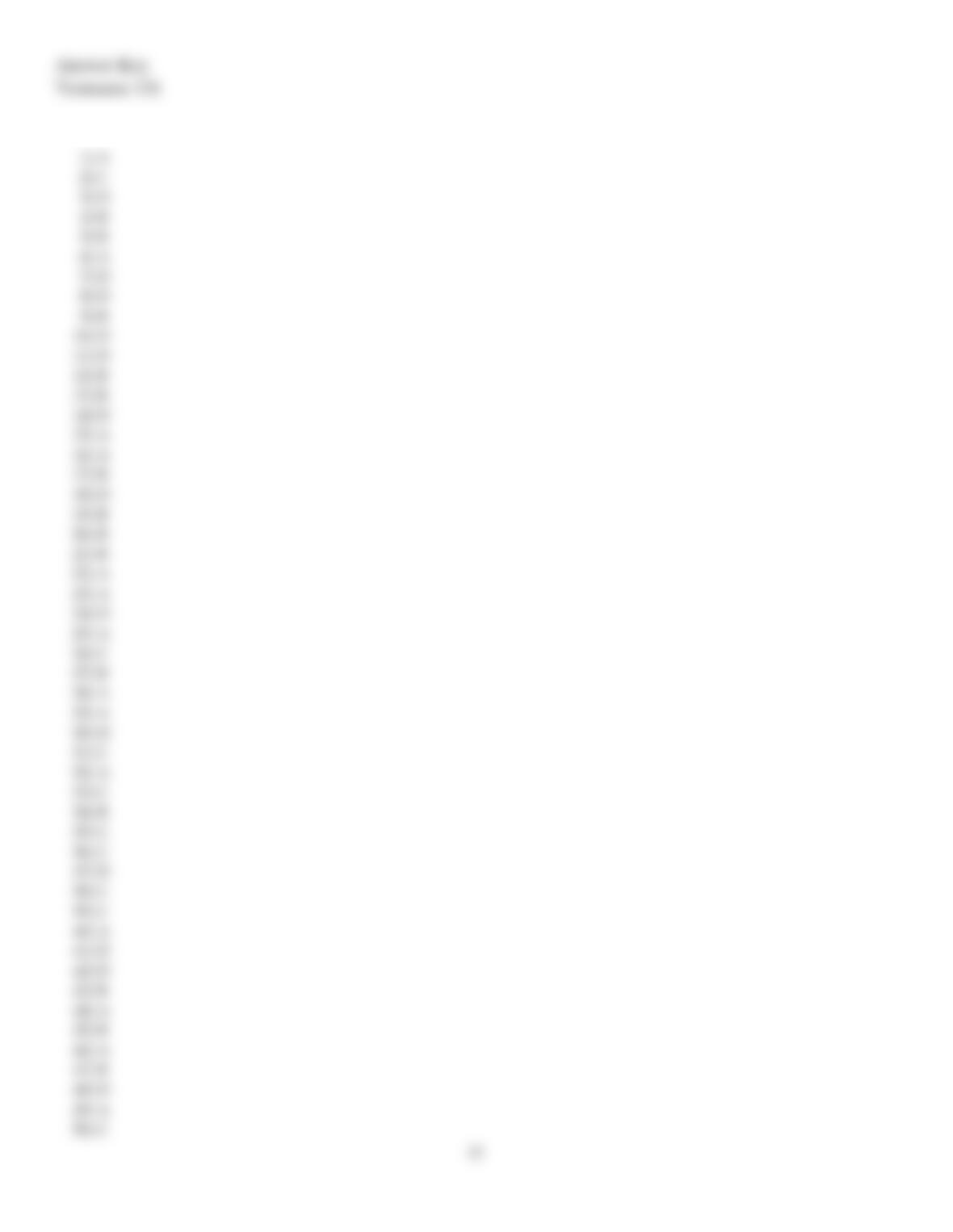
Answer Key
Testname: C6
1)
A
2)
C
3)
D
4)
B
5)
B
6)
A
7)
D
8)
D
9)
B
10)
D
11)
D
12)
B
13)
B
14)
D
15)
A
16)
A
17)
B
18)
D
19)
B
20)
B
21)
B
22)
A
23)
A
24)
D
25)
A
26)
C
27)
B
28)
A
29)
A
30)
D
31)
C
32)
A
33)
C
34)
B
35)
C
36)
C
37)
D
38)
C
39)
C
40)
A
41)
D
42)
D
43)
B
44)
A
45)
B
46)
A
47)
B
48)
D
49)
A
50)
C

Answer Key
Testname: C6
51)
C
52)
C
53)
A
54)
C
55)
B