1
Contemporary Organizational Behavior (Elsbach)
Topic Summary 5 Leadership
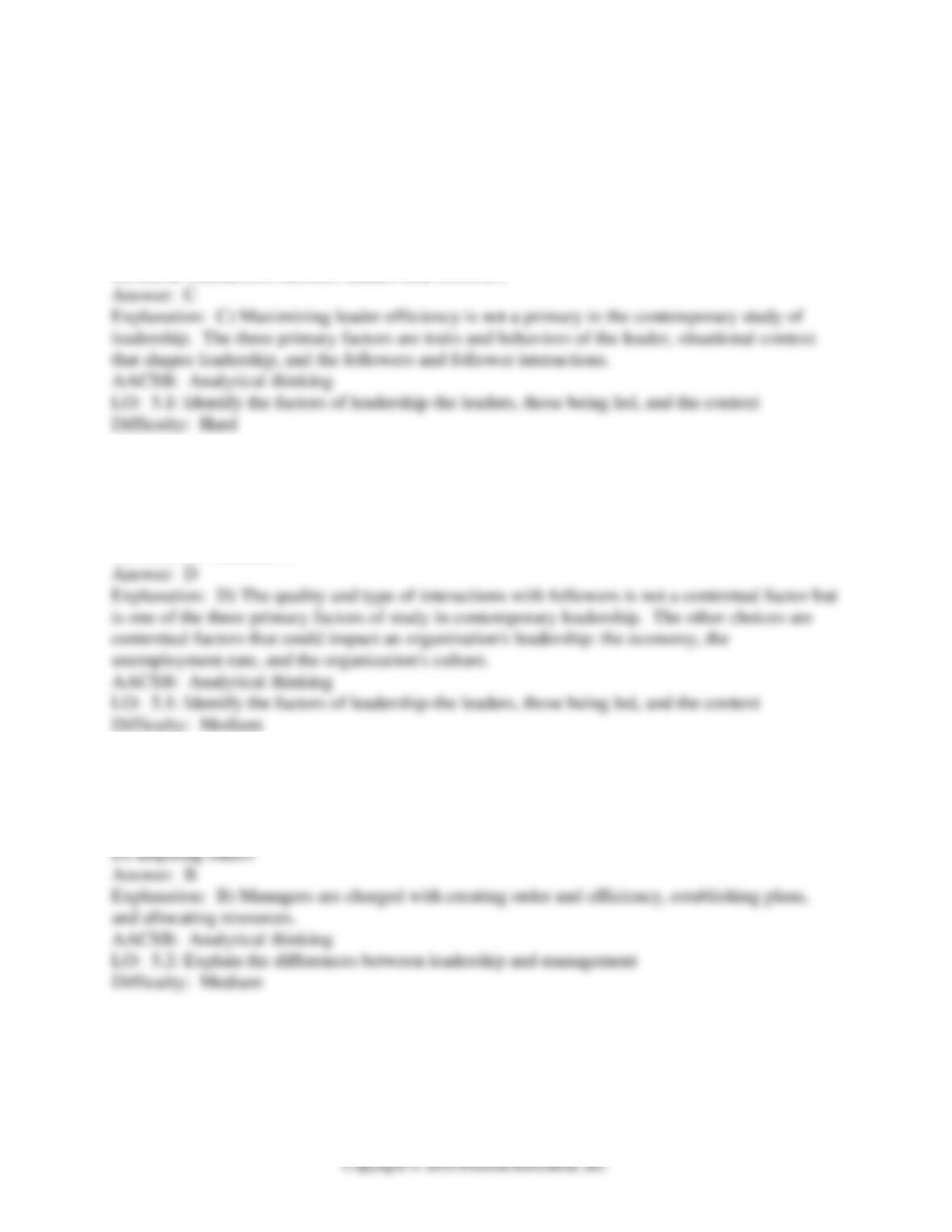
1) Which is not one of the three primary factors of study in contemporary leadership?
A) Traits of the leader
B) Situation leader faces
C) Maximizing leader efficiency
D) Social interactions between leaders and followers
2) Which of the following is not a contextual factor that could impact an organization’s leader(s)?
A) State of the economy
B) Unemployment rate
C) Organizational culture
D) Follower interactions
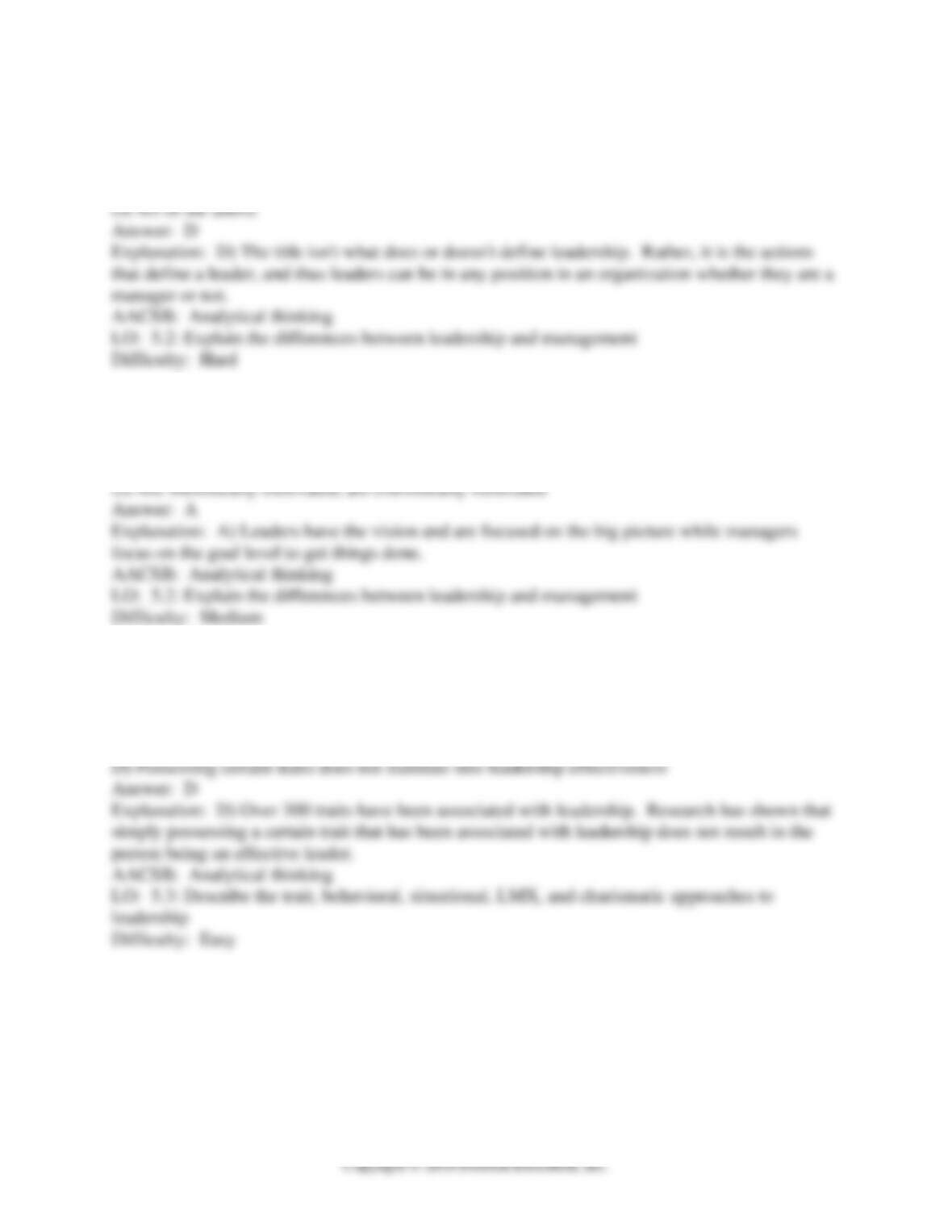
3) Which of the following describes a responsibility of managers?
A) Helping others understand the “why” for their actions
B) Creating order and efficiency
C) Producing change
2
4) Which of the following is a true statement?
A) A manager can be a leader
B) A leader can be a manager
C) A manager can’t be a leader
5) Leaders ________ and managers ________.
A) Create the vision; accomplish goals in plans
B) Inspire people; force people
C) Use intrinsic motivation to lead; use extrinsic motivation to manage
6) Which of the following is true of the research on trait theory?
A) If you are not born with leadership traits, you can develop them
B) No one is born with leadership traits but everyone can develop them
C) Traits consist of task behaviors and interpersonal behaviors but you can only develop
interpersonal traits
3
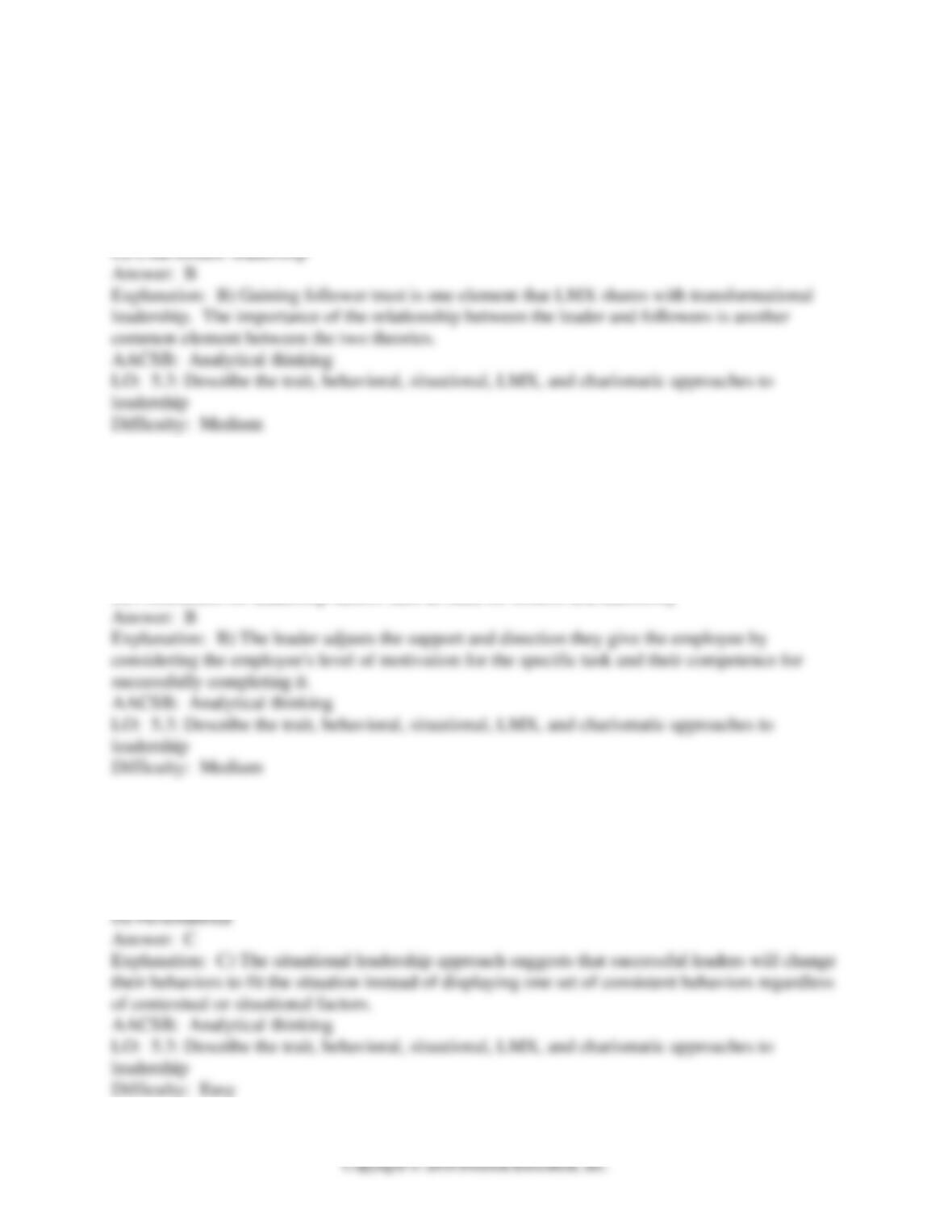
7) Leader-member exchange (LMX) shares the common elements of gaining follower trust and
the importance of the relationship between the leader and followers with which other leadership
style?
A) Transactional leadership
B) Transformational leadership
C) Bureaucratic leadership
8) Situational leaders deliver the support and direction an employee needs to accomplish a given
task. How does the leader determine what support and direction the employee will require for
the specific task?
A) Whether the employee is intrinsically or extrinsically motivated for the task
B) The employee’s motivation and competence for the specific task
C) How the task relates to the employee’s development plan
D) Preferences on leadership factors such as need for control and autonomy
9) Which leadership approach requires leaders to shift their behaviors to address different
situations as they arise in order to be successful?
A) Transformational
B) Transactional
C) Situational
4
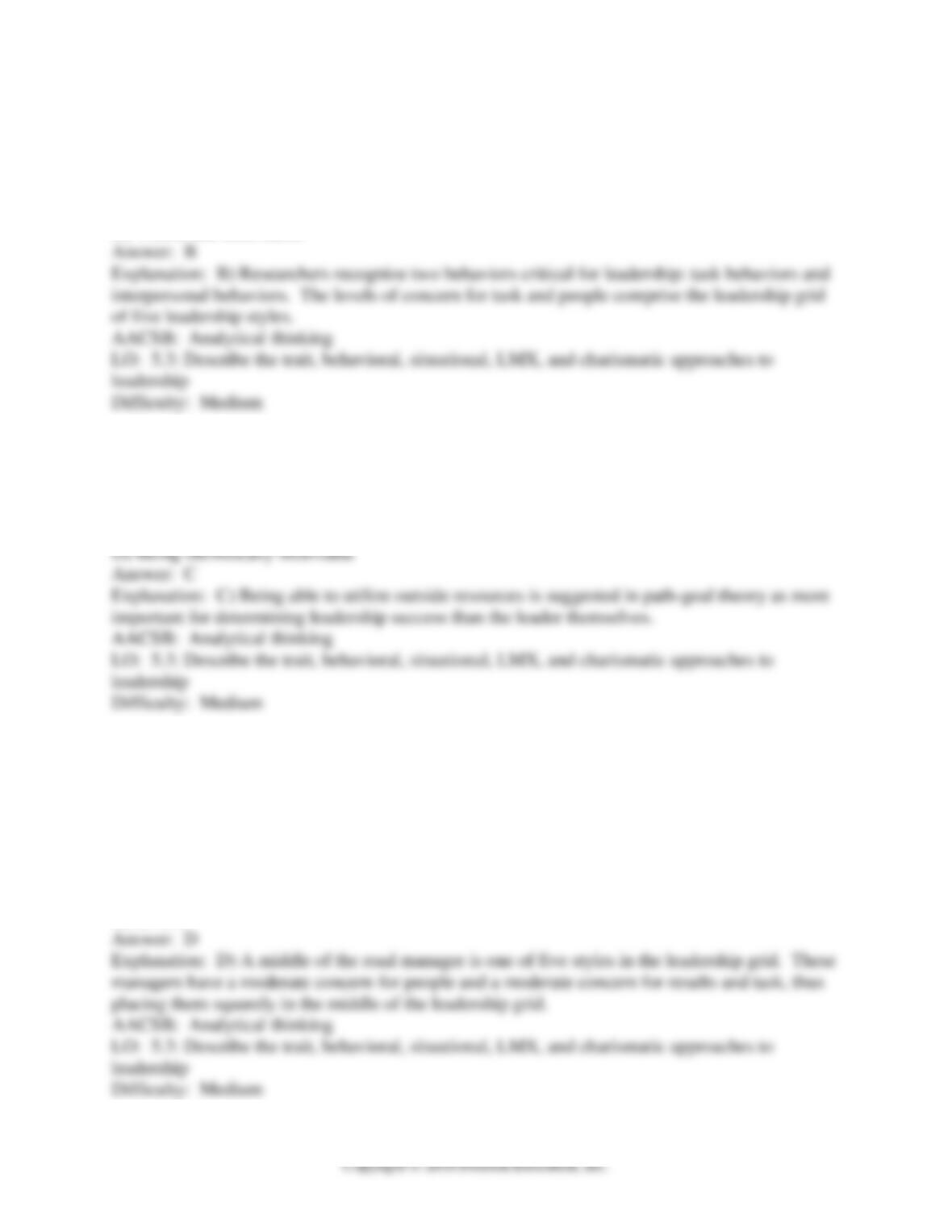
10) The leadership grid results in five styles of leadership based on the levels of which leader
concerns?
A) Motivation and ethics
B) Task and people
C) Charisma and ethics
D) Vision and motivation
11) Which factor does path-goal theory suggest is more important than the capability of the
individual leader when determining leadership success?
A) Ability to set goals
B) Ability to influence followers to reach goals
C) Access to external resources
12) Which of the following is true of middle of the road managers?
A) They have an ideal combination of task and interpersonal behaviors and thus are the most
effective type of leader
B) They are great with people because they demonstrate a compromising leadership style that is
especially effective for resolving conflicts
C) They are good role models because they spend equal energy on task and interpersonal
behaviors
D) They are equally concerned at a medium level with task behaviors and interpersonal
behaviors
5
13) Two leaders have the same leadership style on the leadership grid. How do they compare to
each other in terms of effectiveness?
A) One is an effective leader while the other is a very ineffective leader
B) Both leaders demonstrate the same level of effectiveness
C) The leadership grid does not measure effectiveness so no conclusion can be drawn
D) All of the above are true
14) In what way is charisma unique?
A) It is considered a trait and a behavior
B) It evokes strong social feelings in followers
C) It requires risk to achieve goals
15) How do transformational leaders impact their followers?
A) They can bring awareness and conscientiousness to ethical issues
B) The followers receive personal gain in factors appealing to them
C) They use extrinsic motivation to encourage followers to work toward their vision
D) None of the above
6
16) Which of the following describes transactional leadership?
A) The follower achieves self-actualization they couldn’t have done without the leader’s guidance
B) Leaders can obtain more followers to achieve their vision, and followers can achieve a higher
purpose through their contribution
C) Followers can become leaders and leaders can become moral agents
D) The leader offers something the followers want in exchange for helping them achieve their
vision so both parties benefit
17) All of the following are skills involved in transformational leadership except ________.
A) Effective communication
B) Legitimate power
C) Assuming personal risk
D) Innovating new methods
18) Quid pro quo is a hallmark of which type of leadership?
A) Charismatic leadership
B) Bureaucratic leadership
C) Transactional leadership
7
19) Which of the following is a conclusion of the leadership research in cross-cultural settings?
A) Leadership traits that are effective in China are increasingly important because of China’s
economic growth
B) Leaders should specialize in the roles that make effective cross-cultural leaders
C) Effective leadership differs across different cultures
20) Authentic leadership emphasizes ________ and de-emphasizes the importance of ________.
A) Leadership; management
B) Justice; demagogues
C) Integrity; power
D) Ethics; trust
8
21) What are the four critical leadership issues and challenges facing contemporary
organizations? Provide at least one reason why each of these issues are important to address.
22) Your team leader noticed that you have been really stressed lately. She took the time to
provide detailed positive feedback on your performance, offered encouragement that raised your
self-esteem, and extended an upcoming deadline. Your team leader is obviously a good
________, and because she responds differently according to the situation, she demonstrates the
critical aspect of ________ leadership.
A) Leader; effective
B) Self-monitor; situational
C) Interpersonal leader; social
D) Staff manager; promising
9
23) Followers of ________ leaders are not motivated by the leader’s characteristics or by their
grand vision for the future but instead are motivated to follow because the leader has legitimate
authority granted by an institution that the follower respects.
A) Transactional
B) Bureaucratic
C) Charismatic
D) All of these leaders obtain their power by influencing their followers
24) As a manager, you lead by example through demonstrating high performance. You set high
performance expectations for your subordinates and support their progress toward reaching these
goals with frequent feedback. What is your management style?
A) Team leader
B) Country club
C) Middle of the road
D) Authoritarian
25) Alpha Inc. wants to develop effective leaders by establishing an employee development plan
for their top performing managers. What is Alpha’s underlying assumption about leaders?
A) Effective leadership comes from what a manager does
B) Effective leadership comes from what a manager believes
C) Effective leadership comes from those with natural talent
D) Effective leadership requires the ability to delegate