31)
With a half–wave rectified voltage across a load resistor, load current exists for what part of a
cycle?
31)
A)
0 degrees
B)
90 degrees
C)
360 degrees
D)
180 degrees
Answer:
D
Explanation:
A)
B)
C)
D)
32)
A silicon diode has a voltage to ground of 117 V from the anode. The voltage to ground from the
cathode is 117.7 V. The diode is
32)
A)
forward–biased.
B)
conducting.
C)
shorted.
D)
reverse–biased.
Answer:
D
Explanation:
A)
B)
C)
D)
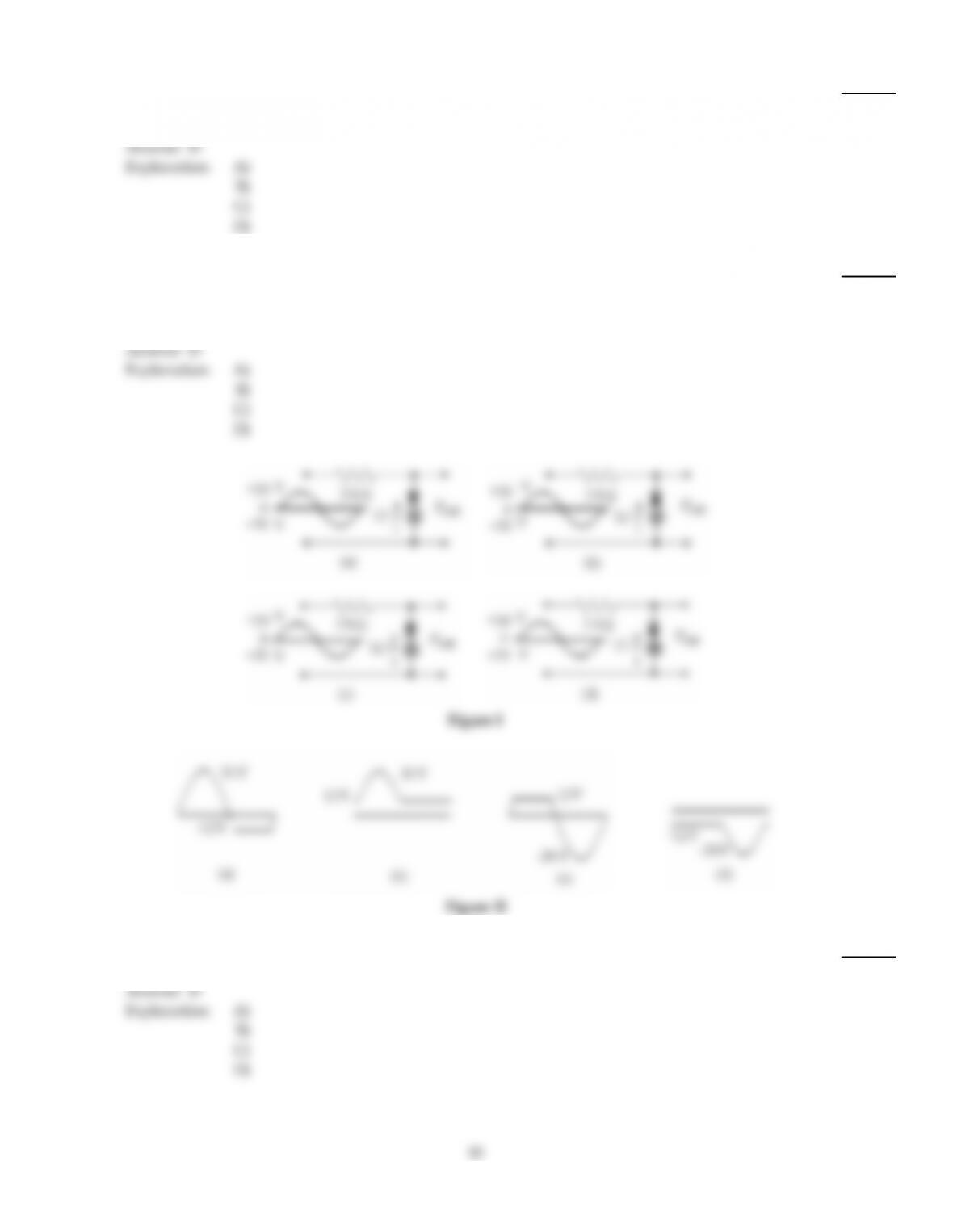
Figure I
Figure II
33)
Which of the circuits in Figure I will produce the signal in Figure II (a)?
33)
A)
(a)
B)
(b)
C)
(c)
D)
(d)
Answer:
D
Explanation:
A)
B)
C)
D)
10
34)
As the load resistance in a filtered power supply varies, the output voltage
34)
A)
varies.
B)
remains constant.
C)
is unaffected.
D)
does not change.
Answer:
A
Explanation:
A)
B)
C)
D)
35)
A diode clamper will
35)
A)
clip off a portion of the input signal.
B)
add a dc voltage to a signal.
C)
add an ac voltage to a signal.
D)
eliminate the positive or negative alternation of a signal.
Answer:
B
Explanation:
A)
B)
C)
D)
36)
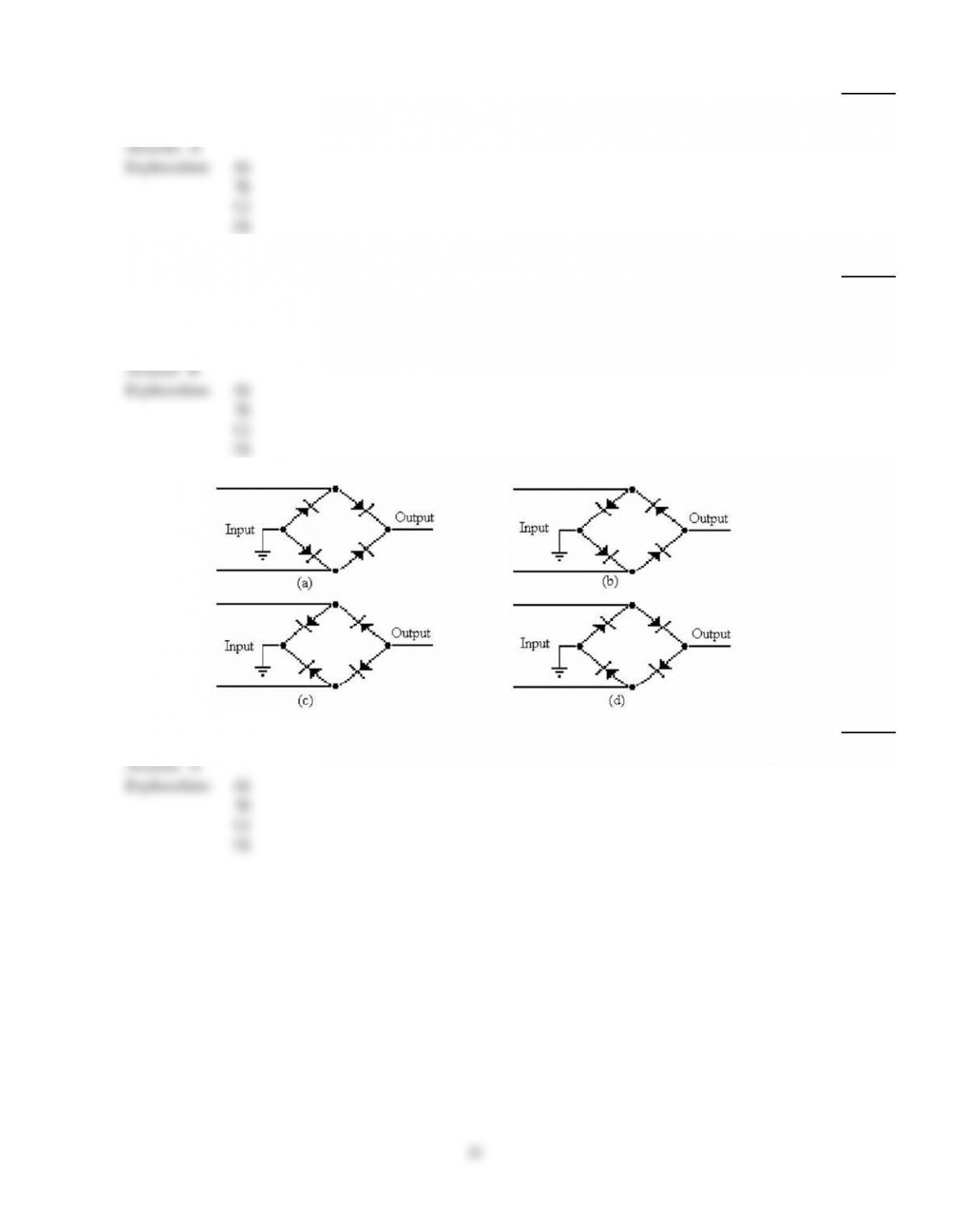
Refer to the figure above. The correct diode arrangement to supply a positive output voltage is
36)
A)
(a).
B)
(b).
C)
(c).
D)
(d).
Answer:
A
Explanation:
A)
B)
C)
D)
11
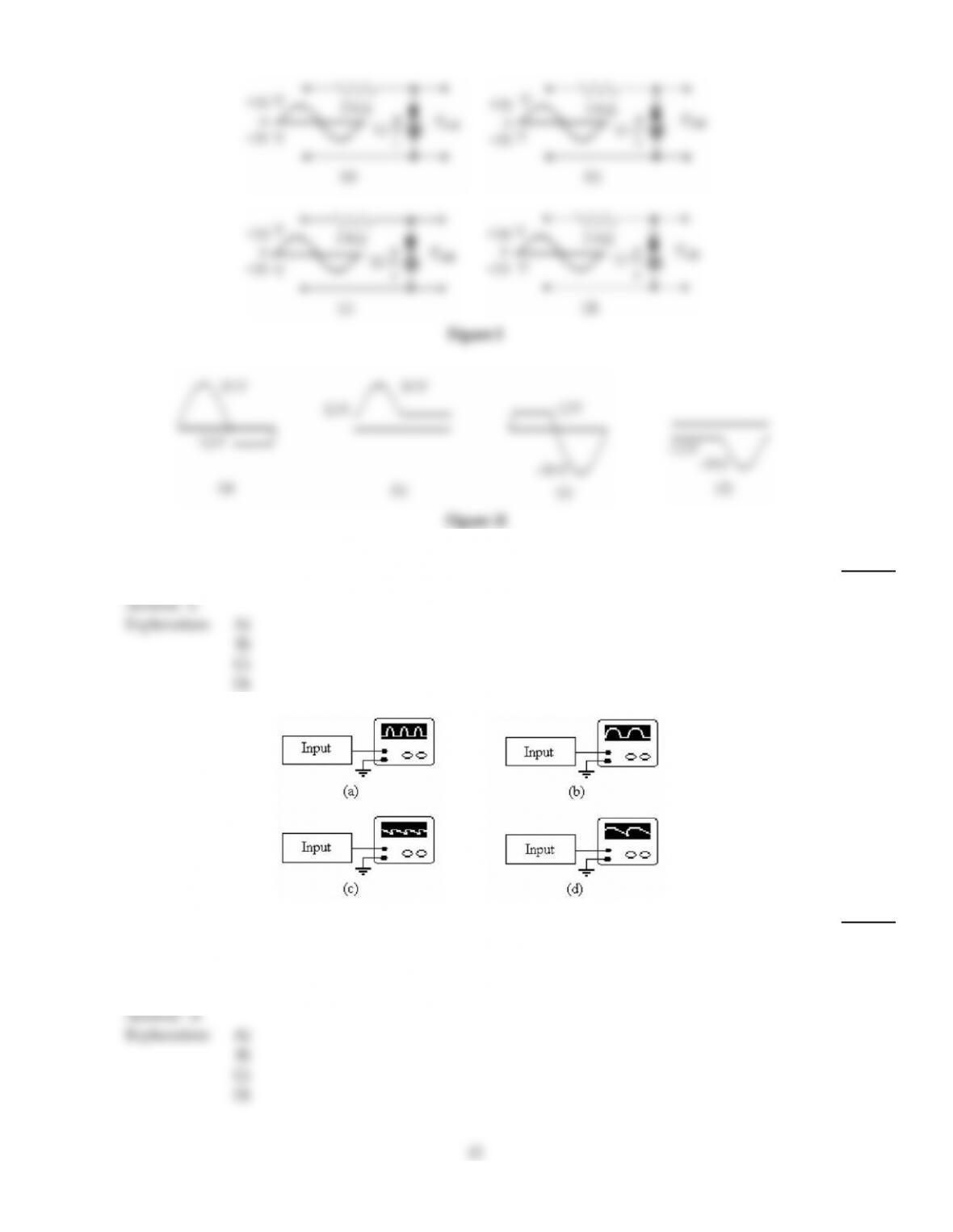
Figure I
Figure II
37)
Which of the circuits in Figure I will produce the signal in Figure II (d)?
37)
A)
(a)
B)
(b)
C)
(c)
D)
(d)
Answer:
C
Explanation:
A)
B)
C)
D)
38)
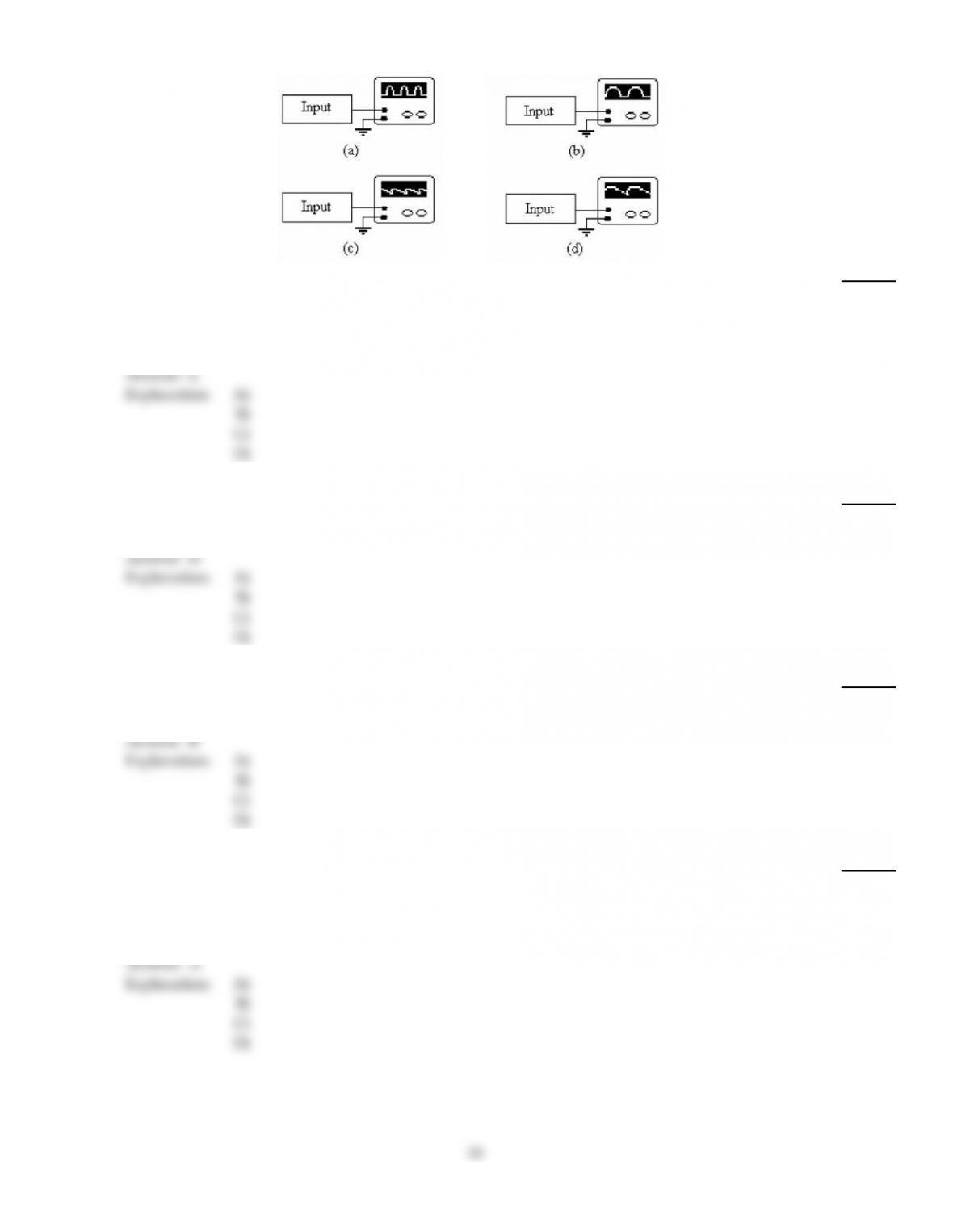
Refer to the figure above. The trace on this oscilloscope indicates the output from
38)
A)
a full–wave rectifier with no filter.
B)
a half–wave rectifier with no filter.
C)
a full–wave filtered rectifier with an open diode.
D)
a full–wave filtered rectifier.
Answer:
A
Explanation:
A)
B)

39)
The forward voltage across a conducting silicon diode is about
39)
A)
1.3 V.
B)
0.7 V.
C)
0.3 V.
D)
–0.3 V.
Answer:
B
Explanation:
A)
B)
C)
D)
40)
A DMM measures 0.13 in both directions when testing a diode. The diode is
40)
A)
shorted.
B)
operating normally.
C)
constructed of Si and is good.
D)
open.
Answer:
A
Explanation:
A)
B)
C)
D)
41)
All of the following diode information is provided by a manufacturer’s data sheet except
41)
A)
mechanical data.
B)
frequency response.
C)
temperature parameters.
D)
PIV ratings.
Answer:
B
Explanation:
A)
B)
C)
D)
42)
A nonconducting diode is ________ biased.
42)
A)
reverse
B)
poorly
C)
forward
D)
inverse
Answer:
A
Explanation:
A)
B)
C)
D)
13
43)
Refer to the figure above. This is the output from
43)
A)
a half–wave rectifier with no filter.
B)
a full–wave filtered rectifier with an open diode.
C)
a full–wave filtered rectifier.
D)
a full–wave rectifier with no filter and an open diode.
Answer:
C
Explanation:
A)
B)
C)
D)
44)
Voltage multipliers use ________ action to increase peak rectified voltages without increasing the
input transformer voltage rating.
44)
A)
clipping
B)
charging
C)
cropping
D)
clamping
Answer:
D
Explanation:
A)
B)
C)
D)
45)
How much forward diode voltage is there with the ideal–diode approximation?
45)
A)
0.7 V
B)
0 V
C)
More than 0.7 V
D)
1 V
Answer:
B
Explanation:
A)
B)
C)
D)
46)
The ideal dc output voltage of a capacitor–input filter equals the
46)
A)
peak value of the rectified voltage.
B)
average value of the rectified voltage.
C)
peak–to–peak value of the secondary voltage.
D)
rms value of the rectified voltage.
Answer:
A
Explanation:
A)
B)
C)
D)
14

47)
A reverse–biased silicon diode is connected in series with a 12 V source and a resistor. The voltage
across the resistor is
47)
A)
0.3 V.
B)
12 V.
C)
0.7 V.
D)
0 V.
Answer:
D
Explanation:
A)
B)
C)
D)
48)
The small current when a diode is reverse–biased is called
48)
A)
forward–bias current.
B)
conventional current.
C)
reverse–leakage current.
D)
reverse breakdown current.
Answer:
C
Explanation:
A)
B)
C)
D)
49)
The voltage regulation stage in a power supply
49)
A)
is inside the transformer.
B)
is located preceding the transformer primary.
C)
is connected to the input of the rectifier(s).
D)
follows the filter stage.
Answer:
D
Explanation:
A)
B)
C)
D)
50)
On diode check, a shorted diode will measure
50)
A)
0.7 V.
B)
0.79 V.
C)
0.3 V.
D)
0 V.
Answer:
D
Explanation:
A)
B)
C)
D)
51)
Reverse bias is a condition that essentially ________ current through the diode.
51)
A)
allows
B)
prevents
C)
increases
D)
amplifies
Answer:
B
Explanation:
A)
B)
C)
D)
15

52)
A silicon diode measures a high value of resistance with the meter leads in both positions. The
trouble, if any, is
52)
A)
the diode is shorted to ground.
B)
the diode is internally shorted.
C)
nothing; the diode is good.
D)
the diode is open.
Answer:
D
Explanation:
A)
B)
C)
D)
53)
The resistance of a forward–biased diode is
53)
A)
minimal above the knee of the curve.
B)
infinite.
C)
minimal below the knee of the curve.
D)
perfectly linear.
Answer:
A
Explanation:
A)
B)
C)
D)
54)
The average value of the half–wave rectified output voltage is approximately ________ of Vp.
54)
A)
100%
B)
63.6%
C)
70.7%
D)
31.8%
Answer:
D
Explanation:
A)
B)
C)
D)
55)
A silicon diode is connected in series with a 10 k resistor and a 12 V battery. If the cathode of the
diode is connected to the positive terminal of the battery, the voltage from the anode to the
negative terminal of the battery is
55)
A)
11.3 V.
B)
12 V.
C)
0 V.
D)
0.7 V.
Answer:
C
Explanation:
A)
B)
C)
D)
56)
A diode is operated in reverse bias. As the reverse voltage is decreased, the depletion region
56)
A)
is not related to reverse voltage.
B)
has a constant width.
C)
widens.
D)
narrows.
Answer:
D
Explanation:
A)
B)
C)
D)
16
57)
Using a practical forward–biased diode, if the voltage at the anode were 10 V, the voltage at the
cathode would equal
57)
A)
10.3 V.
B)
10.7 V.
C)
9.3 V.
D)
10 V.
Answer:
C
Explanation:
A)
B)
C)
D)
58)
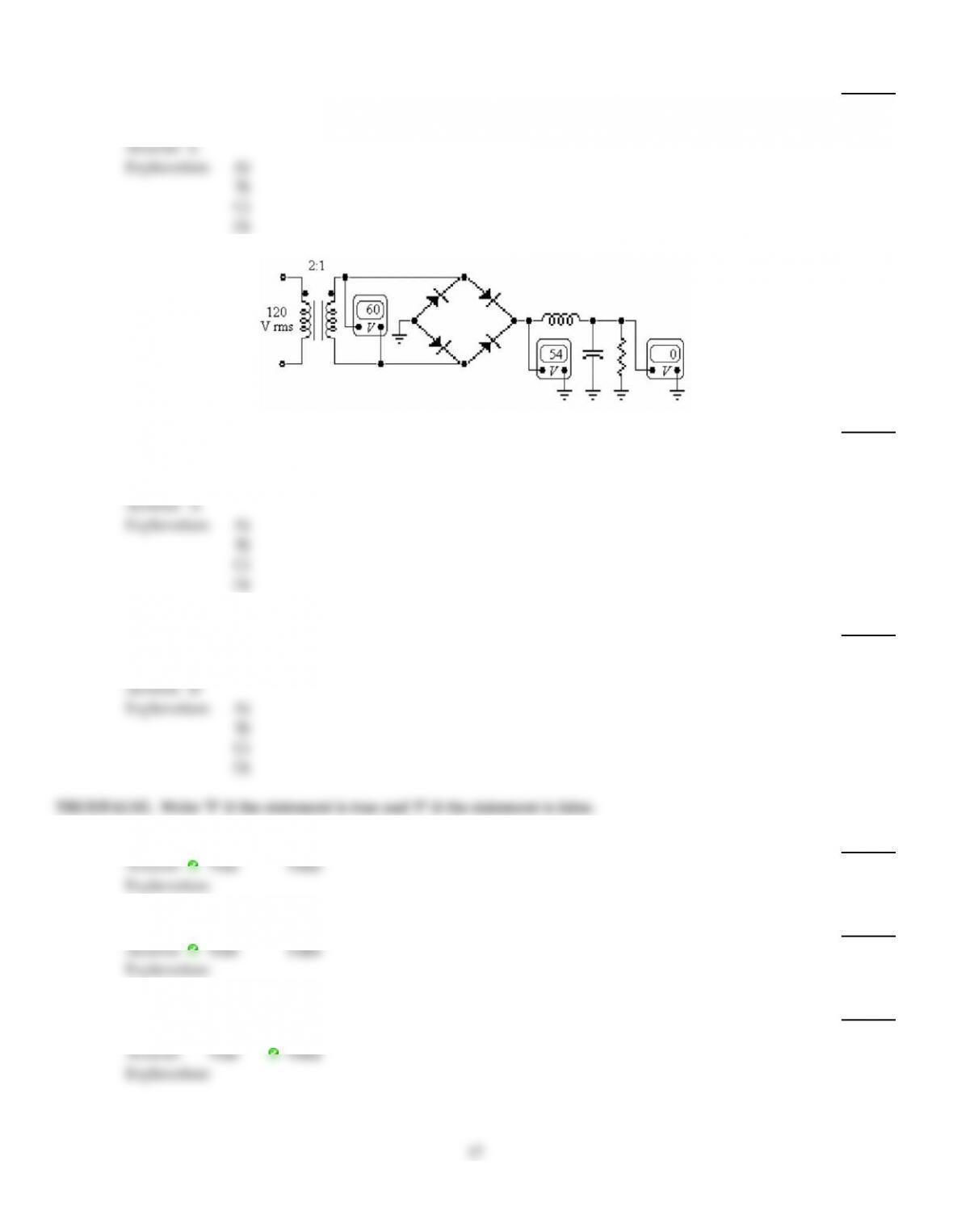
Refer to the figure above. If the voltmeter across the transformer secondary reads 0 V, the probable
trouble, if any, would be
58)
A)
an open transformer primary.
B)
the inductor is open.
C)
one of the diodes is open.
D)
the inductor is shorted.
Answer:
A
Explanation:
A)
B)
C)
D)
59)
If the positive lead of an ohmmeter is placed on the cathode and the negative lead is placed on the
anode, which of the following readings would indicate a defective diode?
59)
A)
400 k
B)
1 M
C)
D)
0
Answer:
D
Explanation:
A)
B)
C)
D)
TRUE/FALSE. Write ‘T’ if the statement is true and ‘F’ if the statement is false.
60)
Clamping circuits use capacitors and diodes to add a dc level to a waveform.
60)
Answer:
True
False
Explanation:
61)
A diode conducts current when forward–biased and blocks current when reverse–biased.
61)
Answer:
True
False
Explanation:
62)
The PIV rating of a diode in a full–wave bridge rectifier is more than that required for a full–wave
center–tapped configuration.
62)
Answer:
True
False
Explanation:
17

63)
One of the advantages of using transformer coupling in a half–wave rectifier is that it allows the ac
source to be directly connected to the load.
63)
Answer:
True
False
Explanation:
64)
Reverse bias permits full current through a pn junction.
64)
Answer:
True
False
Explanation:
65)
The larger the ripple voltage, the better the filter.
65)
Answer:
True
False
Explanation:
18