23)
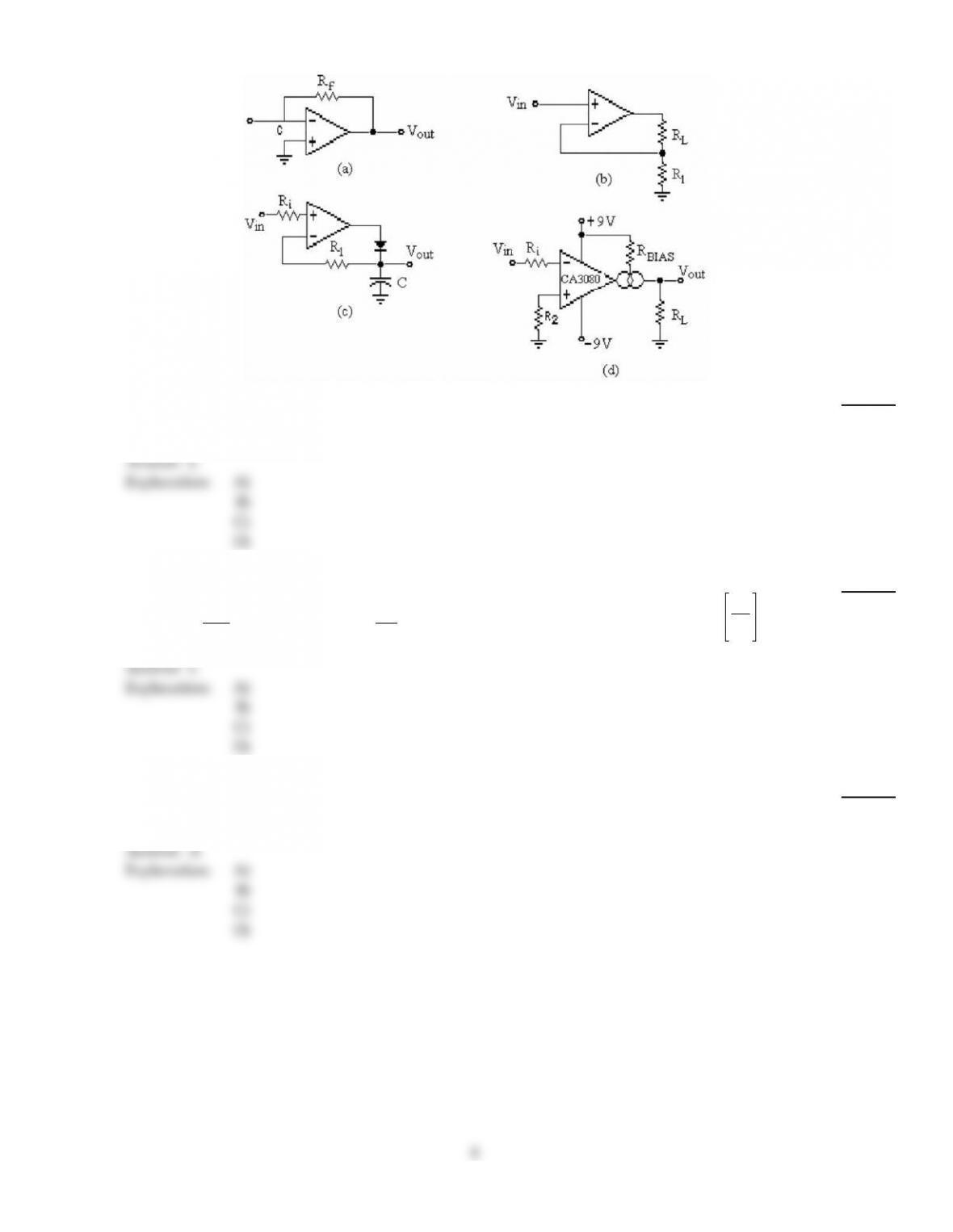
Refer to (d) in the figure above. If gm= 25 mS and RL= 25 k, the voltage gain would be
23)
A)
62.5.
B)
6.25.
C)
625.
D)
Not enough information is given.
Answer:
C
Explanation:
A)
B)
C)
D)
24)
The voltage gain of an OTA can be calculated using the formula
24)
A)
AV =2Rf
Ri.
B)
AV=Rf
Ri.
C)
AV= gmRL.
D)
AV =
Rf
Ri+ 1.
Answer:
C
Explanation:
A)
B)
C)
D)
25)
The voltage gain of the input stage of an isolation amplifier is 12. If the output stage has a gain of 6,
the total voltage gain is
25)
A)
72.
B)
18.
C)
144.
D)
6.
Answer:
A
Explanation:
A)
B)
C)
D)
8
26)
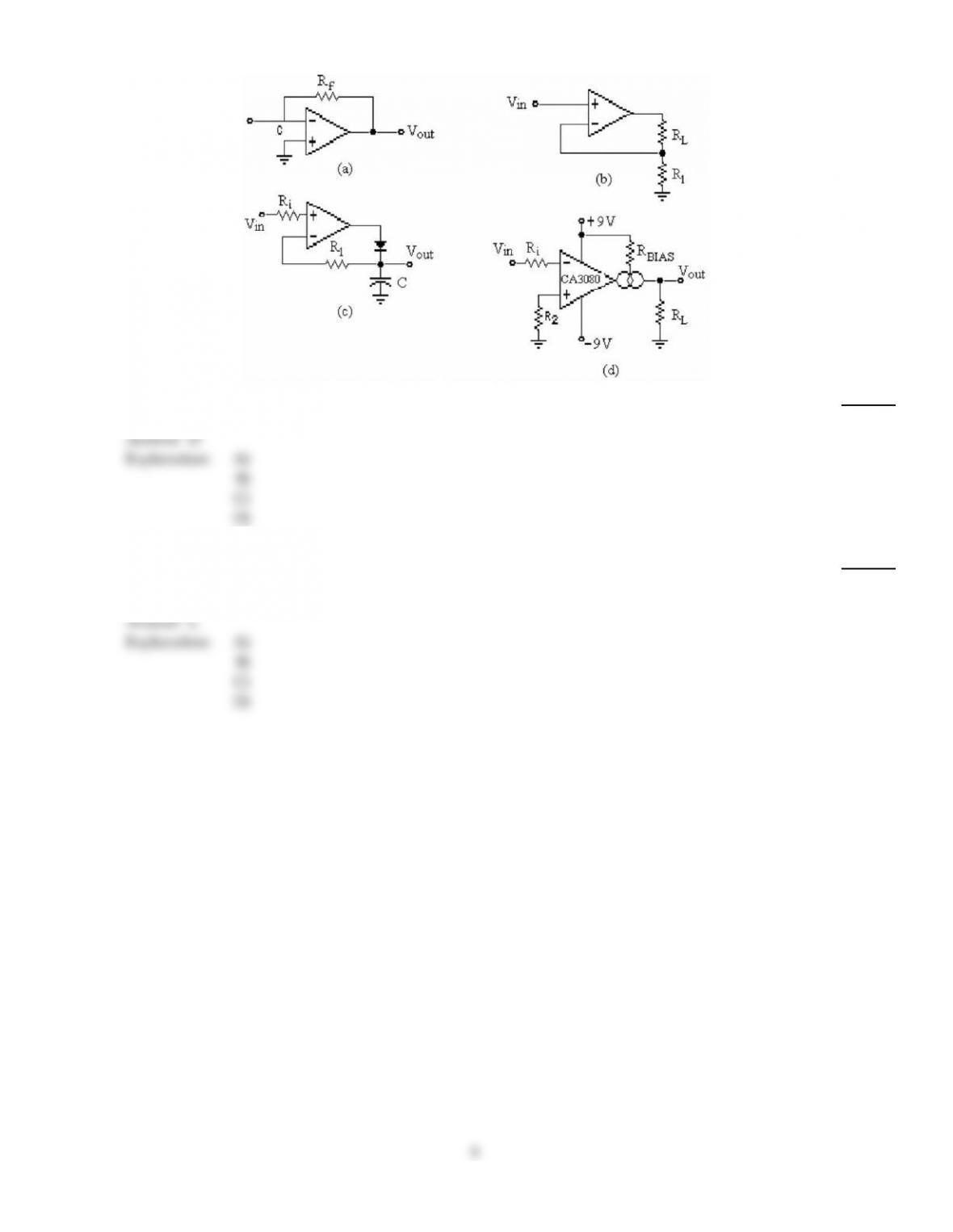
Refer to the figure above. Which of these circuits contains an OTA?
26)
A)
(a)
B)
(b)
C)
(c)
D)
(d)
Answer:
D
Explanation:
A)
B)
C)
D)
27)
The input signal for an instrumentation amplifier usually comes from
27)
A)
an inverting amplifier.
B)
a differential amplifier.
C)
a Wheatstone bridge.
D)
a filtered dc power supply.
Answer:
C
Explanation:
A)
B)
C)
D)
9
28)
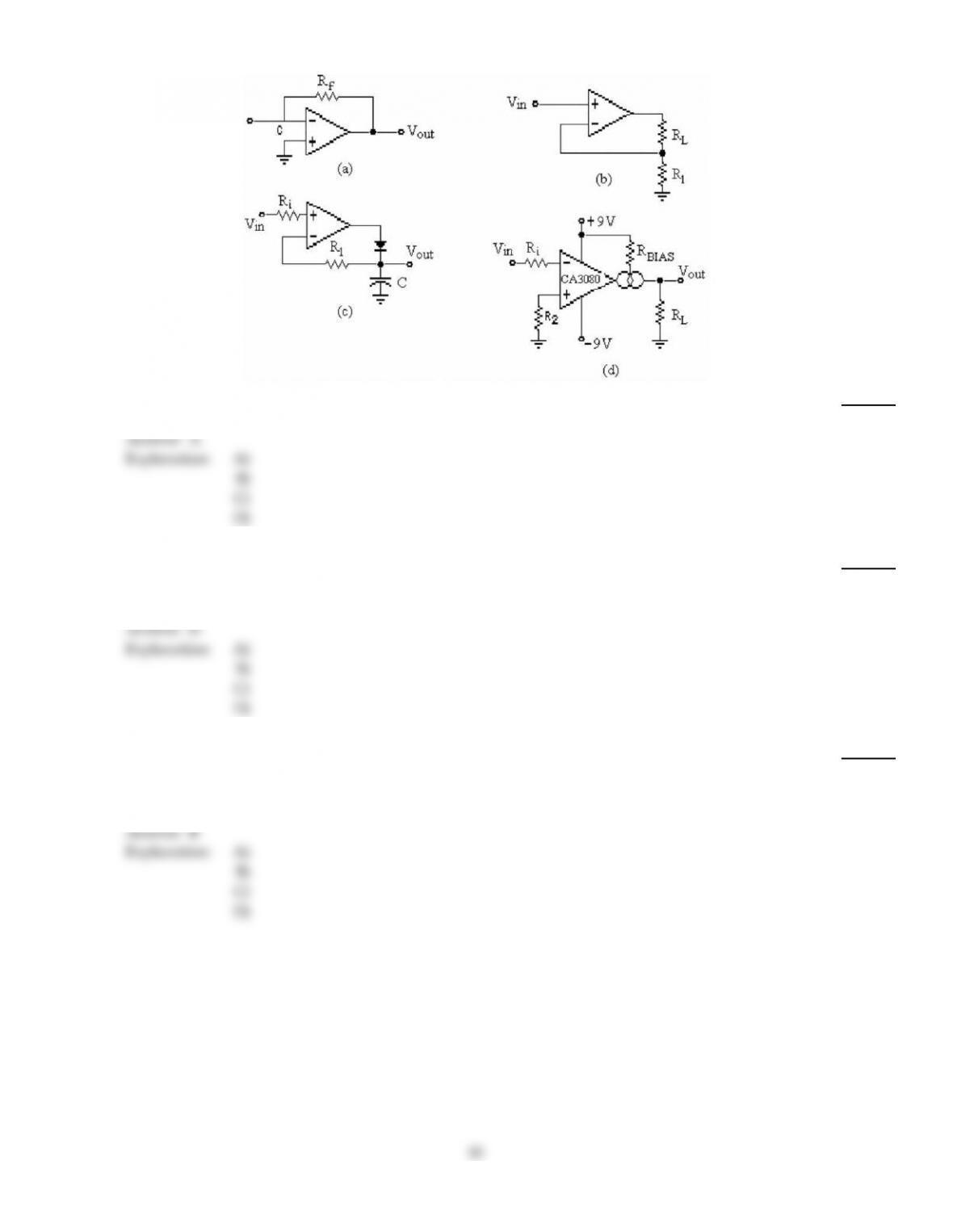
Refer to the figure above. Which of these circuits is known as a current–to–voltage converter?
28)
A)
(a)
B)
(b)
C)
(c)
D)
(d)
Answer:
A
Explanation:
A)
B)
C)
D)
29)
When using an OTA in a Schmitt–trigger configuration, the trigger points are controlled by
29)
A)
the IOUT.
B)
the IBIAS.
C)
the VOUT.
D)
Both A and B above.
Answer:
D
Explanation:
A)
B)
C)
D)
30)
If an operational transconductance amplifier (OTA) is used as a nonlinear mixer and an audio
signal is mixed with an RF signal, the output will be a(n) ________ signal.
30)
A)
triangular wave
B)
amplitude modulated (AM)
C)
square wave
D)
frequency modulated (FM)
Answer:
B
Explanation:
A)
B)
C)
D)
10
31)
Which of the following correctly describes the relationship between bandwidth and gain for an
instrumentation amplifier?
31)
A)
Bandwidth increases as gain increases.
B)
Instrumentation amplifiers have no bandwidth since they can only amplify dc.
C)
Bandwidth decreases as gain increases.
D)
Bandwidth and gain are both zero.
Answer:
C
Explanation:
A)
B)
C)
D)
32)
In some respects an isolation amplifier is nothing more than an elaborate
32)
A)
instrumentation amplifier.
B)
op–amp.
C)
rectifier and filter.
D)
Both A and B above.
Answer:
D
Explanation:
A)
B)
C)
D)
33)
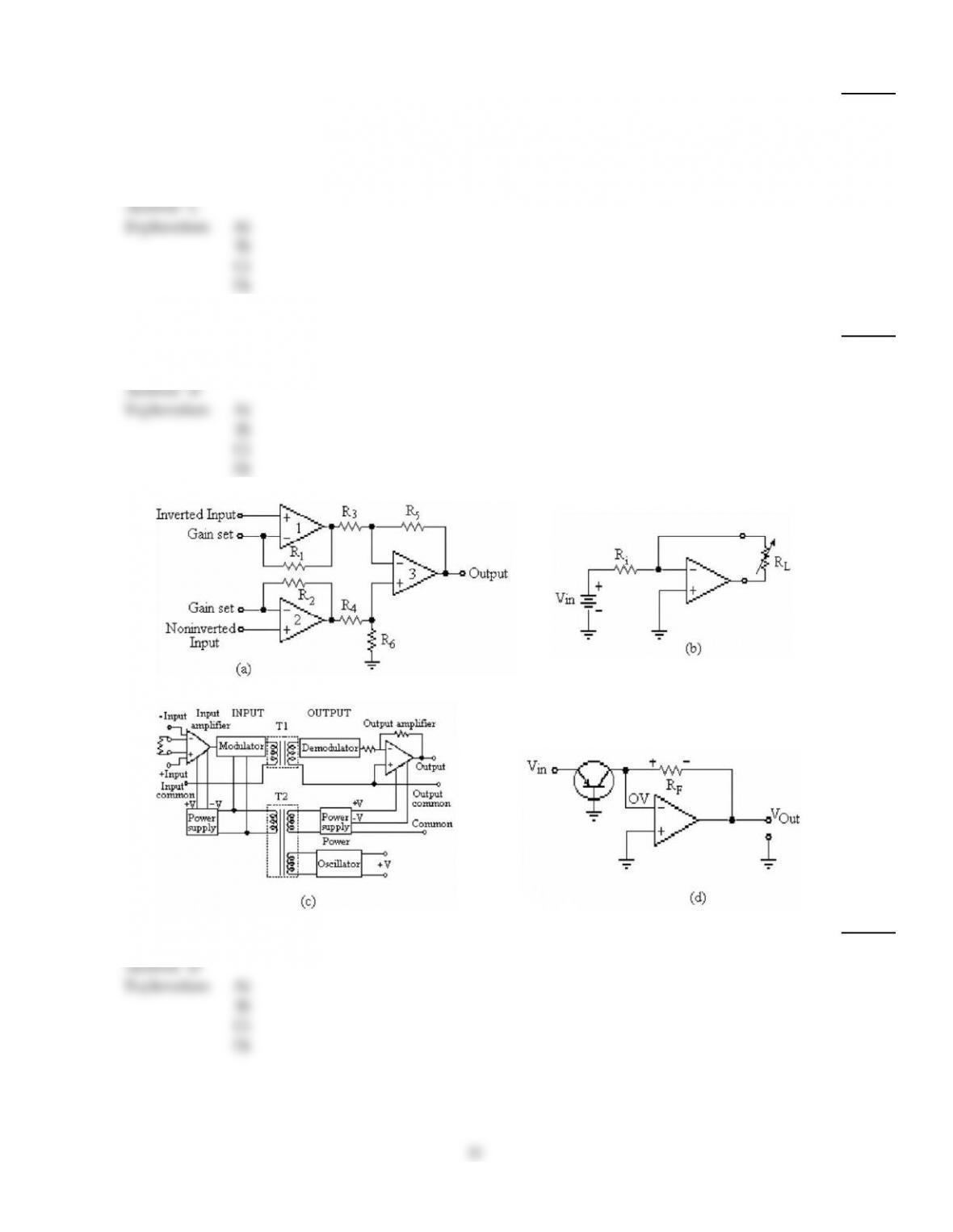
Refer to the figure above. Which of these circuits is known as an antilog amplifier?
33)
A)
(a)
B)
(b)
C)
(c)
D)
(d)
Answer:
D
Explanation:
A)
B)
C)
D)
11

34)
What is the required value of feedback resistance needed in a current–to–voltage converter where
each 100 µA of input current needs to result in an output of 1 V?
34)
A)
10 k
B)
1 M
C)
10 M
D)
1 k
Answer:
A
Explanation:
A)
B)
C)
D)
35)
To scale down large signal voltages without obscuring lower signal voltages, ________ should be
used.
35)
A)
natural logarithmic signal compression
B)
signal compression
C)
logarithmic signal compression
D)
antilogarithmic signal compression
Answer:
C
Explanation:
A)
B)
C)
D)
TRUE/FALSE. Write ‘T’ if the statement is true and ‘F’ if the statement is false.
36)
An antilog amplifier has a BJT in series with the input.
36)
Answer:
True
False
Explanation:
37)
OTA stands for operational transistor amplifier.
37)
Answer:
True
False
Explanation:
38)
Linear signal compression scales down all signal levels by the same amount.
38)
Answer:
True
False
Explanation:
39)
One of the key characteristics of an instrumentation amplifier is its low input impedance.
39)
Answer:
True
False
Explanation:
40)
A basic instrumentation amplifier has three op–amps.
40)
Answer:
True
False
Explanation:
41)
The voltage gain of an instrumentation amplifier is set with an external resistor.
41)
Answer:
True
False
Explanation:
42)
The main purpose of an instrumentation amplifier is to amplify common mode voltage.
42)
Answer:
True
False
Explanation:
12

43)
A log amplifier has a JFET in the feedback loop.
43)
Answer:
True
False
Explanation:
44)
The OTA is a voltage–to–current amplifier.
44)
Answer:
True
False
Explanation:
45)
A basic isolation amplifier has two electrically isolated sections.
45)
Answer:
True
False
Explanation:
46)
Most modern isolation amplifiers use transformer coupling for isolation.
46)
Answer:
True
False
Explanation:
13