Exam
Name___________________________________
MULTIPLE CHOICE. Choose the one alternative that best completes the statement or answers the question.
1)
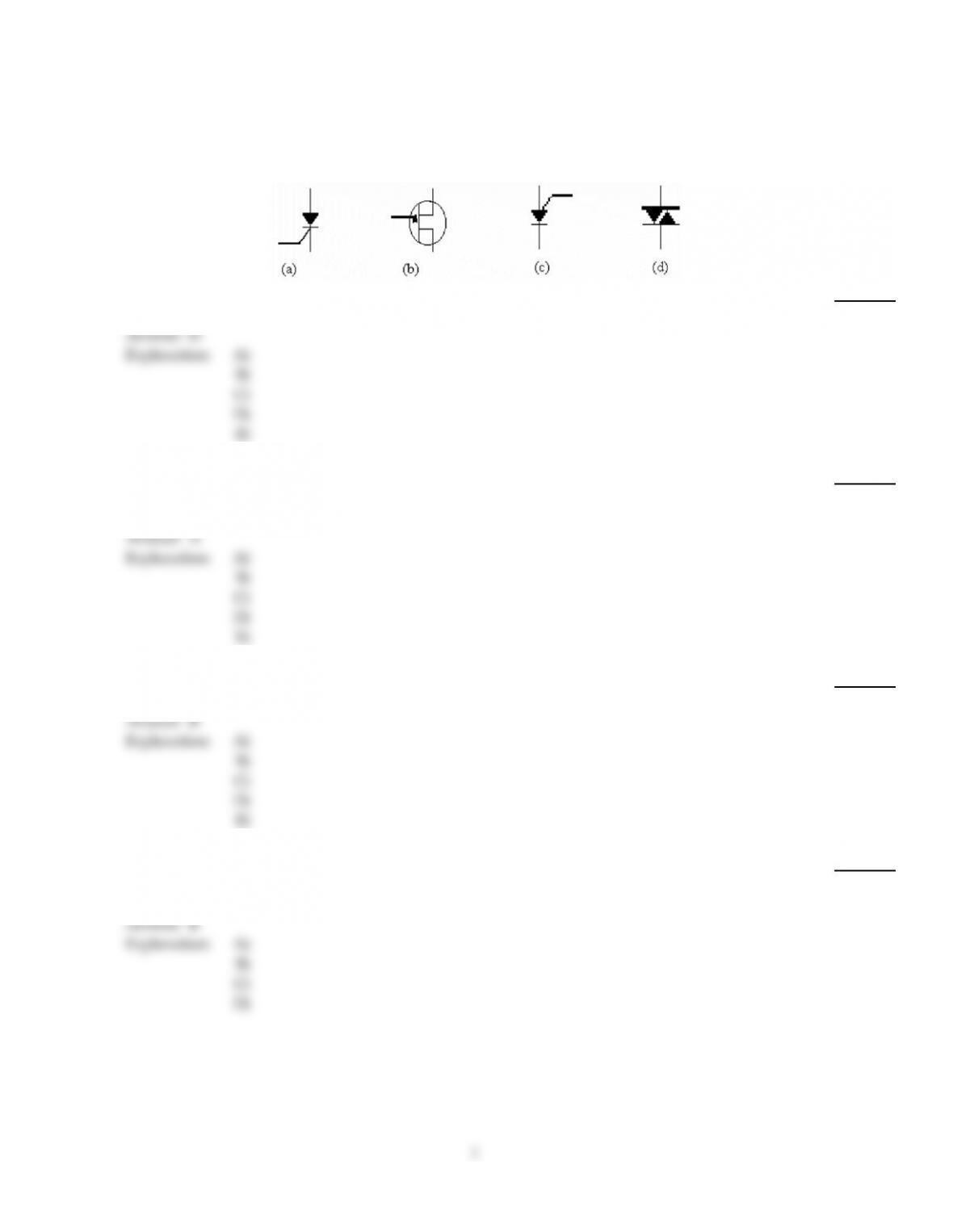
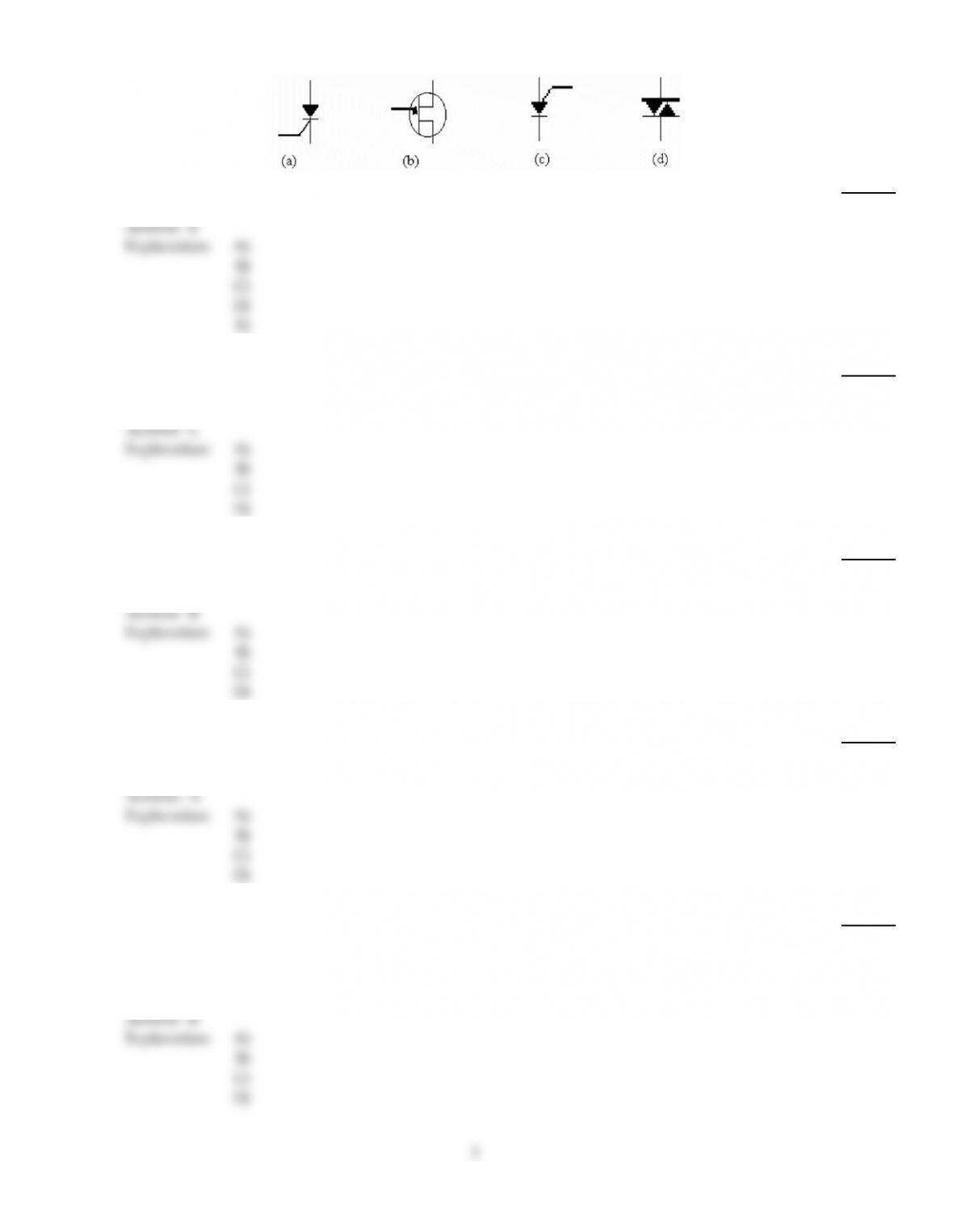
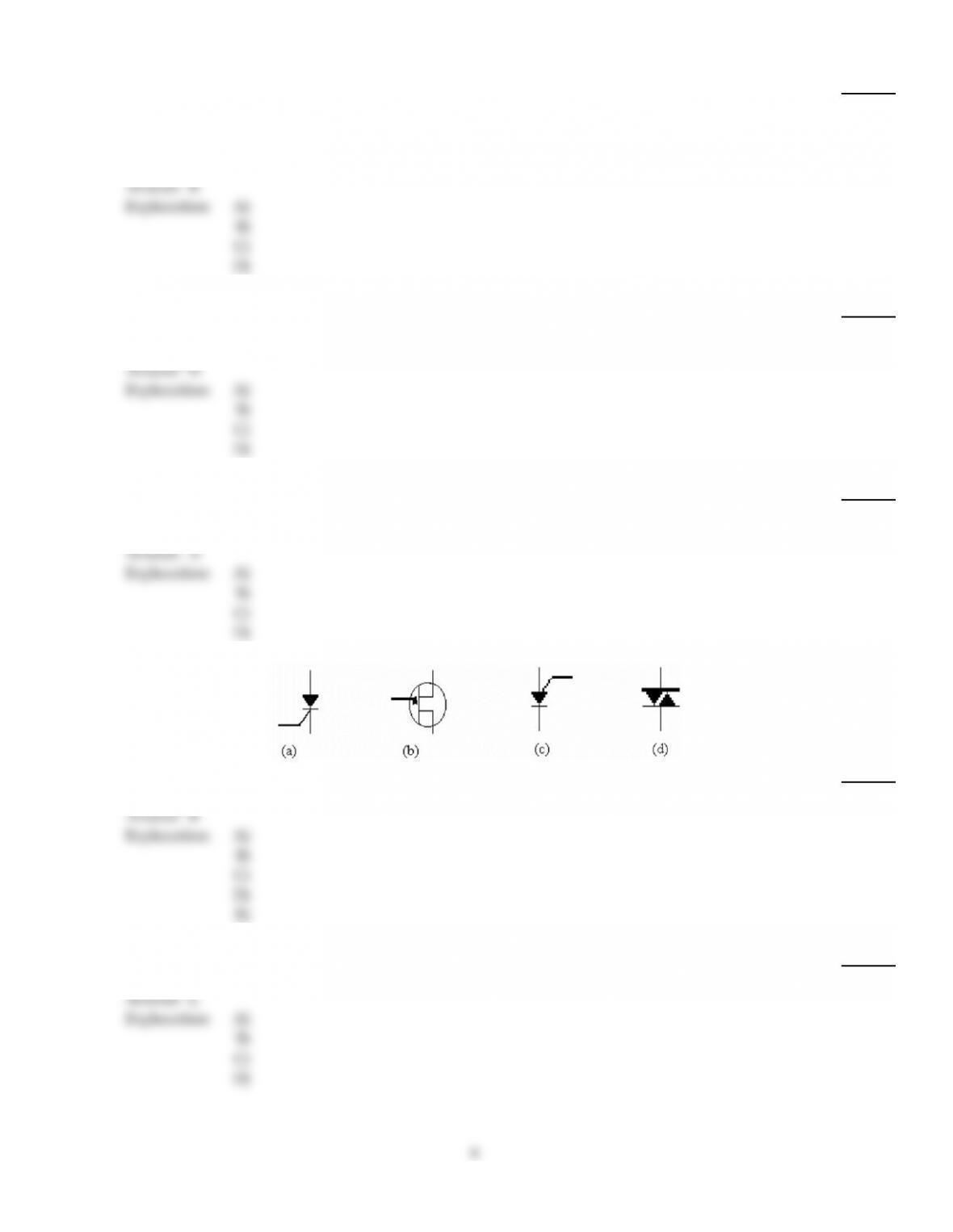
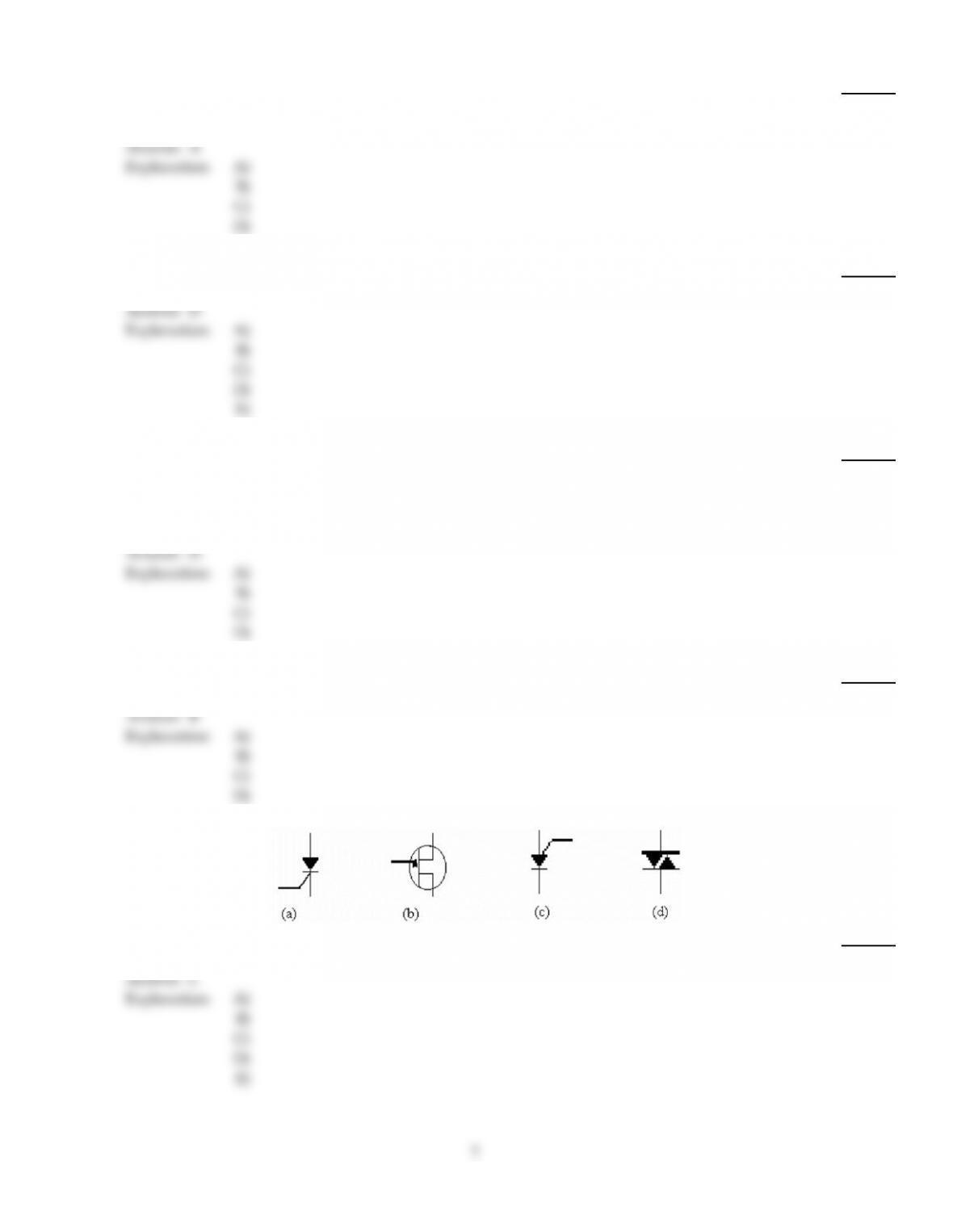
Refer to (c) in the figure above. The symbol is for
1)
A)
a triac.
B)
a UJT.
C)
a diac.
D)
a PUT.
E)
an SCR.
Answer:
D
Explanation:
A)
B)
C)
D)
E)
2)
The best choice to shut down a dc power supply in case of an abnormally high voltage condition is
a(n)
2)
A)
SCR.
B)
diac.
C)
PUT.
D)
triac.
E)
UJT.
Answer:
A
Explanation:
A)
B)
C)
D)
E)
3)
The most likely device to be used in an oscillator is a(n)
3)
A)
diac.
B)
UJT.
C)
PUT.
D)
triac.
E)
SCR.
Answer:
B
Explanation:
A)
B)
C)
D)
E)
4)
An SCR is usually turned on by
4)
A)
breakdown.
B)
a gate trigger.
C)
breakover.
D)
holding current.
Answer:
B
Explanation:
A)
B)
C)
D)
1
5)
The PUT (Programmable Unijunction Transistor) is actually a type of
5)
A)
SCR.
B)
FET device.
C)
triac.
D)
thyristor.
Answer:
D
Explanation:
A)
B)
C)
D)
6)
An SCR will turn off when the voltage across it is
6)
A)
increased to the supply voltage.
B)
timed out.
C)
decreased to near 0 V.
D)
decreased by the value of the gate voltage.
Answer:
C
Explanation:
A)
B)
C)
D)
7)
An SCR crowbar circuit is used to
7)
A)
protect against overvoltage conditions.
B)
detect when a circuit is overheating.
C)
protect against undervoltage conditions.
D)
control three phase ac motors.
Answer:
A
Explanation:
A)
B)
C)
D)
8)
If an SCR starts to conduct when a gate current is established, when the gate circuit is interrupted
the SCR
8)
A)
gate current will increase.
B)
will turn off.
C)
will continue to conduct.
D)
current will increase.
Answer:
C
Explanation:
A)
B)
C)
D)
9)
The diac is a(n)
9)
A)
transistor.
B)
unidirectional device.
C)
bidirectional device.
D)
three–layer device.
Answer:
C
Explanation:
A)
B)
C)
D)
2
10)
Refer to (a) in the figure above. The symbol is for
10)
A)
a triac.
B)
a UJT.
C)
a diac.
D)
a PUT.
E)
an SCR.
Answer:
E
Explanation:
A)
B)
C)
D)
E)
11)
The voltage across a conducting SCR
11)
A)
equals the source voltage.
B)
decreases with more anode current.
C)
is approximately zero.
D)
equals the breakover voltage.
Answer:
C
Explanation:
A)
B)
C)
D)
12)
An SCS has a unique ability to
12)
A)
control a PUT.
B)
be turned on or off with a pulse.
C)
be turned off only with a pulse.
D)
All of the above.
Answer:
B
Explanation:
A)
B)
C)
D)
13)
A device is needed to trigger an SCR. One possible device to use might be a(n)
13)
A)
UJT.
B)
Schockley diode.
C)
SCR.
D)
PUT.
Answer:
A
Explanation:
A)
B)
C)
D)
14)
A silicon–controlled switch
14)
A)
has only 1 gate lead.
B)
has two gate leads.
C)
is bidirectional.
D)
can only be turned off with low–current dropout.
Answer:
B
Explanation:
A)
B)
C)
D)
3
15)
The minimum input current that can turn on a thyristor is called the
15)
A)
breakdown current.
B)
holding current.
C)
switching current.
D)
low–current dropout current.
Answer:
C
Explanation:
A)
B)
C)
D)
16)
The only way to make a four–layer diode conduct is with
16)
A)
low–current dropout.
B)
a trigger input applied to the gate.
C)
forward breakover voltage.
D)
None of the above.
Answer:
C
Explanation:
A)
B)
C)
D)
17)
A good choice to trigger a triac would be a(n)
17)
A)
SCR.
B)
diac.
C)
4–layer diode.
D)
Schockley diode.
Answer:
B
Explanation:
A)
B)
C)
D)
18)
A triac acts like
18)
A)
two SCRs in parallel.
B)
a normal transistor.
C)
two diacs in parallel.
D)
two SCRs in series.
Answer:
A
Explanation:
A)
B)
C)
D)
19)
A silicon controlled rectifier has
19)
A)
three external leads.
B)
two external leads.
C)
three doped regions.
D)
four external leads.
Answer:
A
Explanation:
A)
B)
C)
D)
4
20)
The diac is equivalent to
20)
A)
two four–layered diodes in parallel.
B)
two four–layer diodes in series.
C)
two SCRs in parallel.
D)
two triacs in parallel.
Answer:
A
Explanation:
A)
B)
C)
D)
21)
To avoid confusing the schematic symbols for a JFET and a UJT, keep in mind that the UJT symbol
21)
A)
has an arrow at an angle.
B)
has four terminals.
C)
has no arrow.
D)
has two circles.
E)
uses a dot.
Answer:
A
Explanation:
A)
B)
C)
D)
E)
22)
Of the following applications, the likely one to use a diac is a(n)
22)
A)
high frequency amplifier.
B)
battery charger.
C)
lamp dimmer.
D)
oscillator.
Answer:
C
Explanation:
A)
B)
C)
D)
23)
The trigger voltage of an SCR is closest to
23)
A)
4 V.
B)
0 V.
C)
0.7 V.
D)
breakover voltage.
Answer:
C
Explanation:
A)
B)
C)
D)
24)
Once a diac is conducting, the only way to turn it off is with
24)
A)
low–current dropout.
B)
a positive gate voltage.
C)
a negative gate voltage.
D)
breakover.
Answer:
A
Explanation:
A)
B)
C)
D)
5
25)
A triac
25)
A)
can trigger only on positive gate voltages.
B)
can be triggered by either a positive or a negative gate voltage.
C)
cannot be triggered with gate voltages.
D)
can trigger only on negative gate voltages.
Answer:
B
Explanation:
A)
B)
C)
D)
26)
The minimum current that keeps a latch closed is called the
26)
A)
critical rate of current rise.
B)
pick–up current.
C)
trigger current.
D)
holding current.
Answer:
D
Explanation:
A)
B)
C)
D)
27)
The only way to stop an SCR that is conducting is by
27)
A)
low–current drop out.
B)
breakover.
C)
reverse–bias triggering.
D)
a positive trigger.
Answer:
A
Explanation:
A)
B)
C)
D)
28)
Refer to (b) in the figure above. The symbol is for
28)
A)
a triac.
B)
a UJT.
C)
a diac.
D)
a PUT.
E)
an SCR.
Answer:
B
Explanation:
A)
B)
C)
D)
E)
29)
A thyristor can be used as
29)
A)
an amplifier.
B)
a power source.
C)
a switch.
D)
a resistor.
Answer:
C
Explanation:
A)
B)
C)
D)
6
30)
If the gate circuit is open on a triac used for ac motor control, the motor
30)
A)
can never turn on.
B)
will constantly run at full speed.
C)
will run at 60 RPM.
D)
will constantly run at half speed.
Answer:
A
Explanation:
A)
B)
C)
D)
31)
The best choice to control a small variable speed ac motor is a(n)
31)
A)
PUT.
B)
triac.
C)
UJT.
D)
SCR.
E)
diac.
Answer:
D
Explanation:
A)
B)
C)
D)
E)
32)
Disconnecting the gate lead on an SCR
32)
A)
destroys the device.
B)
will result in maximum gate current.
C)
results in the SCR staying on all the time.
D)
means that the SCR cannot be triggered on.
Answer:
D
Explanation:
A)
B)
C)
D)
33)
The best device to be used to control a dc motor is the
33)
A)
PUT.
B)
SCR.
C)
diac.
D)
triac.
Answer:
B
Explanation:
A)
B)
C)
D)
34)
Refer to (d) in the figure above. The symbol is for
34)
A)
a triac.
B)
a UJT.
C)
a diac.
D)
a PUT.
E)
an SCR.
Answer:
C
Explanation:
A)
B)
C)
D)
E)
7
35)
An SCR is used to control the speed of a dc motor by ________ the ________ of the pulse delivered
to the motor.
35)
A)
increasing, amplitude
B)
decreasing, gate width
C)
varying, width
D)
None of the above.
Answer:
C
Explanation:
A)
B)
C)
D)
36)
A conducting SCR can be turned off by
36)
A)
opening the anode circuit.
B)
temporarily shorting across the SCR’s anode to cathode.
C)
reducing the source voltage to zero.
D)
All of the above.
Answer:
D
Explanation:
A)
B)
C)
D)
37)
For a UJT, the intrinsic standoff ratio is
37)
A)
always less than 1.
B)
usually around 1 k or so.
C)
equal to 1.
D)
always greater than 1.
Answer:
A
Explanation:
A)
B)
C)
D)
38)
A UJT has
38)
A)
one emitter lead.
B)
two base leads.
C)
two emitter and one base leads.
D)
both A and B above.
Answer:
D
Explanation:
A)
B)
C)
D)
39)
SCRs are
39)
A)
bidirectional.
B)
high–current devices.
C)
four–layer diodes.
D)
low–power devices.
Answer:
B
Explanation:
A)
B)
C)
D)
8
40)
Each of the following has a gate except the
40)
A)
diac.
B)
SCR.
C)
triac.
D)
PUT.
Answer:
A
Explanation:
A)
B)
C)
D)
41)
A triac is used for ac because
41)
A)
it can deliver more power to the load in a cycle.
B)
it is turned off when the ac voltage reaches zero.
C)
it conducts on both alternations.
D)
All of the above.
Answer:
D
Explanation:
A)
B)
C)
D)
TRUE/FALSE. Write ‘T’ if the statement is true and ‘F’ if the statement is false.
42)
A triac can be turned on by a pulse applied to the gate.
42)
Answer:
True
False
Explanation:
43)
A device that can be turned on or off by a gate pulse is called an SCS.
43)
Answer:
True
False
Explanation:
44)
A UJT is turned on by a negative pulse at the base.
44)
Answer:
True
False
Explanation:
45)
The SCR is a device that can be triggered on by a pulse applied to the gate.
45)
Answer:
True
False
Explanation:
46)
A device that conducts current in only one direction is called a diac.
46)
Answer:
True
False
Explanation:
47)
The forced commutation method requires momentarily forcing current in the direction opposite to
the reverse conduction so that the net reverse current is reduced below the holding value.
47)
Answer:
True
False
Explanation:
9