CHAPTER 17 SAMPLE QUIZ QUESTIONS
17.1. Weatherproof electrical outlets as seen installed on decks and patios
are
a. approved for Class I, Division 1
b. approved for Class I, Division 2
c. approved for Class III, Division 2
ref. p. 460-461
17.2. A paint spray booth in which flammable paints are used would be
classified as
b. Class I, Division 2
c. Class II, Division 1
d. Class II, Division 2
ref. p. 459
17.3. Which of the following hazardous locations classifications is most
hazardous?
a. Class I, Division 2
c. Class II, Division 2
d. Class III, Division 2
ref. p. 457
17.4. “Reversed polarity” means that
a. the neutral and equipment ground are reversed
b. the hot and equipment ground are reversed
d. none of the above
ref. p. 456
17.5. A common household circuit rated at 15 amps can carry approximately
how many times as much current passing through the heart muscle as
is required to produce heart fibrillation?
a. twice as much
b. five times as much
c. ten times as much
ref. p. 444-445
17.6. Which of the following circuits causes the most electrocutions annually
in the United States?
a. 20 volt
c. 220 volt
d. 440 volt
ref. p. 443
17.7. When one probe of a circuit tester contacts a hot wire and the other
probe a neutral wire,
b. a fuse or breaker or the tester bulb will blow
c. the tester will be electrocuted
d. OSHA will issue a citation
ref. p. 463
17.8. A certain string of Christmas tree lights has twenty bulbs, each rated at
3 watts. If there is no ground fault, how much current flows through
the hot wire at the receptacle plug? Show calculations. How much
flows through the neutral? Would the current flow likely be fatal if all of
the current flowing through the hot wire would pass through a person’s
heart muscle?
17.9. Ordinary household 110v circuits are capable of electric shock but
such shocks can be assumed to not be fatal.
17.10. The presence of wounds in the skin can result in much higher
current flow if electrical contact is made where the skin is broken.
17.11. The most important factor in determining whether a person will
be electrocuted when exposed to electric shock is whether the person
has an inherent physical resistance to electrical hazards.
17.12. Even body perspiration can provide the dampness that can
make electrical contact fatal.
17.13. Public utility companies regulate the oscillation of alternating
current to 60 hertz because this frequency has been found to be the
most safe for exposure to the human heart muscle and thus to prevent
most electrocutions.
17.14. What is the principal disadvantage of relying upon defibrillation
devices to save the lives of electrocution victims?
Ans. A defibrillation device is rarely available soon enough
to save the life of an electrocution victim.
ref. p. 444
17.15. Which of the following circuit voltage levels results in the most
frequent occurrence of electrocution?
b. 220v
c. 440v
d. 7800v
ref. p. 443
17.16. Which of the following circuit voltage levels results in the most
frequent occurrence of electrocution?
a. 6v
b. 12v
d. 220v
ref. p. 443
17.17. Which of the following is the least important factor in
determining whether an electrocution will take place?
a. dampness at the point of contact
c. path of current through the body
d. wounds in the skin where contact is made
ref. p. 443-444
17.18. Explain why electric shock can arrest the heart.
17.19. Fibrillation can sometimes be stopped by controlled electric
shocks to reestablish the heart’s natural rhythms.

17.20. Fibrillation is due primarily to
a. high voltage
b. high current
c. direct current
ref. p. 444
17.21. The standard frequency for alternating current is
a. 20 Hz
c. 110 Hz
d. 220 Hz
ref. p. 444
17.22. The peak voltage for an ordinary household A.C. circuit is
approximately
a. 60
b. 110 volts
d. 220 volts
ref. p. 395
17.23. The current drawn by a 60-watt table lamp circuit is
approximately
b. 1 amp
c. 5 amp
d. 15 amp
ref. p. 446
17.24. Perspiration can lower skin resistance to electricity by as much
as a factor of
a. 2
b. 10
c. 100
ref. p. 447
17.25. A typical 110-volt household circuit delivers 200 watts of power
to an appliance, and another 20 watts of power are consumed by the
circuit. There is no ground fault. The hot wire carries a 2 amp current.
a. How much current is carried by the neutral?
b. How much current is carried by the ground?
c. What is the resistance of the circuit?
17.26. What is the full name represented by the abbreviation GFCI?
17.27. A GFCI is a
a. ground-fault current interruptor
c. ground-fault current inhibitor
d. ground-fault circuit inhibitor
ref. p. 452
17.28. When the ground-fault current flows through a person’s body,
the 15-amp circuit breaker in the circuit will throw and protect the worker
from electrocution.
17.29. “Double insulation” is permitted in lieu of
b. circuit breakers
c. fuses
d. GFCIs
ref. p. 453
17.30. A loose or corroded connection in the neutral circuit will cause
a. a decrease in resistance and an increase in voltage drop
b. an increase in resistance and a decrease in voltage drop
c. a decrease in resistance and a decrease in voltage drop
ref. p. 455
17.31. When equipment is connected to a circuit having an “open
ground,” but equipped with a GFCI
a. a fuse will blow or a breaker will be tripped
b. the equipment will not operate
c. the GFCI will be tripped
ref. p. 455
17.32. When a receptacle wiring tester is plugged into a receptacle that
is wired correctly
a. no indicators will light
b. one indicator will light
d. three indicators will light
ref. p. 464
17.33. When a receptacle wiring tester is plugged into a receptacle that
has reversed polarity
a. no indicators will light
b. one indicator will light
d. three indicators will light
ref. p. 464
17.34. When a receptacle wiring tester is plugged into a receptacle that
has an open ground
a. no indicators will light
c. two indicators will light
d. three indicators will light
ref. p. 464
17.35. In which of the following testers are you likely to find a battery?
a. receptacle wiring tester
b. circuit tester
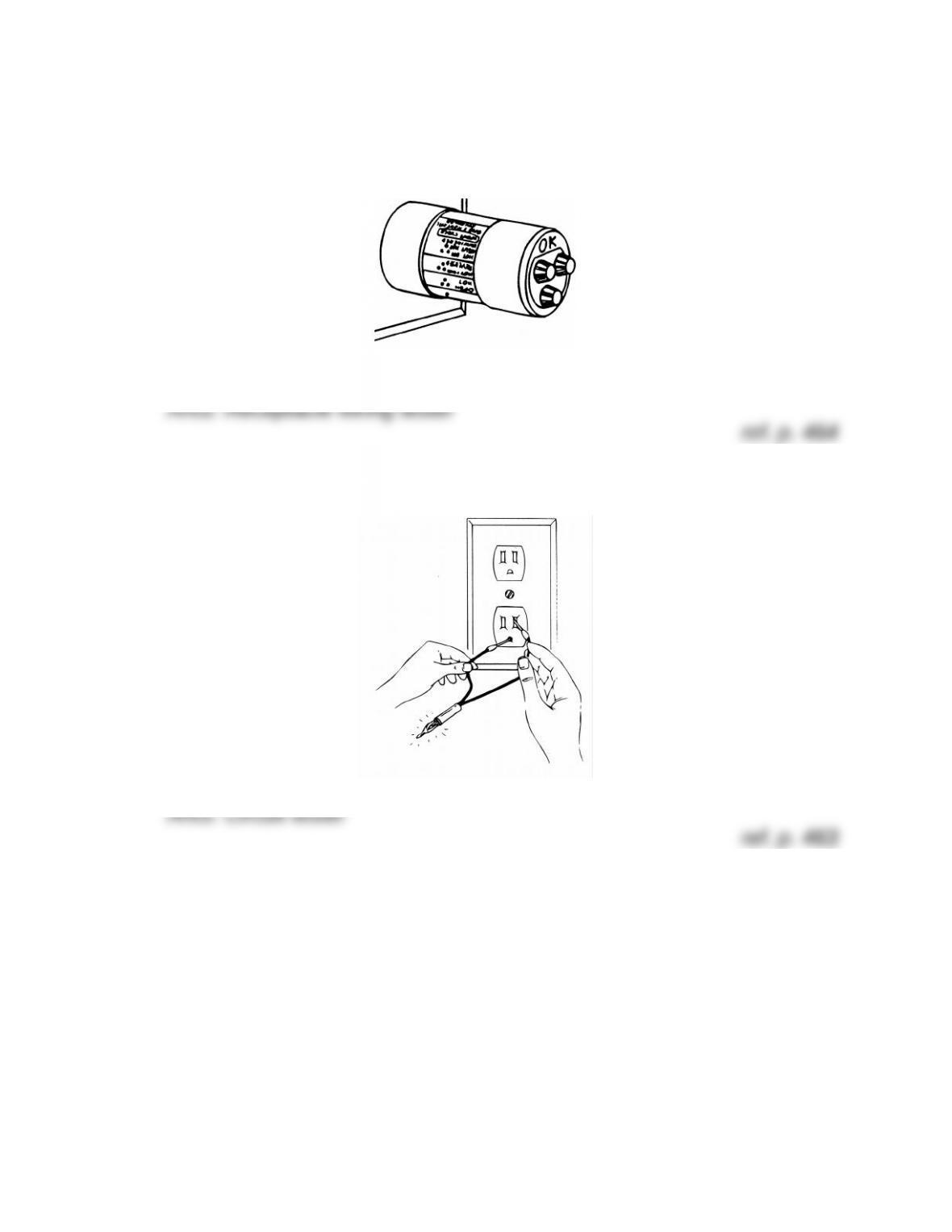
d. none of the above
ref. p. 463-465
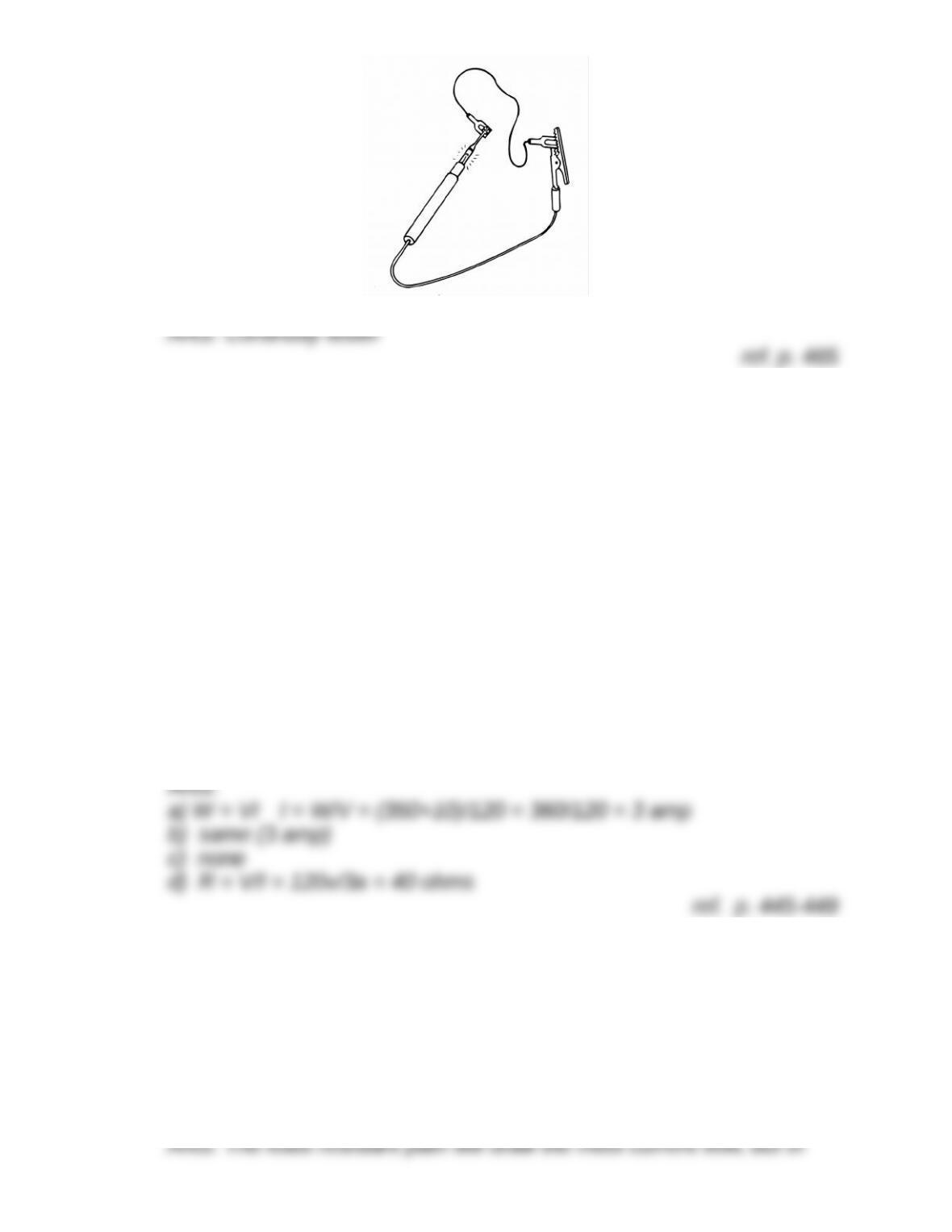
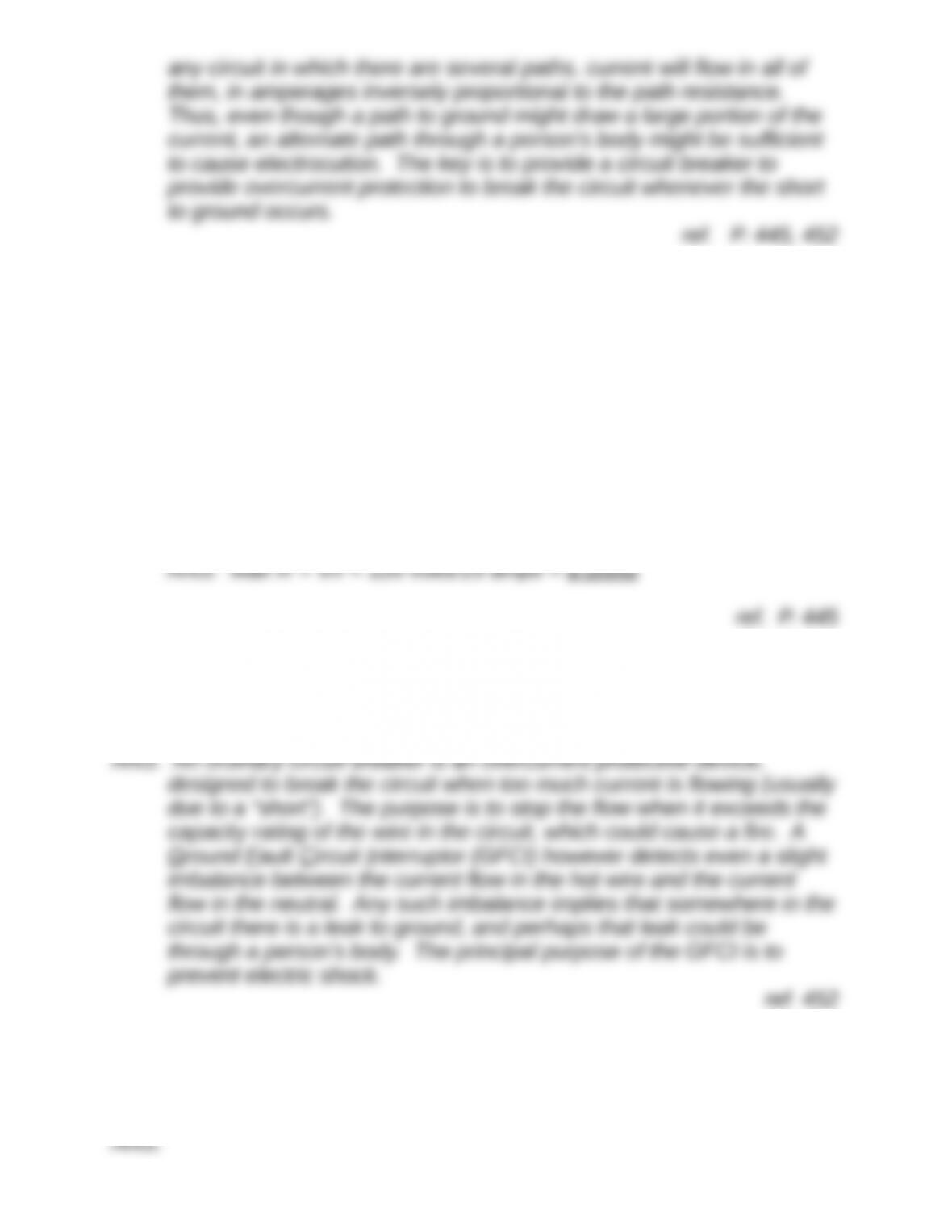
17.36. The diagram illustrates what type of tester?
17.37. The diagram illustrates what type of tester?
17.38. The diagram illustrates what type of tester?
17.39. An alternative to GFCIs on construction sites is
a. the use of anti-two blocking devices
c. double insulation on all tools
d. Underwriters Laboratories or Factory Mutual Engg approval
ref. p. 452
17.40. A typical 120-volt household circuit delivers 350 watts of power
to an appliance, and another 10 watts of power are consumed by the
circuit. There is no ground fault.
a. How much current is carried by the hot wire?
b. How much current is carried by the neutral?
c. How much current is carried by the grounding conductor?
d. Calculate the resistance of the circuit:
17.41. Explain the limitations of the phrase “electricity follows the path
of least resistance,” as it pertains to electrocution hazards.
17.42. Which of the following miswiring conditions is likely to cause a
piece of equipment to continue to operate even after it is turned off?
b. ground jumped to neutral
c. ground and neutral reversed
d. open ground
ref. p. 455
17.43. Calculate the maximum total resistance below which a 120 volt
circuit will trip a 15 amp breaker. Show your work.
17.44. Explain the difference between an ordinary circuit breaker and a
GFCI. Include in your explanation what the letters “GFCI” literally
represent.
17.45. Common modern electrical circuits have three conductors.
Identify and explain the purpose of each of the three. In your
explanation, mention safety features and explain how devices are
used to detect and deal with unsafe conditions that may arise.
1. Hot wire – this is a current-carrying conductor and connects the
source of voltage to the load.
2. Neutral wire – this is a current-carrying conductor and connects the
load back to ground to complete the circuit. (sometimes called the
groundED conductor)
3. Ground wire – this is a non-current-carrying conductor and is a
safety feature for bringing the case and other exposed parts of the
equipment to ground potential in case of a short. The short will cause
a large flow of current through the circuit, which should trip the
breaker and cause current flow to cease. (sometimes called the
groundING conductor)
Some circuits have a Ground Fault Circuit Interruptor (GFCI) that
monitors the balance of current flow between the hot and the neutral.
If an imbalance is detected between the current flows of the hot and
neutral conductors, the GFCI interrupts flow of current in the circuit.
ref. p. 451-452
17.46. Write a brief paragraph on the physiology of electric shock.
Include explanations of organs affected, electric current levels that are
dangerous, conditions that aggravate the problem, and why.
17.47. A certain string of Christmas tree lights has 100 bulbs, each
rated at 500 milliwatts. The string of lights plugs into a standard 120
volt circuit. Assume that there is no ground fault. Calculate the current
flow through the hot wire. Calculate the current flow through the
neutral.
17.48. Explain the term “fibrillation” and how it relates to the field of safety.
17.49. Show calculations to determine the power of the arc flash that would
be generated from an accidental fault in 480-volt circuit that is capable
of delivering a current of 10,000 amperes.
17.50. Electrical energy is measured in
a. amperes
b. volts
c. watts
ref. p. 462
17.51. The release of arc flash energy is measured in
a. millivolts
b. megawatts
d. volt-newtons
ref. p. 462
17.52. The release of arc flash energy is measured in all of the following
except:
b. joules
c. megajoules
d. grams of TNT
ref. p. 462
17.53. The term used to refer to the loud explosion and sudden release of
large amounts of energy in a high energy electrical discharge is
a. uncontrolled demolition
b. electrical detonation
c. megafault
17.54. Workers most exposed to arc flash are
b. refinery turnaround workers
c. OSHA inspectors
d. new hires
ref. p. 463
17.55. To determine the energy released in an arc flash the power in
megawatts is multiplied by the
a. current flow in amperes
b. voltage measured in megavolts
c. the force in newtons
ref. p. 462
17.56. Which of the following will result in the largest arc flash?
b. one pound of TNT
c. 20 cycles of power exposure
d. one gram of TNT
ref. p. 462