
CHAPTER 12 SAMPLE QUIZ QUESTIONS
12.1. What is the advantage of closed-circuit SCBA equipment over open-circuit?
12.2. Suppose an operation requires SCBA equipment but workers complain that
ordinary SCBA equipment is too heavy to be carried around on the job. What
type of SCBA equipment can be recommended that is lighter weight than
ordinary SCBA equipment?
12.3. What is the principal difference between a hose mask and an air line respirator?
12.4. Explain the chemical process (name ingredients) that generates oxygen for
closed circuit SCBA equipment.
12.5. How can a closed-circuit SCBA be more of a fire hazard than an open-circuit
type?
12.6. What alternative is permitted to qualify an air-purifying device to be approved for
a toxic substance that has no warning properties?
12.7. A respirator with an end-of-service life indicator (Type N) is approved for which
of the following air contaminants?
a. hydrogen sulfide
b. sulfur dioxide
d. phosgene
ref. p. 300

12.8. Use of personal protective equipment is preferred over the use of engineering
controls.
12.9. Providing personal protective equipment is a straightforward and simple solution
to the problem of protecting workers from hazards.
12.10. The employer is responsible for maintenance of employee-owned personal
protective equipment.
12.11. Worker comfort affects the amount of protection a worker will receive from
personal protective equipment on the job.
12.12. “Swedish wool” is effective in protecting workers from welding sparks.
12.13. The skull bone structure can transmit noise vibrations.
12.14. When “Swedish wool” becomes impregnated with wax, its effectiveness is
decreased.
12.15. A good seal is more important to the effectiveness of noise attenuators than is
the transmission properties of the attenuating material selected.

12.16. Industrial safety lenses have different specifications than street safety lenses.
12.17. If the worker asks his doctor to fit him with prescription safety lenses, he will
have no need for industrial safety glasses.
12.18. A gas mask is more effective than a cartridge respirator in an oxygen-deficient
atmosphere.
12.19. The employer is responsible for assuring proper use of employee-owned
respiratory protection equipment.
12.20. Dust masks are not approved for systemic poisons.
12.21. Dust masks are not approved for particulates.
12.22. Dust masks are frequently used improperly during hazardous welding
operations.
12.23. Dust masks are bad about leakage.

12.24. Because they are likely to leak, dust masks are not as popular as other
respirators.
12.25. The quarter mask can be approved for lead dusts.
12.26. Respirator canisters contain granular sorbents.
12.27. The gas mask has been made obsolete by modern-day self-contained breathing
apparatus and is no longer used.
12.28. The mouthpiece respirator utilizes a nose clip.
12.29. Respirator cartridges, like vacuum cleaner bags, may be changed from
manufacturer to manufacturer without affecting the approval status of the
equipment.
12.30. A questionnaire can be used as a shortcut to screen employees who may have
obvious problems with respirators.
12.31. Emergency respirators are required to be inspected monthly.

12.32. Welders may wear half-mask respirators beneath a special welding hood.
12.33. Snap-on lenses can make a full–face respirator safe for protection of a welder’s
eyes.
12.34. Court cases have confirmed the need for foot protection for dock workers on
shipping and receiving docks.
12.35. Bacterial contamination is a problem with synthetic milky white oils.
12.36. Barrier creams are generally superior to gloves for protection against contact-
irritants.
12.37. The job should not require workers to place their bare hands in trichloroethylene
to wash piece parts.
12.38. Standards require the plant First Aid station to have an emergency shower.
12.39. Which of the following is of greatest concern with a superficial respirator

program?
a. the respirators may have a short shelf life
b. most organic vapors do not have warning properties
d. cartridges are not interchangeable
ref. p. 292
12.40. The principal advantage of dust masks is
a. absorption efficiency
c. fit
d. reliability
ref. p. 293
12.41. The principal disadvantage of dust masks is
a. they cannot be re-used
b. they are not approved for systemic poisons
d. they are not approved for particulates
ref. p. 293
12.42. Which of the following is capable of being approved for toxic lead dust?
a. dust mask
b. quarter mask
c. full face mask
12.43. The unique advantage of the gas mask is
a. it is easier to clean
b. it uses changeable cartridges
d. it supplies air from a self-contained tank
ref. p. 294
12.44. Canister sorbents purify the air by all of the following except
a. adsorption
b. absorption
d. chemical reaction
ref. p. 294
12.45. The purpose of the mouthpiece respirator is
a. first aid

c. training
d. calibration
ref. p. 295
12.46. The mouthpiece respirator
a. is worn over the mouth area
b. is worn over the lips
d. none of the above
ref. p. 295
12.47. The air line respirator derives its name from
a. its use by the airlines in emergency losses of cabin pressure
b. its ability to purify air in the air line
d. the fact that not only inhaled air but also exhaled air is transported
12.48. Which of the following is not a mode of air delivery for air line respirators?
a. continuous demand
b. demand flow
c. pressure demand
d. continuous flow
ref. p. 295-296
12.49. Which of the following modes of air line respirator would be least appropriate to
be supplied from tanks?
a. continuous demand
b. demand flow
c. pressure demand
ref. p. 295
12.50. Which of the following modes of air line respirator would use the least amount of
supplied air?
a. continuous demand
c. pressure demand
d. continuous flow
ref. p. 295
12.51. Which of the following modes of air line respirator is most dependent upon fit for
its effectiveness?
a. continuous demand
c. pressure demand
d. continuous flow
ref. p. 295
12.52. Which of the following types of supplied air respirators might explode if
immersed in water?
a. pressure demand
b. sulfur dioxide reactor unit
d. demand flow
ref. p. 298
12.53. Which of the following types of respirators is best for a gas which has no
warning properties?
a. cartridge type
b. canister type
c. filter type
ref. p. 299
12.54. Pictured is
a. an open circuit SCBA
c. SCUBA apparatus
d. none of the above
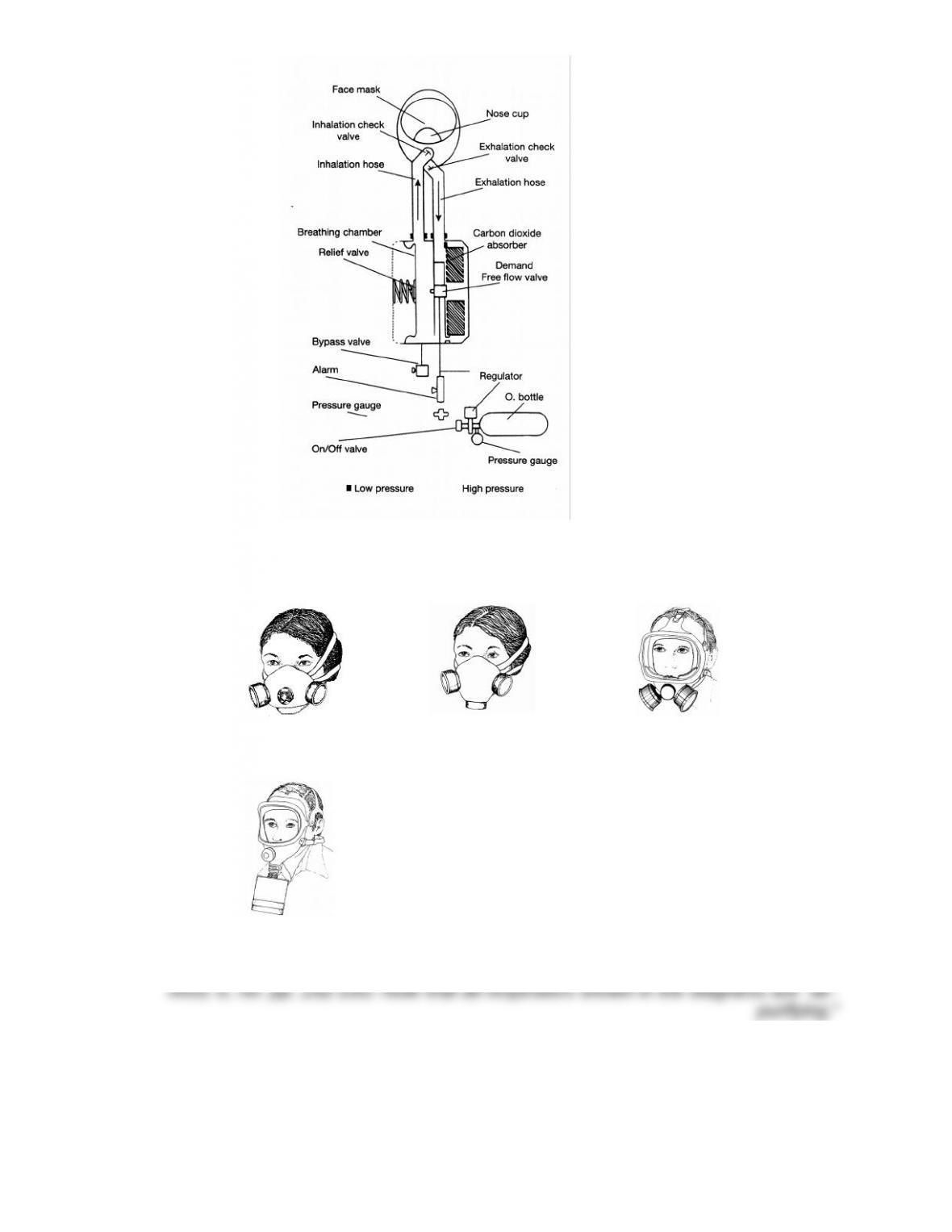
ref. p. 297
12.55. Which of the masks shown is approved for oxygen-deficiency?
(a) (b) (c)
none of these
(d) (e)

12.56. Name the three principal flow modes for the respirators.
2. Continuos flow
3. pressure demand
ref. p. 295-296
12.57. Discuss in general the characteristics of confined spaces that make them
hazardous.
1. A confined space is generally not designed for a continuos occupancy,
making the environment questionable.
2. Since the operation is temporary, the temptation is to “get in and the
get out quickly” foregoing testing the atmosphere or wearing personal
protective equipment.
It might also be mentioned that confined spaces often have
inadequate entry and exit clearance for the passage of equipment,
especially personal protective equipment. Also, the confined spaces inhibit
the dispersion of dangerous air contaminants.
ref. p. 303
12.58. Prior to 1993, what provision of the law usually used by OSHA to prosecute
employers when confined space accidents resulted in multiple fatalities?
12.59. What significant new standard, made effective in April, 1993, was directed at a
major source of multi-fatality accident?
12.60. Fill in the blanks to name two hazard mechanisms that lead to suffocation of a
worker in a confined space even when the atmosphere is not oxygen deficient
and contains no toxic contaminants.
2. Engulfment
ref. p. 304
12.61. Which of the following is associated with the most fatalities with confined space
entry?

a. engulfment
b. entrapment
d. explosion
ref. p. 304
12.62 Name at least three products recommended to positively prohibit the transfer of
dangerous materials from a tank or other source to a confined space that must
be entered.
2. Separate the line and misalign it
3. Blanking (or blinding)
ref. p. 305-306
12.63. Which of the following is required if the respirator is to be used for protection
against a substance that has no warning properties?
a. the respirator must have an end-of-service-life indicator.
b. the atmosphere must not be IDLH.
c. the respirator must not be used in confined spaces.
d. the flow mode must be demand flow.
ref. p. 300
12.64. Which of the following respirator types would be best for oxygen deficiency?
a. cartridge type
b. canister type
c. filter type
ref. p. 292-293
12.65. Describe the situation that is known to frequently result in a series of multiple
fatalities, i.e., victim, then rescuer, then rescuer of the rescuer, etc. What
standard (general name only) does OSHA cite in these situations
(a) prior to 1993 and (b) after 1993?
SITUATION:
12.66. As far as OSHA is concerned, the responsibility for maintenance of employee-
owned respiratory equipment

b. rests with the employee who owns the equipment
c. depends upon the union agreement at the plant
d. rests with OSHA
ref p. 285 & 292
12.67. Identify the term “SCBA” and explain the advantage of “closed-circuit” SCBA
versus “open-circuit” SCBA in industrial safety applications.
12.68. Explain the principle of “closed circuit” operation of SCBA units.
12.69. Which of the following is considered by OSHA to be a responsibility of the
employer?
a. Provision of personal protective equipment when needed.
b. Require employees to use personal protective equipment when needed.
c. Maintenance of personal protective equipment when needed.
d. Pay for personal protective equipment when needed.
ref. pp. 285-286
12.70. In 2007 which of the following responsibilities were added to employers’ duties
with regard to personal protective equipment?
a. Provision of personal protective equipment when needed.
b. Requirement of employees to use personal protective equipment when
needed.
c. Maintenance of personal protective equipment when needed.
d. Pay for personal protective equipment when needed.
e. All of the above.
ref. pp. 285-286
12.71. Certain personal protective equipment has been exempted from the requirement
that the employer pay for all personal protective equipment. Name these exemptions:
12.72. Which of the following personal protective equipment is exempted from the

requirement that the employer pay for the PPE?
b. Respirators
c. Ear protection devices
d. Safety harnesses and lanyards
ref. p. 286
12.73. Which of the following types of personal protective equipment is the employer
always required to pay for when needed for the job?
a. prescription safety eyewear
b. logging boots
d. all of the above
e. none of the above
ref. p. 286
12.74. Which of the following types of personal protective equipment is the employer
always required to pay for when needed for the job?
a. prescription safety eyewear
b. logging boots
d. all of the above
e. none of the above
ref. p. 286
12.75. Which of the following types of personal protective equipment is the employer
always required to pay for when needed for the job?
a. prescription safety eyewear
b. safety shoes
d. all of the above
e. none of the above
ref. p. 286
12.76. Which of the following types of personal protective equipment is the employer
always required to pay for when needed for the job?
a. hearing protective devices
b. respirators
c. fall protection harnesses and lanyards
e. none of the above
ref. p. 286
12.77. What reason was given by OSHA for requiring employers to pay for personal
protective equipment when needed?

12.78. How can a worker readily determine what protection is required of safety shoe
he or she is wearing?
12.79. Name five ways in which metalworking fluids are useful in metal machining
operations.
2. Reducing cutting temperature
3. Removing chips
4. Permitting a higher-quality cut
5. Lengthening tool life.
ref. p. 308
12.80. Name the four basic types of metalworking fluids.
2. Soluble oil
3. Semi-synthetic
4. Synthetic
ref. p. 308
12.81. Which of the following types of metalworking fluids is most often responsible for
oil folliculitis?
b. soluble oils
c. semi-synthetic oils
d. synthetic oils
ref. p. 308
12.82. Which of the following types of metalworking fluids is most often responsible for
skin infections?
b. soluble oils
c. semi-synthetic oils
d. synthetic oils
ref. p. 308