
CHAPTER 11 SAMPLE QUIZ QUESTIONS
11.1. What two physical characteristics of a liquid are principally used to determine its
flammability classification?
11.2. Which of the following physical characteristics of gasoline makes it particularly
hazardous to have basements in service stations?
b. vapor pressure
c. low flash point
d. low boiling point
ref. p. 267
11.3. What two physical characteristics of a liquid are principally used to determine its
flammability classification?
b. flashpoint and firepoint
c. boiling point and firepoint
d. volatility and boiling point
ref. p. 264
11.4. What principal physical characteristic of gasoline makes it particularly
hazardous to have basements in service stations?
11.5. What is the principal criterion for determining whether wiring for flammable paint
spray areas must be Class I Division 1 or Division 2?
11.6. The proper wiring selection for areas twenty feet or more away from flammable
paint spray booths is:
a. Class I, Division 1
b. Class I, Division 2
c. Class II, Division 1
ref. p. 276
11.7. Which of the following is best classified as a Class B explosive?
a. nitroglycerin
b. dynamite
c. black powder
ref. p. 277
11.8. Which of the following is best classified as a Class A explosive?
b. propellant
c. photographic flash powder
d. explosive rivets
ref. p. 277
11.9. Which of the following is best classified as a Class C explosive?
a. black powder
b. propellant
c. photographic flash powder
ref. p. 277
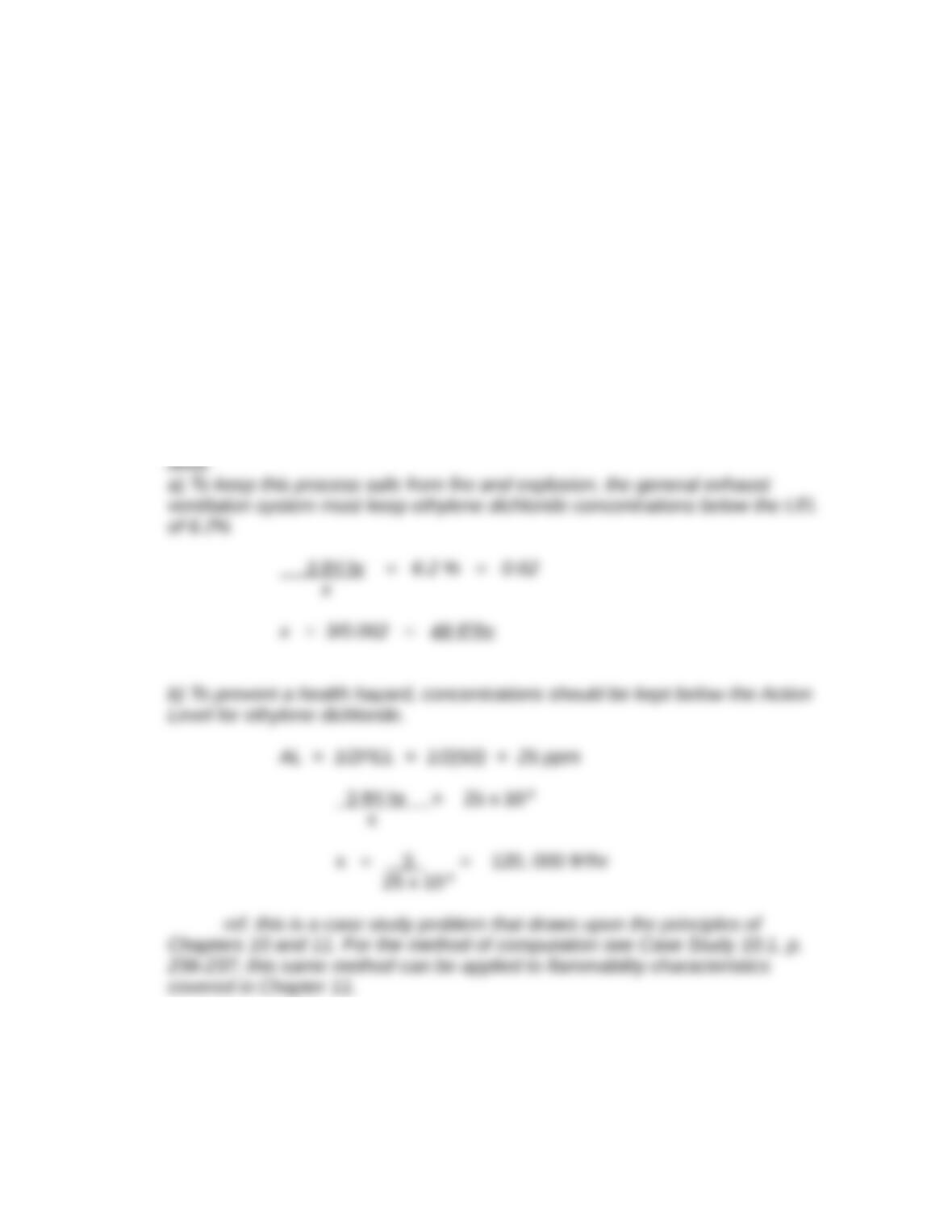
11.10. Ethylene dichloride, a soil fumigant, has the following properties:
a. LEL 6.2%
b. UEL 15.9%
c. FLASHPOINT 56 oF
d. BOILING PT 83.5 oC
e. PEL (TWA) 50 ppm
f. PEL (C) 100 ppm
g. STEL 200 PPM Duration: 5 minutes in any 3 hours
A manufacturing process liberates 3 cubic feet of ethylene dichloride per hour.
a. Calculate the minimum general exhaust ventilation required to keep the
atmosphere around this process safe from fire and explosion. State any
necessary assumptions.
b. Calculate the minimum general exhaust ventilation required to prevent
a health hazard for this process.
11.11. The definition of “liquid” by NFPA as far as flammable liquids are concerned has
little to do with vapor pressure.
11.12. Flashpoint is the temperature at which a fire on top of the liquid is sustained.
11.13. Classification of flammable liquids does not depend upon boiling point.
11.14. Volatility of a liquid bears a close relationship to the boiling point of a liquid.
11.15. All flammable liquids are Class I liquids.
11.16. All Class I liquids are flammable liquids.
11.17. All combustible liquids are Class II liquids.
11.18. All combustible liquids are Class III liquids.
11.19. All Class II liquids are combustible liquids.
11.20. Some flammable liquids are Class III liquids.
11.21. Class III B liquids are not classified by OSHA standards as “hazardous
substances.”
11.22. The ignition temperature for gasoline is higher than for paper.
11.23. An empty tank can be more dangerous than a tank full of gasoline.
11.24. Gasoline/air mixtures in which the gasoline vapors are held to less than 5% are
considered safe.
11.25. Gasoline will ignite at leaner concentrations than alcohol will.
11.26. Alcohol will ignite at richer concentrations than gasoline will.

11.27. Alcohol will ignite inside a drum more readily than gasoline will.
11.28. Fires in underground gasoline tanks burn or explode with such intensity as to
destroy much life and property around service stations.
11.29. Underground tanks of gasoline will not sustain combustion.
11.30. If space permits, the safest place to locate tanks of gasoline is outside in
overhead tanks.
11.31. Gasoline vapors are lighter than air and will therefore gradually rise and
disperse.
11.32. Natural gas is lighter than air and will therefore gradually rise and disperse.
11.33. High octane aviation gasoline is more flammable than ordinary “regular”
gasoline.
11.34. A broken light bulb can ignite vapors of flammable liquids.
11.35. Flammable liquid tank design is an engineering function and is therefore not
discussed in federal safety standards.
11.36. Floating roof tanks are more hazardous than fixed roof tanks.
11.37. When dispensing Class I liquids into plastic containers, NFPA regulations
require electrical bonding.
11.38. Filling tanks or containers generates static electricity due to the flow of the liquid.
11.39. Use of a carbon dioxide fire extinguisher can subject the user to electrical shock.
11.40. “Splash loading” generates static electricity.
11.41. A “rest area” expansion chamber in a liquid flow line permits static electricity to
bleed off.

11.42. Static electrical discharge is a source of ignition for flammable liquid vapors.
11.43. Small portable spraying apparatus not used repeatedly in the same location is
exempt from spray painting standards.
11.44. Electrical wiring inside spray booths, subject to deposits of combustible residue,
must be in rigid conduit or in boxes or fittings containing no taps, splices, or
terminal connections.
11.45. Electrical equipment of any kind is prohibited in a spray area if subject to
deposits of combustible residues.
11.46. Automatic sprinkling systems are required in paint spray areas.
11.47. If a sprinkler system is installed inside ventilation ducts for a spray area,
sprinkler heads are needed on both sides of the filter system.
11.48. Combustible residues contribute to the largest proportion of spray booth fires.
11.49. Spray residue accumulations are difficult to detect and thus do not lead to many
OSHA citations.

11.50. Pure propane has a characteristic odor.
11.51. Injury from liquid propane while opening the tank valve implies that the valve is
defective.
11.52. LPG tanks are required to have “bleed off” valves for removing condensed
moisture.
11.53. Quick action with the proper fire extinguisher is the key to control of burning
LPG.
11.54. Which of the following is not considered a flammable liquid?
a. acetone
b. gasoline
d. carbon disulfide
ref. p. 264
11.55. “Liquids” excluded by NFPA from the definition of “flammable liquid” are those
which have a vapor pressure:
a. less than 40 pounds
c. less than 100 pounds
d. more than 100 pounds
ref. p. 264
11.56. The principal basis for classification of flammable liquids is:
b. firepoint
c. volatility
d. autoignition temperature
ref. p. 264
11.57. The “TAG closed tester” derives its name from
a. the tag indicator device which is suspended in the liquid
b. the term “TEST AND GROUND”
c. the term “TEMPERATURE ABSOLUTE GAUGE”
ref. p. 264
11.58. The most frequently used test for flashpoint is the
a. Cleveland open cup test
c. Pensky-Martens closed tester method
d. BLEVE test
ref. p. 264
11.59. Which of the following is used to extinguish LPG fires?
a. dry chemical portable fire extinguishers
c. CO2
d. BLEVE units
ref. p. 280
11.60. Label the temperatures (Fahrenheit) on the axes.
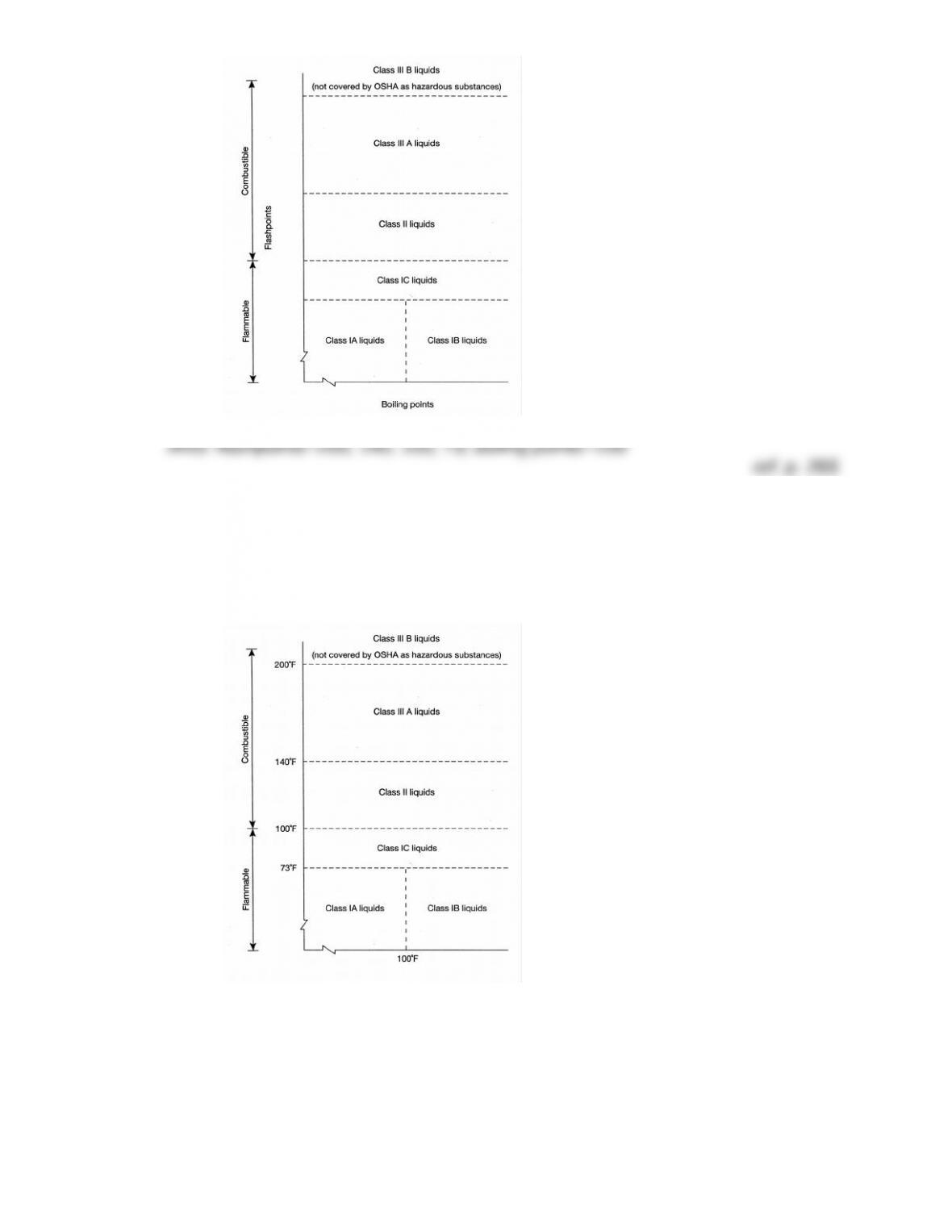
11.61. The diagram plots
a. flammability vs. combustibility
c. liquids vs. vapors
d. class vs. division
ref. p. 265
11.62. Label the axes in the diagram.
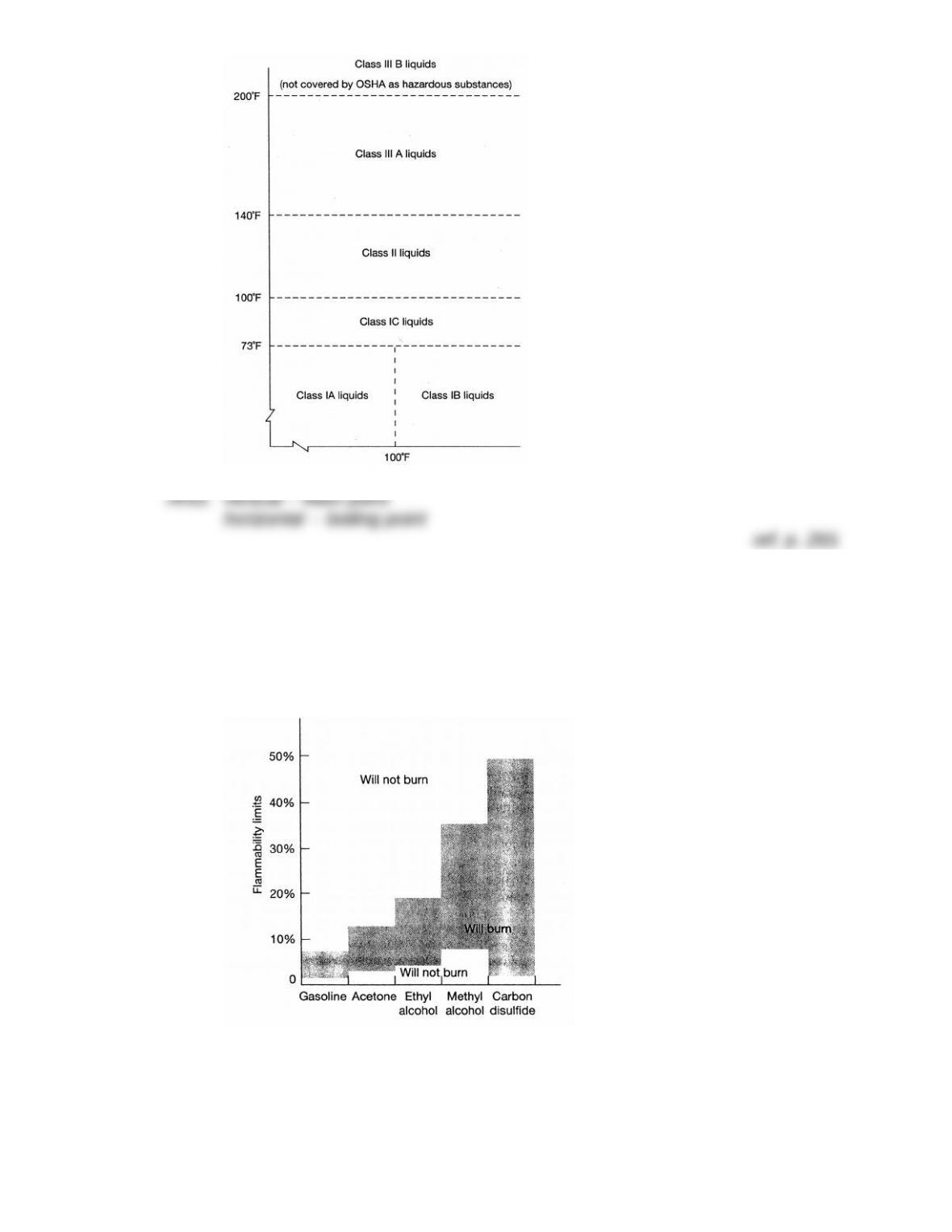
11.63. Which of the following characteristics is indicated by the diagram?
a. flash point
b. boiling point
d. none of the above
ref. p. 266-267
11.64. Which of the following parameters of flammable liquids is shown on the
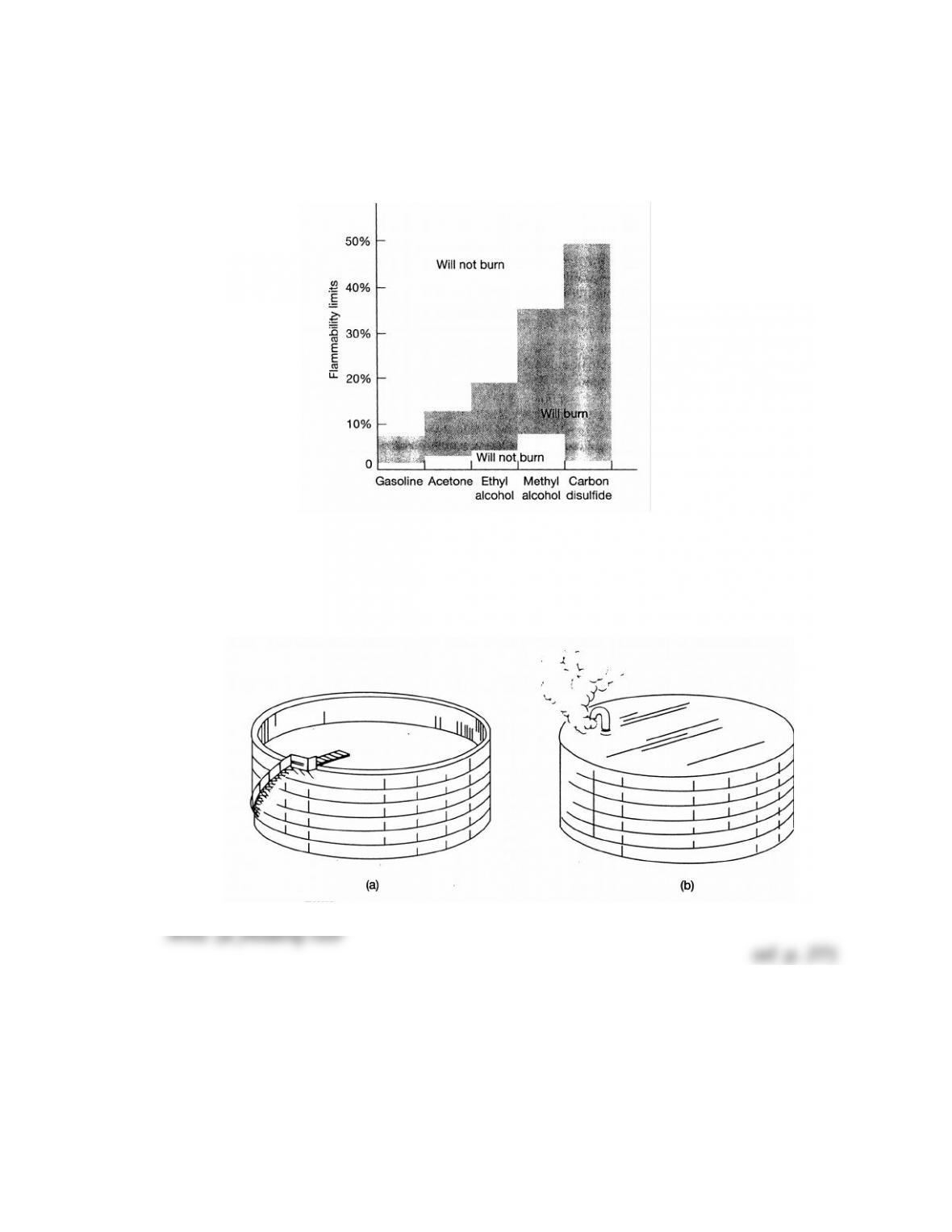
diagram?
a. flash point
b. boiling point
d. none of the above
ref. p. 266-267
11.65. The design concept illustrated in the diagram on the left is.
11.66. The purpose of the device shown (as illustrated in the text) is to
a. expand gases

b. filter particulates
c. bond containers
d. eliminate static
ref. p. 270
11.67. The concentration of flammable vapors in the air that is sufficiently rich to ignite
describes which of the following terms?
a. flash point
b. boiling point
c. LEL
d. UEL
ref. p. 267
11.68. What term describing flammable liquids refers to that concentration below which
the vapors are too lean to ignite?
11.69. What term describing liquid refers to that concentration above which the vapors
are too rich to ignite?
11.70. What term describing flammable liquids refers to that temperature below which
the liquid does not give off sufficient vapors to cause a flash at the surface of the
liquid?
11.71. What term describing flammable liquids refers to that temperature above which
the liquid gives off sufficient vapors to cause a flash at the surface of the liquid?

11.72. Define the term “flash point”.
11.73 The temperature at which a fire on the top of a flammable liquid is sustained is
called.
a. firepoint
b. flash point
c. LEL
d. UEL
ref. p. 264
11.74 The temperature above which a flammable liquid gives off vapors too rich ignite
is called
a. firepoint
b. flash point
c. LEL
d. UEL
e. none of the above
ref. p. 264 & 267
11.75 If the temperature of a liquid is too low for a fire to be sustained on the top of the
liquid, then you know that
a. the temperature is below the flash point but above the firepoint
b. the temperature is below the firepoint but above the flash point
c. the temperature is below both the flash point and the firepoint
d. the temperature is below the firepoint
e. b and d above
11.76 If the temperature of a liquid is high enough that a spark causes a flash at the
liquid, then you know that
a. the temperature is above the flashpoint
b. the liquid is flammable
c. both of the above
d. none of the above
ref. p. 264
11.77. In qualitative terms describe the relationship between flash point and
flammability and combustibility.
11.78. Which of the following characteristics is indicated by the diagram?
a. flash point
b. boiling point
c. LEL
d. none of the above
ref. p. 266-267
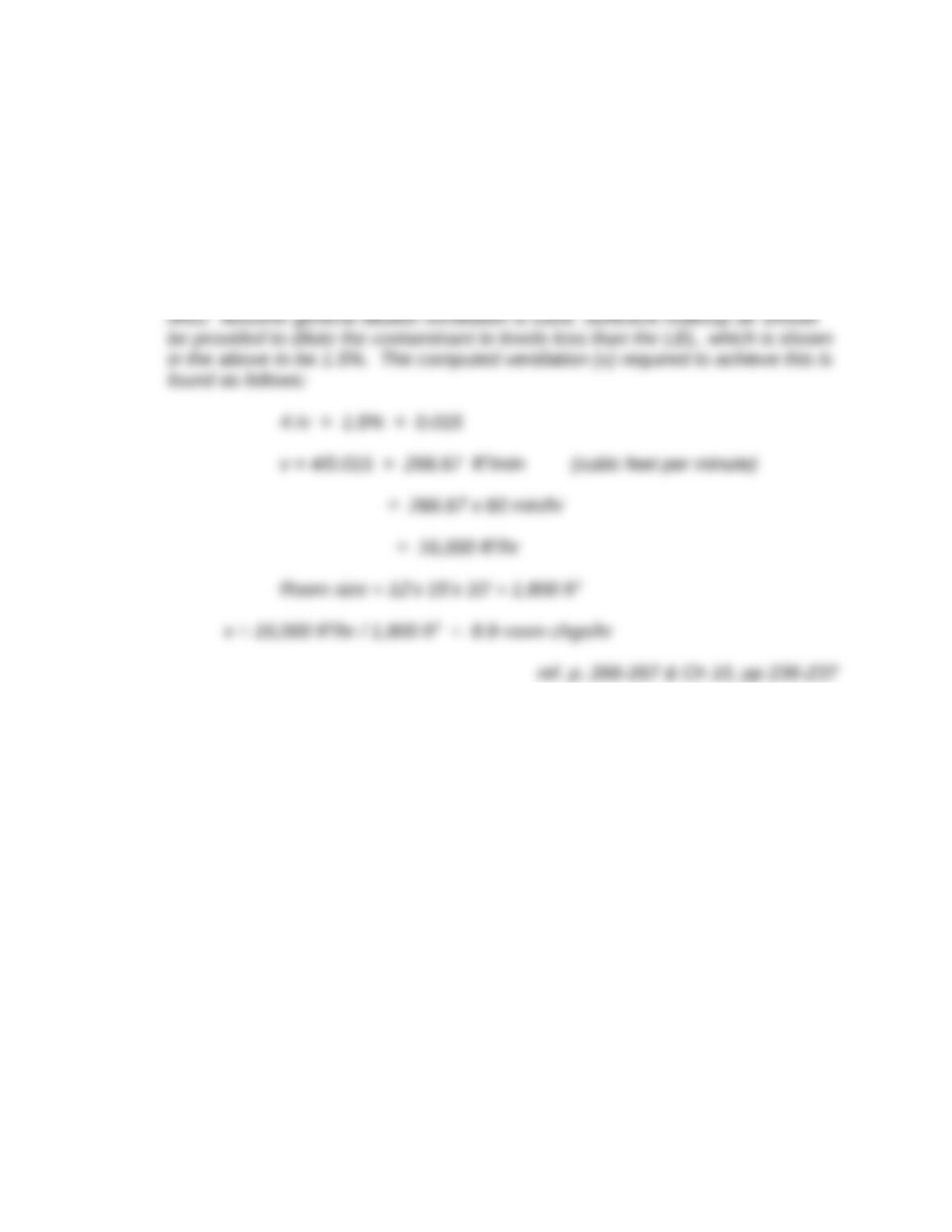
11.79. Calculate the amount of general exhaust ventilation (in room changes per hour)
needed to control (prevent explosion) a general release of gasoline vapors of 4
cubic feet per minute in a room that measures 12’x 15’x 10′. State any
necessary assumptions. Gasoline has the following characteristics:
FLASH POINT: –40OF
BOILING POINT: 36.1OC
LEL: 1.5%
UEL: 7.8%
VAPOR DENSITY: 2.48
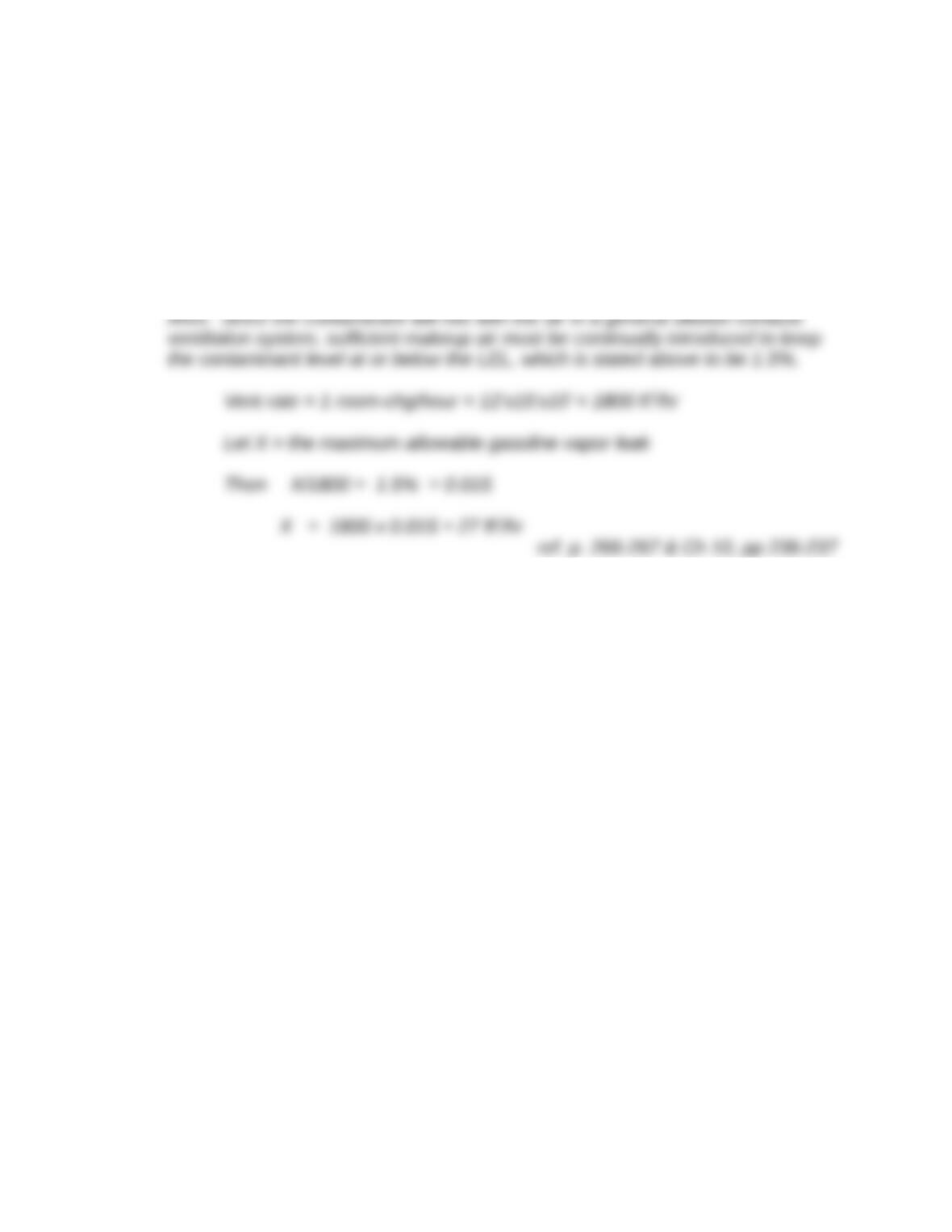
11.80. A room that measures 12’x 15’x 10′ has general dilution exhaust ventilation of 1
room change per hour to prevent explosion. Calculate the maximum tolerable
level of gasoline vapor leaking into the room atmosphere. State any necessary
assumptions. Gasoline has the following characteristics:
FLASH POINT: –40OF
BOILING POINT: 36.1OC
LEL: 1.5%
UEL: 7.8%
VAPOR DENSITY: 2.48
11.81. A glue-making process releases ethylene glycol that becomes generally diluted
and interspersed throughout the plant atmosphere. The rate of release is 2.4
cubic feet per hour vapor volume at standard plant temperature and pressure.
The plant ventilation system is of the general dilution type with make-up air
being supplied at windows and doors throughout the plant area. The plant area
is 4000 square feet and the average ceiling height is 12 feet. The problem is to
specify the capacity of the general ventilation system required to maintain a
steady state condition throughout this process area that protects against both
health and safety hazards due to ethylene glycol. For your information in
performing calculations the following data is provided:
ETHYLENE GLYCOL (CH2OHCH2OH)
Molecular weight: 62.1
Boiling point: 197.5o Celsius
LEL: 3.2%
Firepoint: -13o Celsius
Flash point: 232o Fahrenheit
Autoignition temperature: 752o Fahrenheit
Vapor Pressure: 0.05 mm @ 20o Celsius
PEL: 50 ppm (Ceiling)
(a) Calculate how much exhaust ventilation (in cubic feet per hour,
general dilution type) is required to maintain safety hazards below
explosive levels. Show your work.
(b) Calculate how much exhaust ventilation (in cubic feet per hour,
general dilution type) is required to maintain health hazards below
OSHA-specified Action Levels (AL). Show your work.
2.4/vs = 3.2% = 0.032
vs = 2.4/0.032 = 160 ft3/hr
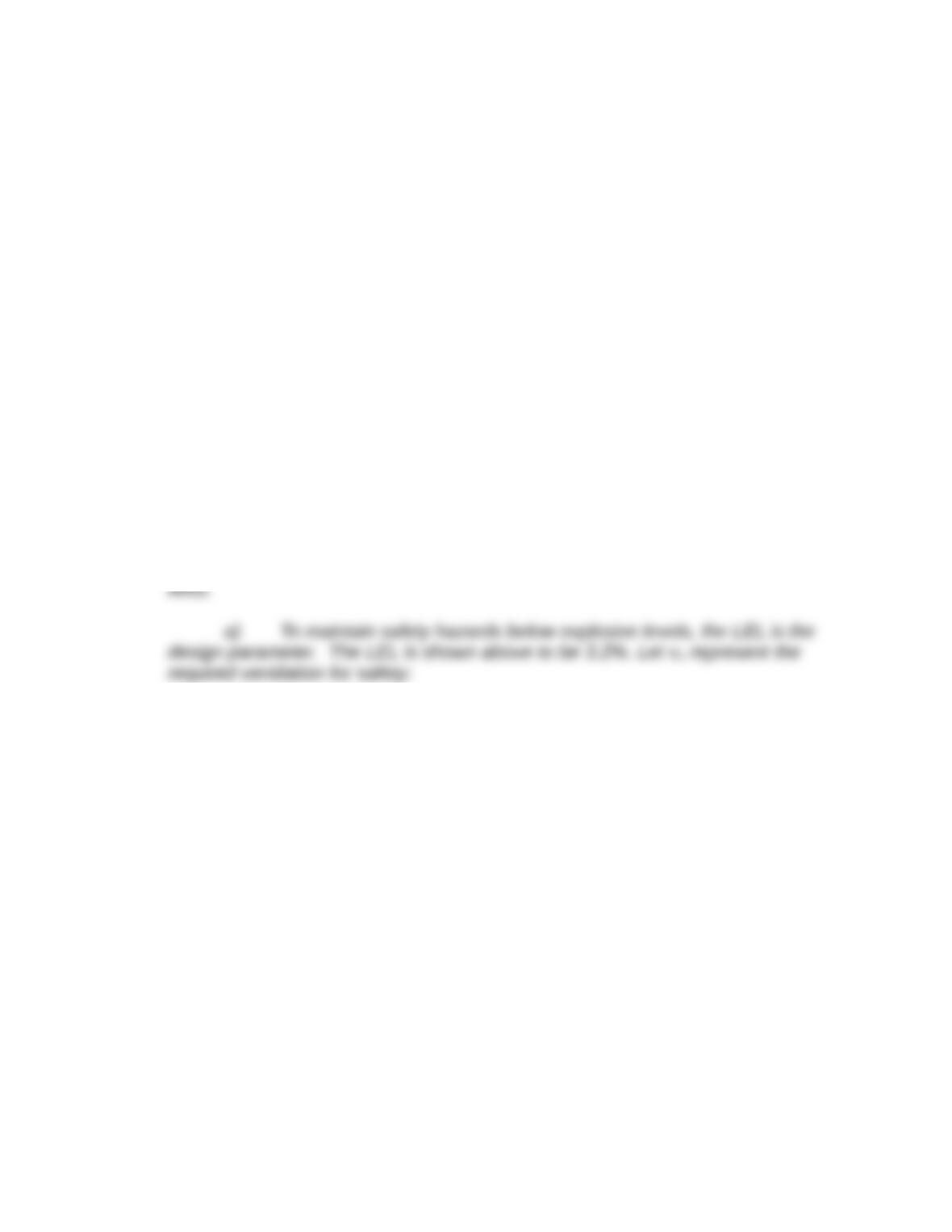
b) To maintain health hazards below acceptable levels, the PEL is the
design parameter. The PEL is shown above to be 50 ppm. Let vh represent the
required ventilation for health:
2.4/vh = 50 ppm = 0.000050
vh = 2.4/0.000050 = 48000 ft3/hr
(see continuation on next page)
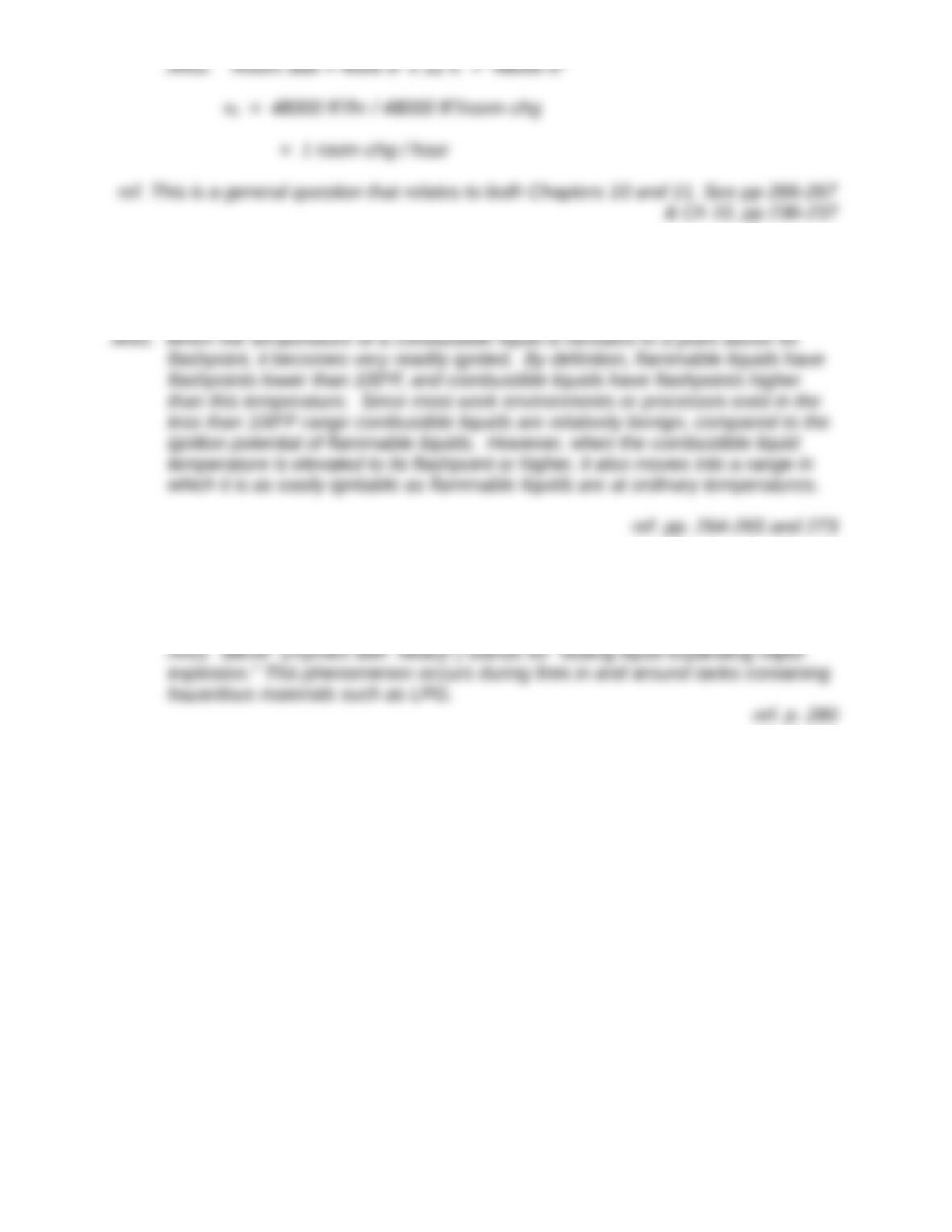
(c) Calculate how many plant area room changes per hour the
level of ventilation calculated in part (b) would represent. Show your
work.
11.82. Under certain conditions, combustible liquids become as easily ignitable as
flammable liquids at room temperature. Explain these conditions and how they
relate to flashpoint.
11.83. A common term used by safety engineers, safety managers, and emergency
personnel is “bleve”. Explain this term, what it means, and how the word is
pronounced (what it rhymes with).
11.84. Transportation of a new explosive requires prior approval and the assignment of:
a. a flashpoint
b. an emergency fire procedure
d. a CAS number
ref. p. 278
11.85. A 1000-gallon dip tank is used for hardening and termpering using a flammable
liquid. Is the dip tank required to have an automatic extinguishing facility?
a. yes
b. no
ref. p. 278
11.86. Do automatically-closing dip tank covers qualify as an appropriate means of
automatic extinguishment for dip tank fires?
a. yes
b. no
ref. p. 277
11.87. Compare the advantages of automatically closing dip tank covers with those of
other automatic extinguishing systems for dip tanks.
11.88. Which of the following characteristics of dip tanks are used to determine
whether automatic extinguishing facilities are needed?
a. capacity of the tank
b. purpose for which the tank will be used
c. liquid surface area of the tank
e. none of the above
ref. p. 278
11.89. A certain plant has two dip tanks of the same capacity. One is required by OSHA
standards to have automatic extinguishment facilities. One is used for hardening and
tempering, and the other is for general use in the application of coatings. Which one is
required to have automatic extinguishment facility?
11.90. A certain plant has two dip tanks of the same capacity. Neither tank has an open
surface area of more than four square feet. One is required by OSHA standards to have
automatic extinguishment facilities, and the other is not required to have such facilities.
From your knowledge of the OSHA requirements for dip tanks, select which of the
following capacities these tanks have:
a. 100 gallons
c. 500 gallons
d. 1000 gallons
ref. p. 278
11.91. Explain how liquid surface area affects the requirement for automatic
extinguishment facilities for dip tanks.
11.92. A frequent problem with dip tanks is keeping them covered when not in use.
What constitutes “not in use?”
11.93. Which is a better choice for liquefied petroleum gas (LPG)? Why?