Chapter 05 – What-If Analysis for Linear Programming
True / False Questions
1. An optimal solution is only optimal with respect to a particular mathematical model that
provides only a representation of the actual problem.
2. The purpose of a linear programming study is to help guide management’s final decision by
providing insights.
3. It is usually quite easy to find the needed data for a linear programming study.
4. If the optimal solution will remain the same over a wide range of values for a particular
coefficient in the objective function, then management will want to take special care to
narrow this estimate down.
5. Shadow price analysis is widely used to help management find the best trade-off between
costs and benefits for a problem.
6. When certain parameters of a model represent managerial policy decisions, what-if analysis
provides information about what the impact would be of altering these policy decisions.
Chapter 05 – What-If Analysis for Linear Programming
7. The term “allowable range for an objective function coefficient” refers to a constraint’s
right-hand side quantity.
8. The allowable range for an objective function coefficient assumes that the original
estimates for all the other coefficients are completely accurate so that this is the only one
9. A shadow price indicates how much the optimal value of the objective function will
increase per unit increase in the right-hand side of a constraint.
10. When maximizing profit in a linear programming problem, the allowable increase and
allowable decrease columns in the sensitivity report make it possible to find the range over
which the profitability does not change.
11. Changing the objective function coefficients may or may not change the optimal solution,
but it will always change the value of the objective function.
12. Every change in the value of an objective function coefficient will lead to a changed
optimal solution.
13. When a change in the value of an objective function coefficient remains within the
allowable range, the optimal solution will also remain the same.

5-3
14. According to the 100% rule for simultaneous changes in objective function coefficients, if
the sum of the percentage changes exceeds 100%, the optimal solution definitely will change.
15. Whenever proportional changes are made to all the unit profits in a problem, the optimal
solution will remain the same.
16. The term “allowable range for the right-hand-side” refers to coefficients of the objective
function.
17. If the change to a right-hand side is within the allowable range, the value of the shadow
price remains valid.
18. If the change to a right-hand side is within the allowable range, the solution will remain
the same.
19. A shadow price tells how much a decision variable can be increased or decreased without
changing the value of the solution.
20. The allowable range gives ranges of values for the objective function coefficients within
which the values of the decision variables are optimal.

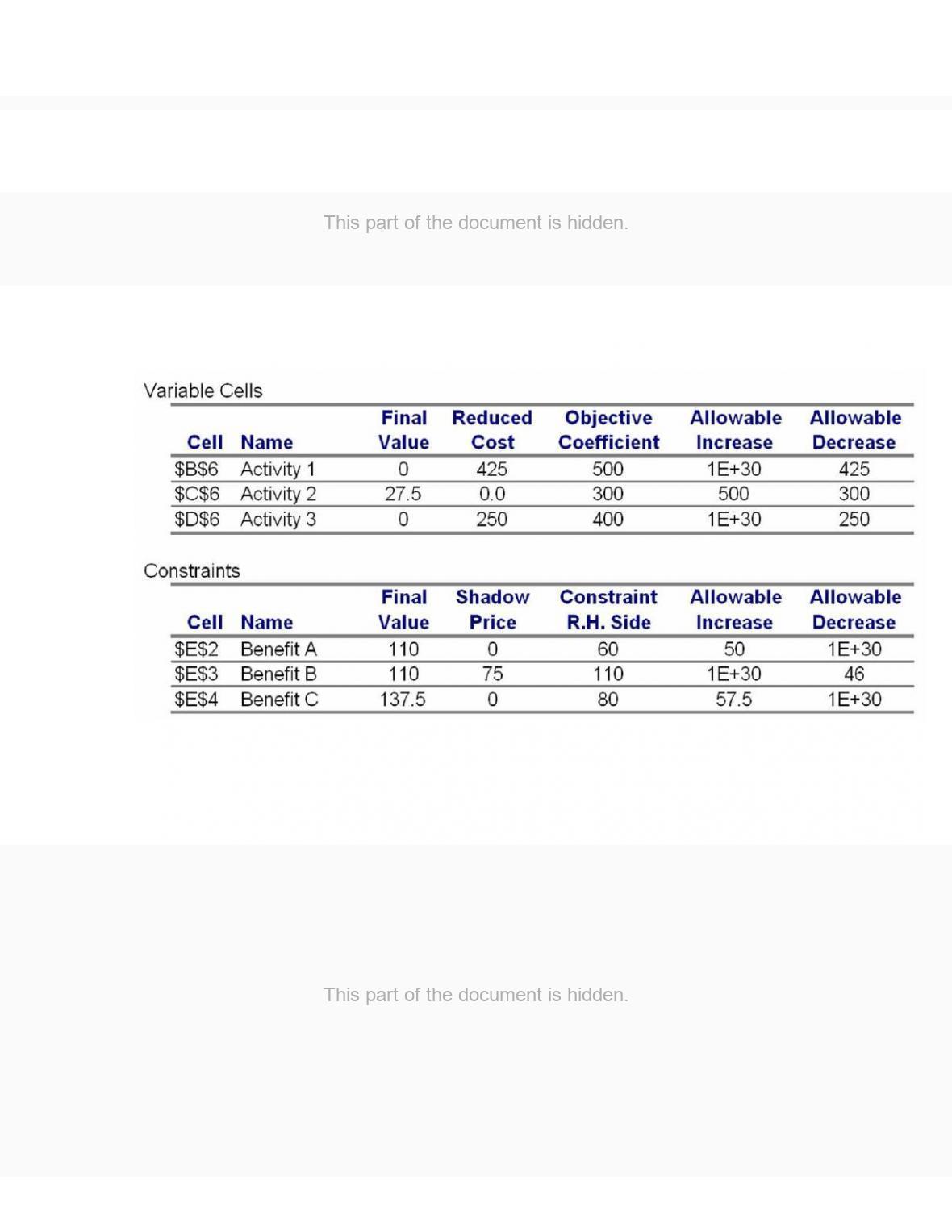
5-13
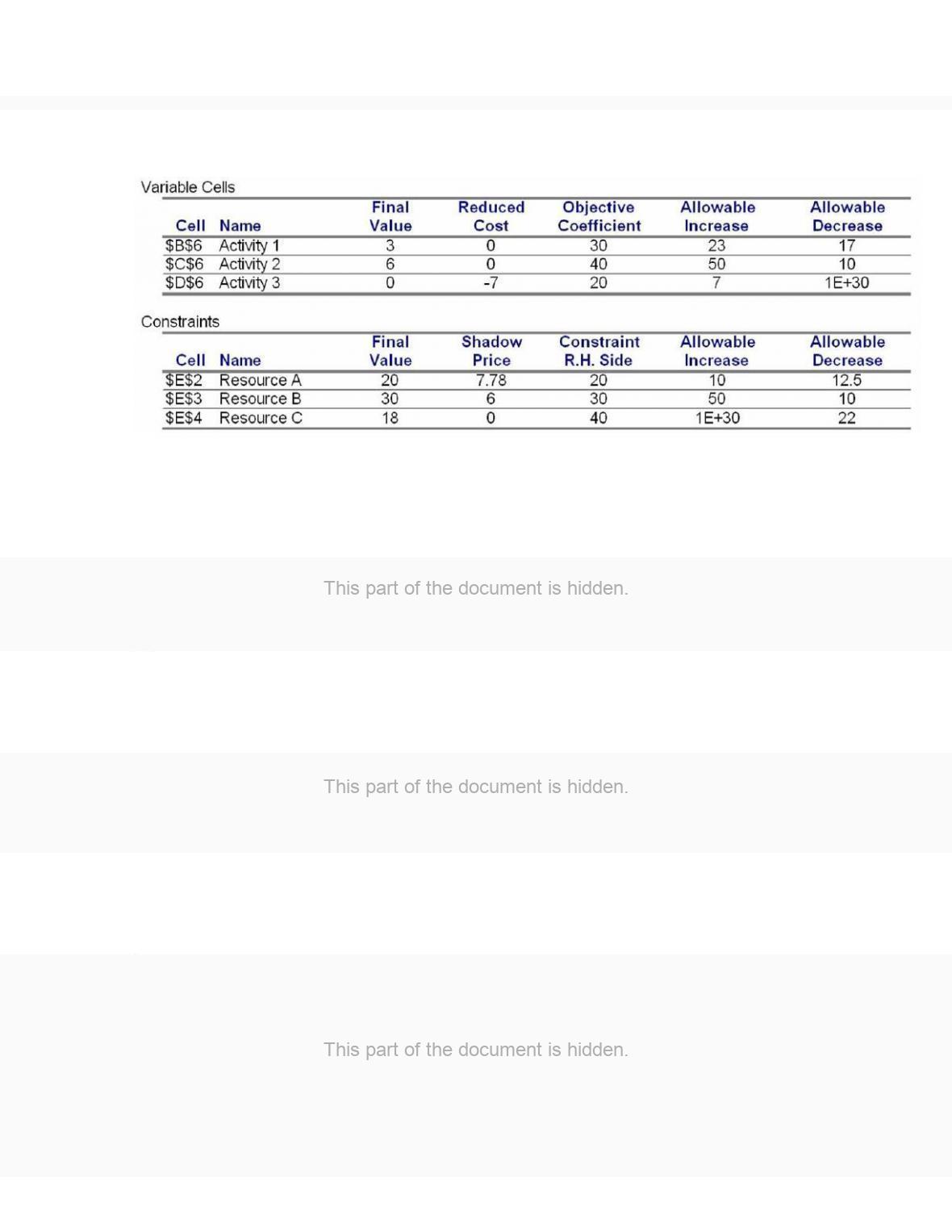
58. If the right-hand side of Resource C is increased by 40, and the right-hand side of
Resource B is decreased by 20, then:
59. Solver Table can be used to investigate the changes in how many data cells at a time?