Chapter 03 – Linear Programming: Formulation and Applications
3-1
True / False Questions
1. When formulating a linear programming model on a spreadsheet, the decisions to be made
are located in the data cells.
2. When formulating a linear programming model on a spreadsheet, the constraints are located
(in part) in the output cells.
3. When formulating a linear programming model on a spreadsheet, the measure of
performance is located in the target cell.
4. A mathematical model will be an exact representation of the real problem.
5. Approximations and simplifying assumptions generally are required to have a workable
model.
6. Linear programming does not permit fractional solutions.

Chapter 03 – Linear Programming: Formulation and Applications
3-2
7. When formulating a linear programming problem on a spreadsheet, data cells will show the
levels of activities for the decisions being made.
8. A key assumption of linear programming is that the equation for each of the output cells,
including the target cell, can be expressed as a SUMPRODUCT (or SUM) function.
9. Resource-allocation problems are linear programming problems involving the allocation of
limited resources to activities.
10. Strict inequalities (i.e., < or >) are not permitted in linear programming formulations.
11. When studying a resource-allocation problem, it is necessary to determine the contribution
per unit of each activity to the overall measure of performance.
12. It is usually quite simple to obtain estimates of parameters in a linear programming
problem.
13. The target cell is a special kind of output cell.

Chapter 03 – Linear Programming: Formulation and Applications
3-3
14. Financial planning is one of the most important areas of application for cost-benefit-
tradeoff problems.
15. A resource constraint refers to any functional constraint with a sign in a linear
programming model.
16. In the algebraic form of a resource constraint, the coefficient of each decision variable is
the resource usage per unit of the corresponding activity.
17. Cost-benefit-tradeoff problems are linear programming problems involving the allocation
of limited resources to activities.
18. For cost-benefit-tradeoff problems, minimum acceptable levels for each kind of benefit
are prescribed and the objective is to achieve all these benefits with minimum cost.
19. A benefit constraint refers to a functional constraint with a sign in a linear programming
model.
20. In most cases, the minimum acceptable level for a cost-benefit-tradeoff problem is set by
how much money is available.
FALSE

Chapter 03 – Linear Programming: Formulation and Applications
3-4
21. It is the nature of the application that determines the classification of the resulting linear
programming formulation.
22. It is the nature of the restrictions imposed on the decisions regarding the mix of activity
levels that determines the classification of the resulting linear programming formulation.
23. It is fairly common to have both resource constraints and benefit constraints in the same
formulation.
24. Choosing the best tradeoff between cost and benefits is a managerial judgement decision.
25. Having one requirement for each location is a characteristic common to all transportation
problems.
26. Fixed-requirement constraints in a linear programming model are functional constraints
that use an equal sign.
27. The capacity row in a distribution-network formulation shows the maximum number of
units than can be shipped through the network.
Chapter 03 – Linear Programming: Formulation and Applications
3-5
28. Once a linear programming problem has been formulated, it is rare to make major
adjustments to it.
29. A mixed linear programming problem will always contain some of each of the three types
of constraints in it.
30. Blending problems are a special type of mixed linear programming problems.
31. Model formulation should precede problem formulation.
32. When dealing with huge real problems, there is no such thing as the perfectly correct
linear programming model for the problem.
33. Transportation problems are concerned with distributing commodities from sources to
destinations in such a way as to minimize the total distribution cost.
34. Transportation problems always involve shipping goods from one location to another.
Chapter 03 – Linear Programming: Formulation and Applications
35. The requirements assumption states that each source has a fixed supply of units, where the
entire supply must be distributed to the destinations and that each destination has a fixed
demand for units, where the entire demand must be received from the sources.
36. A transportation problem requires a unit cost for every source-destination combination.
37. An assignment problem is a special type of transportation problem
38. Generally, assignment problems match people to an equal number of tasks at a minimum
cost.
Multiple Choice Questions
39. Which of the following are categories of linear programming problems?
40. A linear programming model contains which of the following components?
3-7
41. In linear programming formulations, it is possible to have the following types of
constraints:
42. Resource-allocation problems have the following type of constraints:
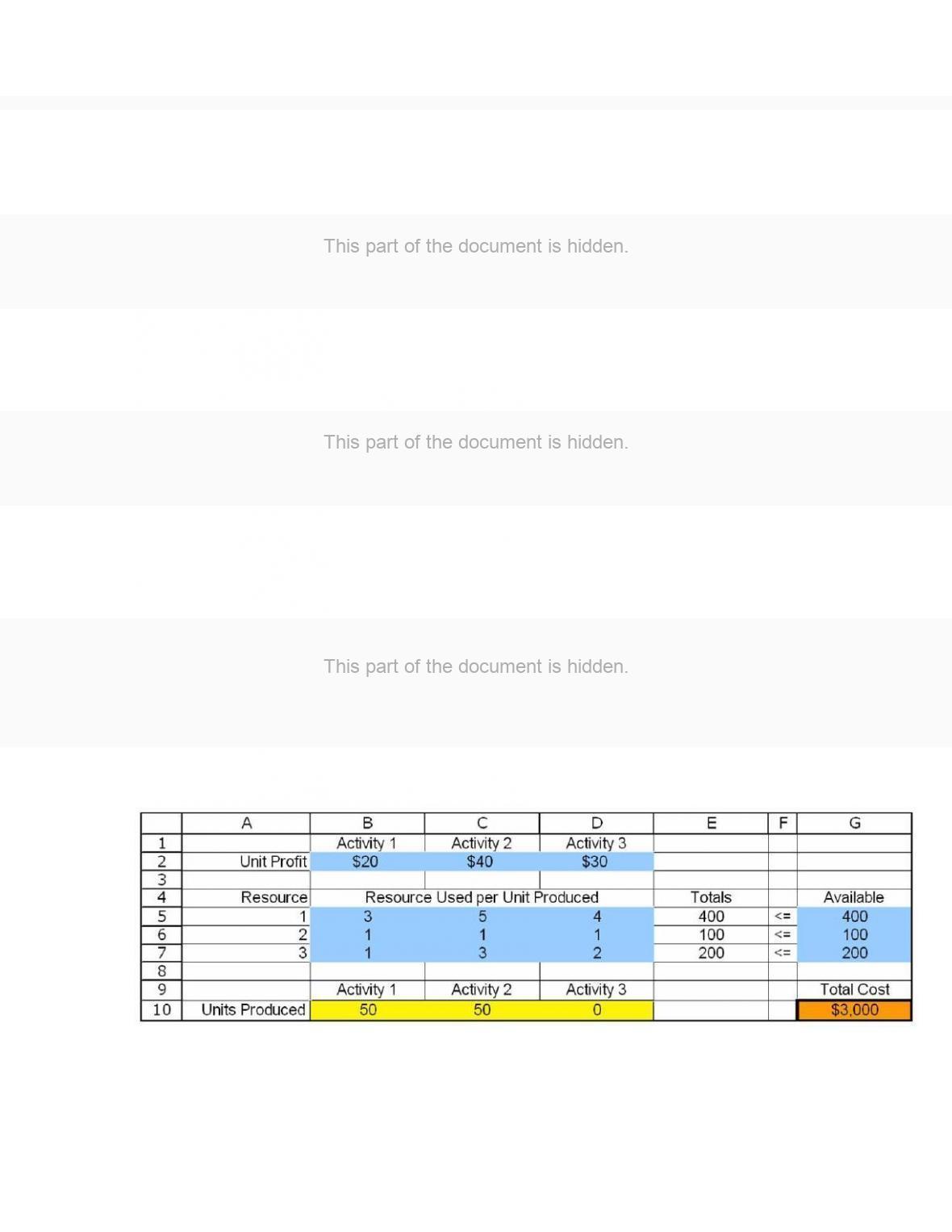
43. When formulating a linear programming problem on a spreadsheet, which of the
following is true?