Chapter 02 – Linear programming: basic concepts
True / False Questions
1. Linear programming problems may have multiple goals or objectives specified.
2. Linear programming allows a manager to find the best mix of activities to pursue and at
what levels.
3. Linear programming problems always involve either maximizing or minimizing an
objective function.
4. All linear programming models have an objective function and at least two constraints.
5. Constraints limit the alternatives available to a decision-maker.
6. When formulating a linear programming problem on a spreadsheet, the data cells will show
the optimal solution.
Chapter 02 – Linear programming: basic concepts
7. When formulating a linear programming problem on a spreadsheet, target cells will show
the levels of activities for the decisions being made.
8. When formulating a linear programming problem on a spreadsheet, the Excel equation for
each output cell can typically be expressed as a SUMPRODUCT function.
9. One of the great strengths of spreadsheets is their flexibility for dealing with a wide variety
of problems.
10. Linear programming problems can be formulated both algebraically and on spreadsheets.
11. The parameters of a model are the numbers in the data cells of a spreadsheet.
12. An example of a decision variable in a linear programming problem is profit
maximization.
13. A feasible solution is one that satisfies all the constraints of a linear programming problem
simultaneously.
14. An infeasible solution violates all of the constraints of the problem.
Chapter 02 – Linear programming: basic concepts
15. The best feasible solution is called the optimal solution.
16. Since all linear programming models must contain nonnegativity constraints, Solver will
automatically include them and it is not necessary to add them to a formulation.
17. The line forming the boundary of what is permitted by a constraint is referred to as a
parameter.
18. The origin satisfies any constraint with a sign and a positive right-hand side.
19. The feasible region only contains points that satisfy all constraints.
20. A circle would be an example of a feasible region for a linear programming problem.
21. The equation 5x + 7y = 10 is linear.
22. The equation 3xy = 9 is linear.
Chapter 02 – Linear programming: basic concepts
43. Where are the output cells located?
44. Which of the following could not be a constraint for a linear programming problem?
45. For the products A, B, C, and D, which of the following could be a linear programming
objective function?
46. After the data is collected the next step to formulating a linear programming model is to:
2-9
47. When using the graphical method, the region that satisfies all of the constraints of a linear
programming problem is called the:
48. Solving linear programming problems graphically,
49. Which objective function has the same slope as this one: 4x + 2y = 20.
50. Given the following 2 constraints, which solution is a feasible solution for a maximization
problem?
(1). 14x1 + 6x2 42
(2). x1 – x2 3
2-11
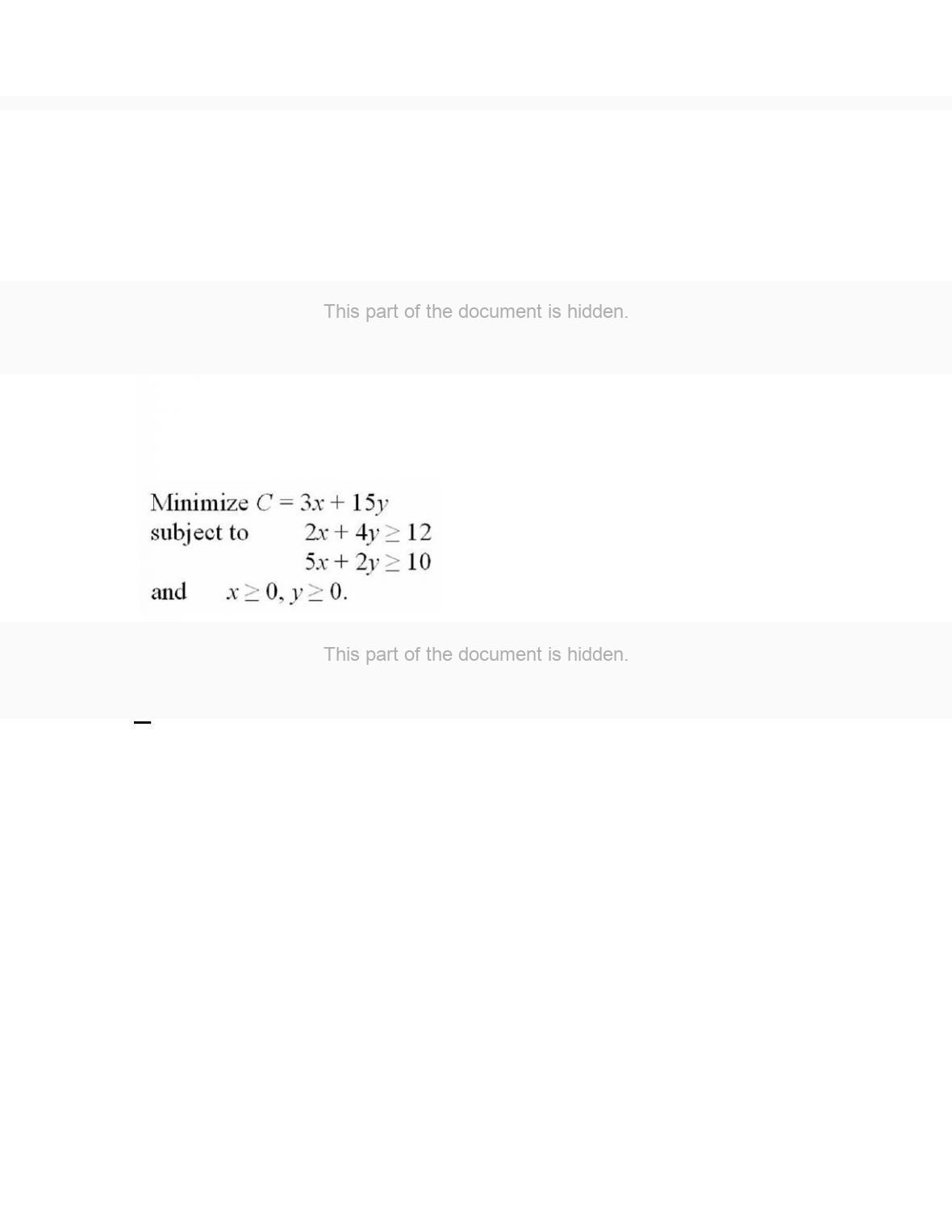
54. Given the following 2 constraints, which solution is a feasible solution for a minimization
problem?
(1). 14x1 + 6x2 42
(2). x1 + 3x2 6
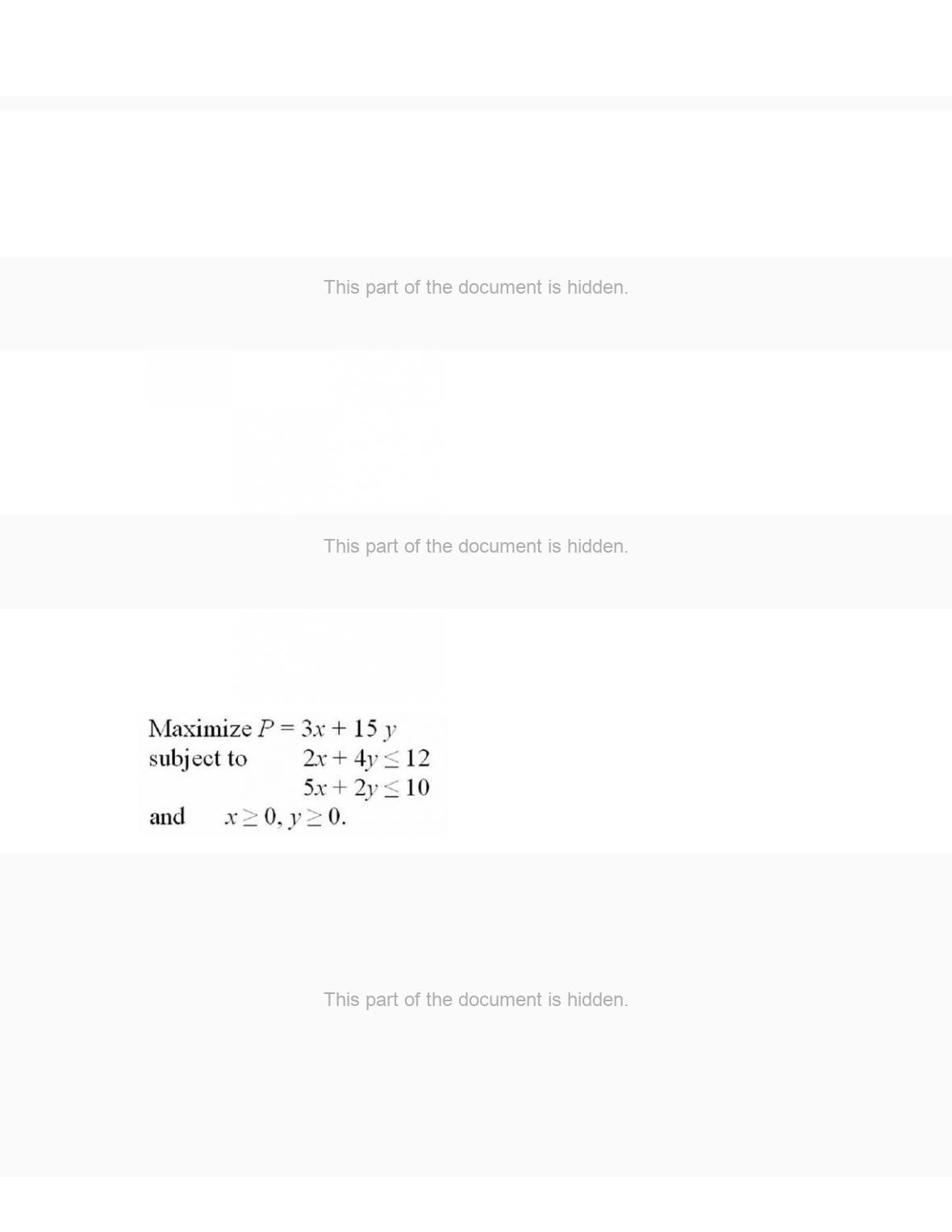
55. What is the optimal solution for the following problem?
E. (x, y) = (6, 0).
The production planner for Fine Coffees, Inc. produces two coffee blends: American (A) and
British (B). He can only get 300 pounds of Colombian beans per week and 200 pounds of
Dominican beans per week. Each pound of American blend coffee requires 12 ounces of
Colombian beans and 4 ounces of Dominican beans, while a pound of British blend coffee
uses 8 ounces of each type of bean. Profits for the American blend are $2.00 per pound, and
profits for the British blend are $1.00 per pound.
Chapter 02 – Linear programming: basic concepts
The operations manager for the Blue Moon Brewing Co. produces two beers: Lite (L) and
Dark (D). He can only get 675 gallons of malt extract per day for brewing and his brewing
hours are limited to 8 hours per day. To produce a keg of Lite beer requires 2 minutes of time
and 5 gallons of malt extract. Each keg of Dark beer needs 4 minutes of time and 3 gallons of
malt extract. Profits for Lite beer are $3.00 per keg and profits for Dark beer are $2.00 per
keg.
61. What is the objective function?
62. What is the time constraint?
63. Which of the following is not a feasible solution?
64. What is the daily profit when producing the optimal amounts?
Chapter 02 – Linear programming: basic concepts
The production planner for a private label soft drink maker is planning the production of two
soft drinks: root beer (R) and sassafras soda (S). There are at most 12 hours per day of
production time and 1500 gallons per day of carbonated water available. A case of root beer
requires 2 minutes of time and 5 gallons of water to produce, while a case of sassafras soda
requires 3 minutes of time and 5 gallons of water. Profits for the root beer are $6.00 per case,
and profits for the sassafras soda are $4.00 per case.
65. What is the objective function?
66. What is the time constraint?
67. Which of the following is not a feasible solution?
68. What is the daily profit when producing the optimal amounts?
Chapter 02 – Linear programming: basic concepts
An electronics firm produces two models of pocket calculators: the A-100 (A) and the B-200
(B). Each model uses one circuit board, of which there are only 2,500 available for this week’s
production. In addition, the company has allocated a maximum of 800 hours of assembly time
this week for producing these calculators. Each A-100 requires 15 minutes to produce while
each B-200 requires 30 minutes to produce. The firm forecasts that it could sell a maximum of
4,000 of the A-100s this week and a maximum of 1,000 B-200s. Profits for the A-100 are
$1.00 each and profits for the B-200 are $4.00 each.
69. What is the objective function?
70. What is the time constraint?
71. Which of the following is not a feasible solution?