Chapter 08 Budgetary Planning Answer Key
True / False Questions
1. Control is a forward-looking process while planning is a backward-looking one.
AICPA: BB Critical Thinking
Accessibility: Keyboard Navigation
Blooms: Remember
Difficulty: 1 Easy
Learning Objective: 08-01 Describe (a) how and why organizations use budgets for planning and control and (b) potential
behavioral issues to consider when implementing a budget.
Topic: Planning and control cycle
2. The budget translates a company’s objectives into financial terms.
AICPA: BB Critical Thinking
Accessibility: Keyboard Navigation
Blooms: Remember
Difficulty: 1 Easy
Learning Objective: 08-01 Describe (a) how and why organizations use budgets for planning and control and (b) potential
behavioral issues to consider when implementing a budget.
Topic: Planning and control cycle
3. An advantage of budgeting is that it provides a benchmark for evaluating performance.
AICPA: BB Critical Thinking
Accessibility: Keyboard Navigation
Blooms: Remember
Difficulty: 1 Easy
Learning Objective: 08-01 Describe (a) how and why organizations use budgets for planning and control and (b) potential
behavioral issues to consider when implementing a budget.
Topic: Benefits of budgeting
8-1
Copyright © 2017 McGraw-Hill Education. All rights reserved. No reproduction or distribution without the prior written consent of
McGraw-Hill Education.
4. One advantage of participative budgeting is managers can build in budgetary slack.
AICPA: BB Critical Thinking
Accessibility: Keyboard Navigation
Blooms: Remember
Difficulty: 1 Easy
Learning Objective: 08-01 Describe (a) how and why organizations use budgets for planning and control and (b) potential
behavioral issues to consider when implementing a budget.
Topic: Behavioral effects of budgets
5. Participative budgeting allows employees throughout the organization to have input into the
budget-setting process.
AICPA: BB Critical Thinking
Accessibility: Keyboard Navigation
Blooms: Remember
Difficulty: 1 Easy
Learning Objective: 08-01 Describe (a) how and why organizations use budgets for planning and control and (b) potential
behavioral issues to consider when implementing a budget.
Topic: Behavioral effects of budgets
6. Participative budgeting is more likely to motivate people to work toward the organization’s
goals than is a top-down approach.
AICPA: BB Critical Thinking
Accessibility: Keyboard Navigation
Blooms: Understand
Difficulty: 2 Medium
Learning Objective: 08-01 Describe (a) how and why organizations use budgets for planning and control and (b) potential
behavioral issues to consider when implementing a budget.
Topic: Behavioral effects of budgets
8-2
Copyright © 2017 McGraw-Hill Education. All rights reserved. No reproduction or distribution without the prior written consent of
McGraw-Hill Education.
7. Operating budgets focus on the financial resources needed to support operations.
AICPA: BB Critical Thinking
Accessibility: Keyboard Navigation
Blooms: Remember
Difficulty: 1 Easy
Learning Objective: 08-02 Describe the major components of the master budget and their interrelationships.
Topic: Components of the master budget
8. The production budget must be prepared before the sales budget can be prepared.
AICPA: BB Critical Thinking
Accessibility: Keyboard Navigation
Blooms: Remember
Difficulty: 1 Easy
Learning Objective: 08-02 Describe the major components of the master budget and their interrelationships.
Topic: Components of the master budget
9. Preparing the sales budget includes calculating the revenues to be earned from units sold in
addition to the number of units to be sold.
AICPA: FN Measurement
Accessibility: Keyboard Navigation
Blooms: Remember
Difficulty: 1 Easy
Learning Objective: 08-03a Prepare the following components of the operating budget: Sales budget.
Topic: Sales budget
10. If a company produces and sells goods to order, the sales budget and production budget are
identical.
AICPA: FN Measurement
8-3
Copyright © 2017 McGraw-Hill Education. All rights reserved. No reproduction or distribution without the prior written consent of
McGraw-Hill Education.
Accessibility: Keyboard Navigation
Blooms: Understand
Difficulty: 2 Medium
Learning Objective: 08-03b Prepare the following components of the operating budget: Production budget.
Topic: Production budget
11. Manufacturing firms prepare a separate raw materials purchases budget for each material
used in production.
AICPA: BB Critical Thinking
Accessibility: Keyboard Navigation
Blooms: Remember
Difficulty: 1 Easy
Learning Objective: 08-03c Prepare the following components of the operating budget: Raw materials purchases budget.
Topic: Raw materials purchases budget
12. The direct labor budget is based on budgeted sales levels.
AICPA: BB Critical Thinking
Accessibility: Keyboard Navigation
Blooms: Remember
Difficulty: 1 Easy
Learning Objective: 08-03d Prepare the following components of the operating budget: Direct labor budget.
Topic: Direct labor budget
13. Budgeted manufacturing overhead includes indirect manufacturing costs, but not selling or
administrative costs.
AICPA: BB Critical Thinking
Accessibility: Keyboard Navigation
Blooms: Remember
Difficulty: 1 Easy
Learning Objective: 08-03e Prepare the following components of the operating budget: Manufacturing overhead budget.
Topic: Manufacturing overhead budget
8-4
Copyright © 2017 McGraw-Hill Education. All rights reserved. No reproduction or distribution without the prior written consent of
McGraw-Hill Education.
14. The selling and administrative expense budget is based on the production budget.
AICPA: BB Critical Thinking
Accessibility: Keyboard Navigation
Blooms: Remember
Difficulty: 1 Easy
Learning Objective: 08-03g Prepare the following components of the operating budget: Selling and administrative expense
budget.
Topic: Selling and administrative expense budget
15. Budgeted cash collections are based on the sales budget.
AICPA: BB Critical Thinking
Accessibility: Keyboard Navigation
Blooms: Remember
Difficulty: 1 Easy
Learning Objective: 08-04 Prepare the cash budget and describe the relationships among the operating budgets, cash budget,
and budgeted balance sheet.
Topic: Budgeted cash receipts
Multiple Choice Questions
16. Which of the following is the forward-looking phase of the planning and control cycle?
B. Directing/Leading
C. Organizing
D. Control
AICPA: BB Critical Thinking
Accessibility: Keyboard Navigation
Blooms: Remember
Difficulty: 1 Easy
Learning Objective: 08-01 Describe (a) how and why organizations use budgets for planning and control and (b) potential
behavioral issues to consider when implementing a budget.
Topic: Planning and control cycle
8-5
Copyright © 2017 McGraw-Hill Education. All rights reserved. No reproduction or distribution without the prior written consent of
McGraw-Hill Education.
17. Creating a budget is an important part of which phase of the planning and control process?
B. Controlling
C. Implementing
D. Executing
AICPA: BB Critical Thinking
Accessibility: Keyboard Navigation
Blooms: Remember
Difficulty: 1 Easy
Learning Objective: 08-01 Describe (a) how and why organizations use budgets for planning and control and (b) potential
behavioral issues to consider when implementing a budget.
Topic: Planning and control cycle
18. A short-term objective is:
A. a specific action managers use to reach their long-term goals.
B. a specific tactic put in place to support the strategic plan.
term goals.
D. a specific component of the budgeted income statement.
AICPA: BB Critical Thinking
Accessibility: Keyboard Navigation
Blooms: Remember
Difficulty: 1 Easy
Learning Objective: 08-01 Describe (a) how and why organizations use budgets for planning and control and (b) potential
behavioral issues to consider when implementing a budget.
Topic: Planning and control cycle
8-6
Copyright © 2017 McGraw-Hill Education. All rights reserved. No reproduction or distribution without the prior written consent of
McGraw-Hill Education.
19. Which of the following statements is true about the strategic plan?
term.
B. It is created by employees of a company and shared with management for execution.
C. It is management’s vision of individual professional development goals over the long term.
D. It is created as a thought exercise for long-term planning purposes, but it does not relate to
AICPA: BB Critical Thinking
Accessibility: Keyboard Navigation
Blooms: Remember
Difficulty: 1 Easy
Learning Objective: 08-01 Describe (a) how and why organizations use budgets for planning and control and (b) potential
behavioral issues to consider when implementing a budget.
Topic: Planning and control cycle
20. A detailed plan that translates the company’s objectives into financial terms, identifying the
resources and expenditures that will be required over the planning horizon is a:
A. Strategic plan
C. Tactic
D. Long-term objective
AICPA: BB Critical Thinking
Accessibility: Keyboard Navigation
Blooms: Remember
Difficulty: 1 Easy
Learning Objective: 08-01 Describe (a) how and why organizations use budgets for planning and control and (b) potential
behavioral issues to consider when implementing a budget.
Topic: Planning and control cycle
8-7
Copyright © 2017 McGraw-Hill Education. All rights reserved. No reproduction or distribution without the prior written consent of
McGraw-Hill Education.
21. Which of the following is the backward-looking phase of the planning and control cycle?
A. Planning
B. Implementing
C. Executing
AICPA: BB Critical Thinking
Accessibility: Keyboard Navigation
Blooms: Remember
Difficulty: 1 Easy
Learning Objective: 08-01 Describe (a) how and why organizations use budgets for planning and control and (b) potential
behavioral issues to consider when implementing a budget.
Topic: Planning and control cycle
22. ____________ are the specific actions managers use to achieve their goals.
A. Strategic plans
B. Long-term objectives
C. Short-term objectives
AICPA: BB Critical Thinking
Accessibility: Keyboard Navigation
Blooms: Remember
Difficulty: 1 Easy
Learning Objective: 08-01 Describe (a) how and why organizations use budgets for planning and control and (b) potential
behavioral issues to consider when implementing a budget.
Topic: Planning and control cycle
23. _____________ are the specific goals that managers want to achieve over a 5- to 10-year
horizon.
A. Strategic plans
C. Short-term objectives
D. Tactics
A long-term objective is a specific goal that managers want to achieve over a five- to ten-year
period (i.e., longer than one year).
AICPA: BB Critical Thinking
Accessibility: Keyboard Navigation
8-8
Copyright © 2017 McGraw-Hill Education. All rights reserved. No reproduction or distribution without the prior written consent of
McGraw-Hill Education.
Blooms: Remember
Difficulty: 1 Easy
Learning Objective: 08-01 Describe (a) how and why organizations use budgets for planning and control and (b) potential
behavioral issues to consider when implementing a budget.
Topic: The planning and control cycle
24. A _____________ is the vision of what management wants the organization to achieve over
the long term.
B. Long-term objective
C. Short-term objective
D. Tactic
AICPA: BB Critical Thinking
Accessibility: Keyboard Navigation
Blooms: Remember
Difficulty: 1 Easy
Learning Objective: 08-01 Describe (a) how and why organizations use budgets for planning and control and (b) potential
behavioral issues to consider when implementing a budget.
Topic: Planning and control cycle
25. Which of the following terms is generally not used to describe the forward-oriented nature of
the budgeting process?
A. Predicted
B. Estimated
D. Expected
AICPA: BB Critical Thinking
Accessibility: Keyboard Navigation
Blooms: Remember
Difficulty: 1 Easy
Learning Objective: 08-01 Describe (a) how and why organizations use budgets for planning and control and (b) potential
behavioral issues to consider when implementing a budget.
Topic: Planning and control cycle
8-9
Copyright © 2017 McGraw-Hill Education. All rights reserved. No reproduction or distribution without the prior written consent of
McGraw-Hill Education.
26. Which of the following is not a benefit of budgeting?
A. It forces managers to look to the future.
B. It plays an important role in communication within the organization.
C. It serves an important role in motivating and rewarding employees.
AICPA: BB Critical Thinking
Accessibility: Keyboard Navigation
Blooms: Remember
Difficulty: 1 Easy
Learning Objective: 08-01 Describe (a) how and why organizations use budgets for planning and control and (b) potential
behavioral issues to consider when implementing a budget.
Topic: Benefits of budgeting
27. Top-down budgeting is:
A. when the local managers impose a budget on the top management.
C. when customers impose a budget on top management of the company.
D. when top management imposes a budget on the board of directors.
AICPA: BB Critical Thinking
Accessibility: Keyboard Navigation
Blooms: Remember
Difficulty: 1 Easy
Learning Objective: 08-01 Describe (a) how and why organizations use budgets for planning and control and (b) potential
behavioral issues to consider when implementing a budget.
Topic: Behavioral effects of budgets
28. A top-down approach to budgeting is one that is:
A. participative.
B. motivational.
C. imposed.
AICPA: BB Critical Thinking
Accessibility: Keyboard Navigation
Blooms: Remember
8-10
Copyright © 2017 McGraw-Hill Education. All rights reserved. No reproduction or distribution without the prior written consent of
McGraw-Hill Education.
Difficulty: 1 Easy
Learning Objective: 08-01 Describe (a) how and why organizations use budgets for planning and control and (b) potential
behavioral issues to consider when implementing a budget.
Topic: Behavioral effects of budgets
29. Participative budgeting is an approach to budgeting that:
A. is top-down in nature.
B. allows top management to set the budget.
C. discourages budget slack.
AICPA: BB Critical Thinking
Accessibility: Keyboard Navigation
Blooms: Remember
Difficulty: 1 Easy
Learning Objective: 08-01 Describe (a) how and why organizations use budgets for planning and control and (b) potential
behavioral issues to consider when implementing a budget.
Topic: Behavioral effects of budgets
30. From a managerial perspective, which budget is most likely to motivate people to succeed in
executing it?
B. A budget that is easy to achieve, because it inspires confidence.
C. A budget that is difficult to achieve, because it encourages people to aim high.
D. A budget that is tight, and nearly impossible to achieve, because it creates camaraderie
and an “us versus them” mentality.
Budgets that are tight but attainable are more likely to motivate people than budgets that are
either too easy or too difficult to achieve.
AICPA: BB Critical Thinking
Accessibility: Keyboard Navigation
Blooms: Understand
Difficulty: 2 Medium
Learning Objective: 08-01 Describe (a) how and why organizations use budgets for planning and control and (b) potential
behavioral issues to consider when implementing a budget.
Topic: Behavioral effects of budgets
8-11
Copyright © 2017 McGraw-Hill Education. All rights reserved. No reproduction or distribution without the prior written consent of
McGraw-Hill Education.
31. Which of the following is correct about budgetary slack?
will be met.
B. Managers may include budgetary slack by overstating budgeted sales figures.
C. Managers may include budgetary slack by understating budgeted expense figures.
D. Budgetary slack helps managers make responsible spending decisions since it removes
AICPA: BB Critical Thinking
Accessibility: Keyboard Navigation
Blooms: Understand
Difficulty: 2 Medium
Learning Objective: 08-01 Describe (a) how and why organizations use budgets for planning and control and (b) potential
behavioral issues to consider when implementing a budget.
Topic: Behavioral effects of budgets
32. Which of the following is not a way to reduce the dysfunctional behaviors associated with
budgeting?
B. Use different budgets for planning and for performance evaluation.
C. Use a continuous or rolling budget approach.
D. Use a zero-based budgeting approach.
AICPA: BB Critical Thinking
Accessibility: Keyboard Navigation
Blooms: Remember
Difficulty: 1 Easy
Learning Objective: 08-01 Describe (a) how and why organizations use budgets for planning and control and (b) potential
behavioral issues to consider when implementing a budget.
Topic: Behavioral effects of budgets
8-12
Copyright © 2017 McGraw-Hill Education. All rights reserved. No reproduction or distribution without the prior written consent of
McGraw-Hill Education.

33. Which of the following statements about employee motivation is true?
A. A budget that is too easy to achieve is more likely to motivate than a budget that is too
difficult or that is tight but attainable.
B. A budget that is too difficult to achieve is more likely to motivate than a budget that is too
easy or that is tight but attainable.
or too difficult to achieve.
D. Budgets are difficult to use for motivation.
Research suggests that budgets that are tight but attainable are more likely to motivate people
than budgets that are either too easy or too difficult to achieve.
AICPA: BB Critical Thinking
Accessibility: Keyboard Navigation
Blooms: Understand
Difficulty: 2 Medium
Learning Objective: 08-01 Describe (a) how and why organizations use budgets for planning and control and (b) potential
behavioral issues to consider when implementing a budget.
Topic: Behavioral effects of budgets
34. How might the budgeting process be used ethically within an organization?
A. A sales manager defers sales to future periods once she has met her quota for the month
to avoid having her budgeted quota increased in future periods. (She worries an increased
quota would prevent her from spending time with her ailing father.)
B. A production manager begins production on orders that have not been placed in order to
meet a budgetary goal for production units started during a period. (She worries that failing
to meet a production goal will cause her department to forfeit their bonuses for the year.)
C. An entrepreneur offers a steep discount on services to increase the number of clients
served during the quarter. (He worries his investor will withdraw funding if the service
numbers aren’t met and employees will lose their jobs.)
impact of the production process, striving to reduce emissions from the factory. (She
worries not enough emphasis is placed on the non-financial measures of success.)
Budgetary goals—and the budget process more broadly—may be used within an organization
to encourage focus on sustainability measures. Unfortunately, the converse—that budgetary
goals may inspire unethical behavior, often when tied to performance results—is often true.
AICPA: BB Critical Thinking
Accessibility: Keyboard Navigation
Blooms: Understand
Difficulty: 2 Medium
Learning Objective: 08-01 Describe (a) how and why organizations use budgets for planning and control and (b) potential
behavioral issues to consider when implementing a budget.
Topic: Behavioral effects of budgets
8-13
Copyright © 2017 McGraw-Hill Education. All rights reserved. No reproduction or distribution without the prior written consent of
McGraw-Hill Education.
35. Which of the following is not a component of the master budget?
A. Operating budget
B. Budgeted income statement
C. Budgeted balance sheet
AICPA: BB Critical Thinking
Accessibility: Keyboard Navigation
Blooms: Remember
Difficulty: 1 Easy
Learning Objective: 08-02 Describe the major components of the master budget and their interrelationships.
Topic: Components of the master budget
36. Which of the following is not a component of the operating budget?
B. Sales budget
C. Selling and administrative budget
D. Raw materials purchases budget
AICPA: BB Critical Thinking
Accessibility: Keyboard Navigation
Blooms: Remember
Difficulty: 1 Easy
Learning Objective: 08-02 Describe the major components of the master budget and their interrelationships.
Topic: Components of the master budget
37. The starting point for preparing the master budget is the:
A. inventory budget.
C. production budget.
D. budgeted balance sheet.
AICPA: BB Critical Thinking
Accessibility: Keyboard Navigation
Blooms: Remember
Difficulty: 1 Easy
Learning Objective: 08-02 Describe the major components of the master budget and their interrelationships.
8-14
Copyright © 2017 McGraw-Hill Education. All rights reserved. No reproduction or distribution without the prior written consent of
McGraw-Hill Education.
Topic: Components of the master budget
38. Which of the following budgets shows how many units will be produced each period?
A. Direct materials budget
B. Direct labor budget
C. Sales budget
AICPA: BB Critical Thinking
Accessibility: Keyboard Navigation
Blooms: Remember
Difficulty: 1 Easy
Learning Objective: 08-02 Describe the major components of the master budget and their interrelationships.
Topic: Components of the master budget
39. A component of the financial budget is the:
A. production budget.
C. inventory budget.
D. selling and administrative budget.
AICPA: BB Critical Thinking
Accessibility: Keyboard Navigation
Blooms: Remember
Difficulty: 1 Easy
Learning Objective: 08-02 Describe the major components of the master budget and their interrelationships.
Topic: Components of the master budget
40. Which of the following sequences is correct?
B. Budgeted income statement – direct materials budget – production budget – sales budget
C. Cash receipts budget – sales budget – production budget – budgeted income statement
D. Inventory budget – production budget – sales budget – selling and administrative budget
AICPA: BB Critical Thinking
Accessibility: Keyboard Navigation
Blooms: Understand
8-15
Copyright © 2017 McGraw-Hill Education. All rights reserved. No reproduction or distribution without the prior written consent of
McGraw-Hill Education.
Difficulty: 2 Medium
Learning Objective: 08-02 Describe the major components of the master budget and their interrelationships.
Topic: Components of the master budget
41. The number of units included in the production budget:
A. are always the same as the number of units in the sales budget.
B. depends on the raw materials purchases budget.
C. is based on the number of units in the sales budget, and increased for increases in the
selling and administrative expense budget to account for increased demand.
AICPA: BB Critical Thinking
Accessibility: Keyboard Navigation
Blooms: Understand
Difficulty: 2 Medium
Learning Objective: 08-02 Describe the major components of the master budget and their interrelationships.
Topic: Components of the master budget
42. Which of the following is not a source that can be used in preparing the sales budget?
A. Prior sales.
C. Industry trends.
D. Marketing activities.
AICPA: FN Measurement
Accessibility: Keyboard Navigation
Blooms: Remember
Difficulty: 1 Easy
Learning Objective: 08-03a Prepare the following components of the operating budget: Sales budget.
Topic: Sales budget
8-16
Copyright © 2017 McGraw-Hill Education. All rights reserved. No reproduction or distribution without the prior written consent of
McGraw-Hill Education.
43. Parker Corp., which operates on a calendar year, expects to sell 4,000 units in October, and
expects sales to increase 20% each month thereafter. Sales price is expected to stay constant
at $8 per unit. What are budgeted revenues for the fourth quarter?
A. $32,000
B. $96,000
C. $115,200
AICPA: FN Measurement
Accessibility: Keyboard Navigation
Blooms: Apply
Difficulty: 2 Medium
Learning Objective: 08-03a Prepare the following components of the operating budget: Sales budget.
Topic: Sales budget
44. Budgeted production is calculated by:
A. adding budgeted unit sales to budgeted beginning finished goods inventory, and
subtracting budgeted ending finished goods inventory.
B. adding budgeted unit sales to budgeted beginning work in process inventory, and
subtracting budgeted ending work in process inventory.
budgeted beginning finished goods inventory.
D. adding budgeted unit sales to budgeted ending work in process inventory, and subtracting
AICPA: FN Measurement
Accessibility: Keyboard Navigation
Blooms: Understand
Difficulty: 2 Medium
Learning Objective: 08-03b Prepare the following components of the operating budget: Production budget.
Topic: Production budget
8-17
Copyright © 2017 McGraw-Hill Education. All rights reserved. No reproduction or distribution without the prior written consent of
McGraw-Hill Education.
45. If a company is planning to build inventory:
B. sales should exceed production.
C. production should equal sales.
D. production should equal inventory.
To build inventory (i.e., make the inventory balance greater), production levels must be greater
AICPA: BB Critical Thinking
Accessibility: Keyboard Navigation
Blooms: Understand
Difficulty: 2 Medium
Learning Objective: 08-03b Prepare the following components of the operating budget: Production budget.
Topic: Production budget
46. Lea Company produces hand tools. Budgeted sales for March are 10,000 units. Beginning
finished goods inventory in March is budgeted to be 1,300 units, and ending finished goods
inventory is budgeted to be 1,400 units. How many units will be produced in March?
A. 9,900
B. 10,000
D. 12,700
AICPA: FN Measurement
Accessibility: Keyboard Navigation
Blooms: Apply
Difficulty: 2 Medium
Learning Objective: 08-03b Prepare the following components of the operating budget: Production budget.
Topic: Production budget
8-18
Copyright © 2017 McGraw-Hill Education. All rights reserved. No reproduction or distribution without the prior written consent of
McGraw-Hill Education.
47. Meadow Company produces hand tools. A sales budget for the next four months is as follows:
March 10,000 units, April 13,000, May 16,000 and June 21,000. Meadow Company’s ending
finished goods inventory policy is 10% of the following month’s sales. What is budgeted ending
finished goods inventory for May?
A. 1,000
B. 1,300
C. 1,600
AICPA: FN Measurement
Accessibility: Keyboard Navigation
Blooms: Apply
Difficulty: 1 Easy
Learning Objective: 08-03b Prepare the following components of the operating budget: Production budget.
Topic: Production budget
48. Meadow Company produces hand tools. A sales budget for the next four months is as follows:
March 10,000 units, April 13,000, May 16,000 and June 21,000. Meadow Company’s ending
finished goods inventory policy is 10% of the following month’s sales. March 1 beginning
inventory is projected to be 1,400 units. How many units will be produced in March?
A. 10,000
C. 13,000
D. 10,100
AICPA: FN Measurement
Accessibility: Keyboard Navigation
Blooms: Apply
Difficulty: 2 Medium
Learning Objective: 08-03b Prepare the following components of the operating budget: Production budget.
Topic: Production budget
8-19
Copyright © 2017 McGraw-Hill Education. All rights reserved. No reproduction or distribution without the prior written consent of
McGraw-Hill Education.
49. Meadow Company produces hand tools. A sales budget for the next four months is as follows:
March 10,000 units, April 13,000, May 16,000 and June 21,000. Meadow Company’s ending
finished goods inventory policy is 10% of the following month’s sales. March 1 beginning
inventory is projected to be 1,400 units. How many units will be produced in April?
B. 15,900
C. 12,700
D. 13,000
AICPA: FN Measurement
Accessibility: Keyboard Navigation
Blooms: Apply
Difficulty: 2 Medium
Learning Objective: 08-03b Prepare the following components of the operating budget: Production budget.
Topic: Production budget
50. Marlow Company produces hand tools. A production budget for the next four months is as
follows: March 10,300 units, April 13,300, May 16,500, and June 21,800. Marlow Company’s
ending finished goods inventory policy is 10% of the following month’s sales. Meadow plans to
sell 16,000 units in May. How many units will be sold in April?
A. 12,380
C. 13,570
D. 13,620
AICPA: FN Measurement
Accessibility: Keyboard Navigation
Blooms: Apply
Difficulty: 3 Hard
Learning Objective: 08-03b Prepare the following components of the operating budget: Production budget.
Topic: Production budget
8-20
Copyright © 2017 McGraw-Hill Education. All rights reserved. No reproduction or distribution without the prior written consent of
McGraw-Hill Education.
51. Marlow Company produces hand tools. A production budget for the next four months is as
follows: March 10,300 units, April 13,300, May 16,500, and June 21,800. Marlow Company’s
ending finished goods inventory policy is 10% of the following month’s sales. Marlow plans to
sell 16,000 units in May. What is budgeted ending inventory for March?
A. 1,030
C. 1,330
D. 1,650
AICPA: FN Measurement
Accessibility: Keyboard Navigation
Blooms: Apply
Difficulty: 3 Hard
Learning Objective: 08-03b Prepare the following components of the operating budget: Production budget.
Topic: Production budget
52. The formula for budgeted raw materials purchases is:
A. Budgeted production units + Ending raw materials inventory – Beginning raw materials
inventory
B. Budgeted production units + Beginning raw materials inventory – Ending raw materials
inventory
materials inventory
D. Materials needed for production + Beginning raw materials inventory – Ending raw
AICPA: FN Measurement
Accessibility: Keyboard Navigation
Blooms: Remember
Difficulty: 1 Easy
Learning Objective: 08-03c Prepare the following components of the operating budget: Raw materials purchases budget.
Topic: Raw materials purchases budget
8-21
Copyright © 2017 McGraw-Hill Education. All rights reserved. No reproduction or distribution without the prior written consent of
McGraw-Hill Education.
53. When calculating raw materials purchases, the starting point should be:
A. actual materials purchases from the previous year.
B. budgeted sales.
D. budgeted cost of raw materials.
AICPA: BB Critical Thinking
Accessibility: Keyboard Navigation
Blooms: Remember
Difficulty: 1 Easy
Learning Objective: 08-03c Prepare the following components of the operating budget: Raw materials purchases budget.
Topic: Raw materials purchases budget
54. Jeremy Inc. produces leather handbags. The production budget for the next four months is:
July 5,000 units, August 7,000, September 7,500, October 8,000. Each handbag requires 0.5
square meters of leather. Jeremy Inc.’s leather inventory policy is 30% of next month’s
production needs. If the leather policy is met, what will the July 1 inventory be?
B. 1,050 square meters
C. 1,825 square meters
D. 300 square meters
AICPA: FN Measurement
Accessibility: Keyboard Navigation
Blooms: Apply
Difficulty: 1 Easy
Learning Objective: 08-03c Prepare the following components of the operating budget: Raw materials purchases budget.
Topic: Raw materials purchases budget
8-22
Copyright © 2017 McGraw-Hill Education. All rights reserved. No reproduction or distribution without the prior written consent of
McGraw-Hill Education.
55. Johnson Inc. produces leather handbags. Johnson Inc. estimates it will use 3,500 square
meters of leather in production in August, and 3,750 square meters of leather in production in
September. Johnson Inc.’s leather inventory policy is 30% of next month’s production needs.
What will leather purchases be in August?
A. 3,425 square meters
B. 3,500 square meters
D. 4,625 square meters
AICPA: FN Measurement
Accessibility: Keyboard Navigation
Blooms: Apply
Difficulty: 2 Medium
Learning Objective: 08-03c Prepare the following components of the operating budget: Raw materials purchases budget.
Topic: Raw materials purchases budget
56. Jackson Inc. produces leather handbags. The production budget for the next four months is:
July 5,000 units, August 7,000, September 7,500, October 8,000. Each handbag requires 0.5
square meters of leather. Jackson Inc.’s leather inventory policy is 30% of next month’s
production needs. On July 1 leather inventory was expected to be 1,000 square meters. What
will leather purchases be in August?
A. 7,150 square meters
C. 7,075 square meters
D. 3,425 square meters
AICPA: FN Measurement
Accessibility: Keyboard Navigation
Blooms: Apply
Difficulty: 2 Medium
Learning Objective: 08-03c Prepare the following components of the operating budget: Raw materials purchases budget.
Topic: Raw materials purchases budget
8-23
Copyright © 2017 McGraw-Hill Education. All rights reserved. No reproduction or distribution without the prior written consent of
McGraw-Hill Education.

57. Jackson Inc. produces leather handbags. The production budget for the next four months is:
July 5,000 units, August 7,000, September 7,500, October 8,000. Each handbag requires 0.5
square meters of leather. Jackson Inc.’s leather inventory policy is 30% of next month’s
production needs. On July 1 leather inventory was expected to be 1,000 square meters. What
will leather purchases be in July?
A. 2,300 square meters
C. 2,700 square meters
D. 3,575 square meters
AICPA: FN Measurement
Accessibility: Keyboard Navigation
Blooms: Apply
Difficulty: 2 Medium
Learning Objective: 08-03c Prepare the following components of the operating budget: Raw materials purchases budget.
Topic: Raw materials purchases budget
58. Jackson Inc. produces leather handbags. The production budget for the next four months is:
July 5,000 units, August 7,000, September 7,500, October 8,000. Each handbag requires 0.5
square meters of leather. Jackson Inc.’s leather inventory policy is 30% of next month’s
production needs. On July 1 leather inventory was expected to be 1,000 square meters.
Leather is expected to cost $5.00 per square meter in June, but go up to $6.00 per square
meter in July. What is the expected cost of leather purchases in July?
A. $13,800
C. $16,200
D. $16,300
AICPA: FN Measurement
Accessibility: Keyboard Navigation
Blooms: Apply
Difficulty: 3 Hard
Learning Objective: 08-03c Prepare the following components of the operating budget: Raw materials purchases budget.
Topic: Raw materials purchases budget
8-24
Copyright © 2017 McGraw-Hill Education. All rights reserved. No reproduction or distribution without the prior written consent of
McGraw-Hill Education.

59. Jared Inc. produces leather handbags. The sales budget for the next four months is: July
5,000 units, August 7,000, September 7,500, October 8,000. Each handbag requires 0.5
square meters of leather. Jared Inc.’s finished goods inventory policy is 10% of next month’s
sales needs. Jared Inc.’s leather inventory policy is 30% of next month’s production needs.
What will leather purchases be in August?
A. 3,425 square meters
B. 3,450 square meters
C. 3,508 square meters
AICPA: FN Measurement
Accessibility: Keyboard Navigation
Blooms: Apply
Difficulty: 3 Hard
Learning Objective: 08-03c Prepare the following components of the operating budget: Raw materials purchases budget.
Topic: Raw materials purchases budget
60. Budgeted direct labor hours are calculated as:
A. Budgeted production units × Direct labor requirements per unit + Ending inventory –
Beginning inventory
B. Budgeted production units × Direct labor requirements per unit + Beginning inventory –
Ending inventory
D. Budgeted sales units × Direct labor requirements per unit
AICPA: BB Critical Thinking
Accessibility: Keyboard Navigation
Blooms: Remember
Difficulty: 1 Easy
Learning Objective: 08-03d Prepare the following components of the operating budget: Direct labor budget.
Topic: Direct labor budget
8-25
Copyright © 2017 McGraw-Hill Education. All rights reserved. No reproduction or distribution without the prior written consent of
McGraw-Hill Education.
61. When calculating the direct labor budget, the starting point should be:
A. actual direct labor hours from the previous year.
B. budgeted sales.
D. budgeted cost of direct labor.
AICPA: FN Measurement
Accessibility: Keyboard Navigation
Blooms: Remember
Difficulty: 1 Easy
Learning Objective: 08-03d Prepare the following components of the operating budget: Direct labor budget.
Topic: Direct labor budget
62. Jillian Inc. produces leather handbags. The production budget for the next four months is: July
5,000 units, August 7,000, September 7,500, October 8,000. Each handbag requires 1.3 hours
of unskilled labor (paid $8 per hour) and 2.2 hours of skilled labor (paid $15 per hour). How
many unskilled labor hours will be budgeted for August?
A. 7,000
C. 15,400
D. 24,500
AICPA: FN Measurement
Accessibility: Keyboard Navigation
Blooms: Apply
Difficulty: 1 Easy
Learning Objective: 08-03d Prepare the following components of the operating budget: Direct labor budget.
Topic: Direct labor budget
8-26
Copyright © 2017 McGraw-Hill Education. All rights reserved. No reproduction or distribution without the prior written consent of
McGraw-Hill Education.
63. Jillian Inc. produces leather handbags. The production budget for the next four months is: July
5,000 units, August 7,000, September 7,500, October 8,000. Each handbag requires 1.3 hours
of unskilled labor (paid $8 per hour) and 2.2 hours of skilled labor (paid $15 per hour). How
many total labor hours will be budgeted for September?
A. 7,500
B. 9,750
C. 16,500
AICPA: FN Measurement
Accessibility: Keyboard Navigation
Blooms: Apply
Difficulty: 1 Easy
Learning Objective: 08-03d Prepare the following components of the operating budget: Direct labor budget.
Topic: Direct labor budget
64. Jillian Inc. produces leather handbags. The production budget for the next four months is: July
5,000 units, August 7,000, September 7,500, October 8,000. Each handbag requires 1.3 hours
of unskilled labor (paid $8 per hour) and 2.2 hours of skilled labor (paid $15 per hour). How
much will be paid to skilled labor during the three months July through September?
A. $742,500
C. $4,387,500
D. $292,500
AICPA: FN Measurement
Accessibility: Keyboard Navigation
Blooms: Apply
Difficulty: 2 Medium
Learning Objective: 08-03d Prepare the following components of the operating budget: Direct labor budget.
Topic: Direct labor budget
8-27
Copyright © 2017 McGraw-Hill Education. All rights reserved. No reproduction or distribution without the prior written consent of
McGraw-Hill Education.
65. Jillian Inc. produces leather handbags. The production budget for the next four months is: July
5,000 units, August 7,000, September 7,500, October 8,000. Each handbag requires 1.3 hours
of unskilled labor (paid $8 per hour) and 2.2 hours of skilled labor (paid $15 per hour). What
will be the total labor cost for the month of August?
B. $231,000
C. $121,500
D. $161,000
AICPA: FN Measurement
Accessibility: Keyboard Navigation
Blooms: Apply
Difficulty: 2 Medium
Learning Objective: 08-03d Prepare the following components of the operating budget: Direct labor budget.
Topic: Direct labor budget
66. Jaybird Inc. produces leather handbags. The sales budget for the next four months is: July
5,000 units, August 7,000, September 7,500, October 8,000. Jaybird Inc.’s ending finished
goods inventory policy is 10% of the following month’s sales. Each handbag requires 1.3 hours
of unskilled labor (paid $8 per hour) and 2.2 hours of skilled labor (paid $15 per hour). What
will be the total labor cost for the month of August?
A. $24,675
B. $225,680
C. $303,800
AICPA: FN Measurement
Accessibility: Keyboard Navigation
Blooms: Apply
Difficulty: 3 Hard
Learning Objective: 08-03b Prepare the following components of the operating budget: Production budget.
Learning Objective: 08-03d Prepare the following components of the operating budget: Direct labor budget.
Topic: Direct labor budget
8-28
Copyright © 2017 McGraw-Hill Education. All rights reserved. No reproduction or distribution without the prior written consent of
McGraw-Hill Education.
67. Jaybird Inc. produces leather handbags. The sales budget for the next four months is: July
5,000 units, August 7,000, September 7,500, October 8,000. Jaybird Inc.’s ending finished
goods inventory policy is 10% of the following month’s sales. Each handbag requires 1.3 hours
of unskilled labor (paid $8 per hour) and 2.2 hours of skilled labor (paid $15 per hour). How
much is total labor cost during the three months July through September?
A. $69,300
B. $327,670
C. $846,300
AICPA: FN Measurement
Accessibility: Keyboard Navigation
Blooms: Apply
Difficulty: 3 Hard
Learning Objective: 08-03b Prepare the following components of the operating budget: Production budget.
Learning Objective: 08-03d Prepare the following components of the operating budget: Direct labor budget.
Topic: Direct labor budget
68. Skylark has forecast production for the next three months as follows: July 4,900 units, August
6,600 units, September 7,500 units. Monthly manufacturing overhead is budgeted to be
$17,000 plus $6 per unit produced. What is budgeted manufacturing overhead for July?
A. $29,400
B. $47,000
D. $17,000
AICPA: FN Measurement
Accessibility: Keyboard Navigation
Blooms: Apply
Difficulty: 1 Easy
Learning Objective: 08-03e Prepare the following components of the operating budget: Manufacturing overhead budget.
Topic: Manufacturing overhead budget
8-29
Copyright © 2017 McGraw-Hill Education. All rights reserved. No reproduction or distribution without the prior written consent of
McGraw-Hill Education.
69. Skylark has forecast production for the next three months as follows: July 4,900 units, August
6,600 units, September 7,500 units. Monthly manufacturing overhead is budgeted to be
$17,000 plus $6 per unit produced. What is budgeted manufacturing overhead for August?
B. $17,000
C. $39,600
D. $62,000
AICPA: FN Measurement
Accessibility: Keyboard Navigation
Blooms: Apply
Difficulty: 1 Easy
Learning Objective: 08-03e Prepare the following components of the operating budget: Manufacturing overhead budget.
Topic: Manufacturing overhead budget
70. Larken has forecast sales for the next three months as follows: July 4,000 units, August 6,000
units, September 7,500 units. Larken’s policy is to have an ending inventory of 40% of the next
month’s sales needs on hand. July 1 inventory is projected to be 1,500 units. Monthly
manufacturing overhead is budgeted to be $17,000 plus $6 per unit produced. What is
budgeted manufacturing overhead for July?
A. $29,400
B. $41,000
D. $17,000
AICPA: FN Measurement
Accessibility: Keyboard Navigation
Blooms: Apply
Difficulty: 2 Medium
Learning Objective: 08-03b Prepare the following components of the operating budget: Production budget.
Learning Objective: 08-03e Prepare the following components of the operating budget: Manufacturing overhead budget.
Topic: Manufacturing overhead cost budget
8-30
Copyright © 2017 McGraw-Hill Education. All rights reserved. No reproduction or distribution without the prior written consent of
McGraw-Hill Education.

71. Larken has forecast sales for the next three months as follows: July 4,000 units, August 6,000
units, September 7,500 units. Larken’s policy is to have an ending inventory of 40% of the next
month’s sales needs on hand. July 1 inventory is projected to be 1,500 units. Monthly
manufacturing overhead is budgeted to be $17,000 plus $6 per unit produced. What is
budgeted manufacturing overhead for August?
B. $17,000
C. $53,000
D. $38,600
AICPA: FN Measurement
Accessibility: Keyboard Navigation
Blooms: Apply
Difficulty: 2 Medium
Learning Objective: 08-03b Prepare the following components of the operating budget: Production budget.
Learning Objective: 08-03e Prepare the following components of the operating budget: Manufacturing overhead budget.
Topic: Manufacturing overhead cost budget
72. Skybird has forecast sales for the next three months as follows: July 4,000 units, August 6,000
units, September 7,500 units. Skybird’s policy is to have an ending inventory of 40% of the
next month’s sales needs on hand. July 1 inventory is projected to be 1,500 units. Monthly
costs are budgeted as follows:
Fixed manufacturing costs $17,000
Fixed selling costs $10,000
Fixed administrative costs $8,300
Variable manufacturing costs $6 per unit produced
Variable selling costs $3 per unit sold
What is budgeted manufacturing overhead cost for July?
A. $32,000
B. $41,000
D. $17,000
AICPA: FN Measurement
Accessibility: Keyboard Navigation
Blooms: Apply
Difficulty: 2 Medium
Learning Objective: 08-03b Prepare the following components of the operating budget: Production budget.
Learning Objective: 08-03e Prepare the following components of the operating budget: Manufacturing overhead budget.
8-31
Copyright © 2017 McGraw-Hill Education. All rights reserved. No reproduction or distribution without the prior written consent of
McGraw-Hill Education.
Topic: Manufacturing overhead cost budget
73. Pacific has forecast sales for the next three months as follows: July 4,000 units, August 6,000
units, September 7,500 units. Pacific’s policy is to have an ending inventory of 40% of the next
month’s sales needs on hand. July 1 inventory is projected to be 1,500 units. Monthly costs
are budgeted as follows:
Fixed manufacturing costs $17,000
Fixed selling costs $10,000
Fixed administrative costs $8,300
Variable manufacturing costs $5 per unit produced
Variable selling costs $3 per unit sold
What is budgeted manufacturing overhead cost for August?
B. $47,000
C. $33,000
D. $32,000
AICPA: FN Measurement
Accessibility: Keyboard Navigation
Blooms: Apply
Difficulty: 2 Medium
Learning Objective: 08-03b Prepare the following components of the operating budget: Production budget.
Learning Objective: 08-03e Prepare the following components of the operating budget: Manufacturing overhead budget.
Topic: Manufacturing overhead cost budget
74. Budgeted cost of goods manufactured reflects:
A. all the costs required to manufacture and sell the product.
C. all the costs required to sell the product, but not manufacture it.
D. direct costs required to manufacture a product, but not indirect manufacturing costs (like
AICPA: FN Measurement
Accessibility: Keyboard Navigation
Blooms: Remember
Difficulty: 1 Easy
Learning Objective: 08-03f Prepare the following components of the operating budget: Cost of goods sold budget.
Topic: Budgeted cost of goods sold
8-32
Copyright © 2017 McGraw-Hill Education. All rights reserved. No reproduction or distribution without the prior written consent of
McGraw-Hill Education.

75. Budgeted cost of goods sold should include which of the following?
A. Raw materials and direct labor
C. Raw materials, direct labor, manufacturing overhead, and selling expenses
D. Raw materials, direct labor, manufacturing overhead, selling expenses, and administrative
AICPA: BB Critical Thinking
Accessibility: Keyboard Navigation
Blooms: Remember
Difficulty: 1 Easy
Learning Objective: 08-03f Prepare the following components of the operating budget: Cost of goods sold budget.
Topic: Budgeted cost of goods sold
76. Harney, Inc. has prepared the following budgets for March. In March, budgeted production
equals budgeted sales, and raw materials inventory will stay constant.
Direct materials $5,200
Direct labor $9,360
Manufacturing overhead $13,000
Selling and administrative expense $10,400
What is budgeted cost of goods sold for March?
A. $14,560
B. $24,960
D. $37,960
AICPA: FN Measurement
Accessibility: Keyboard Navigation
Blooms: Apply
Difficulty: 1 Easy
Learning Objective: 08-03f Prepare the following components of the operating budget: Cost of goods sold budget.
Topic: Budgeted cost of goods sold
8-33
Copyright © 2017 McGraw-Hill Education. All rights reserved. No reproduction or distribution without the prior written consent of
McGraw-Hill Education.

77. Atlantic, Inc. has prepared the following budgets for March. In March, budgeted production
equals budgeted sales of 1,000 units, and raw materials inventory will stay constant.
Direct materials $6.00 per unit
Direct labor $10.80 per unit
Variable manufacturing overhead $7.50 per unit
Fixed manufacturing overhead $7,500
What is budgeted cost of goods sold for March?
A. $16,800
B. $24,300
D. $43,800
AICPA: FN Measurement
Accessibility: Keyboard Navigation
Blooms: Apply
Difficulty: 1 Easy
Learning Objective: 08-03f Prepare the following components of the operating budget: Cost of goods sold budget.
Topic: Budgeted cost of goods sold
78. Crystal, Inc. has prepared the following budgets for March. In March, budgeted production is
1,000 units, budgeted sales is 1,200 units, and raw materials inventory will stay constant.
Direct materials $4.00 per unit
Direct labor $7.20 per unit
Manufacturing overhead $10.00 per unit
Selling and administrative expense $8.00 per unit
What is budgeted cost of goods sold for March?
A. $20,367
B. $21,200
D. $35,040
AICPA: FN Measurement
Accessibility: Keyboard Navigation
Blooms: Apply
Difficulty: 2 Medium
Learning Objective: 08-03f Prepare the following components of the operating budget: Cost of goods sold budget.
Topic: Budgeted cost of goods sold
8-34
Copyright © 2017 McGraw-Hill Education. All rights reserved. No reproduction or distribution without the prior written consent of
McGraw-Hill Education.

79. Crystal, Inc. has prepared the following budgets for March. In March, budgeted production is
1,000 units, budgeted sales is 1,200 units, and raw materials inventory unit costs will stay
constant.
Direct materials $6.00 per unit
Direct labor $10.80 per unit
Variable manufacturing overhead $7.50 per unit
Fixed manufacturing overhead $7,500
What is budgeted cost of goods sold for March?
A. $30,551
B. $31,800
C. $36,660
AICPA: FN Measurement
Accessibility: Keyboard Navigation
Blooms: Apply
Difficulty: 2 Medium
Learning Objective: 08-03f Prepare the following components of the operating budget: Cost of goods sold budget.
Topic: Budgeted cost of goods sold
80. Lemon, Inc. has prepared the following budgets for March. In March, budgeted production is
1,000 units, budgeted sales is 1,200 units, and raw materials inventory and unit costs will stay
constant.
Direct materials $8,000
Direct labor $14,400
Manufacturing overhead $20,000
Selling and administrative expense $16,000
What is budgeted cost of goods sold for March?
A. $40,734
B. $42,400
C. $48,880
AICPA: FN Measurement
Accessibility: Keyboard Navigation
8-35
Copyright © 2017 McGraw-Hill Education. All rights reserved. No reproduction or distribution without the prior written consent of
McGraw-Hill Education.
Blooms: Apply
Difficulty: 2 Medium
Learning Objective: 08-03f Prepare the following components of the operating budget: Cost of goods sold budget.
Topic: Budgeted cost of goods sold
81. Which of the following would not be an example of a cost to include in a selling and
administrative expense budget?
A. Legal expenses
B. Accounting services
D. Franchise fees
AICPA: BB Critical Thinking
Accessibility: Keyboard Navigation
Blooms: Remember
Difficulty: 1 Easy
Learning Objective: 08-03g Prepare the following components of the operating budget: Selling and administrative expense
budget.
Topic: Selling and administrative expense budget
82. Walnut has forecast sales for the next three months as follows: July 4,000 units, August 6,000
units, September 7,500 units. Walnut’s policy is to have an ending inventory of 40% of the next
month’s sales needs on hand. July 1 inventory is projected to be 1,500 units. Selling and
administrative costs are budgeted to be $15,000 per month plus $5 per unit sold. What are
budgeted selling and administrative expenses for July?
A. $24,500
B. $39,500
D. $30,500
AICPA: FN Measurement
Accessibility: Keyboard Navigation
Blooms: Apply
Difficulty: 2 Medium
Learning Objective: 08-03g Prepare the following components of the operating budget: Selling and administrative expense
budget.
Topic: Selling and administrative expense budget
8-36
Copyright © 2017 McGraw-Hill Education. All rights reserved. No reproduction or distribution without the prior written consent of
McGraw-Hill Education.
83. Walnut has forecast sales for the next three months as follows: July 4,000 units, August 6,000
units, September 7,500 units. Walnut’s policy is to have an ending inventory of 40% of the next
month’s sales needs on hand. July 1 inventory is projected to be 1,500 units. Selling and
administrative costs are budgeted to be $15,000 per month plus $5 per unit sold. What are
budgeted selling and administrative expenses for September?
A. $30,000
B. $67,500
C. $32,500
AICPA: FN Measurement
Accessibility: Keyboard Navigation
Blooms: Apply
Difficulty: 2 Medium
Learning Objective: 08-03g Prepare the following components of the operating budget: Selling and administrative expense
budget.
Topic: Selling and administrative expense budget
84. The budgeted income statement is a combination of:
B. All the operating budgets plus the budgeted balance sheet.
C. The direct materials budget, the direct labor budget, and the manufacturing overhead
budget.
D. The production budget, the cost of goods sold budget, and the selling and administrative
AICPA: BB Critical Thinking
Accessibility: Keyboard Navigation
Blooms: Understand
Difficulty: 2 Medium
Learning Objective: 08-03h Prepare the following components of the operating budget: Budgeted income statement.
Topic: Budgeted income statement
8-37
Copyright © 2017 McGraw-Hill Education. All rights reserved. No reproduction or distribution without the prior written consent of
McGraw-Hill Education.
85. The purpose of the cash budget is to:
A. be used as a basis for the operating budgets.
B. provide external users with an estimate of future cash flows.
their operating needs.
D. summarize the cash flowing into and out of the business during the past period.
AICPA: BB Critical Thinking
Accessibility: Keyboard Navigation
Blooms: Remember
Difficulty: 1 Easy
Learning Objective: 08-04 Prepare the cash budget and describe the relationships among the operating budgets, cash budget,
and budgeted balance sheet.
Topic: Budgeted cash payments
Topic: Budgeted cash receipts
86. The basic form of the cash budget is:
A. Budgeted cash collections – Budgeted cash payments +/- Cash borrowed or repaid =
Ending cash balance
borrowed or repaid = Ending cash balance
C. Beginning cash balance – Budgeted cash collections + Budgeted cash payments +/- Cash
borrowed or repaid = Ending cash balance
D. Beginning cash balance + Budgeted cash collections – Budgeted cash payments = Cash
borrowed or repaid
The formula for the cash budget is the sum of beginning cash balance and budgeted cash
collections, les budgeted cash payments, plus or minus cash borrowed or repaid. This amount
equals the ending cash balance.
AICPA: FN Measurement
Accessibility: Keyboard Navigation
Blooms: Remember
Difficulty: 1 Easy
Learning Objective: 08-04 Prepare the cash budget and describe the relationships among the operating budgets, cash budget,
and budgeted balance sheet.
Topic: Budgeted cash payments
Topic: Budgeted cash receipts
8-38
Copyright © 2017 McGraw-Hill Education. All rights reserved. No reproduction or distribution without the prior written consent of
McGraw-Hill Education.
87. Which of the following is not a component of the cash budget?
A. Budgeted cash collections
B. Budgeted cash payments
D. Cash borrowed or repaid
AICPA: FN Measurement
Accessibility: Keyboard Navigation
Blooms: Remember
Difficulty: 1 Easy
Learning Objective: 08-04 Prepare the cash budget and describe the relationships among the operating budgets, cash budget,
and budgeted balance sheet.
Topic: Cash budget
88. Which component of the cash budget is shown as a line item on the budgeted balance sheet?
A. Budgeted cash collections
B. Budgeted cash payments
C. Cash repaid
AICPA: BB Critical Thinking
Accessibility: Keyboard Navigation
Blooms: Remember
Difficulty: 1 Easy
Learning Objective: 08-04 Prepare the cash budget and describe the relationships among the operating budgets, cash budget,
and budgeted balance sheet.
Topic: Cash budget
89. Grover has forecast sales to be $125,000 in February, $135,000 in March, $150,000 in April,
and $140,000 in May. The average cost of goods sold is 70% of sales. All sales are on made
on credit and sales are collected 60% in the month of sale, and 40% the month following.
What are budgeted cash receipts in March?
B. $135,000
C. $94,500
D. $91,700
AICPA: FN Measurement
Accessibility: Keyboard Navigation
Blooms: Apply
8-39
Copyright © 2017 McGraw-Hill Education. All rights reserved. No reproduction or distribution without the prior written consent of
McGraw-Hill Education.

Difficulty: 2 Medium
Learning Objective: 08-04 Prepare the cash budget and describe the relationships among the operating budgets, cash budget,
and budgeted balance sheet.
Topic: Cash budget
90. Grover has forecast sales to be $125,000 in February, $135,000 in March, $150,000 in April,
and $140,000 in May. The average cost of goods sold is 70% of sales. All sales are made on
credit and sales are collected 60% in the month of sale, and 40% the month following. What
are budgeted cash receipts in April?
A. $105,000
B. $141,000
C. $150,000
AICPA: FN Measurement
Accessibility: Keyboard Navigation
Blooms: Apply
Difficulty: 2 Medium
Learning Objective: 08-04 Prepare the cash budget and describe the relationships among the operating budgets, cash budget,
and budgeted balance sheet.
Topic: Cash budget
91. Dayton has forecast sales to be $205,000 in February, $270,000 in March, $290,000 in April,
and $310,000 in May. The average cost of goods sold is 60% of sales. All sales are made on
credit and sales are collected 50% in the month of sale, 30% the month following and the
remainder two months after the sale. What are budgeted cash receipts in May?
A. $267,000
C. $161,250
D. $241,500
AICPA: FN Measurement
Accessibility: Keyboard Navigation
Blooms: Apply
Difficulty: 2 Medium
Learning Objective: 08-04 Prepare the cash budget and describe the relationships among the operating budgets, cash budget,
and budgeted balance sheet.
Topic: Cash budget
8-40
Copyright © 2017 McGraw-Hill Education. All rights reserved. No reproduction or distribution without the prior written consent of
McGraw-Hill Education.

92. Blue has forecast sales to be $410,000 in February, $540,000 in March, $580,000 in April, and
$620,000 in May. The average cost of goods sold is 60% of sales. All sales are made on credit
and sales are collected 50% in the month of sale, 30% the month following and the remainder
two months after the sale. What are budgeted cash receipts in May?
B. $620,000
C. 310,000
D. $483,334
AICPA: FN Measurement
Accessibility: Keyboard Navigation
Blooms: Apply
Difficulty: 2 Medium
Learning Objective: 08-04 Prepare the cash budget and describe the relationships among the operating budgets, cash budget,
and budgeted balance sheet.
Topic: Cash budget
93. Dane Inc. has forecast purchases on account to be $465,000 in March, 555,000 in April,
$630,000 in May, and $735,000 in June. Seventy percent of purchases are paid for in the
month of purchase, the remaining 30% are paid in the following month. What are budgeted
cash payments for April?
B. $577,500
C. $388,500
D. $189,000
AICPA: FN Measurement
Accessibility: Keyboard Navigation
Blooms: Apply
Difficulty: 2 Medium
Learning Objective: 08-04 Prepare the cash budget and describe the relationships among the operating budgets, cash budget,
and budgeted balance sheet.
Topic: Cash budget
8-41
Copyright © 2017 McGraw-Hill Education. All rights reserved. No reproduction or distribution without the prior written consent of
McGraw-Hill Education.

94. Ivory Inc. has forecast purchases on account to be $310,000 in March, $370,000 in April,
$420,000 in May, and $490,000 in June. Seventy percent of purchases are paid for in the
month of purchase, the remaining 30% are paid in the following month. What are budgeted
cash payments for June?
A. $441,000
C. $343,000
D. $294,000
AICPA: FN Measurement
Accessibility: Keyboard Navigation
Blooms: Apply
Difficulty: 2 Medium
Learning Objective: 08-04 Prepare the cash budget and describe the relationships among the operating budgets, cash budget,
and budgeted balance sheet.
Topic: Cash budget
95. Cedar Co. has forecast purchases to be $330,000 in June, $375,000 in July, $310,000 in
August, and $270,000 in September. Purchases average 30% paid in cash, 70% are on credit.
Credit purchases are paid 60% in the month of purchase, 30% during the month following, and
10% the second month following the purchase. Cash disbursements in September would be:
A. $113,400
B. $204,750
C. $261,450
AICPA: FN Measurement
Accessibility: Keyboard Navigation
Blooms: Apply
Difficulty: 3 Hard
Learning Objective: 08-04 Prepare the cash budget and describe the relationships among the operating budgets, cash budget,
and budgeted balance sheet.
Topic: Cash budget
8-42
Copyright © 2017 McGraw-Hill Education. All rights reserved. No reproduction or distribution without the prior written consent of
McGraw-Hill Education.
96. Arbor Co. has forecast sales to be $400,000 in May, $475,000 in June, $575,000 in July and
$700,000 in August. Forty percent of sales are made in cash, the remainder is on credit. Credit
sales are collected 60% in the month of sale, the remaining the following month. What are
budgeted cash collections for July?
A. $230,000
B. $334,000
C. $459,000
AICPA: FN Measurement
Accessibility: Keyboard Navigation
Blooms: Apply
Difficulty: 3 Hard
Learning Objective: 08-04 Prepare the cash budget and describe the relationships among the operating budgets, cash budget,
and budgeted balance sheet.
Topic: Cash budget
97. Ebony Co. has forecast sales to be $300,000 in May, $375,000 in June, $475,000 in July and
$600,000 in August. Forty percent of sales are made in cash, the remainder is on account.
Credit sales are partially collected in the month of sale, with all collections completed by the
end of the month following the sale. The August 31 accounts receivable is budgeted to be
$108,000. What are budgeted cash collections for July?
A. $389,500
B. $267,000
D. $415,000
For August, $600,000 × 60% = $360,000 of sales are on account. $108,000/$360,000 = 30%
of credit sales are still not collected at the end of August, so 70% are collected in the month of
sale. For July, then, collections will be $475,000 × 40% = $190,000 in cash, plus ($475,000 ×
AICPA: FN Measurement
Accessibility: Keyboard Navigation
Blooms: Apply
Difficulty: 3 Hard
Learning Objective: 08-04 Prepare the cash budget and describe the relationships among the operating budgets, cash budget,
and budgeted balance sheet.
Topic: Cash budget
8-43
Copyright © 2017 McGraw-Hill Education. All rights reserved. No reproduction or distribution without the prior written consent of
McGraw-Hill Education.
98. Which of the following budgets do not provide information needed for the budgeted balance
sheet?
A. Materials purchases budget
B. Production budget
D. Cash budget
AICPA: BB Critical Thinking
Accessibility: Keyboard Navigation
Blooms: Understand
Difficulty: 2 Medium
Learning Objective: 08-04 Prepare the cash budget and describe the relationships among the operating budgets, cash budget,
and budgeted balance sheet.
Topic: Budgeted balance sheet
99. Orchard has forecast sales to be $250,000 in February, $270,000 in March, $300,000 in April,
and $280,000 in May. The average cost of goods sold is 70% of sales. All sales are made on
credit and sales are collected 60% in the month of sale, and 40% the month following. What is
the budgeted Accounts Receivable balance on May 31?
A. $196,000
B. $117,600
D. $168,000
AICPA: FN Measurement
Accessibility: Keyboard Navigation
Blooms: Apply
Difficulty: 2 Medium
Learning Objective: 08-04 Prepare the cash budget and describe the relationships among the operating budgets, cash budget,
and budgeted balance sheet.
Topic: Budgeted balance sheet
8-44
Copyright © 2017 McGraw-Hill Education. All rights reserved. No reproduction or distribution without the prior written consent of
McGraw-Hill Education.

100. Boxwood Inc. has forecast purchases on account to be $620,000 in March, $740,000 in April,
$840,000 in May, and $980,000 in June. Seventy percent of purchases are paid for in the
month of purchase, the remaining 30% are paid in the following month. What is the budgeted
Accounts Payable balance for June 30?
A. $588,000
B. $686,000
D. $252,000
AICPA: FN Measurement
Accessibility: Keyboard Navigation
Blooms: Apply
Difficulty: 2 Medium
Learning Objective: 08-04 Prepare the cash budget and describe the relationships among the operating budgets, cash budget,
and budgeted balance sheet.
Topic: Budgeted balance sheet
101. Audrey has forecast sales to be $205,000 in February, $270,000 in March, $290,000 in April,
and $310,000 in May. The average cost of goods sold is 60% of sales. All sales are made on
credit and sales are collected 50% in the month of sale, 30% the month following and the
remainder two months after the sale. What is the budgeted Accounts Receivable balance on
May 31?
A. $155,000
C. $127,800
D. $186,000
AICPA: FN Measurement
Accessibility: Keyboard Navigation
Blooms: Apply
Difficulty: 3 Hard
Learning Objective: 08-04 Prepare the cash budget and describe the relationships among the operating budgets, cash budget,
and budgeted balance sheet.
Topic: Budgeted balance sheet
8-45
Copyright © 2017 McGraw-Hill Education. All rights reserved. No reproduction or distribution without the prior written consent of
McGraw-Hill Education.
102. Which of the following budgets would not exist for a merchandising firm?
A. Sales budget
B. Purchases budget
D. Selling and administrative expense budget
AICPA: FN Measurement
Accessibility: Keyboard Navigation
Blooms: Understand
Difficulty: 1 Easy
Learning Objective: 08-05 Prepare a merchandise purchases budget for a merchandising firm.
Topic: Budgeting in nonmanufacturing firms
103. Clare purchases a single product for $15 and sells it for $30. Forecasted sales for the next
three months are July 4,000 units, August 6,000 units, September 7,500 units. Clare’s policy is
to have an ending inventory of 40% of the next month’s sales needs on hand. July 1 inventory
is projected to be 1,500 units. What are budgeted purchases in units for August?
B. 10,400 units
C. 5,400 units
D. 600 units
AICPA: FN Measurement
Accessibility: Keyboard Navigation
Blooms: Apply
Difficulty: 2 Medium
Learning Objective: 08-05 Prepare a merchandise purchases budget for a merchandising firm.
Topic: Budgeting in nonmanufacturing firms
104. Parsley Inc., a merchandising firm, has forecasted sales to be $125,000 in February, $135,000
in March, $150,000 in April, and $140,000 in May. The average cost of goods sold is 60% of
sales. The merchandise inventory policy is to carry 50% of next month’s sales needs. If actual
February 1 inventory is $40,000, what will the cost of March purchases be?
A. $58,500
B. $142,500
C. $81,000
8-46
Copyright © 2017 McGraw-Hill Education. All rights reserved. No reproduction or distribution without the prior written consent of
McGraw-Hill Education.
AICPA: FN Measurement
Accessibility: Keyboard Navigation
Blooms: Apply
Difficulty: 3 Hard
Learning Objective: 08-05 Prepare a merchandise purchases budget for a merchandising firm.
Topic: Budgeting in nonmanufacturing firms
Essay Questions
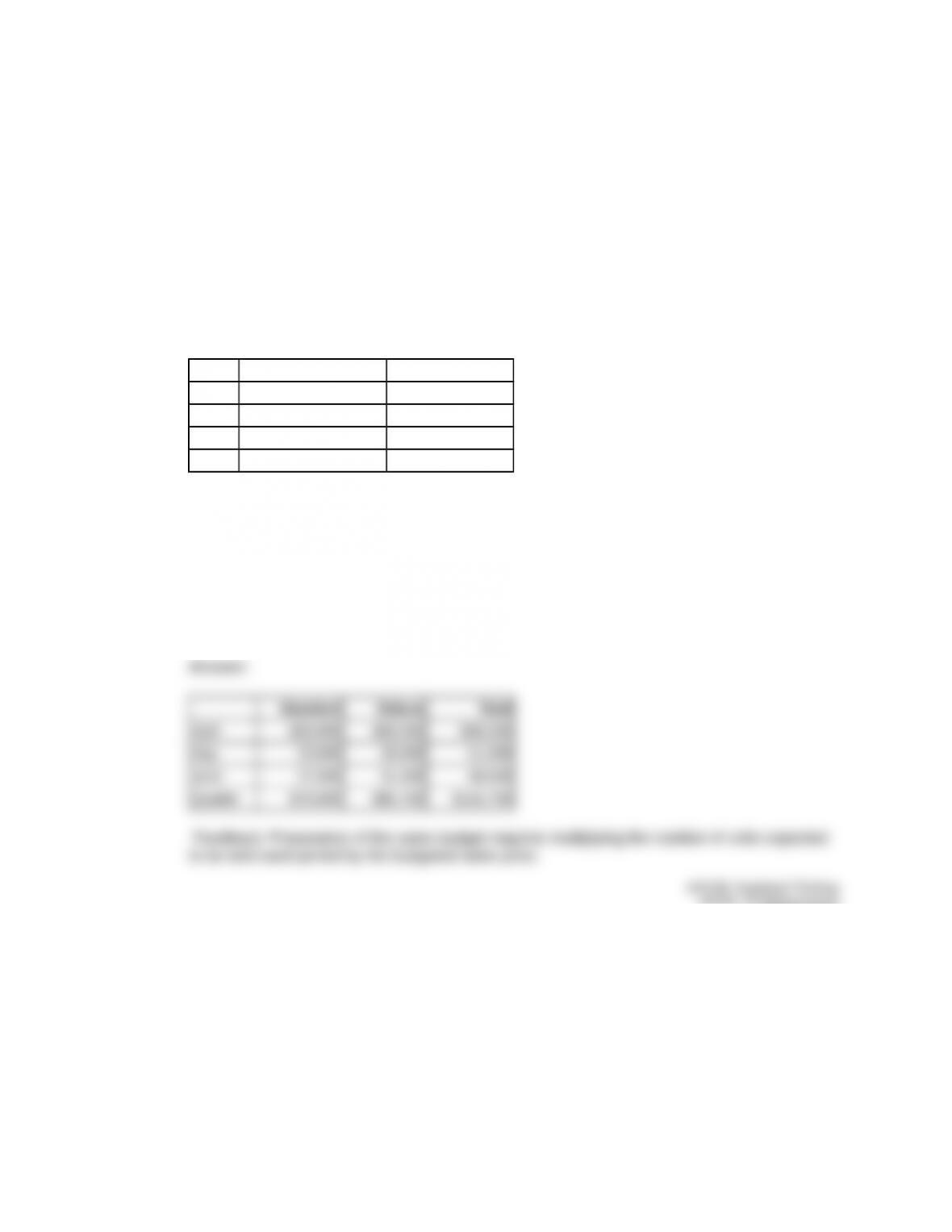
105. Mango Place has forecast its sales for the coming months as follows:
Standard Units Deluxe Units
April 100 75
May 115 80
June 135 90
July 150 100
The standard unit sells for $200, the deluxe unit sells for $350.
Required:
Prepare a sales budget for each of the three months April through June as well as the total for
the quarter. Present the budget for each product as well as total sales.
AICPA: FN Measurement
Blooms: Apply
Difficulty: 1 Easy
Learning Objective: 08-03a Prepare the following components of the operating budget: Sales budget.
Topic: Sales budget
8-47
Copyright © 2017 McGraw-Hill Education. All rights reserved. No reproduction or distribution without the prior written consent of
McGraw-Hill Education.
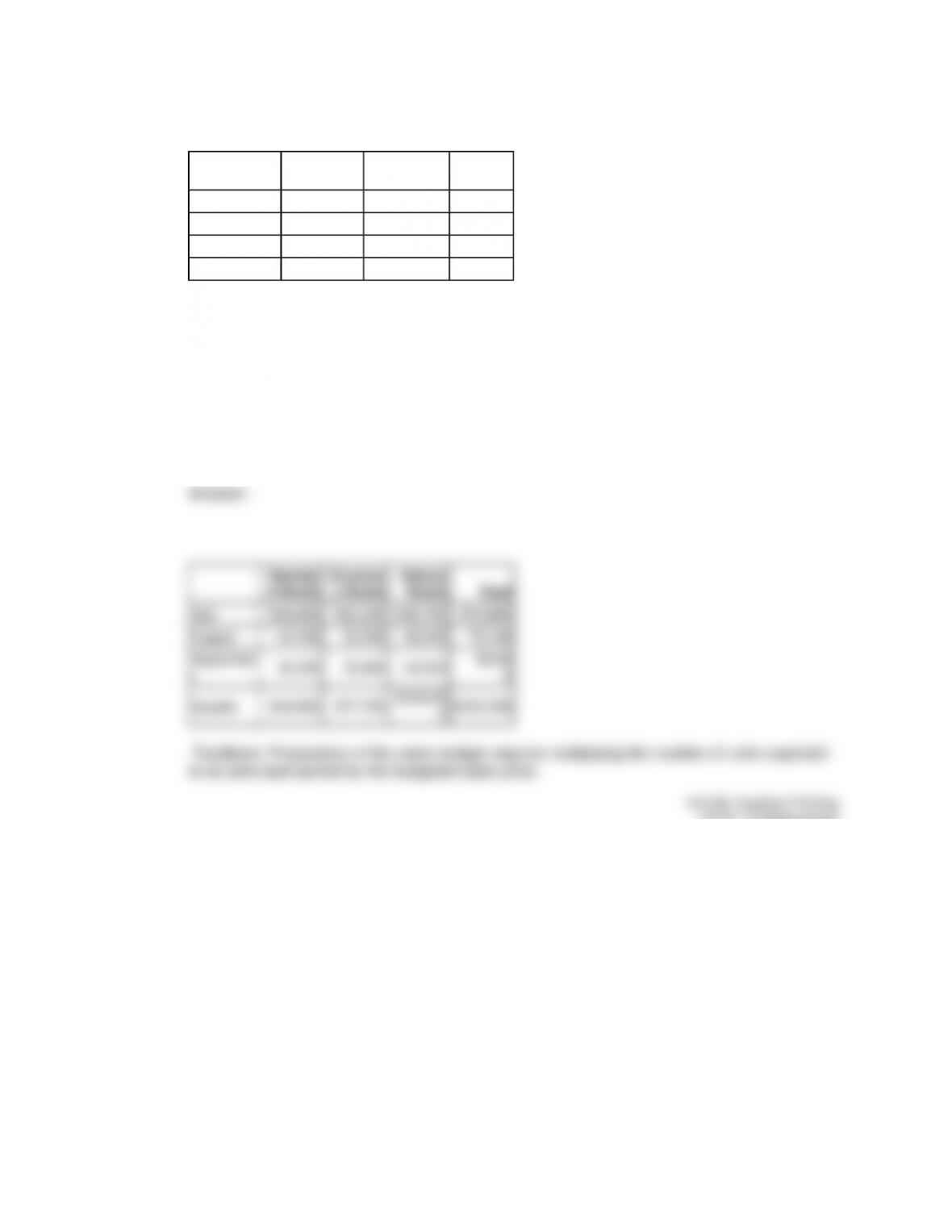
106. Edna Inc. has forecast its sales for the coming months as follows:
Standard
Units
Economy
Units
Deluxe
Units
July 500 1,100 750
August 525 1,200 800
September 575 1,400 900
October 650 1,500 1,000
The standard model sells for $28, the economy model sells for $21, and the deluxe model
sells for $49.
Required:
Prepare a sales budget for each of the three months July through September as well as the
total for the quarter. Present the budget for each product as well as total sales.
AICPA: FN Measurement
Blooms: Apply
Difficulty: 1 Easy
Learning Objective: 08-03a Prepare the following components of the operating budget: Sales budget.
Topic: Sales budget
8-48
Copyright © 2017 McGraw-Hill Education. All rights reserved. No reproduction or distribution without the prior written consent of
McGraw-Hill Education.
8-49
Copyright © 2017 McGraw-Hill Education. All rights reserved. No reproduction or distribution without the prior written consent of
McGraw-Hill Education.
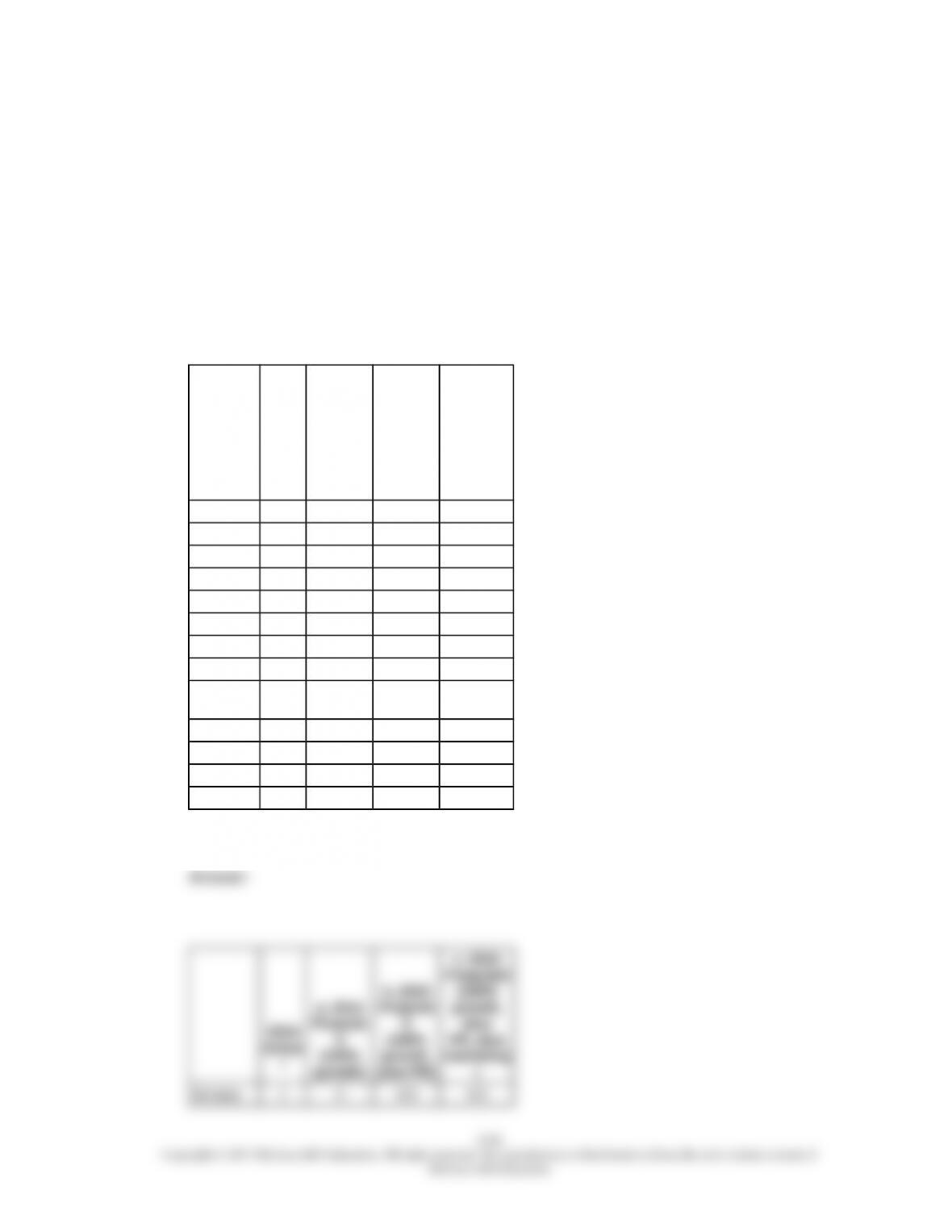
107. In 2014, a design service firm served 12 clients (approximately one per month). The average
client project lasted 20 (business) days and the clients were served evenly throughout the
year. The firm expects 100% growth in the number of clients served in 2015.
a. Prepare a sales forecast based on this information for 2015.
b. In December of 2014, an influential journalist wrote an article about the type of approach
this design firm used, generating 30 new potential client inquiries for the firm. Historically, 50%
of the inquiries result in new projects within a six-month period. (Assume the projects begin
evenly throughout the period.) Prepare a sales forecast based on this information for 2015.
c. To capitalize on the publicity generated by the article, the firm invests in a robust marketing
strategy in June. Based on its projections, the marketing efforts will result in an additional 50%
growth in clients for the six-month period July through December. Prepare a sales forecast
based on this information for 2015.
2014
Actua
l
a. 2015
Projecte
d
(100%
growth)
b. 2015
Projecte
d
(100%
growth,
plus PR)
c. 2015
Projected
(100%
growth,
plus
PR, plus
marketing
)
January 1
February 1
March 1
April 1
May 1
June 1
July 1
August 1
Septembe
r1
October 1
November 1
December 1
Total 12
AICPA: BB Critical Thinking
Blooms: Analyze
Difficulty: 3 Hard
Learning Objective: 08-03a Prepare the following components of the operating budget: Sales budget.
Topic: Sales budget
8-51
Copyright © 2017 McGraw-Hill Education. All rights reserved. No reproduction or distribution without the prior written consent of
McGraw-Hill Education.
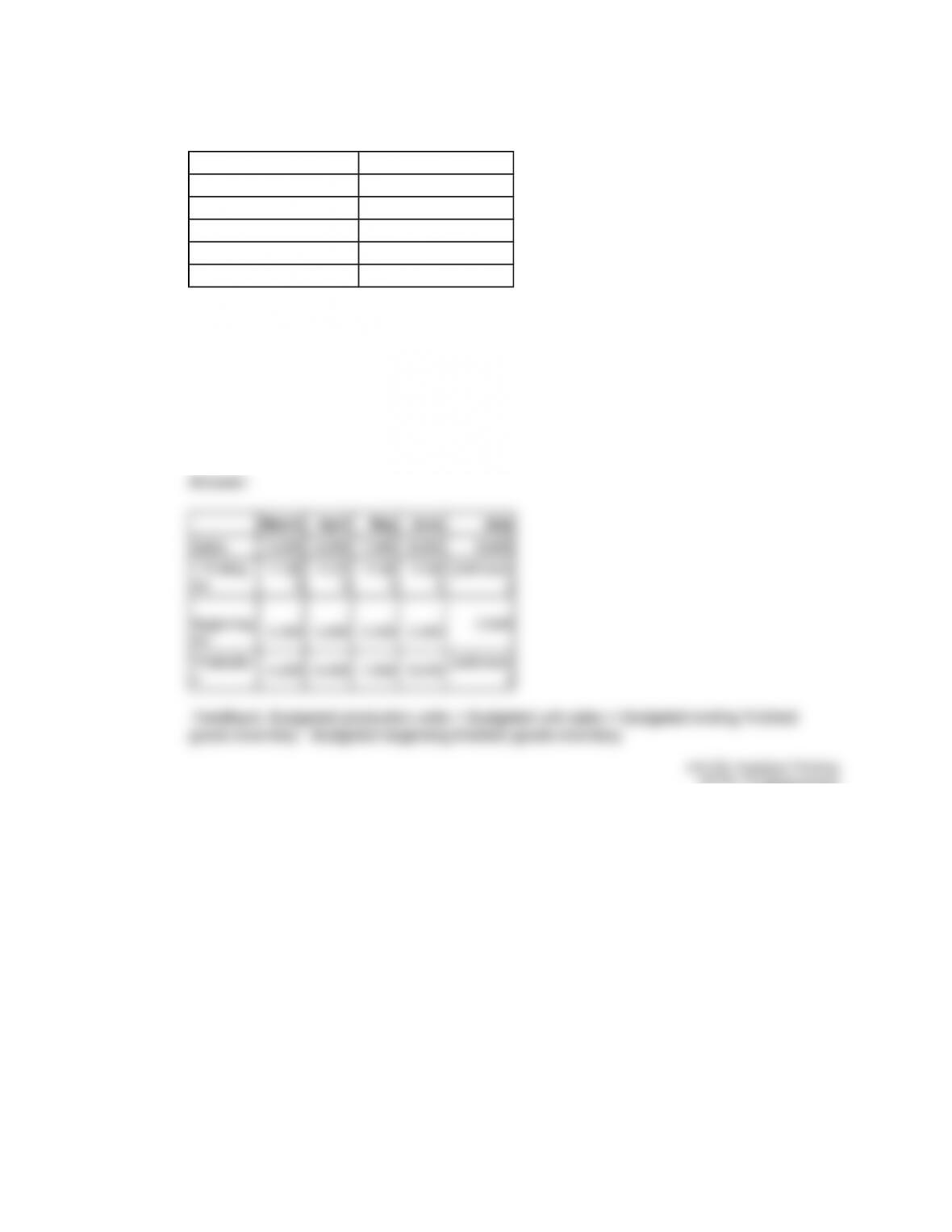
108. Willow Products expects the following sales of its single product:
Units
March 5,000
April 6,000
May 7,500
June 8,000
July 8,800
Willow Products desires an ending finished goods inventory to be equal to 30% of the next
month’s sales needs. Actual March 1 inventory is projected to be 1,300 units.
Required:
Prepare a production budget for Willow Products for as many months as is possible.
AICPA: FN Measurement
Blooms: Apply
Difficulty: 2 Medium
Learning Objective: 08-03b Prepare the following components of the operating budget: Production budget.
Topic: Production budget
8-52
Copyright © 2017 McGraw-Hill Education. All rights reserved. No reproduction or distribution without the prior written consent of
McGraw-Hill Education.
109. Heather Products expects the following sales of its single product:
Units
May 15,000
June 16,000
July 17,500
August 18,000
September 19,000
Heather desires an ending finished goods inventory to be equal to 20% of the next month’s
sales needs. Actual May 1 inventory will be 3,300 units.
Required:
Prepare a production budget for Heather for as many months as is possible.
AICPA: FN Measurement
Blooms: Apply
Difficulty: 2 Medium
Learning Objective: 08-03b Prepare the following components of the operating budget: Production budget.
Topic: Production budget
8-53
Copyright © 2017 McGraw-Hill Education. All rights reserved. No reproduction or distribution without the prior written consent of
McGraw-Hill Education.
110. Wheat Inc. has forecast its sales for the coming months as follows:
Standard
Units
Deluxe
Units
April 100 75
May 115 80
June 135 90
July 150 100
Wheat maintains finished goods inventory equal to 20% of the next month’s sales
requirements. April 1 inventories were 14 standard units and 10 deluxe.
Required:
Prepare a production schedule for April through June.
AICPA: FN Measurement
Blooms: Apply
Difficulty: 2 Medium
Learning Objective: 08-03b Prepare the following components of the operating budget: Production budget.
Topic: Production budget
8-54
Copyright © 2017 McGraw-Hill Education. All rights reserved. No reproduction or distribution without the prior written consent of
McGraw-Hill Education.
111. Cherry Inc. has forecast its sales for the coming months as follows:
Standard Units Economy Units
April 200 150
May 230 160
June 270 180
July 300 200
Cherry maintains finished goods inventory equal to 40% of the next month’s sales
requirements. April 1 inventories were 74 standard units and 72 deluxe.
Required:
Prepare a production schedule for April through June.
AICPA: FN Measurement
Blooms: Apply
Difficulty: 2 Medium
Learning Objective: 08-03b Prepare the following components of the operating budget: Production budget.
Topic: Production budget
8-55
Copyright © 2017 McGraw-Hill Education. All rights reserved. No reproduction or distribution without the prior written consent of
McGraw-Hill Education.
8-56
Copyright © 2017 McGraw-Hill Education. All rights reserved. No reproduction or distribution without the prior written consent of
McGraw-Hill Education.
112. Gertrude Products expects the following sales of its single product:
Units
July 6,000
August 6,500
September 7,200
October 7,800
November 8,800
Gertrude desires an ending finished goods inventory to be equal to 10% of the next month’s
sales needs. July 1 inventory is projected to be 800 units. Each unit requires 5 pounds of
Chemical A and 14 pounds of Chemical B. July 1 materials inventory includes 8,600 pounds of
Chemical A and 76,000 pounds of Chemical B. Gertrude desires to maintain a Chemical A
inventory equal to 20% of next month’s production needs and a Chemical B inventory equal to
100% of next month’s production needs.
a. Prepare a production budget for Gertrude for as many months as is possible.
b. Prepare a raw materials purchases budget for both Chemical A and Chemical B for the
months of July through September.
AICPA: FN Measurement
Blooms: Apply
Difficulty: 3 Hard
Learning Objective: 08-03b Prepare the following components of the operating budget: Production budget.
Learning Objective: 08-03c Prepare the following components of the operating budget: Raw materials purchases budget.
Topic: Production budget
Topic: Raw materials purchases budget
8-58
Copyright © 2017 McGraw-Hill Education. All rights reserved. No reproduction or distribution without the prior written consent of
McGraw-Hill Education.
8-59
Copyright © 2017 McGraw-Hill Education. All rights reserved. No reproduction or distribution without the prior written consent of
McGraw-Hill Education.
113. Crest Products expects the following sales of its single product:
Units
August 25,000
September 24,000
October 22,000
November 20,000
December 17,500
Crest desires an ending finished goods inventory to be equal to 30% of the next month’s sales
needs. August 1 inventory is projected to be 7,800 units. Each finished unit requires 2 units of
component X and 11 units of component Z. August 1 materials inventory includes 5,000 units
of component X and 184,000 units of component Z. Crest desires to maintain a component X
inventory equal to 10% of next month’s production needs and a component Z inventory equal
to 70% of next month’s production needs.
a. Prepare a production budget for Crest for as many months as is possible.
b. Prepare a raw materials purchases budget for both Component X and Component Z for the
months of August through October.
AICPA: FN Measurement
Blooms: Apply
Difficulty: 3 Hard
Learning Objective: 08-03b Prepare the following components of the operating budget: Production budget.
Learning Objective: 08-03c Prepare the following components of the operating budget: Raw materials purchases budget.
Topic: Production budget
Topic: Raw materials purchases budget
8-61
Copyright © 2017 McGraw-Hill Education. All rights reserved. No reproduction or distribution without the prior written consent of
McGraw-Hill Education.

114. Honeysuckle Inc. produces canvas bags. The production budget for the next four months is:
July 5,000 units, August 7,000, September 7,500, October 8,000. Each bag requires 2.6 hours
of unskilled labor (paid $8 per hour) and 4.4 hours of skilled labor (paid $15 per hour).
Required:
Prepare a labor budget for the three months July through September. Provide the labor
requirements according to skill level in hours and in labor cost as well as in total. Provide the
budget monthly as well as a total for the quarter.
2.6)
Skilled
hours (×
4.4)
22,00
0
30,80
0
33,00
0
85,80
0
Total
labor
hours
35,000 49,000 52,500 136,500
Unskilled
cost ($8) $104,000 $145,60
0$156,000 $405,600
Skilled
cost
($15)
330,00
0
462,00
0 495,000 1,287,00
0
Total
labor
cost
434,000 607,600 651,000 1,692,60
0
Feedback: Budgeted direct labor cost = Budgeted production × Direct labor requirements per
unit × Direct labor cost per hour.
AACSB: Analytical Thinking
AICPA: FN Measurement
Blooms: Apply
Difficulty: 3 Hard
Learning Objective: 08-03d Prepare the following components of the operating budget: Direct labor budget.
Topic: Direct labor budget
8-62
Copyright © 2017 McGraw-Hill Education. All rights reserved. No reproduction or distribution without the prior written consent of
McGraw-Hill Education.
115. Maple Inc. produces wooden boxes. The production budget for the next four months is: July
15,000 units, August 17,000, September 17,500. Each box requires three skill levels: 1.0 hours
of unskilled labor (paid $8 per hour), 1.5 hours of semi-skilled labor (paid $10) and 2.0 hours of
skilled labor (paid $15 per hour).
Required:
Prepare a labor budget for the three months July – September. Provide the labor requirements
according to skill level in hours and in labor cost as well as in total. Provide the budget monthly
as well as a total for the quarter.
1.0)
Semiskille
d (× 1.5) 22,500 25,500 26,250 74,250
Skilled (×
2.0)
30,00
0
34,00
0 35,000 99,00
0
Total labor
hours 67,500 76,500 78,750 222,750
Unskilled
cost ($8)
$120,00
0
$136,00
0
$140,00
0$396,000
Semiskille
d ($10) 225,000 255,000 262,500 742,500
Skilled
($15)
450,00
0
510,00
0
525,00
0
1,485,00
0
Total labor
cost 795,000 901,000 927,500 2,623,500
Feedback: Budgeted direct labor cost = Budgeted production × Direct labor requirements per
unit × Direct labor cost per hour
AACSB: Analytical Thinking
AICPA: FN Measurement
Blooms: Apply
Difficulty: 3 Hard
Learning Objective: 08-03d Prepare the following components of the operating budget: Direct labor budget.
Topic: Direct labor budget
8-63
Copyright © 2017 McGraw-Hill Education. All rights reserved. No reproduction or distribution without the prior written consent of
McGraw-Hill Education.
116. Sugar Co. has forecast sales for the next three months as follows: July 4,000 units, August
6,000 units, September 7,500 units, and October 8,000 units. Sugar’s policy is to have an
ending inventory of 40% of the next month’s sales needs on hand. July 1 inventory is projected
to be 1,500 units. Manufacturing overhead is budgeted to be $17,000 plus $5 per unit
produced.
a. Prepare a production budget for Sugar for as many months as is possible.
b. Prepare a manufacturing overhead budget for the three months July – September. Be sure
to include a total for the quarter as well.
AICPA: FN Measurement
Blooms: Apply
Difficulty: 3 Hard
Learning Objective: 08-03b Prepare the following components of the operating budget: Production budget.
Learning Objective: 08-03e Prepare the following components of the operating budget: Manufacturing overhead budget.
Topic: Manufacturing overhead budget
Topic: Production budget
8-64
Copyright © 2017 McGraw-Hill Education. All rights reserved. No reproduction or distribution without the prior written consent of
McGraw-Hill Education.
117. Butler Corp. has forecast sales for the next three months as follows: July 14,000 units, August
16,000 units, September 17,500 units, October 18,000 units. Butler’s policy is to have an
ending inventory of 20% of the next month’s sales needs on hand. July 1 inventory is projected
to be 2,500 units. Manufacturing overhead is budgeted to be $18,000 (depreciation $2,000,
supervision $7,000, factory lease $1,500, maintenance $4,000, training $3,500) plus $5 per
unit produced ($3 indirect materials, $2 utilities).
a. Prepare a production budget for Butler for as many months as is possible.
b. Prepare a manufacturing overhead budget for the three months July through September. Be
sure to include a total for the quarter as well.
AICPA: FN Measurement
Blooms: Apply
8-65
Copyright © 2017 McGraw-Hill Education. All rights reserved. No reproduction or distribution without the prior written consent of
McGraw-Hill Education.
Difficulty: 3 Hard
Learning Objective: 08-03b Prepare the following components of the operating budget: Production budget.
Learning Objective: 08-03e Prepare the following components of the operating budget: Manufacturing overhead budget.
Topic: Manufacturing overhead cost budget
Topic: Production budget
8-66
Copyright © 2017 McGraw-Hill Education. All rights reserved. No reproduction or distribution without the prior written consent of
McGraw-Hill Education.
118. Bear Corp. sells its product for $120. Forecasted sales are 1,200 units in October, 1,500 in
November, and 1,600 in December. Variable costs are based on sales, and consist of
commissions (7% of sales), advertising (3%) and shipping (5%). Fixed costs per month are
$4,000 sales salaries, $3,300 office salaries, $2,000 depreciation, $1,800 office rent, $750
insurance and $900 utilities.
Required:
Prepare Bear Corp’s selling and administrative expense budget for the period October
through December. Present monthly totals as well as a 3-month total.
AICPA: FN Measurement
Blooms: Apply
Difficulty: 3 Hard
8-67
Copyright © 2017 McGraw-Hill Education. All rights reserved. No reproduction or distribution without the prior written consent of
McGraw-Hill Education.
Learning Objective: 08-03a Prepare the following components of the operating budget: Sales budget.
Learning Objective: 08-03g Prepare the following components of the operating budget: Selling and administrative expense
budget.
Topic: Selling and administrative expense budget
119. Rapid Corp. sells its product for $200. Forecasted sales are 1,500 units in January, 1,800 in
February, and 1,600 in March. Variable costs are based on sales, and consist of commissions
(6% of sales), cooperative advertising (2%) and shipping (6%). Monthly fixed costs are $7,000
sales salaries, $6,500 office salaries, $2,500 depreciation, $1,800 office rent, $900 insurance
and $1,200 utilities.
a. Prepare Rapid’s selling and administrative expense budget for the period January through
March. Present monthly totals as well as a 3-month total.
AICPA: FN Measurement
Blooms: Apply
Difficulty: 3 Hard
Learning Objective: 08-03a Prepare the following components of the operating budget: Sales budget.
8-68
Copyright © 2017 McGraw-Hill Education. All rights reserved. No reproduction or distribution without the prior written consent of
McGraw-Hill Education.
Learning Objective: 08-03g Prepare the following components of the operating budget: Selling and administrative expense
budget.
Topic: Selling and administrative expense budget
120. Meredith Company has budgeted sales for the upcoming months as follows:
April $360,000
May $372,000
June $392,000
July $412,000
August $400,000
September $380,000
Forty percent of the sales are credit sales, the remainder are made in cash. Credit sales are
collected 50% in the month of sale, 40% in the month following the sale, and 8% in the second
month following the sale.
a. Compute Meredith Company’s cash receipts for June.
b. Compute Meredith Company’s cash receipts for July.
c. Compute Meredith Company’s cash receipts for August.
AICPA: FN Measurement
Blooms: Apply
Difficulty: 2 Medium
Learning Objective: 08-04 Prepare the cash budget and describe the relationships among the operating budgets, cash budget,
and budgeted balance sheet.
Topic: Cash budget
8-69
Copyright © 2017 McGraw-Hill Education. All rights reserved. No reproduction or distribution without the prior written consent of
McGraw-Hill Education.
121. Spencer Company has budgeted sales for the upcoming months as follows:
February $600,000
March $615,000
April $645,000
May $670,000
Seventy percent of the sales are credit sales, the remainder are made in cash. Credit sales
are collected 40% in the month of sale, 50% in the month following the sale, and 10% in the
second month following the sale.
a. Compute Spencer’s cash receipts for April.
b. Compute Spencer’s cash receipts for May.
c. Compute the accounts receivable balance for May 31.
AICPA: FN Measurement
Blooms: Apply
Difficulty: 2 Medium
Learning Objective: 08-04 Prepare the cash budget and describe the relationships among the operating budgets, cash budget,
and budgeted balance sheet.
Topic: Budgeted balance sheet
Topic: Cash budget
8-70
Copyright © 2017 McGraw-Hill Education. All rights reserved. No reproduction or distribution without the prior written consent of
McGraw-Hill Education.
122. Blair is a retailer of assorted baby products. The sales forecast for the coming months is:
Revenues
April (actual) $175,000
May (actual) $200,000
June $225,000
July $240,000
August $230,000
All sales are credit sales. The cash collection pattern is 20% in the month of sale, 70% in the
month following the sale, and the remainder in the second month following the sale. Accounts
receivable on June 1 were $177,500.
a. Prepare a cash receipts schedule for the period June through August (by month).
b. What will the Accounts Receivable balance be on August 31?
AICPA: FN Measurement
Blooms: Apply
Difficulty: 2 Medium
Learning Objective: 08-04 Prepare the cash budget and describe the relationships among the operating budgets, cash budget,
and budgeted balance sheet.
Topic: Budgeted balance sheet
Topic: Cash budget
8-71
Copyright © 2017 McGraw-Hill Education. All rights reserved. No reproduction or distribution without the prior written consent of
McGraw-Hill Education.
123. Portia is a retailer of scrapbooking products. The sales forecast for the coming months is:
Revenues
April (actual) $250,000
May (actual) $275,000
June $300,000
July $350,000
August $350,000
Portia’s sales are all credit. The collection pattern is 60% in the month of sale, 35% the
following month and the remainder in the second month following the sale. Accounts
receivable on April 1 were $122,500.
a. Prepare a cash receipts schedule for the period June through August (by month).
b. What will the Accounts Receivable balance be on August 31?
AICPA: FN Measurement
Blooms: Apply
Difficulty: 2 Medium
Learning Objective: 08-04 Prepare the cash budget and describe the relationships among the operating budgets, cash budget,
and budgeted balance sheet.
Topic: Budgeted balance sheet
Topic: Cash budget
8-72
Copyright © 2017 McGraw-Hill Education. All rights reserved. No reproduction or distribution without the prior written consent of
McGraw-Hill Education.
8-73
Copyright © 2017 McGraw-Hill Education. All rights reserved. No reproduction or distribution without the prior written consent of
McGraw-Hill Education.
124. Young is a retailer of assorted baby products. The sales forecast for the coming months is:
Revenues
April $175,000
May $200,000
June $225,000
July $240,000
August $230,000
Young’s cost of sales averages 60% of revenues. The inventory policy is to carry 30% of next
month’s sales needs. April 1 inventory will be as expected under the policy. Young pays for
purchases 80% in the month of purchase and 20% the following month. Accounts payable on
April 1 is $22,400.
a. Prepare a purchases budget for as many months as is possible.
b. Prepare a cash payments budget for April through July.

AICPA: FN Measurement
Blooms: Apply
Difficulty: 3 Hard
Learning Objective: 08-04 Prepare the cash budget and describe the relationships among the operating budgets, cash budget,
and budgeted balance sheet.
Learning Objective: 08-05 Prepare a merchandise purchases budget for a merchandising firm.
Topic: Budgeting in nonmanufacturing firms
Topic: Cash budget
8-75
Copyright © 2017 McGraw-Hill Education. All rights reserved. No reproduction or distribution without the prior written consent of
McGraw-Hill Education.
8-76
Copyright © 2017 McGraw-Hill Education. All rights reserved. No reproduction or distribution without the prior written consent of
McGraw-Hill Education.
125. Carmen is a retailer of scrapbooking products. The sales forecast for the coming months is:
Revenues
April $250,000
May $275,000
June $300,000
July $350,000
August $350,000
Carmen’s sales are 70% cash and 30% store credit. The credit sales are collected 60% in the
month of sale, the remainder the following month. Accounts receivable on April 1 are $32,000.
Carmen’s cost of sales averages 65% of revenues. The inventory policy is to carry 40% of
next month’s sales needs. April 1 inventory will be as expected under the policy. Carmen pays
for purchases 30% in the month of purchase and 70% the following month. Accounts payable
on April 1 is $125,000.
a. Prepare a purchases budget for as many months as is possible.
b. Prepare a cash payments budget for April through July.
c. Prepare a cash receipts budget for April through July.
AICPA: FN Measurement
Blooms: Apply
Difficulty: 3 Hard
Learning Objective: 08-04 Prepare the cash budget and describe the relationships among the operating budgets, cash budget,
and budgeted balance sheet.
Learning Objective: 08-05 Prepare a merchandise purchases budget for a merchandising firm.
Topic: Budgeting in nonmanufacturing firms
Topic: Cash budget
8-78
Copyright © 2017 McGraw-Hill Education. All rights reserved. No reproduction or distribution without the prior written consent of
McGraw-Hill Education.