To: Professor Dirk Primus
From: Gayatri Subramanian
Subject: Zara: Fast Fashion case analysis.
Purpose: The main objecfive of this memo is to address issues on the in uence of parent company’s choice of verfical
integrafion accommodates the business model of Zara fast fashion. The limitafions and opportunifies of Zara to expand
globally.
Inditex aimed at providing quick responses to customer needs by exploifing technology to its at most potenfial
and by having a fragmented decision making model and thus Zara came into existence. Inditex owns eight retail brands
that caters to different customer demographic. The market segmentafion tacfic has propelled Inditex to capture a huge
share of the consumer market. Zara is one of the largest internafional brands owned by Inditex. Inditex owns around
1600 retail showrooms and around 550 retail showrooms belong to Zara segment. The business model of Zara is
consumer centric and a lot of emphasis is made on customer needs and customer safisfacfion.
The business system of Zara (refer Exhibit 1) shows that Inditex incorporated verfical integrafion business system.
The verfical integrafion that links design, sourcing and manufacturing, distribufion and retailing exercises control on
every part of the supply chain system. The design of products in fast fashion industry is generally out-sourced, however
Zara does not out-source its design, instead it invests on 300 in-house designers and banks on its retail store manager.
The retail store managers idenfify the consumer needs and availability of these products based on consumer behavior
trends. Zara uses modern methods in sourcing and manufacturing products. This gives Zara a compefifive advantage in
speed and efficiency.
As a parent company Inditex provides moral assistance to Zara with global expansion and promotes new trends
and styles in current markets at affordable prices. The price posifion map (refer Exhibit 2) plots Zara in the fourth
quadrant which indicates that Zara provides highly fashionable products at lower prices. The fast fashion industry is
driven by the speed factor and not by quality. People understand that fast fashion trendy clothes will get worn out
sooner. Experienced parent company, Inditex, has mapped a model that allows Zara to maintain a low / moderate
product cost yet maintain high quality.
Zara does not focus on adverfising instead invests on new stores. The store is the heart of Zara’s products. The
store provides customers an interacfion with their products which proves to be more favorable compared to
adverfisements. The compefifive advantage is created not just by speed but trend and style. The stores change clothing
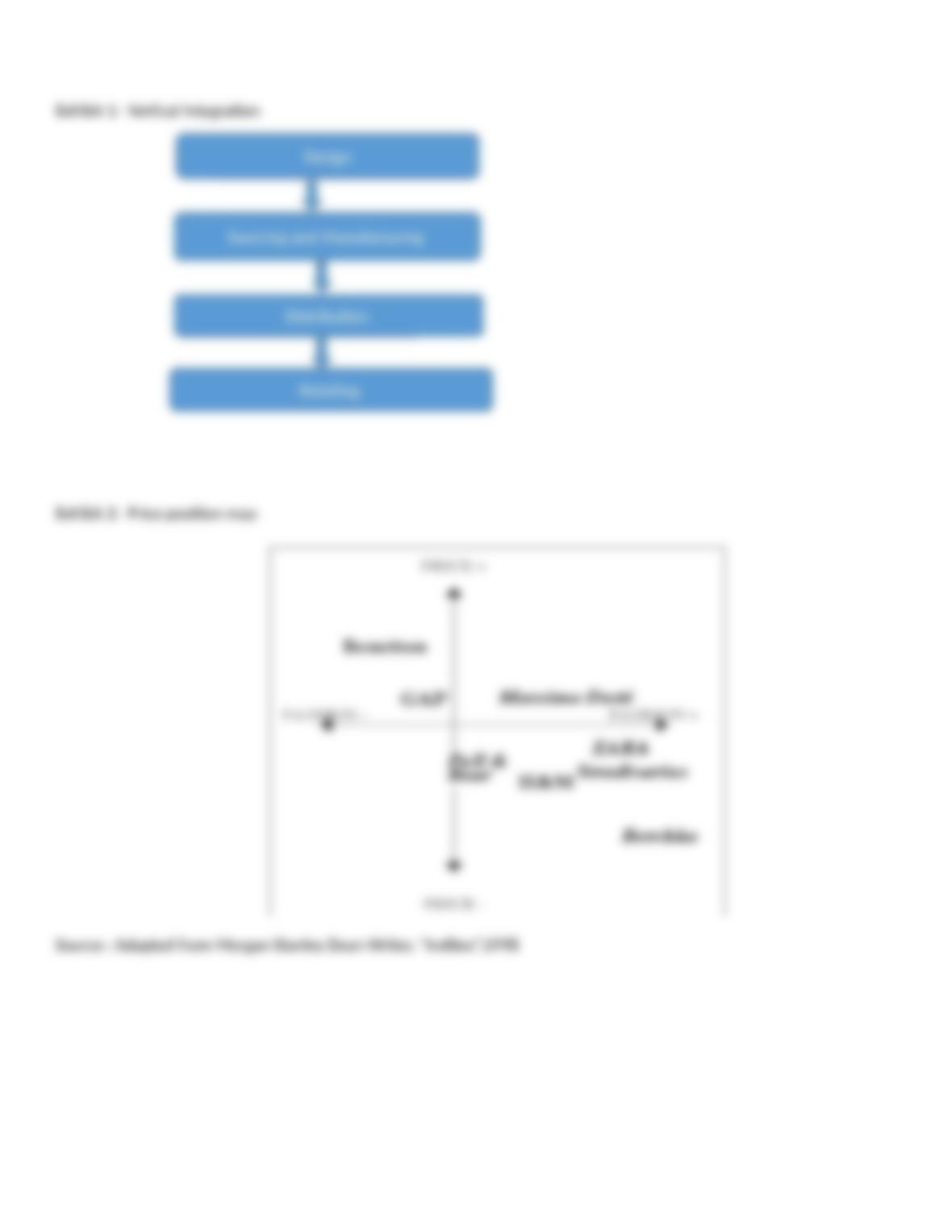
Exhibit 2: Price posifion map
Source : Adapted from Morgan Stanley Dean Writer, “Inditex”,1998
Retailing