Blomquist
AP Microeconomics Class Notes
Principles of Economics – Mankiw
Chapter 1: Ten Principles of Economics
• Society faces many decisions: What jobs will be done? Who will work those jobs? What will be produced?
To who do the goods produced and services provided go to?
• How great would it be to have the Magic Matter Making Machine 3000? Whenever you want a new car,
type in the make, model, and color then BAM! You get a brand new Ferrari. Out of gas? Tell the machine
to produce more and refill the tank. Hungry? Filet Minion cooked however you want whenever you
want! I want to live in that world!
• Unfortunately we can’t get whatever we want whenever we want it. All resources are scarce.
o Scarcity – the limited nature of society’s resources.
o Society has limited resources and therefore cannot produce all the goods and services people
wish to have.
• Economics – is the study of how society manages its scarce resources.
o Resources are allocated (distributed) not by one dictator, but by millions of households
(consumers) and firms (producers).
o Economists study how people make decisions, how people interact with one another, and
analyze forces and trends that affect the economy as a whole.
How People Make Decisions (Principles 1-4)
• It’s funny to think that in a simplified sense, an economy is simply a group of people dealing with one
another as they go about their normal lives.
• Principle 1: People Face Trade-offs
o “There ain’t no such thing as a free lunch” – Discuss
o “Trade–offs” example using time: When you spend 5 hours studying for your AP Microeconomics
exam you give up (or “trade–off”) 5 hours that you could have used to nap, go bike riding, watch
movies, etc.
o “Trade–offs” example using money: When you spend an extra $250 on a Coach purse, you have
$250 less to spend towards college books.
o Society as a whole faces “Trade-offs”: Clean Environment vs. More Money in your Pocket:
▪ Laws that require firms (factories) to reduce pollution raise the cost of producing the
good.
▪ Firms end up earning smaller profits, pay lower wages, and/or charge higher prices.
▪ The trade-off for a cleaner and healthier environment is a reduction in income for firm’s
owners, workers, and customers.
o Efficiency vs. Equality
▪ Efficiency – the property of society getting the most from its scarce resources.
▪ Equality – the property of distributing economic prosperity uniformly among the
members of society.
▪ Efficiency and Equality goals conflict with one another with government policies.
• Income tax example: The financially successful contribute more taxes to the
government. If the government attempts to achieve more equality by giving
more tax dollars from the rich to the poor, what effect would it have on
efficiency?
o People are to make good decisions as long as they are aware of the trade-offs available.
• Principle 2: The Cost of Something is What you Give Up to Get It
o Effective decision making requires you to compare the costs and benefits of particular trade-offs.
o Let’s look at an example: What are the benefits/costs of going to college?
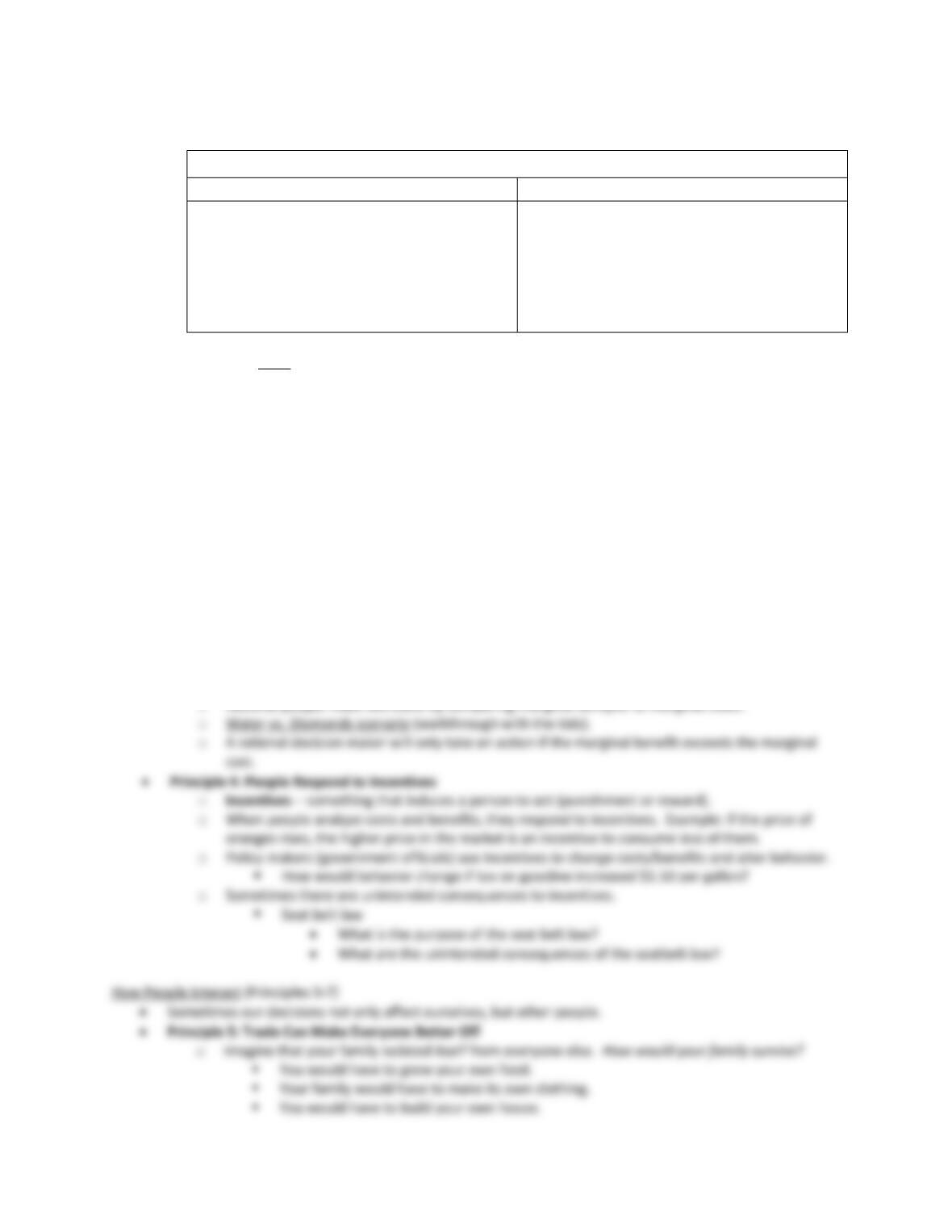
What are the Benefits/Costs of going to College?
Benefits
Costs
o Your TIME is one of the most significant costs you will factor when making a decision.
o One should always be aware of the Opportunity Costs – whatever must be given up to obtain
some item.
o What is the opportunity cost for a star college basketball player who wants to finish his senior
year and graduate?
• Principle 3: Rational People Think at the Margin
o Economists assume people are rational.
o Rational People – people who systematically and purposefully do the best they can to achieve
their objectives. If a person who aspired to be rich by any means necessary saw a suitcase of
money sitting on the floor, what rational decision would he/she make?
▪ (Rational) Firms decide how many people to hire and much of a good to produce to
maximize profits.
▪ (Rational) Individuals decide how much time they want to work and what goods to buy
to maximize level of satisfaction (utility).
o Marginal Changes – small incremental adjustments to a plan of action.
▪ Let’s say your plan of action is to study tonight for an important exam to pass AP Econ.
Would you make any marginal changes if your favorite show (like Jersey Shore?) was on
television that night?