Chapter 17
Monopolistic Competition
MULTIPLE CHOICE
1. Monopolistic competition is characterized by which of the following attributes?
(i) free entry
(ii) product differentiation
(iii) many sellers
a. (i) and (iii) only
b. (i) and (ii) only
c. (ii) and (iii) only
d. (i), (ii), and (iii)
ANSWER: d. (i), (ii), and (iii)
TYPE: M DIFFICULTY: 1 SECTION: 17.1
2. The phenomenon of product differentiation contrasts sharply with the phenomenon of
a. homogeneous products.
b. industrial products.
c. monopolistic competition.
d. product integration.
ANSWER: a. homogeneous products.
TYPE: M DIFFICULTY: 1 SECTION: 17.1
3. In a monopolistically competitive industry, price is
a. equal to marginal cost since each firm is a price taker.
b. below marginal cost since each firm is a price taker.
c. above marginal cost since each firm is a price setter.
d. always a fraction of marginal cost since each firm is a price setter.
ANSWER: c. above marginal cost since each firm is a price setter.
TYPE: M DIFFICULTY: 2 SECTION: 17.1
4. In which of the following market structures is the number of sellers less than “many?”
(i) monopolistic competition
(ii) monopoly
(iii) oligopoly
a. (i) and (ii) only
b. (ii) and (iii) only
c. (ii) only
d. All of the above are correct.
ANSWER: b. (ii) and (iii) only
TYPE: M DIFFICULTY: 1 SECTION: 17.1
5. Which of the following market structures features free entry and exit?
(i) perfect competition
(ii) monopolistic competition
(iii) monopoly
a. (i) only
b. (i) and (ii) only
c. (ii) and (iii) only
d. All of the above are correct.
ANSWER: b. (i) and (ii) only
TYPE: M DIFFICULTY: 2 SECTION: 17.1
6. Monopolistic competition differs from perfect competition because in monopolistically
competitive markets
a. there are barriers to entry.
b. all firms can eventually earn economic profits.
c. each of the sellers offers a somewhat different product.
d. strategic interactions between firms is vitally important.
ANSWER: c. each of the sellers offers a somewhat different product.
TYPE: M DIFFICULTY: 2 SECTION: 17.1
7. One way in which monopolistic competition differs from oligopoly is
a. there are no barriers to entry in oligopolies.
b. in oligopoly markets there are only a few sellers.
c. all oligopoly firms eventually earn zero economic profits.
d. strategic interactions between firms are rarely evident in oligopolies.
ANSWER: b. in oligopoly markets there are only a few sellers.
TYPE: M DIFFICULTY: 2 SECTION: 17.1
8. A similarity between monopoly and monopolistic competition is that, in both market
structures,
a. strategic interactions among sellers are important.
b. there are fewer than “many” sellers.
c. sellers are price makers rather than price takers.
d. product differentiation is important.
ANSWER: c. sellers are price makers rather than price takers.
TYPE: M DIFFICULTY: 2 SECTION: 17.1
9. A profit-maximizing firm in a monopolistically competitive market differs from a firm
in a perfectly competitive market because the firm in the monopolistically competitive
market
a. is characterized by market share maximization.
b. has no barriers to entry.
c. faces a downward-sloping demand curve for its product.
d. faces a horizontal demand curve at the market clearing price.
ANSWER: c. faces a downward-sloping demand curve for its product.
TYPE: M DIFFICULTY: 2 SECTION: 17.1
10. The profit-maximizing rule for a firm in a monopolistically competitive market is to
select the quantity at which
a. marginal revenue is equal to marginal cost.
b. average total cost is equal to marginal revenue.
c. average total cost is at its minimum value.
d. average revenue exceeds average total cost.
ANSWER: a. marginal revenue is equal to marginal cost.
TYPE: M DIFFICULTY: 2 SECTION: 17.1
11. A profit-maximizing firm in a monopolistically competitive market is characterized by
which of the following?
a. Average revenue exceeds marginal revenue.
b. Marginal revenue exceeds average revenue.
c. Average revenue is equal to marginal revenue.
d. Revenue is always maximized along with profit.
ANSWER: a. Average revenue exceeds marginal revenue.
TYPE: M DIFFICULTY: 2 SECTION: 17.1
Use the figures below to answer questions 12 through 14.
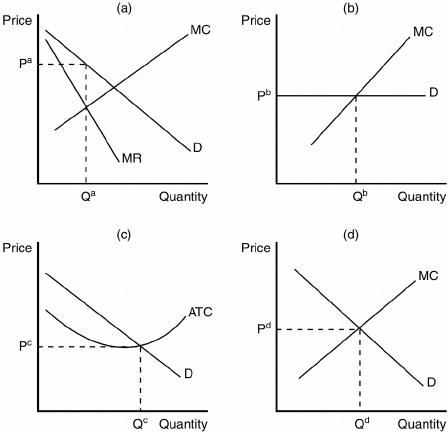
12. Which of the graphs would most likely represent a profit-maximizing firm in a
monopolistically competitive market?
a. panel a
b. panel b
c. panel c
d. panel d
ANSWER: a. panel a
TYPE: M DIFFICULTY: 2 SECTION: 17.1
13. If a firm in a monopolistically competitive market was producing the level of output
depicted as Qd in panel d, it would
a. not be maximizing its profit.
b. be minimizing its losses.
c. be losing market share to other firms in the market.
d. be operating at excess capacity.
ANSWER: a. not be maximizing its profit.
TYPE: M DIFFICULTY: 2 SECTION: 17.1
14. The firm depicted in panel b faces a horizontal demand curve. If panel b depicts a
profit-maximizing firm,
a. it could be operating in either a perfectly competitive market or in a monopolistically
competitive market.
b. it would not have excess capacity in its production as long as it is earning zero economic
profit.
c. it is able to choose the price at which it sells its product.
d. All of the above are correct.
ANSWER: b. it would not have excess capacity in its production as long as it is earning
zero economic profit.
TYPE: M DIFFICULTY: 2 SECTION: 17.1
15. Product differentiation causes the seller of a good to face what type of demand curve?
a. downward sloping
b. upward sloping
c. horizontal
d. vertical
ANSWER: a. downward sloping
TYPE: M DIFFICULTY: 2 SECTION: 17.1
Use the figure below to answer questions 16 through 18.
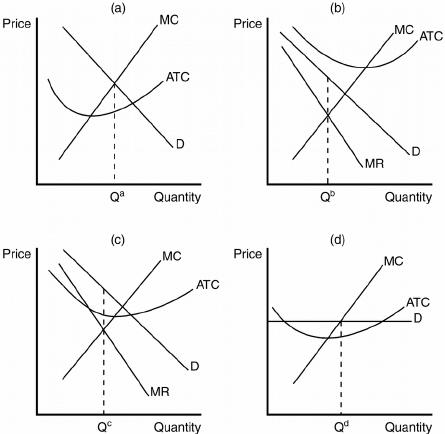
16. Which of the graphs shown would be consistent with a firm in a monopolistically
competitive market that is earning a positive profit?
a. panel a
b. panel b
c. panel c
d. panel d
ANSWER: c. panel c
TYPE: M DIFFICULTY: 2 SECTION: 17.1
17. Which of the graphs shown would be consistent with a firm in a monopolistically
competitive market that is doing its best but still losing money?
a. panel a
b. panel b
c. panel c
d. panel d
ANSWER: b. panel b
TYPE: M DIFFICULTY: 2 SECTION: 17.1
18. Which of the graphs depicts a monopolistically competitive firm in long-run
equilibrium?
a. panel a
b. panel b
c. panel c
d. None of the above are correct.
ANSWER: d. None of the above are correct.
TYPE: M DIFFICULTY: 2 SECTION: 17.1
19. In the short run, a firm in a monopolistically competitive market operates much like
a(n)
a. perfectly competitive firm.
b. oligopoly firm.
c. monopoly.
d. All of the above are correct.
ANSWER: c. monopoly.
TYPE: M DIFFICULTY: 2 SECTION: 17.1
20. A monopolistically competitive firm chooses
a. the quantity of output to produce, but the market determines price.
b. the price, but competition in the market determines the quantity.
c. price, but output is determined by a cartel production quota.
d. the quantity of output to produce and the price at which it will sell its output.
ANSWER: d. the quantity of output to produce and the price at which it will sell its output.
TYPE: M DIFFICULTY: 2 SECTION: 17.1
21. If firms in a monopolistically competitive market are earning positive profits,
a. firms will likely be subject to regulation.
b. barriers to entry will be strengthened.
c. some firms must exit the market.
d. new firms will enter the market.
ANSWER: d. new firms will enter the market.
TYPE: M DIFFICULTY: 2 SECTION: 17.1
22. If firms in a monopolistically competitive market are earning economic profits, which
of the following scenarios would best reflect the change facing incumbent firms as the
market adjusts to its new equilibrium?
a. an increase in demand
b. a decrease in demand
c. a downward shift in their marginal cost curve
d. an upward shift in their marginal cost curve
ANSWER: b. a decrease in demand
TYPE: M DIFFICULTY: 2 SECTION: 17.1
23. If firms in a monopolistically competitive market are incurring economic losses, which
of the following scenarios would best reflect the change facing incumbent firms (who are
able to stay in the market) as the market adjusts to its new equilibrium?
a. a downward shift in their marginal cost curve
b. an upward shift in their marginal cost curve
c. a decrease in demand
d. an increase in demand
ANSWER: d. an increase in demand
TYPE: M DIFFICULTY: 2 SECTION: 17.1
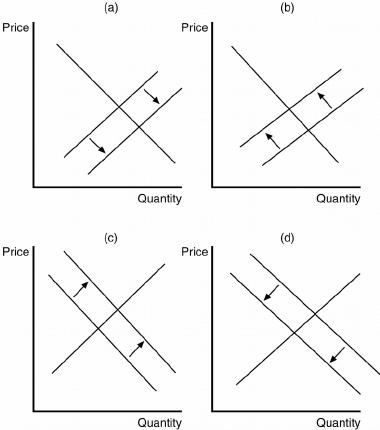
Lines in the figures below reflect the potential effect of entry and exit in a monopolistically
competitive market on the demand and/or marginal cost curves of incumbent firms. Use
these figures to answer questions 24 and 25.
24. Panel d in the set of figures shown depicts the effect on incumbent firms of
a. long-run economic losses.
b. a decrease in the diversity of products offered in the market.
c. new entrants in the market.
d. existing firms exiting the market.
ANSWER: c. new entrants in the market.
TYPE: M DIFFICULTY: 2 SECTION: 17.1
25. Which of the diagrams depicts the effect on incumbent firms of some existing firms
leaving the market?
a. panel a
b. panel b
c. panel c
d. panel d
ANSWER: c. panel c
TYPE: M DIFFICULTY: 2 SECTION: 17.1
26. In monopolistically competitive markets, economic profits
a. signal some incumbent firms to exit the market.
b. signal new firms to enter the market.
c. are maintained through government-imposed barriers to entry.
d. are never possible.
ANSWER: b. signal new firms to enter the market.
TYPE: M DIFFICULTY: 1 SECTION: 17.1
27. In monopolistically competitive markets, economic losses
a. signal some incumbent firms to exit the market.
b. signal new firms to enter the market.
c. are maintained through government-imposed barriers to exit.
d. are never possible.
ANSWER: a. signal some incumbent firms to exit the market.
TYPE: M DIFFICULTY: 1 SECTION: 17.1
28. As new firms enter a monopolistically competitive market, profits of existing firms
a. rise and product diversity in the market increases.
b. rise and product diversity in the market decreases.
c. decline and product diversity in the market increases.
d. decline and product diversity in the market decreases.
ANSWER: c. decline and product diversity in the market increases.
TYPE: M DIFFICULTY: 2 SECTION: 17.1
29. As some incumbent firms exit a monopolistically competitive market, profits of
existing firms
a. decline and product diversity in the market decreases.
b. decline and product diversity in the market increases.