CLASSROOM ASSIGNMENTS FOR CHAPTER 2
E2-3 Classifying Accounts and Their Usual Balances
As described in a recent annual report, Verizon Wireless provides wireless voice and data
services across one of the most extensive wireless networks in the United States. Verizon now
serves more than 80 million customers, making it the largest wireless service provider in the
United States in terms of the total number of customers. The following are accounts from a
recent balance sheet for Verizon Communications, Inc.
(1)
Accounts Receivable
(2)
Retained Earnings
(3)
Taxes Payable
(4)
Prepaid Expenses
(5)
Common Stock
(6)
Long-Term Investments
(7)
Plant, Property, and Equipment
(8)
Accounts Payable
(9)
Short-Term Investments
(10)
Long-Term Debt
Required:
For each account, indicate whether the account is usually classified as a current asset (CA),
noncurrent asset (NCA), current liability (CL), noncurrent liability (NCL), or stockholders’ equity
(SE), and whether the account usually has a debit or credit balance.
E2-4 Determining Financial Statement Effects of Several Transactions
The following events occurred for Johnson Company:
1. Received $40,000 cash by organizers and distributed 1,000 shares of $1 par value
common stock to them.
2. Purchased $15,000 of equipment, paying $3,000 in cash and signing a note for the rest.
3. Borrowed $10,000 cash from a bank.
4. Loaned $800 to an employee who signed a note.
5. Purchased $13,000 of land; paid $4,000 in cash and signed a mortgage note for the
balance.
Required: For each of the events (1) through (5), record journal entries for these transactions.
If you can, identify the type of account and whether it is increasing or decreasing.
E2-5 Determining Financial Statement Effects of Several Transactions
Nike, Inc., with headquarters in Beaverton, Oregon, is one of the world’s leading manufacturers
of athletic shoes and sports apparel. The following activities occurred during a recent year. The
amounts are rounded to millions.
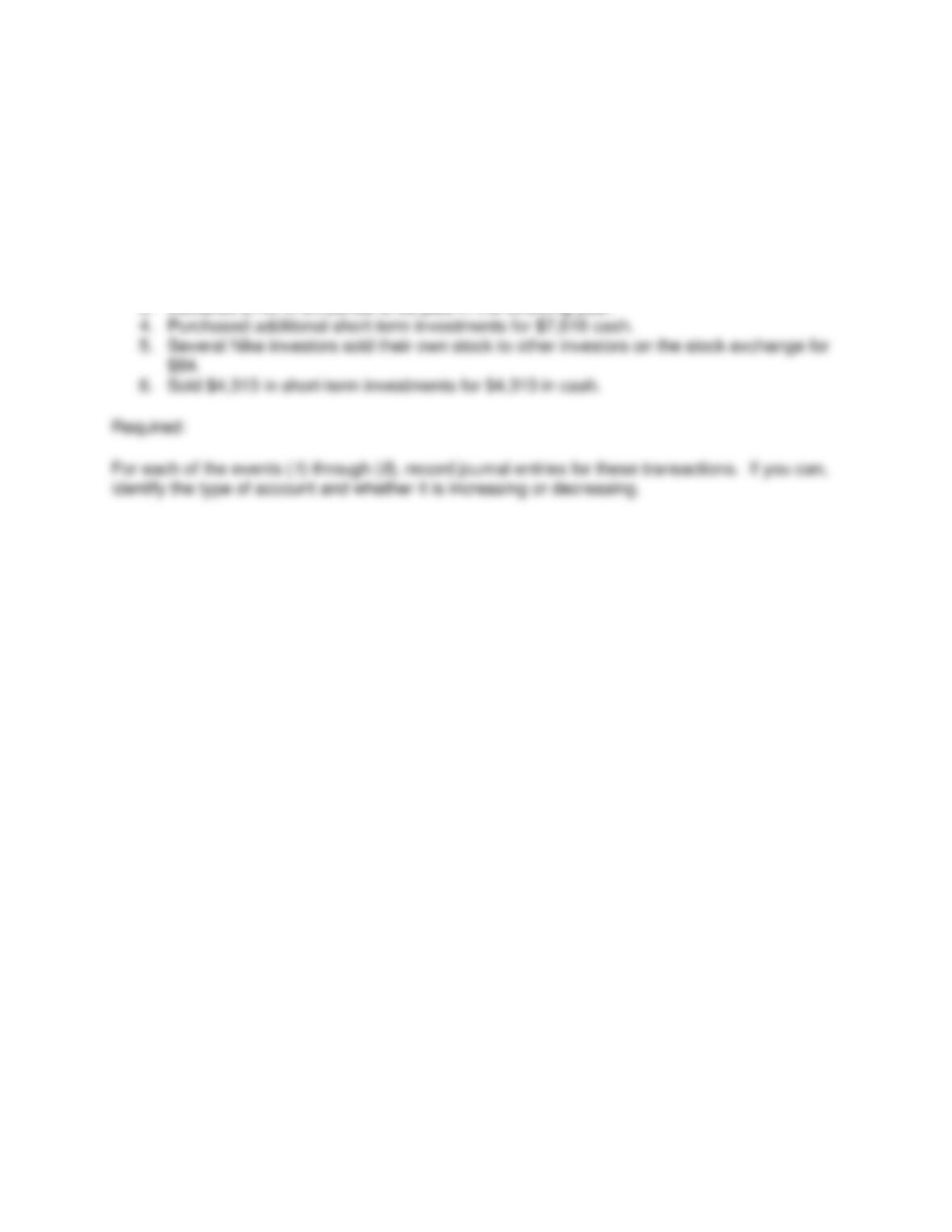
1. Purchased additional buildings for $172 and equipment for $270; paid $432 in cash and
signed a long-term note for the rest.
2. Issued 100 shares of $2 par value common stock for $345 cash.