Worked Examples for Chapter 17
Example for Section 17.4
A queueing system has two servers whose service times are independent random
variables with an exponential distribution with a mean of 15 minutes. Customer X
arrives when both servers are idle. Five minutes later, customer Y arrives and customer
X still is being served. Another 10 minutes later, customer Z arrives and both customer
X and Y are still being served. No other customer arrived during this 15-minute
interval.
(a) What is the probability that customer X will complete service before customer
Y?
By Property 2 of the exponential distribution (the lack-of-memory property) given in
Sec. 17.4, when customer Y arrives, the remaining time until customer X completes
service has the same distribution as the service time for customer Y, so they are equally
likely to finish first. Thus, the probability that customer X will complete service before
customer Y is 0.5.
(b) What is the probability that customer Z will complete service before customer
X?
Customer Z cannot begin service until either customer X or customer Y completes
service. Given that customer Y completes service first (which has probability 0.5 from
part (a)), then the reasoning of part (a) implies that the probability that customer Z
completes service before customer X is 0.5. Therefore, the unconditional probability
that customer Z will complete service before customer X is 0.5(0.5) = 0.25.
(c) What is the probability that customer Z will complete service before customer
Y?
By the same reasoning as in part (b), the probability that customer Z will complete
service before customer Y is 0.5(0.5) = 0.25.
(d) Determine the cumulative distribution function of the waiting time in the
system for customer X. Also determine the mean and standard deviation.
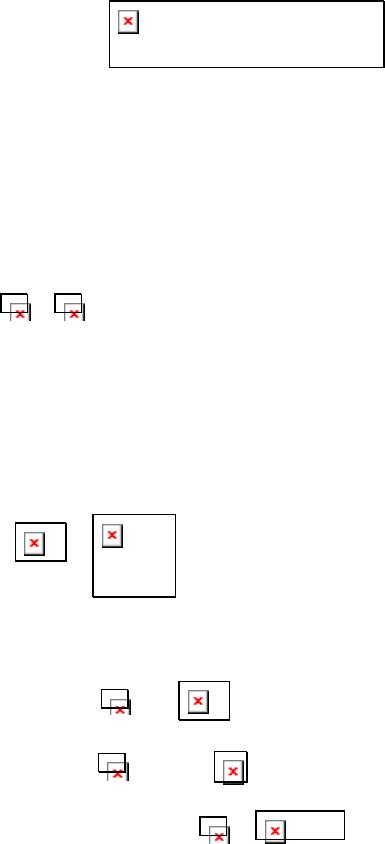
We are given that customer X has not completed service after 15 minutes. By Property
2, the remaining time until service is completed still has an exponential distribution
with a mean (and standard deviation) of 15 minutes. Therefore, in units of minutes, the
CDF of the waiting time in the system for customer X is
P{T ≤ t} = .
Since the remaining time after 15 minutes has a mean and standard deviation of 15
minutes, the mean of the total time is 15 + 15 = 30 minutes. The first 15 minutes are a
fixed constant, so the standard deviation of the total time continues to be the standard
deviation of the remaining time, namely, 15 minutes.
(e) Repeat part (d) for customer Y.
The reasoning is the same as for part (d), except now the given time without completing
service is 10 minutes instead of 15 minutes.
Therefore,
P{T ≤ t} = .
The mean is 10 + 15 = 25 minutes and the standard deviation is 15 minutes.
(f) Determine the expected value and standard deviation of the waiting time in the
system for customer Z.
The waiting time in the system for customer Z is
= q + T,
where Wq is the waiting time in the queue and T is the service time. The waiting time in
the queue is the time until either customer X or customer Y completes service after
customer Z arrives. By Properties 2 and 3 in Sec. 17.4, this time until either customer X
or customer Y completes service after customer Z arrives has an exponential
distribution with a mean (and standard deviation) of
E = = 7.5 minutes.
Consequently, since E (T) = 15 minutes and Var (T) = (15)2,
E( ) = E + E(T) = 7.5 + 15 = 22.5 minutes,
Var ( ) = Var ( + T) = (7.5)2 + (15)2 = 281.25,
so the standard deviation of is = 16.77 minutes.
(g) Determine the probability of exactly 2 more customers arriving during the next
15-minute interval.
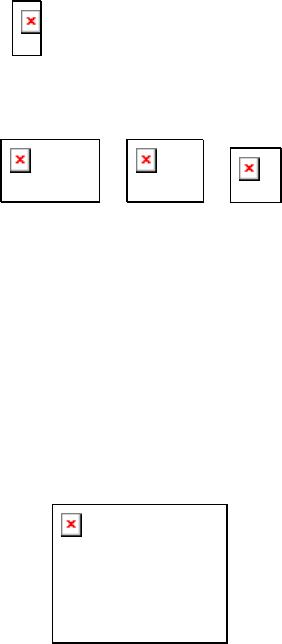
By Property 4 in Sec. 17.4, we can simply use the Poisson distribution with a mean of
E{X(t)} = t = (15) = 1
to find the probability of 2 arrivals,
P{X(t) = 2} = = = 0.1839.
Example for Section 17.5
Consider a single server queueing system where some potential customers balk (refuse
to enter the system) and some customers who enter the system later get impatient and
renege (leave without being served). Potential customers arrive according to a Poisson
process with a mean rate of 4 per hour. An arriving potential customer who finds n
customers already there will balk with the following probabilities:
P{balk | n already there} =
Service times have an exponential distribution with a mean of 1 hour.
A customer already in service never reneges, but the customers in the queue
may renege. In particular, the remaining time that the customer at the front of the queue
is willing to wait in the queue before reneging has an exponential distribution with a
mean of 1 hour. For a customer in the second position in the queue, the time that she or
he is willing to wait in this position before reneging has an exponential distribution
with a mean of 1/2 hour.
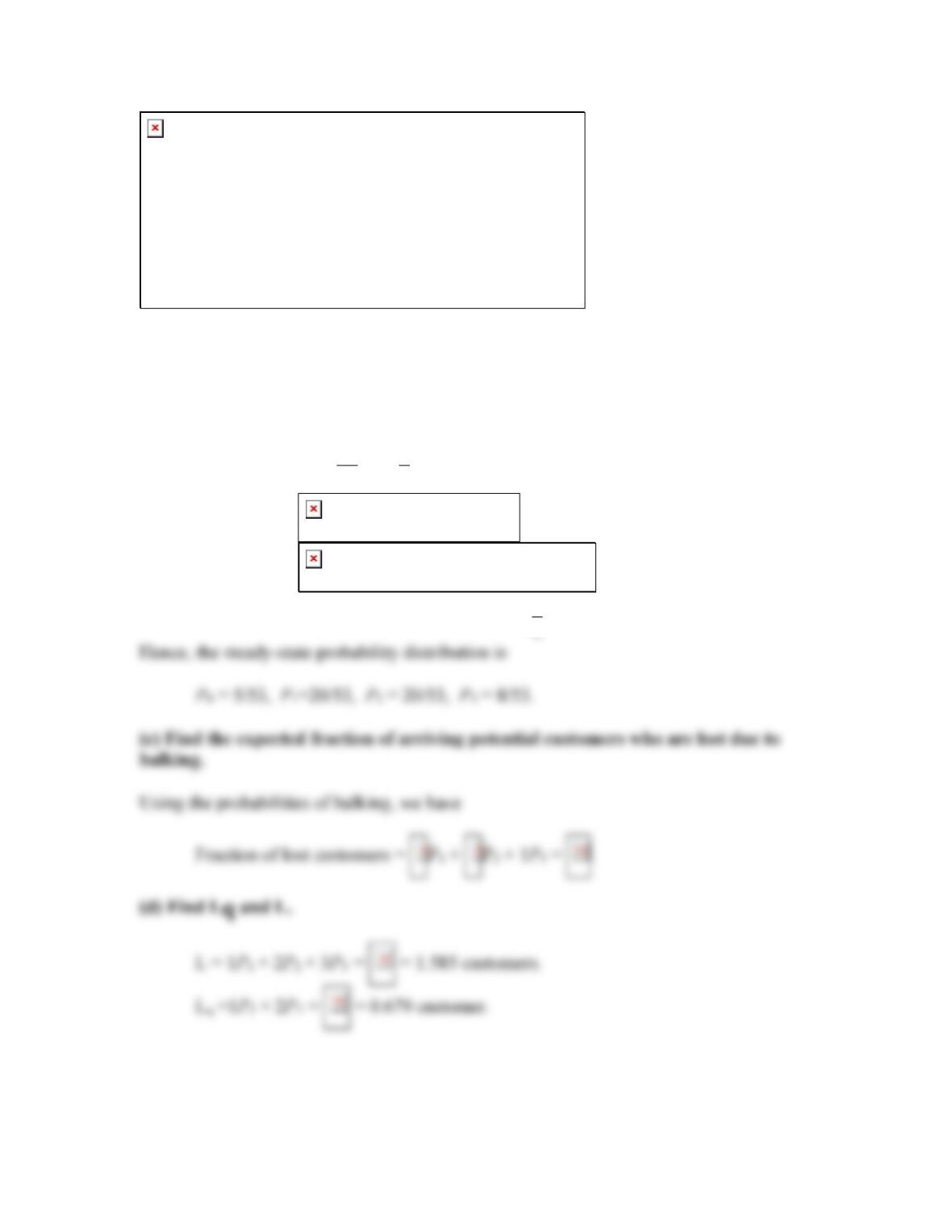
(a) Construct the rate diagram for this queueing system.
The rate diagram is shown next.
(b) Obtain the steady-state distribution of the number of customers in the system.
Using the general solution for the steady-state distribution given in Sec. 17.5, we use
the following equations to obtain this distribution for this system:
000
1
0
14
1
4PPPP ===
,
.1)
8
441( 03210 =+++=+++ PPPPP