Additional questions for chapter 4
1. A stock price is currently $100. Over the next two six-month periods it is expected
to go up by 10% or go down by 10%. The risk-free interest rate is 8% per annum
with continuous compounding.
(i) What is the value of a one-year European call option with a strike price of $
100.
(ii) What is the value of a one-year European put option with a strike price of $
100.
(iii) Verify that the European call and the European put satisfy put-call parity.
Solution:
Parameters are u= 0.1, d =−0.1,1 + r=e0.5×0.08. So the risk-neutral probability is
p∗= 0.7. After evaluation of the options at the terminal nodes we use the risk-neutral
valuation to get (i)
πC(0) = e−2(0.5×0.08) £0.72×21 + 2 ×0.7(1 −0.7) ×0 + (1 −0.7)2×0¤= 9.61
and (ii)
πP(0) = e−2(0.5×0.08) £0.72×0+2×0.7(1 −0.7) ×1 + (1 −0.7)2×19¤= 1.92
(iii) For put-call parity one has to verify S−πC+πP=Ke−r, here :
100 −9.61 + 1.92 = 100e−0.08.

2. Assume a standard 3-period CRR binomial model. The price of the stock is currently
$100. The risk-free interest rate with continuous compounding is 6% per annum.
Over the next three 4 month periods, the stock is expected to go up by 8% or go down
by 7% in each period.
(a) What is the value of a one-year European call with strike price $103?
(b) What is the value of a one-year European put with strike price $103?
(c) Verify the Put-Call parity for the European call and the European put.
Solution:
We first calculate the Martingale probability in the tree. We get
p=r−d
u−d=e0.06/3−1+0.07
0.08 + 0.07 = 0.6013423
(a) The tree for the call option looks as follows:
time t= 0
S=100
C=6.93 ´´
´108
10.503
QQ
Q93
1.9022
t= 1/3
©©
©
116.64
15.679
HH
H100.44
3.2272
©©
©
HH
H86.49
0
t= 2/3
©©
©125.97
22.97
HH
H
©©
©
108.475
5.475
HH
H
©©
©
HH
H
93.409
0
80.435
0
t= 1
(b) The tree for the put option is:
time t= 0
S=100
C=3.936
´´
´108
1.46448
QQ
Q93
7.8635
t= 1/3
©©
©
116.64
0
HH
H100.44
3.7477
©©
©
HH
H86.49
14.47
t= 2/3
©©
©125.97
0
HH
H
©©
©
108.475
0
HH
H
©©
©
HH
H
93.409
9.5908
80.435
22.5643
t= 1
(c) The Put-Call parity holds:
C−P= 6.9342−3.936 = 2.9982 = 100−103e−0.06 = 100−97.0017 = S−Ke−rT .

3. Consider a 3-period Cox-Ross-Rubinstein model. The annual interest rate is r= 0.05
(discrete), u= 0.1and d=−0.1. The initial price of the stock is S(0) = 100. The
time horizon is T= 3 years.
(a) Calculate the risk-neutral probability and the stock prices at each node in the
binomial tree (correct up to 2 decimal places after the decimal point).
(b) Calculate the value of the European option with payoff
P(T) =
sup
0≤t≤T
St−STSt<110 ∀t
0otherwise
(c) Find a replicating portfolio for the above option for the first trading period.
Solution:
(a) For the risk-neutral probability we get p=r−d
u−d=3
4. The tree with the stock
prices and the value of the option is
time t= 0
S=100
P=1.25 ££££££££
£
110
0
BBBBBBBB
B90
5.24
t= 1/3
121
0
JJJJ
J99
0
99
2.595
JJJJ
J81
14.23
t= 2/3
½½
½133.1
0
ZZ
Z108.9
0
½½
½108.9
0
ZZ
Z89.1
0
½½
½108.9
0
ZZ
Z89.1
10.9
½½
½
89.1
10.9
ZZ
Z72.9
27.1
t= 1
(b) The replicating portfolio can be found by solving the equations
1.05 ·ϕ1+ 110 ·ϕ2= 0
1.05 ·ϕ1+ 90 ·ϕ2= 5.24
As solution we get ϕ1= 27.45 and ϕ2=−0.262.
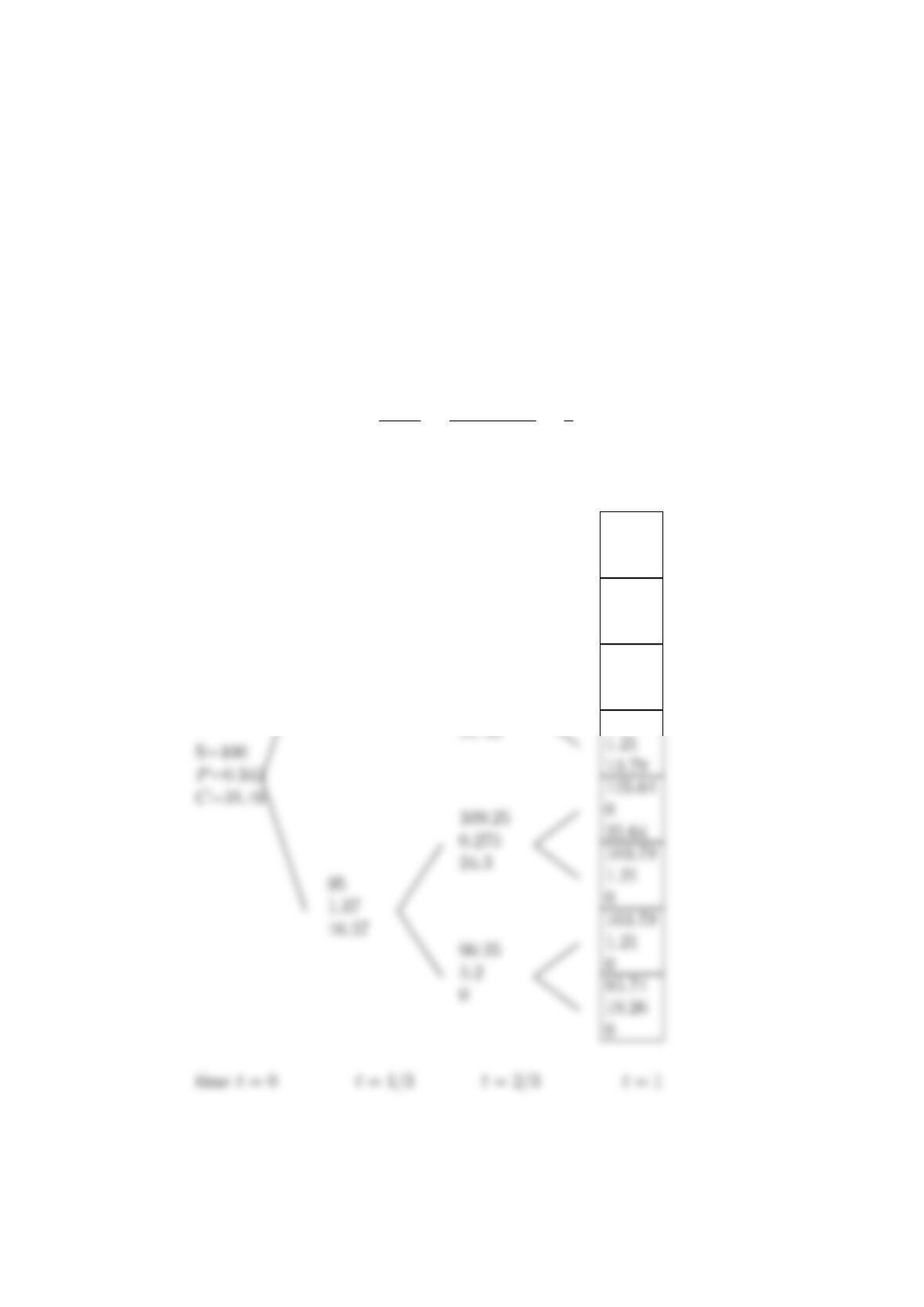
4. Construct a three period binomial tree using the parameters r= 0.1(discrete, per
period), u= 0.15,d=−0.05 and S0= 100.
(a) Find the price of a European Put Pwith strike 105 and maturity date T= 3.
(b) Find the price of the knock in Call option Cwith knock in level H= 110, strike
K= 90 and maturity date T= 3, i.e.
C=((S(T)−90)+∃t:St> H = 110
0St≤H= 110 ∀t.
Solution:
The risk neutral probability is
p=r−d
u−d=0.1+0.05
0.15 + 0.05 =3
4
We first set up a tree with the stock price movements, then compute the values of
the two options:
£
115
0.0625
40.62
132.25
0
50.43
JJJJ
J
109.25
0.275
½½
½
152.09
0
62.09
ZZ
Z125.64
0
35.64
½½
½
125.64
0
35.64
ZZ