ABSTRACT
This project is totally dedicated to the fresh Network Engineer for new and smart learning of the
Network Structure. In this concept it is possible for the networker to check the incoming & the
outgoing traffic and to maintain some security concepts as well. In this logic we use the multiple
Routing Protocols in different areas of the countrywide WAN. Now it will show the proper
movement of the packet from one part of the country to the other part of the country. The project
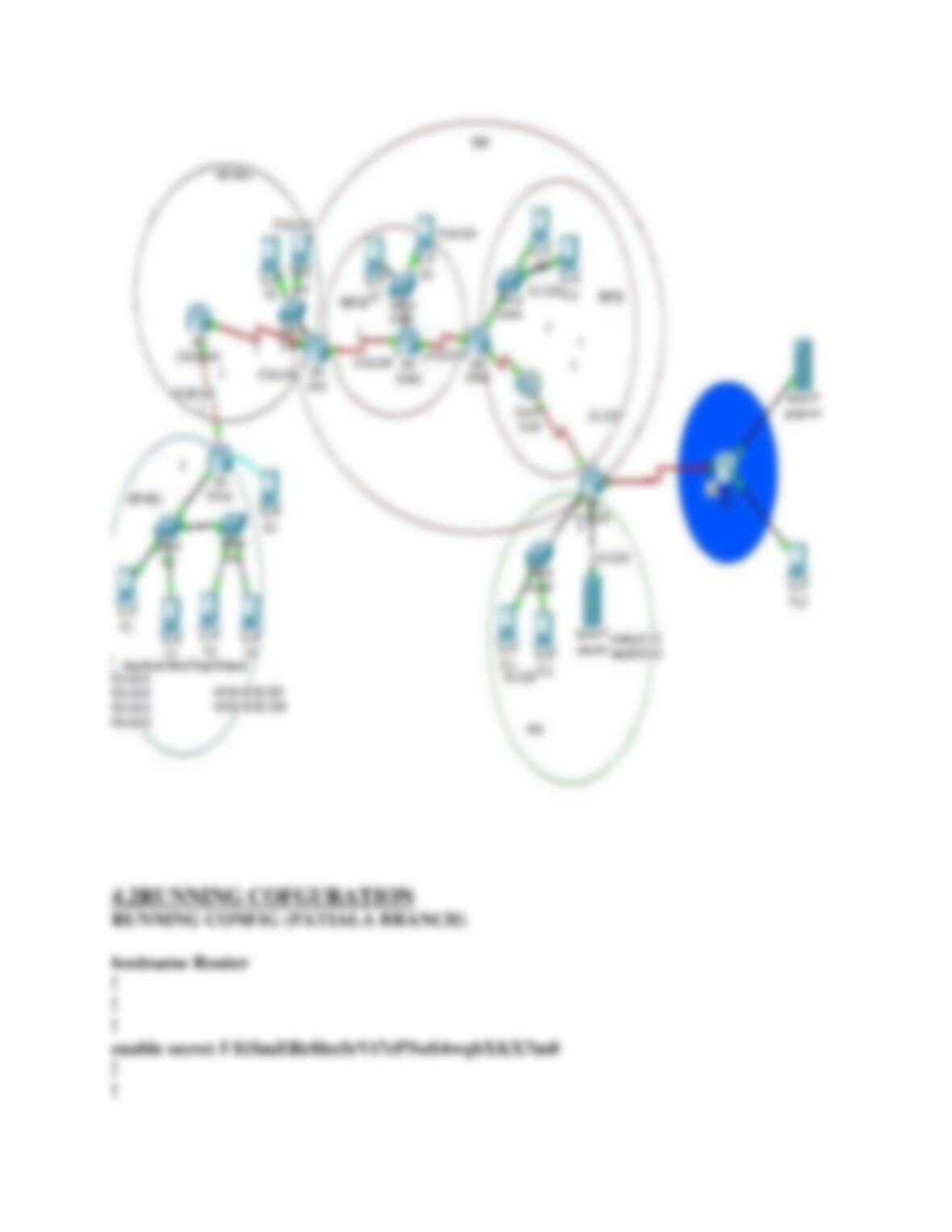
starts working from Northern India. The user who is sitting at Patiala location need to access
Cisco server in bangalore. The project explains that how from Patiala location’s computer, the
packet moves out and reaches the Patiala’s Local ISP. From Patiala the WAN comes into action
and reaches Chandigarh followed by Delhi following the OSPF Multi-area concept. The Packet
flows out of Delhi towards the western Region of the country including Gujrat & Maharashtra
while following the EIGRP, The multiple Administrative Unit. The Packet moves out of the
West India and reaches the South-Western Part of India, Bangalore & Southern Part of India by
following Frame-Relay Switch Technology. The Bangalore’s Local ISP make the packet
reachable to the CISCO server. The Google webserver can be accessed at the Southern Part of
India as well.
The concept of Access Control List (ACL), Network Address Translation (NAT), and
Redistribution has also been applied along with the different Routing Protocols which have
been used including Routing Information Protocol (RIP), Open Shortest Path First (OSPF) &
Enhanced Interior Gateway Routing Protocol (EIGRP) as well.

A Seminar Report
on
Wide Area Network
Submitted by
_______
In partial fulfillment for the award of the completion
Of
Cisco Certified Network Associate
At
Network Bulls Private Limited.
Gurgaon
On
—st December 2056
UNDER THE GUIDANCE OF
_______
_________
SUBMITTED BY: ________
ACKNOWLEDGEMENT
Before we get into the actual report, we would like to express our gratitude to all those who
helped us in shaping up this project. In numerous ways, people who gave unending support right
from the start.
We would like to thank Mr. _______whose guidance and stimulating suggestions helped me
conceive the idea of the project.
We would also like to thankour project coordinator Mr. (_______) and our guide Mr. (_______),
for their encouragement, support and perseverance shown during the course of my project.
We would also like to take this opportunity to thank our teachers for their continued
understanding, active involvement, inspiration and patience.
Submitted By:
________
NAME OF THE COLLEGE
CERTIFICATE FROM SUPERVISOR
This is to certify that the project entitled “WIDE AREA NETWORK” which is being
submitted by _______ to the Department Of Computer Science Engineering, (COLLEGE
NAME) College Of Engineering, Gurgaon, in partial fulfillment of requirement of the certificate
of Summer Training Program/Internship in (Cisco Certified Network Engineer) is a record of
bona fide work carried out by him under my guidance and supervision.
Mr. _______(PROJECT GUIDE)
Lecturer
Department of Computer ScienceEngineering
_____ College of Engineering
Ms. _______ (PROJECT COORDINATOR)
Lecturer
Department of Computer ScienceEngineering
_____ College of Engineering
Dr. _______(HEAD OF DEPARTMENT)
Professor
Department of Computer ScienceEngineering
_____ College of Engineering
CERTIFICATE FROM STUDENT
This is to certify that the work embodied in this project entitled “Wide Area Network”
submitted to the Department of Computer Science & Engineering, ____ College of Engineering,
Gurgaon for the fulfillment of the requirement for the award of Degree of “Summer Training in
Cisco Certified Network Engineer” is my authentic record of my work carried out and written by
me under the direct supervision and guidance of Mr. ____ (Department of Computer Science
Engineering) and also to Mr. ____ (Department of Computer Science Engineering).
Submitted By:
_______
NAME OF THE COLLEGE
Chapter 1
INTRODUCTION
Here are some ideas of projects in the Networking area. Some of these are new, and
some are ideas that have run before but could be run again. Note that, unlike the
normal project ideas, these ideas do not have a contact listed against them. They are
there to give you ideas of the sort of things that could be done. If a project idea
seems interesting, and you would like to pursue it further, then you should discuss it
with one of the lecturers who are experienced in the Networking area: Bill Buchanan,
Gordon Russell, Ahmed Al-Dubai, Imed Romdhani, Jim Jackson, Robert Ludwiniak
or Neil Urquhart. They may not be able to help you directly, but will at least be able to
point you to somebody better placed, perhaps because their specialist knowledge is
in the area of the project.
This introduces the underlying concepts behind networking using the
Internet and its protocols as examples. There are two goals:
(1) to give you an understanding of how networks, especially the Internet, work,
(2) to teach you network programming.
We will cover the first five chapters of Kurose in detail, working our way down
the network stack from the application layer to the data-link layer. Concurrent
with the lectures, you (in groups of two) will be building a functional TCP/IP
stack and a small web server that will run on it. What you build will be “real” –
your code will interoperate with other TCP/IP stacks and you’ll be able to talk to
your web server using any browser on any TCP/IP stack.
This is a learn-by-doing kind of class. You will get your hands dirty by
examining parts of our Internet infrastructure and building other parts. It will be
a lot of work, but it will also be a lot of fun, provided you enjoy this sort of thing.
We will assume that you do and that you will make a good faith effort. We don’t
want to have to spend too much time measuring your performance. If you care
about what we’re teaching, you’ll do a better job of that yourself, and if you don’t
care, then you should take some course that you do care about.
The goal of the networking project is to enable you to do the following:
Build implementations of the Internet protocols
Generalize this knowledge to other networking protocols.
Be a competent network and systems programmer.
Think like a networking practitioner
Read and judge articles on networking in trade magazines
Begin to read and judge research and technical articles on networking
Create simplicity and reliability out of complexity and unreliability
Structure and design software systems to achieve that simplicity and
Reliability

Chapter 2
Project Specification
2.1 Hardware Specification
CPU Speed :2GHz recommended or higher
Processor :Pentium Processor or above
Memory/RAM: 1GB minimum,2GB recommended or higher
Display Properties: Greater than 256 color depth
Size of Hard Disk:60 GBminimum
NIC Card
2.2 Software Specification
Software Used: Packet Tracer 5.3.2
Operating System: Microsoft Windows XP,Vista,7
2.2.1Packet Tracer
Packet Tracer is a Cisco router simulator that can be utilized in training and education, but also