Critical Thinking Final Paper
Topic: Which one should take priority at present in China, environmental
protection or economic development?
Affirmative
THBT in China, economic development should take priority than environmental
protection at present.
Introduction
One of the most famous principles of Marxist Philosophy said: “Economic
basis determine superstructure”1, in this sentence, economic basis including
productivity and production relations, especially the level of economic development.
The so called superstructure is the sum of various kinds of social system、state
facilities and ideology. This principle tries to explain the decisive role of the economy.
There is no doubt, this doctrine not only applies to the time when Marx lived, it’s also
applies today.
Thirty years ago, China started to open the closed national door and
integration into the world. Before that, this country living under the shadow of
complete planned economy, a popular saying of that time is even the price of toilet
paper and toothpick was taken by the central government. In the operation of
economy, the government controlled everything. After the Reform and Opening
police, everything in this country has experienced an earth-shaking change. One of
Deng Xiaoping’s well-known saying began take deep root in the heart of common
people since that time: “Economic development is the absolute truth.” 2 China today’s
achievement due to the last thirty years’ high speed economy development, and this
development also helps the world a lot.
At the same time, many social problems also exist, compared to environment
problem, these problems are much more in demand at present. For example, today,
China faces too much difference between the rich and the poor, this problem is caused
by the economy underdeveloped, to solve this problem, there is no
doubt, it should further develop and improve the process. Besides, China has the
largest amount popularity in the world, still many poor areas need help, a lot of people
still live under the poverty line; The aging of the society is becoming more and more
serious; because of the One Child Policy, now the society is facing the potential lack
1
1. 、Basic Principles of Marxism、 Chapter three. By Peking University Press
2. 、Deng Xiaoping and the start of the reform and open policy、 Preface. The
history of the Party Press.
2

of labor, in some southern regions, the factories have to hire unlawful labors 3from
Vietnam and other southeast Asian nations; and it’s still a developing country,
compared to Korea and Japan, the per capita economic level is not high; at present,
especially during the worldwide economic recession time, though China is so called
world factory, the economy also be battered seriously, the economy is facing
downside risks to growth.
Compared to these problems, environment protection is not the main
contradictory problem. Apparently, there is no excuse to slow down the economic
speed; China should focus on economic construction. The purpose of this policy paper
is to explain why economy development is the urgent affair and why it should take
priority than environmental protection at present.
Definition of Terms
Economic recession
In economics, a recession is a business cycle contraction, a general
slowdown in economic activity.3 Macroeconomic indicators such as GDP,
employment, investment spending, capacity utilization, household income, business
profits, and inflation fall, while bankruptcies and the unemployment rate rise.
Recessions generally occur when there is a widespread drop in spending, often
following an adverse supply shock or the bursting of an economic bubble.
Governments usually respond to recessions by adopting expansionary macroeconomic
policies, such as increasing money supply, increasing public spending and decreasing
taxation.4 More generally, economic recession means the rate of economic growth
slows down, and the amount of available money for the public sector or our individual
families decreased.
Economic inequality
Economic inequality (also known as the gap between rich and poor, income
inequality, wealth disparity, or wealth and income differences) comprises disparities
in the distribution of economic assets and income within or between populations or
3
3. ^ “Recession”. Merriam-Webster Online Dictionary. http://www.merriam-
webster.com/dictionary/recession. Retrieved 19 November 2008.
4.The explanation of economic recession comes from
http://en.wikipedia.org/wiki/Recession
4

individuals. The term typically refers to inequality among individuals and groups
within a society, but can also refer to inequality among countries. The issue of
economic inequality is related to the ideas of equity, equality of outcome and equality
of opportunity.5 Observers differ on both the morality and utility of inequality,
whether, and/or how much inequality is necessary in society and how it can be
affected. It has been praised as necessary and beneficial, and attacked as a social
problem.6 We often use the shape of pyramid metaphor for the difference between the
income inequalities among each social stratum.
Take priority
Priority means “1.the condition of being prior; antecedence; precedence; or
2.the right of precedence over others; 3. something given specified attention; 4. Status
established in order of importance or urgency. ” 7 In this paper, it can be taken as A is
much more important than B vulgarly.
Developing country
According to the International Monetary Fund’s World Economic Outlook
Report, April 2012, China is one of the members in the list of developing countries. A
developing country, also known as a less-developed country (LDC), is a nation with a
low living standard, undeveloped industrial base, and low Human Development Index
(HDI) relative to other countries.8 The World Bank classifies countries into four
income groups, according to 2008 GNI per capita; China was in the penultimate rank,
which said: “Lower middle income countries had GNI per capita between US$1,006
and US$3,975.” 9
Policy
55.http://en.wikipedia.org/wiki/Income_gap
66. Wilkinson, Richard; Pickett, Kate (2009). The Spirit Level: Why More Equal
Societies Almost Always Do Better. Allen Lane. pp. 352. ISBN [[Special:
BookSources/1-84614-039-6|1-84614-039-6]].
7. http://www.thefreedictionary.com/priority
78. ^ Farlex Financial Dictionary. “Financial Definition of less-developed country”.
TheFreeDictionary.com. Farlex, Inc. http://financial-
dictionary.thefreedictionary.com/less-developed+country. Retrieved 18 November
2011.
8
99. “How we Classify Countries”. World Bank.
data.worldbank.org/about/country-classifications. Retrieved September 25, 2010.
10. http://news.xinhuanet.com/newscenter/2005-01/16/content_2467918.htm
11. Gini, C (1909) Concentration and dependency ratios (in Italian). English
translation in Rivista di Politica Economica, 87 (1997), 769-789.
12. Gini, C. (1936) On the Measure of Concentration with Special Reference to
Income and Statistics, Colorado College Publication, General Series No. 208, 73-79.
Harm 1- The gap between rich and poor is becoming larger.
Thirty years ago, most common Chinese people were living in the situation called
widespread poverty, in economic status, everybody seems equal; and in that time, the
government took central planning policy, just like today’s North Korea. When the
country began to practice the reform and opening policy, one slogan by Deng
Xiaoping was very deeply into the human mind: “I have consistently maintained that
some people and some regions should be allowed to prosper before others, always
with the goal of common prosperity.”10 After that, Shenzhen Special Economic Zone,
Shanghai Pudong New Area arisen one by one in eastern coastal zone. Many people
especially lived in coastal areas caught the opportunity, gradually become rich.
At the same time, a lot of citizens lived in remote and rural areas or vulnerable
groups in the society still stumbled. During the last thirty years’ high speed
development, the gap between rich and poor is becoming larger and larger. Now, the
slogan by Deng is disputed continuously, some extremists changed the sentence
to:”Some people and some regions should be allowed to prosper before others, then,
the rich kill the poor, so we can reach the goal of common prosperity.” This problem
has caused many mass incidents these years. Here, we adopt the Gini coefficient as
our reference standard.
“Gini coefficient” also known as the Gini index or Gini ratio, it’s a measure of
statistical dispersion developed by the Italian statistician and sociologist Corrado Gini
and published in his 1912 paper “Variability and Mutability“.11 It is commonly used as
a measure of inequality of income or wealth.12
10
11
12
13 http://baike.baidu.com/view/186.htm
、、、、
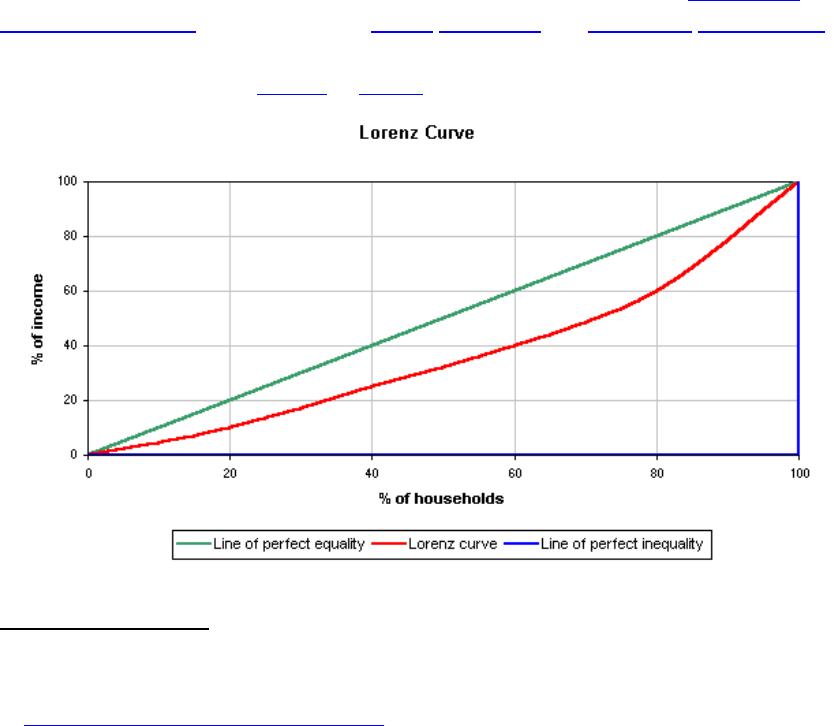
The Gini coefficient measures the inequality among values of a frequency
distribution (for example levels of income). A Gini coefficient of zero expresses
perfect equality where all values are the same (for example, where everyone has an
exactly equal income). A Gini coefficient of one (100 on the percentile scale)
expresses maximal inequality among values (for example where only one person has
all the income).14
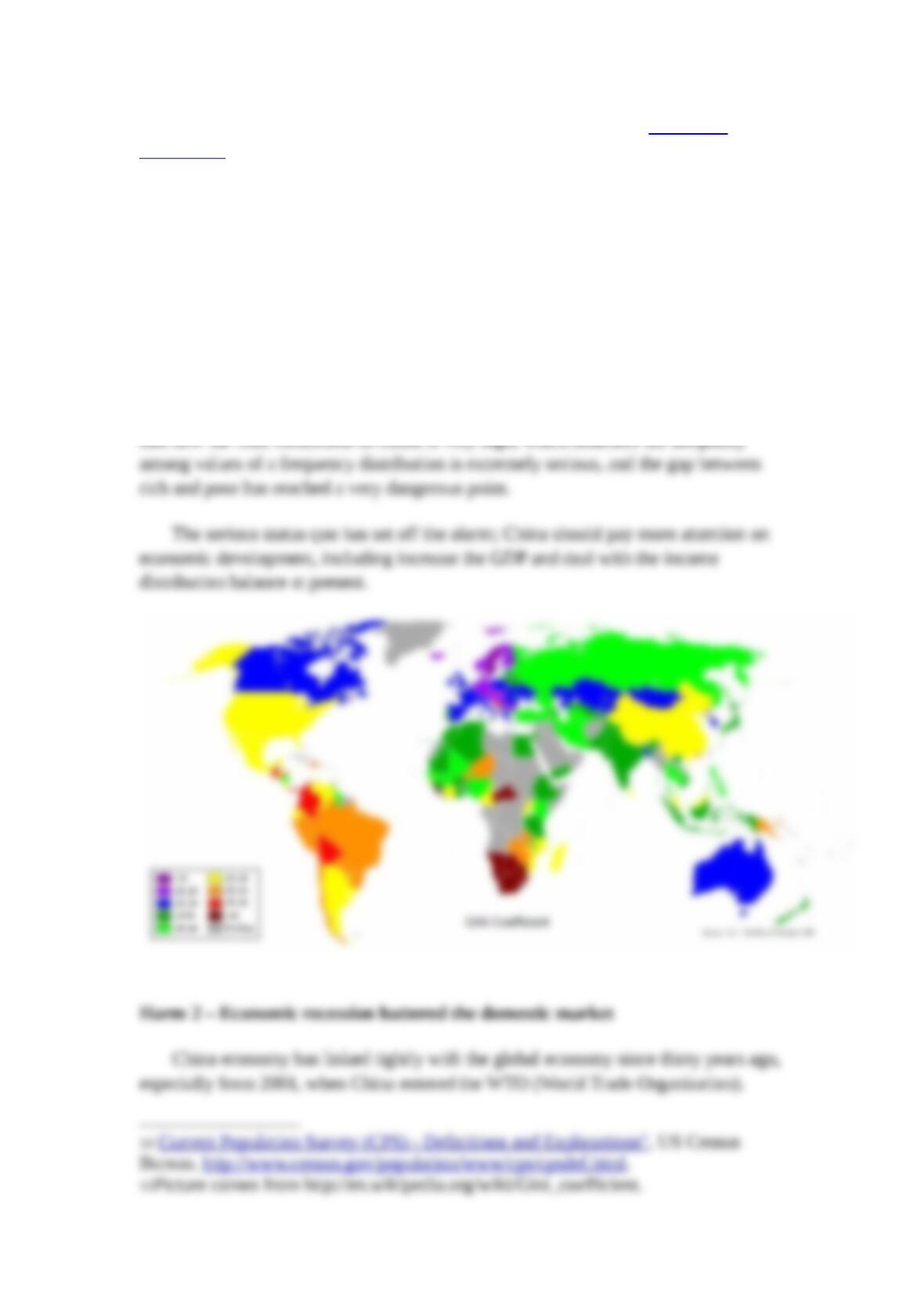
According some related organizations of UN, if the number lower than 0.2, that
means the income is absolute average; if the number is between 0.2-0.3, that means
relatively average; if the number is between 0.3-0.4, that means relatively reasonable;
if it’s between 0.4-0.5, that means gap is big; when it’s higher than 0.5, that means
great disparity. Through the following map, we can find the situation of some
countries clearly. The yellow part, 0.45-0.49, which is included in 0.4-0.5, it shows