Demography
Lecture-6
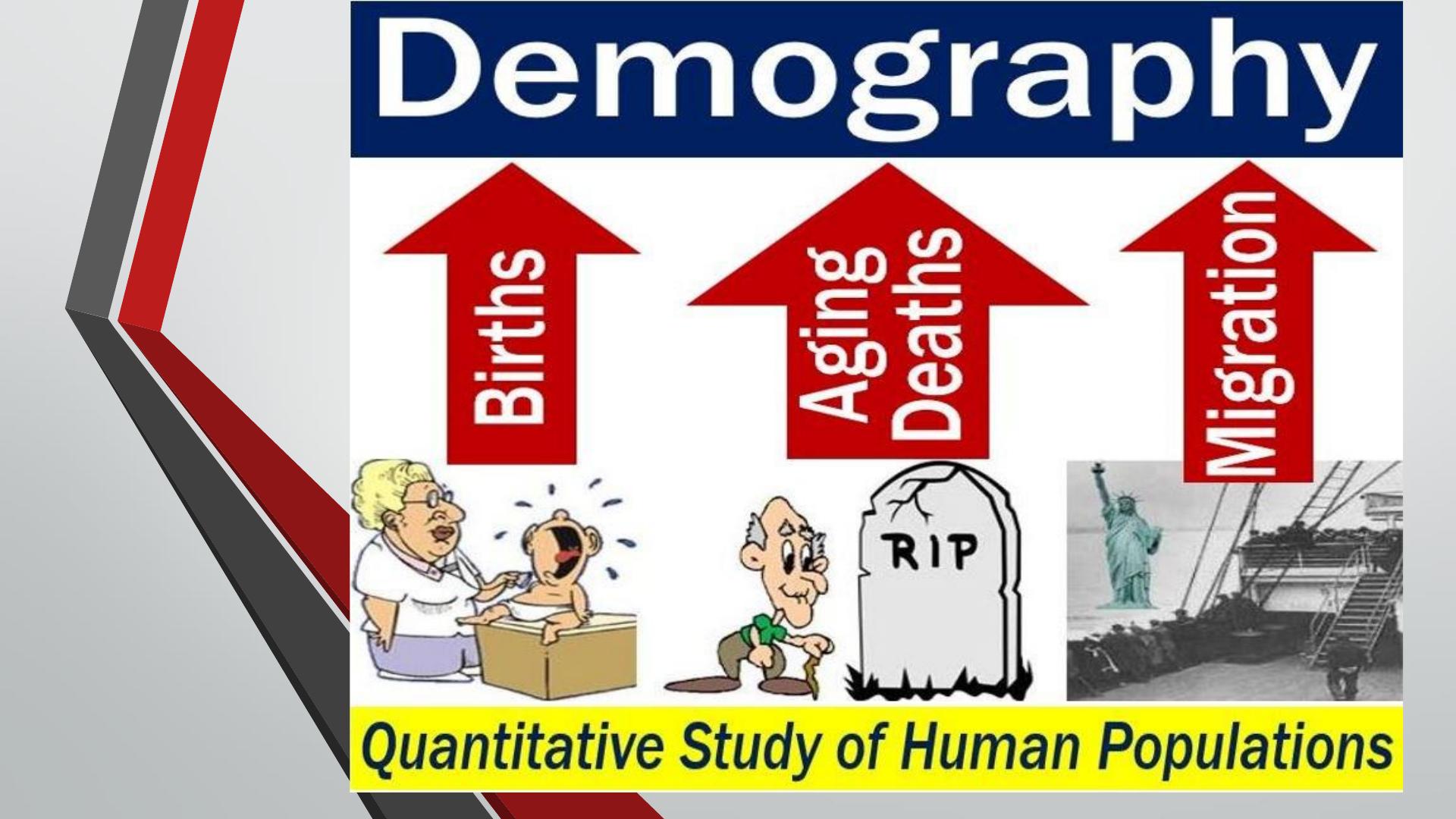

What is Demography?
•The word ‘ Demography’ derives from the Greek words ‘Demo’ meaning
People and ‘Graphy’ meaning writing, drawing or measuring.
•Demography is the scientific study of human population, primarily to their
size, structure and changes therein.
•Population change is mainly affected by these variables, fertility( birth),
mortality( deaths), migration and income.
•These are the these components of most interest to demographers.

Explanation:
•Demography also includes the study of disease incidences, marriages, and
migration. It mainly focuses on data that illustrates the changing structure of
human populations.
•Demographers analyze dynamic living populations. In other words, populations
that change over time.
•Population studies , it is not only deals with levels and changes in the size,
composition and distribution of the population but also with the causes and
consequences of the levels and changes.
•In this wider perspectives demography overlaps with a number of other disciplines
such as economics, sociology, law, political science, health and productive
physiology.

Demographic transition theory:
•Theory of Demographic Transition is a theory that throws light on changes in birth rate and
death rate and consequently on the growth-rate of population.
•Along with the economic development, tendencies of birth-rate and death rate are different.
•Demographic transition refers to a population cycle that begins with a fall in the death rate,
continues with a phase of rapid population growth and concludes with a decline in the birth
rate”-E.G. Dolan.