Reflections on the Fear of Death
What is death?
Biological definitions: “brain death”
Historical difficulties with determining death conclusively
For the present discussion, let’s assume death involves not only the permanent termination of
the agent’s biological functions but also the permanent termination of any and all conscious
awareness in the agent’s mind
Let’s focus upon our individual psychological attitudes toward OUR OWN deaths, as opposed to
our attutudes towards the death of others around us
What should be our mental attitude toward our own inevitable death? One of fear? Acceptance?
Anticipation?
1. Epicurus’ (341–270 BC) philosophy on death:
Accustom yourself to believing that death is nothing to us, for good and
evil imply the capacity for sensation, and death is the privation of all
sentience; therefore a correct understanding that death is nothing to us
makes the mortality of life enjoyable, not by adding to life a limitless
time, but by taking away the yearning after immortality. For life has no
terrors for him who has thoroughly understood that there are no terrors
for him in ceasing to live. Foolish, therefore, is the man who says that
he fears death, not because it will pain when it comes, but because it
pains in the prospect. Whatever causes no annoyance when it is present,
causes only a groundless pain in the expectation. Death, therefore, the
most awful of evils, is nothing to us, seeing that, when we are, death is
not come, and, when death is come, we are not. It is nothing, then,
either to the living or to the dead, for with the living it is not and the
dead exist no longer.
This approach is NOT arguing that it is irrational to fear a painful illness as it leads to death; it is
perfectly rational to fear THAT, and take steps (e.g. staying healthy) to prevent that sort of
condition from happening. Rather, where we go wrong according to Epicurus, is when we
imagine death itself to be a negative experience for the person who has died (e.g. in terms of
suffering or mental anguish over what they’ve left behind etc.) but in reality, once death occurs,
the conscious self is no longer present to feel or “miss” ANYTHING that happens subsequent to
death!
Thomas NAGEL’s consideration of Epicurus sheds light on what it might mean to say that
something is a “bad” or “evil” thing in relation to a person.
Consider: Is a LIE only BAD for someone once that person DISCOVERS the lie, or only because
that discovery makest hem UNHAPPY? Or might X be OBJECTIVELY be BAD for an individual
person P without P ever being aware of X’s existence?
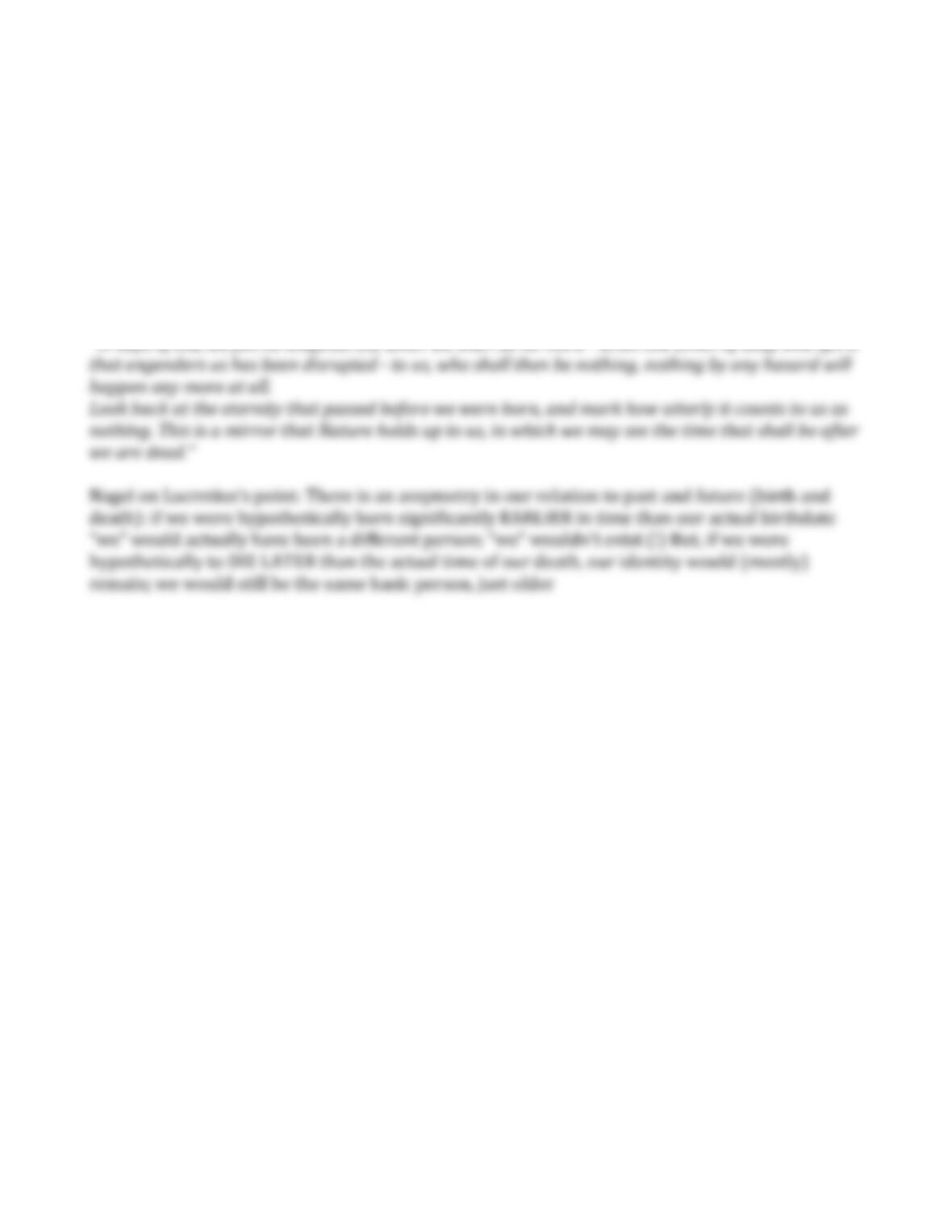
Brings up the issue of whether there could be OBJECTIVELY good or bad things: can something
be BAD for someone who is not around to appreciate the (alleged) BADNESS of the thing?
Can a dead person be harmed? (example of someone breaking a deathbed promise)
• But WHO is hurt by that action? The person that existed in the past (but not any
longer)?
A psychological issue with death: life SEEMS infinite, open-ended; we are not (always) acutely
aware that it will have an ending (let alone WHEN that ending will come), as we are when
reading a book or listening to a song. Death is a BAD thing in this light then because it abruptly
“cancels” indefinitely many possible future good things to come.
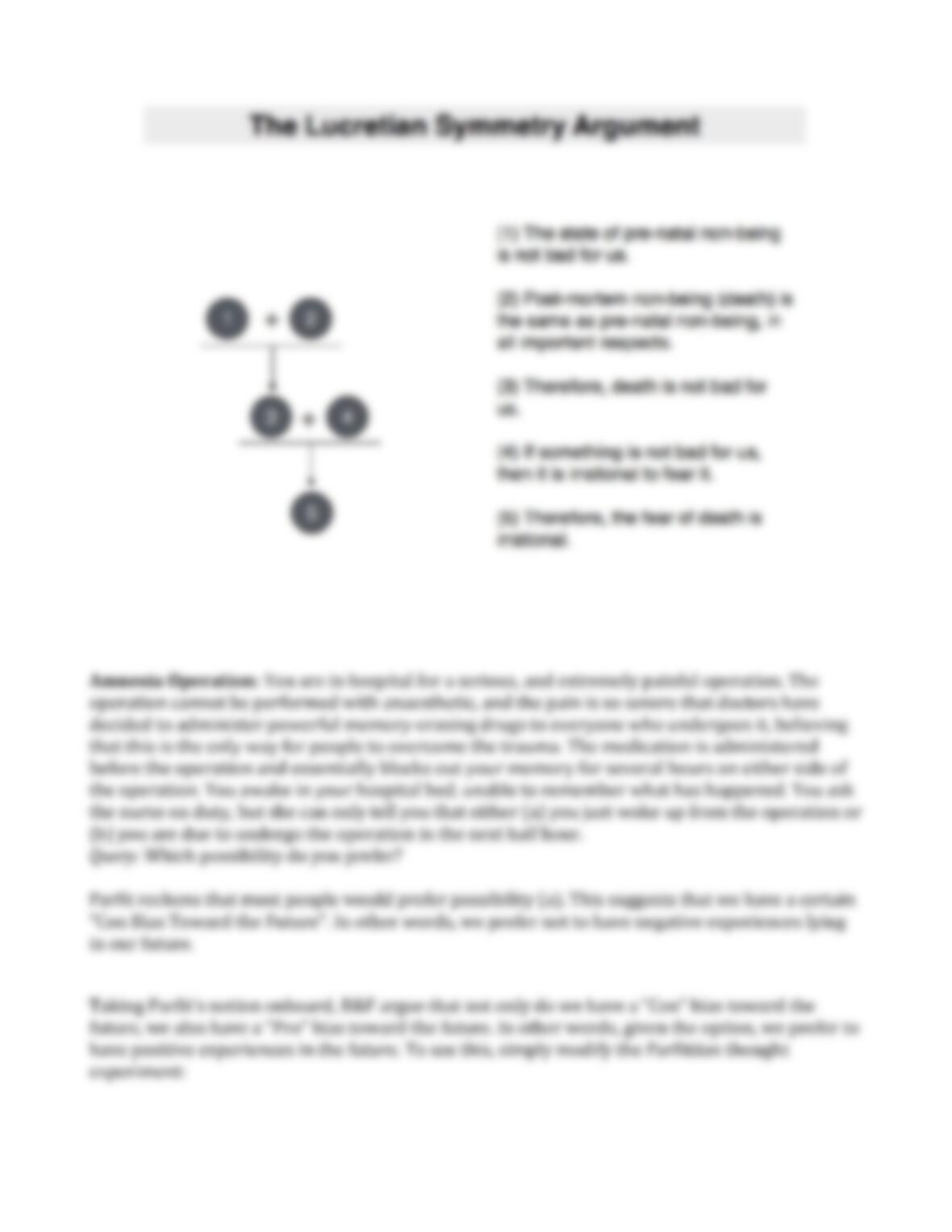
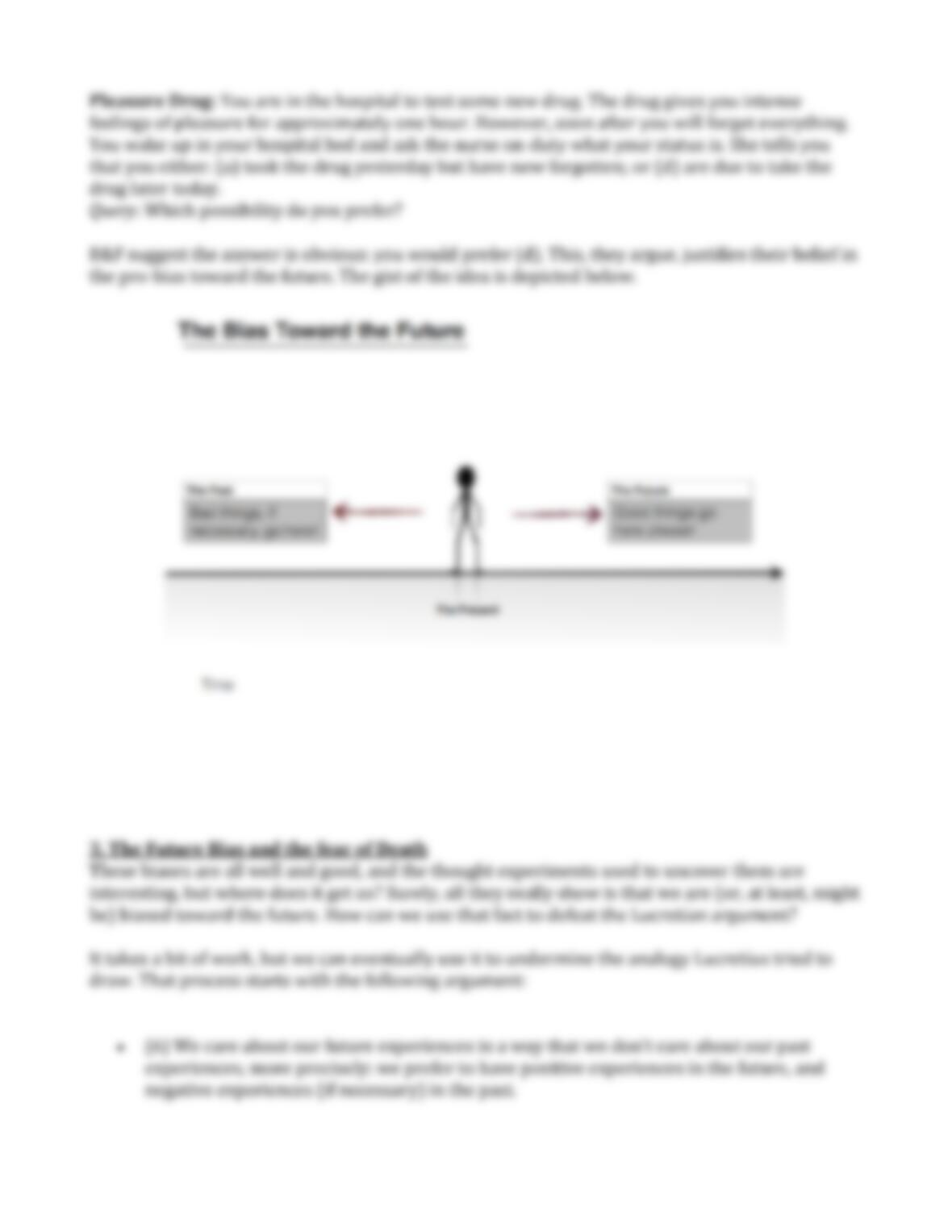
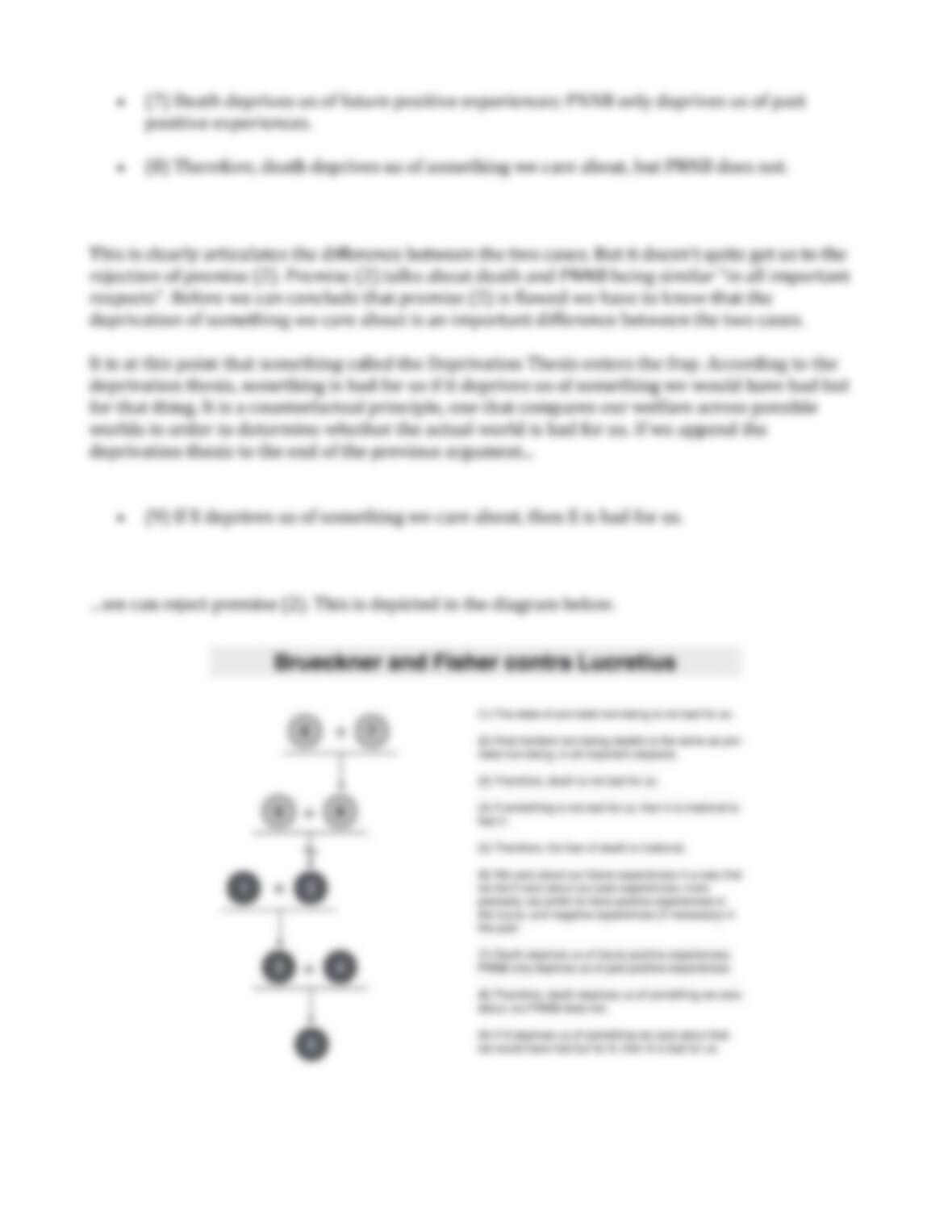
2. Lucretius’ (99-55 B.C.) “Symmetry Argument”