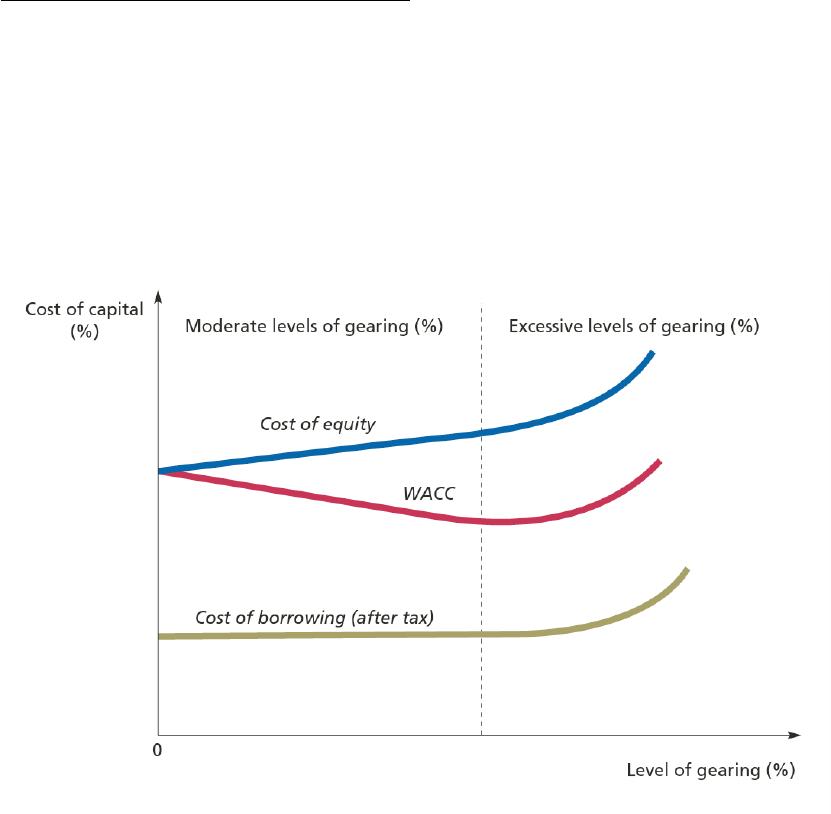
5.3 Gearing and the Long-term financing decision
• Gearing: The existence of fixed-payment bearing securities (e.g. loans) in the
capital structure of the business.
• Gearing (also known as leverage) occurs when a business is financed, by
contributions from fixed-charge capital, such as loans, debentures and
preference shares.
• Business’s level of gearing is often an important factor in assessing the risk
and returns to ordinary shareholders.
The ‘Trade–off theory of financial gearing”
• As the level of gearing increases, the cost of equity rises to reflect the
additional risk of gearing engenders.
• Despite this, tax deductibility of interest means that the weighted average
cost of capital (WACC) decreases. Once the level of gearing reaches a level
that is considered as being excessive, the risk of forced liquidation causes
both the cost of equity and of borrowing to increase with further elements of
borrowing. This leads to a rise in the WACC.
Financial Analysis
Learning Objectives
1. Explain what we can learn by analysing a firm’s financial statements.
2. Use common-size financial statements as a tool of financial analysis.
3. Calculate and use a comprehensive set of financial ratios to evaluate a
company’s performance.

4. Select an appropriate benchmark for use in performing a financial ratio
analysis.
5. Describe the limitations of financial ratio analysis.
7.1 Why do we need Financial Statements?
• Any firm’s financial statements can be analysed internally by employees of
the firm or externally by bankers, investors, customers and other interest
parties.
• There are several reasons an internal financial analysis might be done, such
as:
o To evaluate the performance of employees and determine their pay
raises and bonuses.
o To compare the financial performance of the firm’s different divisions.
o To prepare financial projections, such as those associated with the
launch of a new product.
o To evaluate the firm’s financial performance in light of its
competitor’s performance and determine how the firm might improve
its own operations.
• A variety of firms and individuals that have an economic interest in a firm’s
financial performance might undertake an external financial analysis,
including:
o Banks and other lenders deciding whether to lend money to the firm.
o Suppliers who are considering whether to grant credit to the firm. (To
ensure their return)
o Credit-rating agencies trying to determine the firm’s creditworthiness.
o Professional analysts who work for investment companies considering
investing in the firm or advising others about investing.
o Individual investors deciding whether to invest in the firm.
Common-size statements: Standardising Financial Information
• A common-size financial statement is a standardised version of a financial
statement in which all entries are presented in percentage.
• It helps to compare a firm’s financial statements with those of other firms,
even if the other firms are not of equal size.
• How to prepare a common size financial statement:
o For a common size income statement, divide each entry in the
income statement by sales.
o For s common size balance sheet, divide each entry the balance sheet
by total assets.
•
7.2 Common-Size Statements: Standardising Financial
Information.
7.3 Using Financial Ratios
• Financial ratios provide a second method for standardising the financial
information in the income statement and balance sheet. Rations can help us
answer the following questions about the firm’s financial health:
Question
Category of ratios used to address the
question
How liquid is the firm? Will it be able to
pay its bills as they come due?
Liquidity rations
How has the firm financed the purchase
of its assets?
Capital structure ratios.
How efficient has the firm’s
management been in utilising its assets
to generate sales?
Asset management efficiency rations.
Has the firm earned adequate returns
on its investments?
Profitability ratios.
Are the firm’s managers creating value
Market value rations.
for shareholders?