Samson Owoyele
WEBSITE AS A MARKETING COMMUNICATION TOOL
Thesis
CENTRIA UNIVERSITY OF APPLIED SCIENCES
Business Management
May 2016

ABSTRACT
Centria University
of Applied Sciences
Date
May 2017
Author
Samson Owoyele
Degree programme
Business Management
Name of thesis
WEBSITE AS A MARKETING COMMUNICATION TOOL
Instructor
Birgitta Niemi
Pages
42 + 2
Supervisor
Birgitta Niemi
This study
explores the role that contents, visual elements and aesthetics plays in the use of university
websites as a marketing communication tool. The focus of this study is on establishing if visual content
and aesthetics could influence student decision to consider and attend any specific university. The study
was motivated by the growing interests in how some Finnish universities of Applied Sciences can com-
pete in the face of introduction of tuition fees in Finnish institutions of higher learning. Entirely quali-
tative in content, this study examines the framework for accessing website quality: web accessibility,
web usability, web attractiveness, web credibility, web controllability, web efficiency, web helpfulness
and web learnability. The results obtained
from this research revealed the need for universities to have
attractive and clearly understood webpages with readily navigable information on such characteristics
such as programs, course offerings. location, tuition and scholarships. Results also reveale
d that a good
website can influence the decision of prospective student.
Key words
Aesthetics, Contents, Higher education institutions, Visual elements, Websites, Marketing communi-
cation tool.
ABSTRACT
CONTENTS
1 INTRODUCTION ……………………………………………………………………………………………………………….. 1
2 WEBSITE MARKETING COMMUNICATION ………………………………………………………………….. 4
2.1 Marketing communications on internet …………………………………………………………………………… 4
2.2 Objectives of marketing communications on internet ………………………………………………………. 5
2.2.1 Website target audience …………………………………………………………………………………………. 7
2.2.2 Evaluation of the effectiveness of the website as marketing communication tool ……………. 7
2.3 Designing a website ………………………………………………………………………………………………………… 8
2.4 Organization website and search engine optimization ……………………………………………………. 10
2.5 Framework for accessing website quality ………………………………………………………………………. 11
2.6 Visual communication ………………………………………………………………………………………………….. 14
2.7 Recruiting prospective students in higher education institutions ……………………………………. 14
2.8 Web contents using information needs ………………………………………………………………………….. 16
3 PRESENTATIONS OF CASE UNIVERSITIES …………………………………………………………………. 19
3.1 Website marketing strategies implemented in the case universities ………………………………… 19
3.2 Centria University of Applied Sciences …………………………………………………………………………….. 20
3.3 Seinajoki University of Applied Sciences ………………………………………………………………………….. 24
3.4 Lapland University of Applied Sciences …………………………………………………………………………… 27
4.1 Research purpose ……………………………………………………………………………………………………………. 31
4.2 Research design ………………………………………………………………………………………………………………. 32
4.3 Target population ……………………………………………………………………………………………………………. 32
4.4 Sampling size ………………………………………………………………………………………………………………….. 33
5 DATA ANALYSIS, RESULTS AND DISCUSSION ……………………………………………………………. 34
5.1 Information about the interviewees ………………………………………………………………………………. 34
5.2 Contents of the case universities website ……………………………………………………………………….. 35
5.3 Research questions ……………………………………………………………………………………………………….. 35
5.3.1 How does a university website portray the school image ……………………………………………… 35
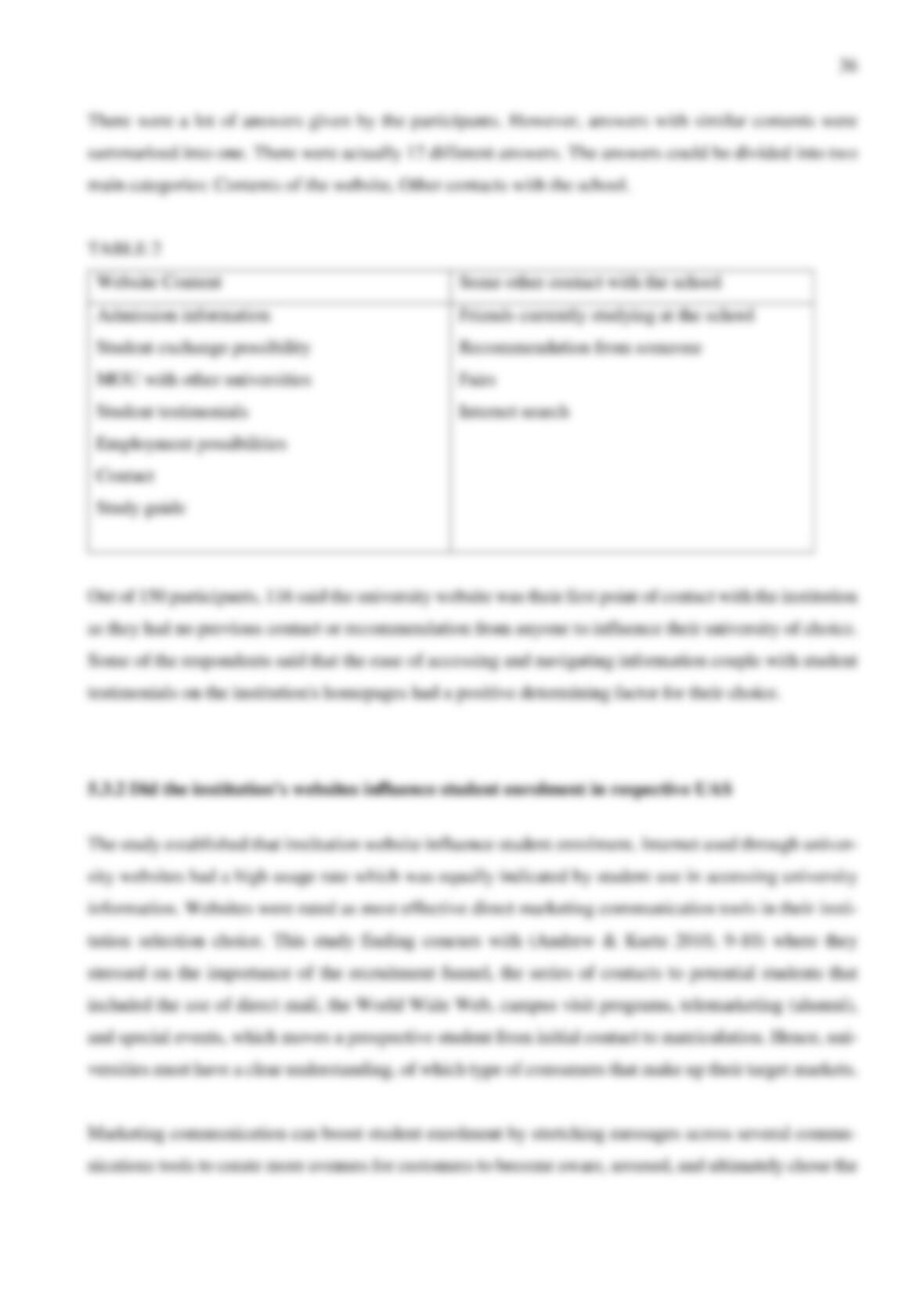
5.3.2 Did the institution’s websites influence student enrolment in respective UAS ………………. 36
6 CONCLUSION AND RECOMMENDATIONS ………………………………………………………………….. 38
REFERENCES …………………………………………………………………………………………………………………….. 40
ACKNOWLEDGEMENT
To list everyone, I want to thank in the completion of my BBA programme in this university would be
a long essay in itself. This is because in truth, the success story is the result of countless people of
goodwill, friends and families who believed in my dream. Nevertheless, I’ll attempt to thank some whose
efforts are too significant to go unmentioned.
First of all, my sincere thanks goes to Mr. Adeboga Adedayo who made my dream of pursuing another
degree in Business Management a reality. Adedayo, thank you for teaching me about life’s greatest
values: compassion, empathy, endurance and integrity. You taught me to cultivate a big dream, no matter
what. I hope the completion of this degree has done justice to your love. I’ll forever be grateful!
I would also like to express my deep gratitude to my thesis supervisor, Mrs. Birgitta Niemi, who has
always been a source of motivation even when I feel like giving up on this research work. Your supports
and intellectual advices are highly valued. A kinder, gentler supervisor I could not wish for.
My superlative appreciation goes to the best 2 things in my world: my beautiful wife–Owoyele Fun-
milayo Grace and my dearest daughter– Owoyele Crystal Adebola for their unwavering supports, love,
care and understanding throughout this program. You guys mean the world to me. You are my greatest
hope and inspirations and I’ll gladly give the world to see you happy.
To all my friends; Segun Dada, Adebiyi Ifeoluwa, Abiodun Amosun, Mufutau Hammed, Taiwo Yomi,
Olufemi Mayowa, and many others, I say thank you for your friendship. You guys have had and still
having positive impacts on my life.
To my one and only sister in person of Ms. Owoyele Deborah, I say a big thank you. You have never
ceased to amaze me of your love and passion for seeing me happy. This success story would have been
difficult or practically impossible without your love and support.
Finally, to God almighty, the givers of life and wisdom, I’ll forever worship and adore you.
1
1 INTRODUCTION
Internet is radically changing the traditional way that organizations interact with the public. For organi-
zations, the web gives access to a large audience and improves operational efficiency. Websites are
becoming key components of an organization’s survival in the globalized competition. The website rep-
resents an organization, communicating an organization’s culture, values, and vision. The website acts
as a delivery mechanism for service that facilitate various tasks a stakeholder needs to perform. The
website also serves as a platform through which an organization can interact with its stakeholders.
Organizational websites have different purposes, designs and implementations that indicate their focus
or priority. The value an organization attaches to a website is reflected in the operations and content of
the website. University web sites are no exception. The university website is not only a cost efficient
and timely method to communicate with various stakeholders such as students, faculty, administrative
staff and visitors it is also a way for a university to shape its image. Universities need to do everything
within their power to keep positive images with their various constituents, and one way to do this is to
make use of the opportunities website presents.
Knowing how to reach and ultimately connect with prospective students is a primary responsibility of
marketing and admissions departments at all institutions of higher education. Admissions offices are
challenged to evaluate their recruitment practices under the increased use of online communication and
social media. The rapid growth of technology and easy access to online resources for many students and
parents has dramatically reduced dependence on traditional forms of media, yielding a demand for
change in the recruitment process.
College and university websites play a vital role in this process. A university home page is a gateway to
information that can regularly assist future/current students and their parents. Meticulous attention to
detail in the content arrangement and aesthetics of the home page is therefore crucial. It is widely popular
in university website creation to add relevant information about the school and its offerings. In fact, most
of these home pages are designed specifically for the targeted students and their parents. For example,
the homepage of Lapland university of Applied Sciences has undergone a major redesign in order to
make the page more recruitment oriented with useful information for prospective students.
2
Some higher education institutions have incorporated modern design styles to their websites, featuring
large photographic banners and improved on information accessibility on the website by providing a
user-friendly navigation system. Seamk University of Applied Sciences provides an excellent example
of an institution which pays great attention to both enhancement of visual elements (including high-
resolution photography) and user–friendly site navigation for optimum functionality. Using high–resolu–
tion photography on home page banners is known to generate interest and captivate the visitor (Bordbar
2016, 5– 8.). High–resolution visual elements provide a far more memorable, immediately understanda-
ble message and clarity of message in web presentation.
Available research on how the contents of a website affects an applicant’s college choice shows students
trust a professionally designed website more and find it more credible for accessing information
(Youngblood 2013, 11-12.) The credibility perception of a website greatly affects a user’s interest in the
contents of website and consequently, users tend to spend longer sessions on the site and access more
information. The use of aesthetics and high–resolution visual elements like colour, texture, text format-
ting, graphics, lines and icons increases the credibility of a website. Recent researches have shown that
judgements on website credibility are based on the overall aesthetics of a website and that a profession-
ally designed website wins people’s credibility points. This point is appreciated when observing that web
users tend to appreciate the professional appeal of a website when deciding which site to select for the
same information and services.
Higher education institutions have started to create marketing communication strategies which directly
involve the website content and especially the redesign of their institution homepage (Halvorsen, 2014).
These strategies help convey various rhetorical messages for visitors (Bordbar, 2016, 5-8.) Usage of
both textual and graphic designs/photography in websites plays a large role in creating a site that gains
aesthetic interest and continues to provide better information to the targeted audience.
Institutional websites provide information to users such as staff, prospective students, incoming students
and students; allow contact with the university through feedback; and advertises programs or courses for
interested people. There are many other uses such as online surveys that websites can be put to. The
website also serves as one of the most important marketing communication tools for higher education
institution to interact and communicate with their clients.
3
Recently, researchers have responded to calls for additional research on the use of the website as a mar-
keting communication tool by investigating conditions that may facilitate effective use of the website as
a marketing tool.
Despite these recent research efforts on the subject matter, however, a fundamental gap in the website
recruitment literature remains. Namely, while previous studies have examined the correlates of recruit–
ment website features using cross–sectional designs, researchers have not empirically demonstrated that
viewers’ choice of institution selection can be changed by viewing the institution’s website.
In the wake of 2016, The Finnish parliament passed a new regulation to introduce tuition fees for non-
European union students studying in higher education institutions in Finland. The tuition fees policy will
take effect from the fall of 2017 academic session. Before the introduction of tuition fees, Finnish uni-
versities, especially the University of Applied Sciences have enjoyed relatively little traditional compe-