Case
Waseela Foundation: Accounting
for Zakat
Junaid Ashraf1 and Abdul Rauf1
Abstract
The case focusses on the issues faced by Waseela Foundation in its accounting system, specifically
in recording the receipt of zakat donations and utilization thereof. The existing accounting system is
simple and puts all types of donations into one pool. Expenses are paid out of that pool indiscriminately.
It is not acceptable to some zakat donors who have different interpretations regarding the use of zakat
funds. Mr Mustafa was given the task of redesigning the accounting system which would assure the
donors that their zakat was being managed and disposed of as per their instructions. Accounting for
donations in non-profits requires an elaborate system of recording and reporting that can distinguish
between different sources of donations and their utilization. This is important because some donations
have to be spent on specific purposes. Hence, unlike for-profit organizations, non-profit organizations
have to keep different sources of funds separate for recording and reporting purposes. Zakat poses
special accounting challenges because there are variations in interpretations of different schools of
thought with regard to avenues of spending the zakat. The case thus provides students with an excel-
lent opportunity to understand the intricacies of fund accounting for non-profits.
Keywords
Zakat Accounting, Donation Management, Civil Society Organizations, Not-for-profit, Restricted Funds
Discussion Questions
1. What is the existing accounting system at Waseela for the collection of donations and spending
money from the donation pool?
2. How would zakat donors evaluate the current accounting practices at Waseela? What would they
like to see in the system to satisfy them?
3. What changes should the foundation make in the accounting and reporting system to properly
account for zakat donations?
Asian Journal of Management Cases
1–6
© 2020 Lahore University of
Management Sciences
Reprints and permissions:
in.sagepub.com/journals-permissions-india
DOI: 10.1177/0972820119884406
journals.sagepub.com/home/ajc
1 Suleman Dawood School of Business, Lahore University of Management Sciences, Lahore, Pakistan.
Corresponding author:
Junaid Ashraf, Suleman Dawood School of Business, Lahore University of Management Sciences, Lahore 54792, Pakistan.
E-mail: jashraf@lums.edu.pk
2 Asian Journal of Management Cases
4. Once a proper system of accounting is put in place and zakat starts pouring in, will it help the
foundation in setting up the hospital? What further challenges can arise? How can the manage-
ment address those challenges?
5. How can this learning be generalized and applied to other situations?
Ramadan, the month of fasting in the Islamic calendar, was to commence from Wednesday, 10 July
2013. Mr Mustafa, the executive director of Waseela Foundation (the Foundation), a Lahore-based
small charity, was thinking about creating an accounting and control mechanism that would help the
foundation tap potential zakat-funds (mandatory charitable almsgiving by Muslims). Mustafa knew that
for his organization to tap zakat funds an elaborate system of accounting and control was required.
In the earlier years, members supported the operations and bore the project management costs of the
foundation through their own donations, including zakat. However, in recent years, the foundation had
expanded its operations. New projects were being launched, and existing projects were being expanded.
It triggered the need to expand the foundation’s donation base. An important source of the donation was
zakat. In the past, because of conflicting interpretations of zakat that donors had about the use of their
funds, the foundation did not actively pursue these funds. However, the organization’s growing financial
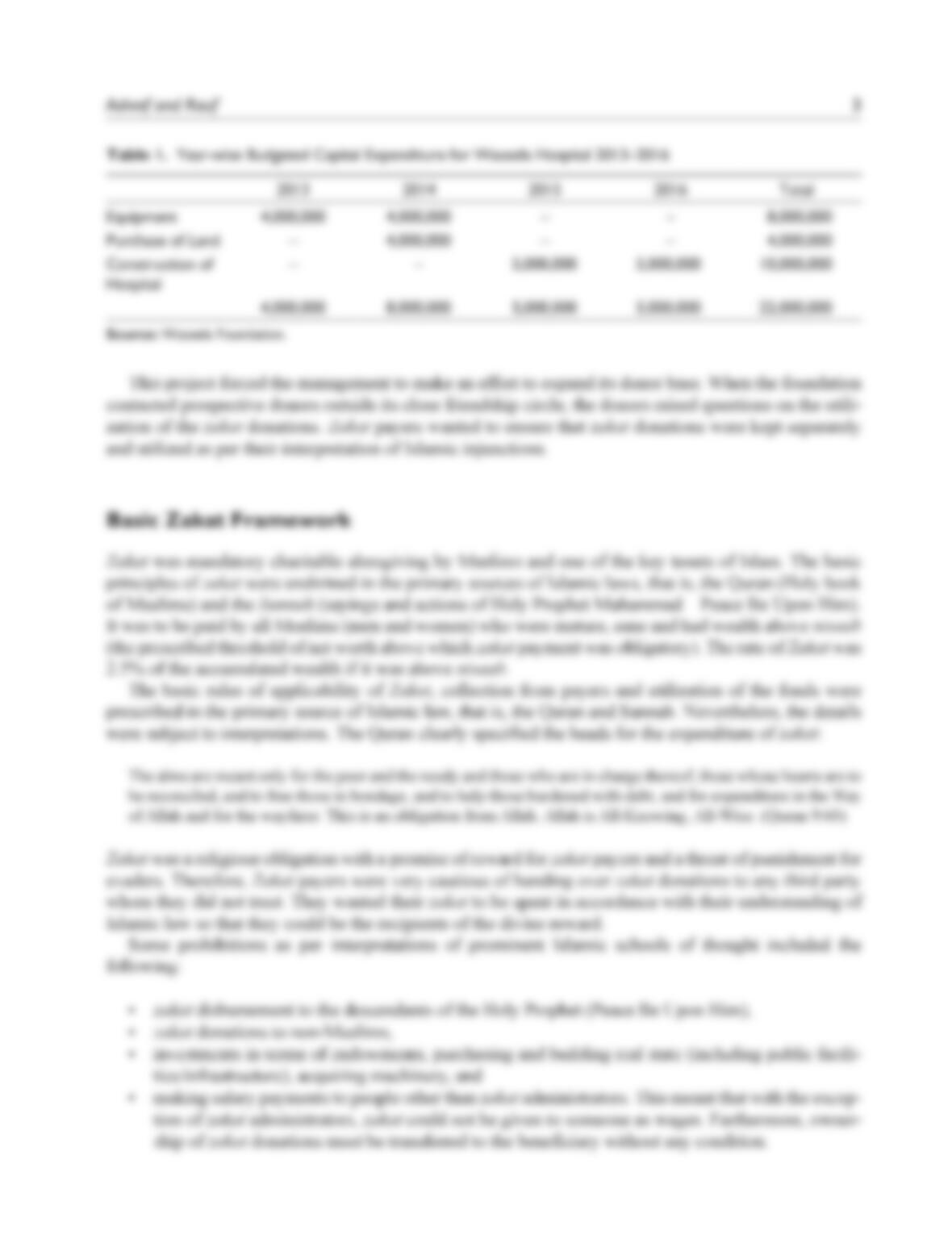
needs, especially with regard to the expansion of the hospital project (details to come later), meant that
the management could not afford to rule out zakat donations any longer.
Waseela Foundation
Waseela Foundation was registered as a charity (as a non-religious, non-political and non-partisan