Operations Management
Wal-Mart, 2005
Executive Summary
Walmart Stores, Inc., founded in 1945 by Sam Walton is one of the largest retailers worldwide
today approaching $300 billion in sales as of 2005. Wal-Mart is mainly known for its low prices
and convenient store hours which attracts over 100 million customers each week. Operating as
supermarkets, discount stores, wholesale clubs and online stores, the Wal-Mart giant hits just
about every market space there is. However, competition is growing strong against Wal-Mart
and Wal-Mart must leverage its competitive advantages and transfer them into international
spheres to continue to maintain and grow market share.
What is a competitive advantage? Competitive advantage refers to factors that allow a
company to produce goods or services better or more cheaply than its rivals and therefore
generating more sales or superior margins compared to its market rivals. One of Wal-Mart’s
biggest competitive advantages is selling goods at a low price by keeping costs low. By using
advanced technology and a largely automated supply-chain management system, keeping the
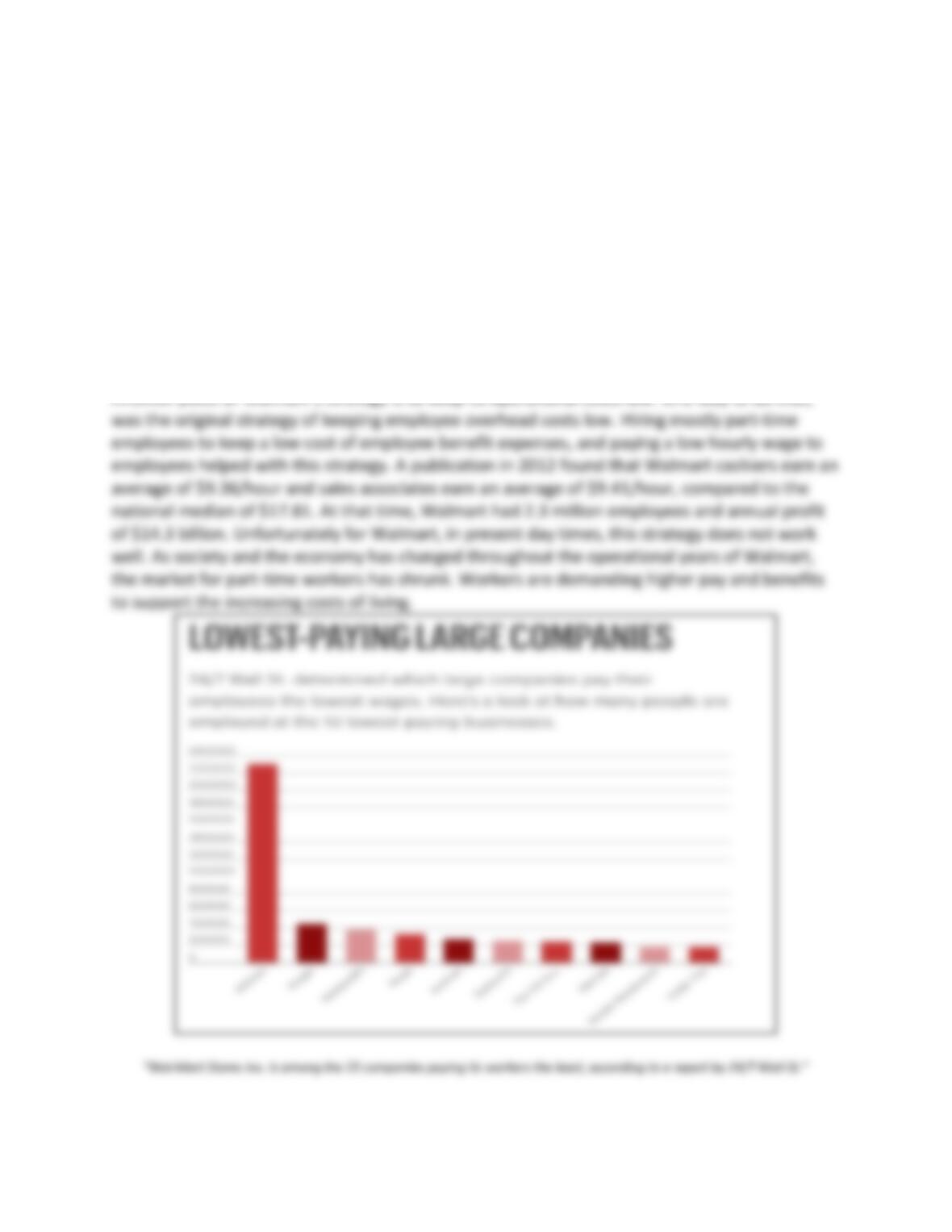
store layout simple, and keeping costs of employees lower than competitors, Wal-Mart has
been able to move up as the crème of the crop of low prices. As Wal-Mart grew to the super–
giant it is today, it utilizes several additional advantages to keep its strategy of low prices for
their consumers as big e-commerce competition enters the market space.
Competition – or lack thereof
To compete with growing competition, such as the e-commerce company Amazon, it is critical
that Wal-Mart keeps its prices low. According to a study by Clark in 2018, Wal–Mart’s products
were approximately 34% lower priced than Amazon. While many retailers are moving to online
platforms like Amazon, Wal-Mart’s physical stores gain the advantage of being really the only
major retailer in the towns they’re located in. According to an article titled, “How Wal-Mart
keeps its prices so low”, about 90% of Americans live within 15 miles of a Wal-Mart store. This
means the company can count on millions of customers going into their store locations for
groceries, clothing, household goods, etc.
Bargaining Power – including Sheer Volume of Sales
Walmart is the world’s largest retailer and therefore has huge bargaining power with its
suppliers. Walmart’s strategy has been to buy in large quantities for a low wholesale price and
sell in large quantities with low prices through its large number of retail stores and wide variety
of product offerings. Walmart’s suppliers depend on greatly on Walmart’s business to keep
their own sales up and growing and Walmart knows this. Walmart has the power to negotiate
low pricing with their suppliers to fit their strategy putting them in a ‘blue ocean’ of sorts by
offering lower prices to consumers than their competition can.
Along with Walmart’s power to negotiate low prices with their suppliers to save on their cost of
goods, Walmart’s margins and profits are high simply due to the sheer volume of sales. Even as
Walmart passes along its savings to their customer base, a small margin equals a large profit
when sold at as large of a scale as Walmart sells.
Low Operations Costs (Employee Overhead, Store Layout, Inventory Management)