Executive Summary
At the beginning of 2009, Wal-Mart top management faces the question of whether the
same strategy that it has been adopting in the past can be used to maintain the company’s
remarkable performance and growth in the next decade.
In the last 10 years, Wal-Mart has achieved strong and constant growth in sales and net
income. It has maintained the leading position in the U.S. discount retail industry and has
become the largest retailer in the world. With the maturity of the industry, coupled with the
intense competition from rivalry companies, maintaining the current level of high
performance becomes very challenging.
The Porter’s Five Forces analysis reveals that the competition among rivals is the driving
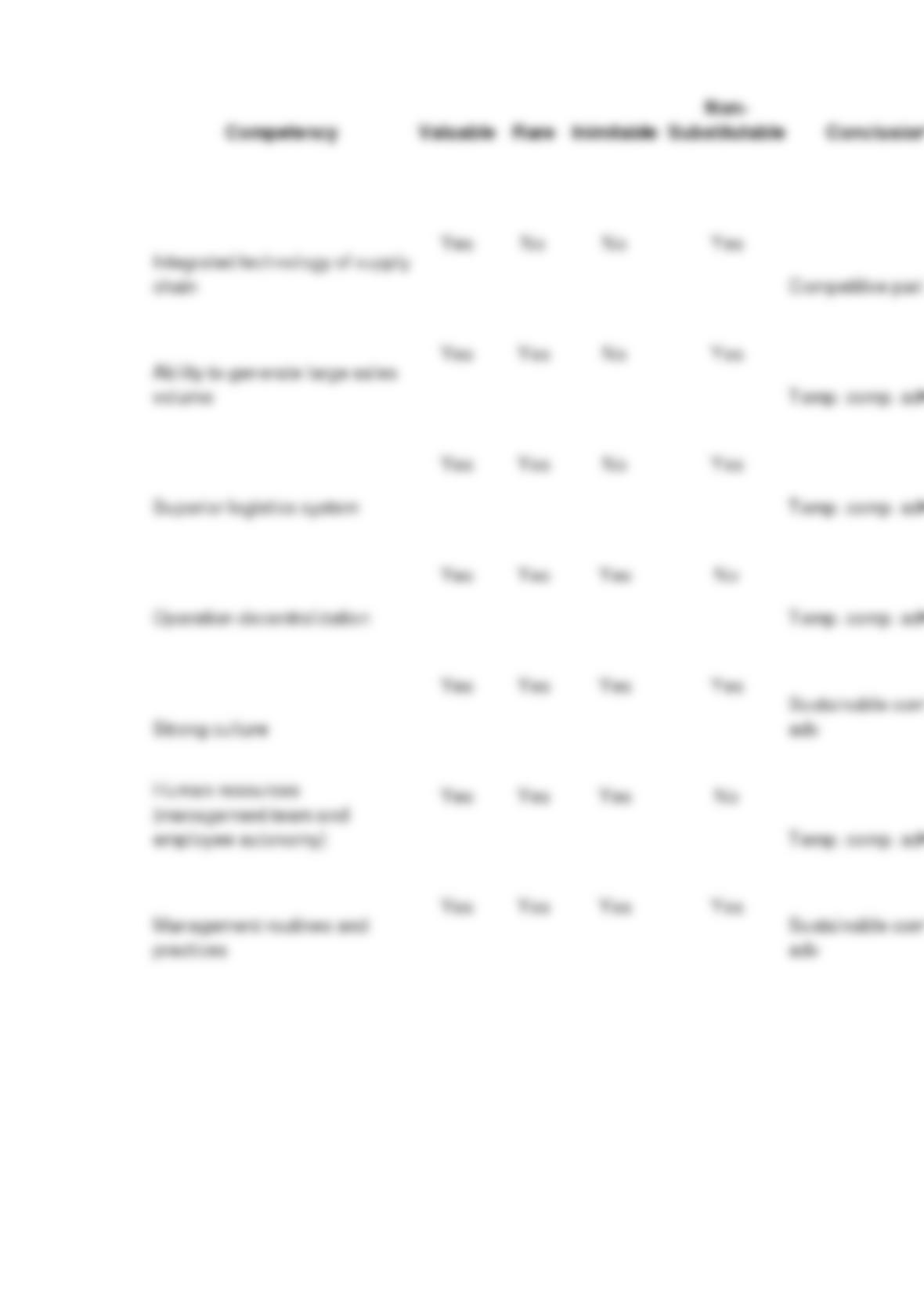
force of the industry, in which price is the most critical factor. The value chain analysis
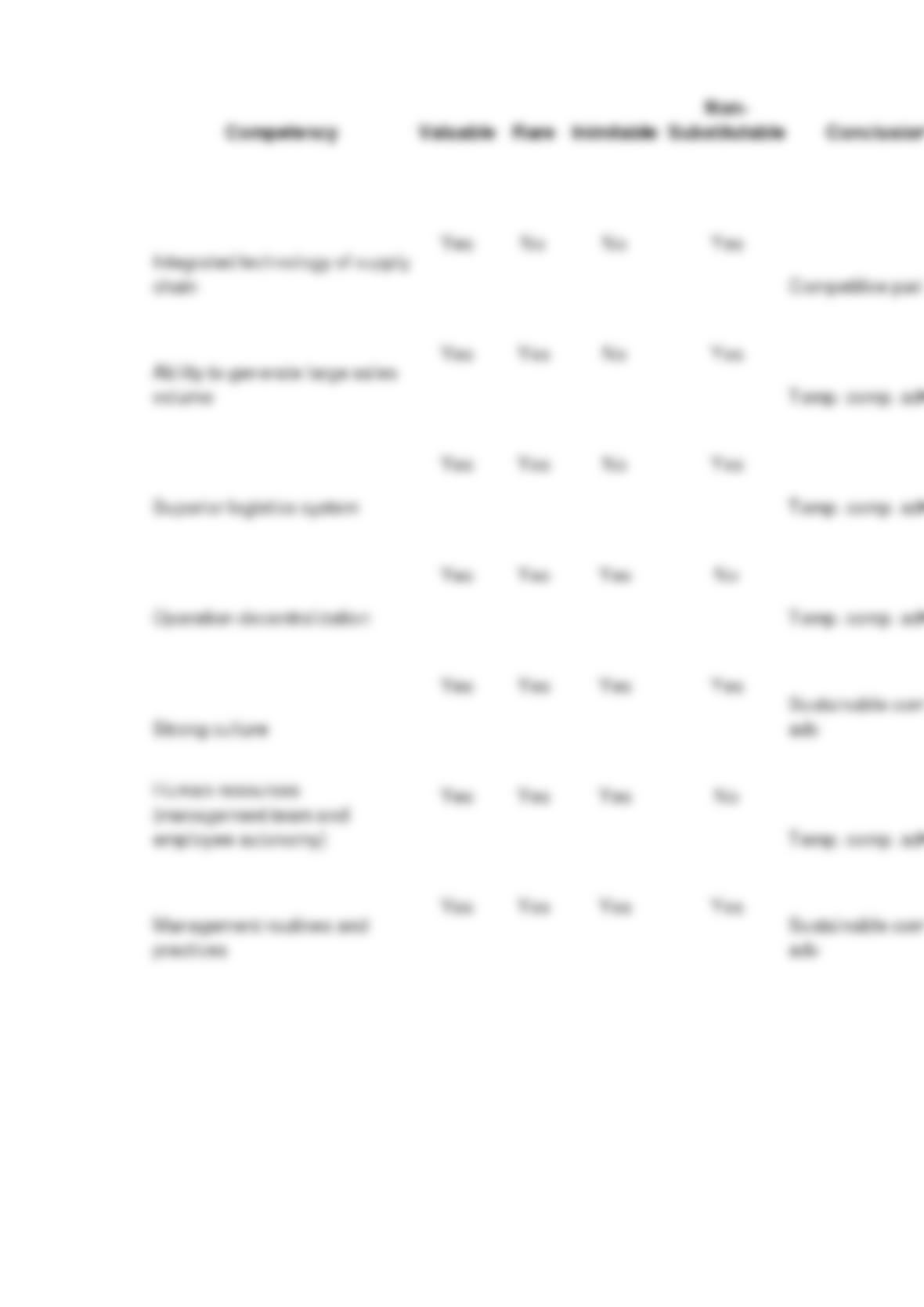
and resource based view analysis show that Wal-Mart has been very successful in
implementing the strategy as the low-cost leader by inculcating cost efficiency in its
corporate culture, management style, and operations. It has been the pioneer in adopting
cutting edge technology to streamline its supply chain, and to understand and respond
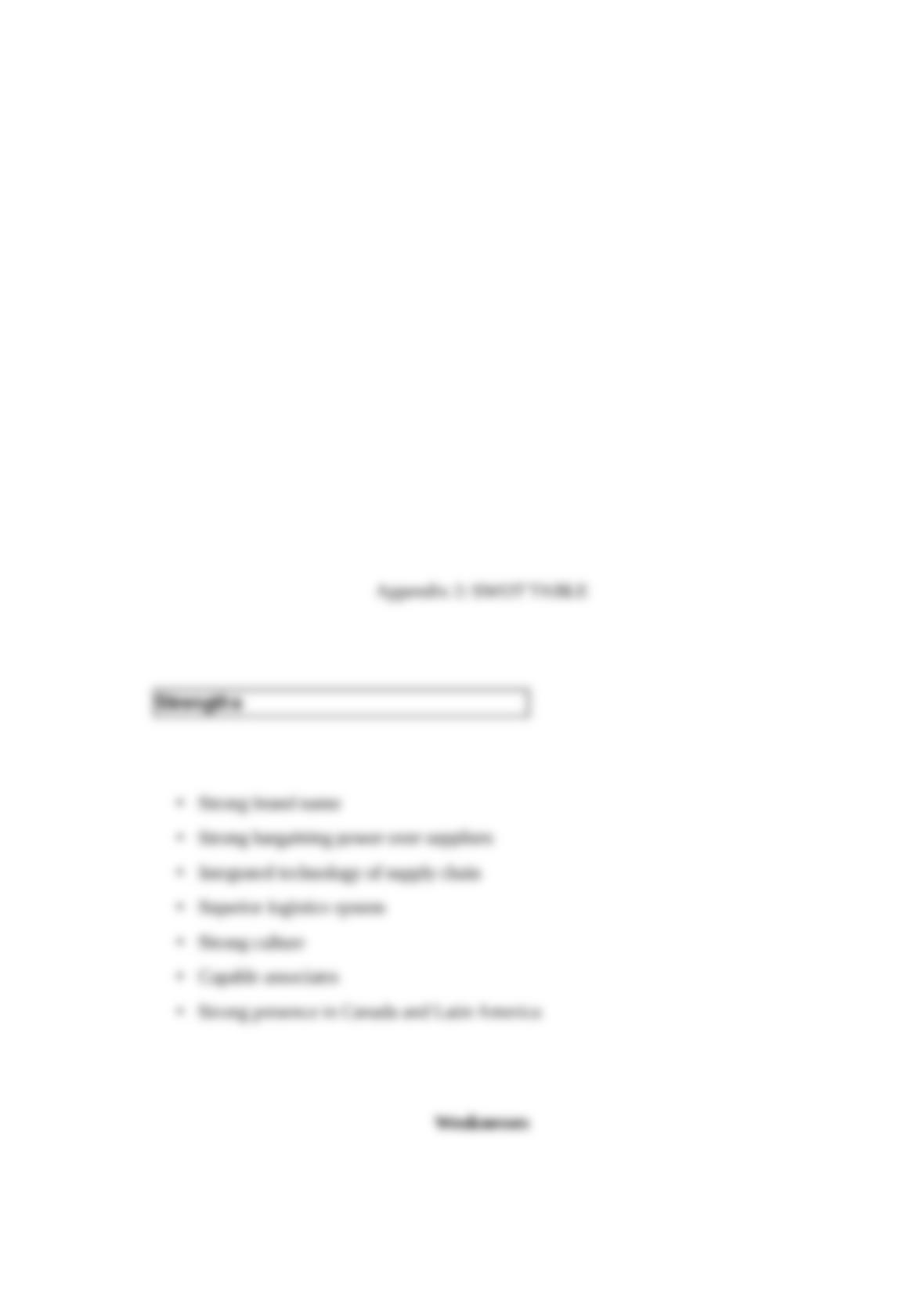
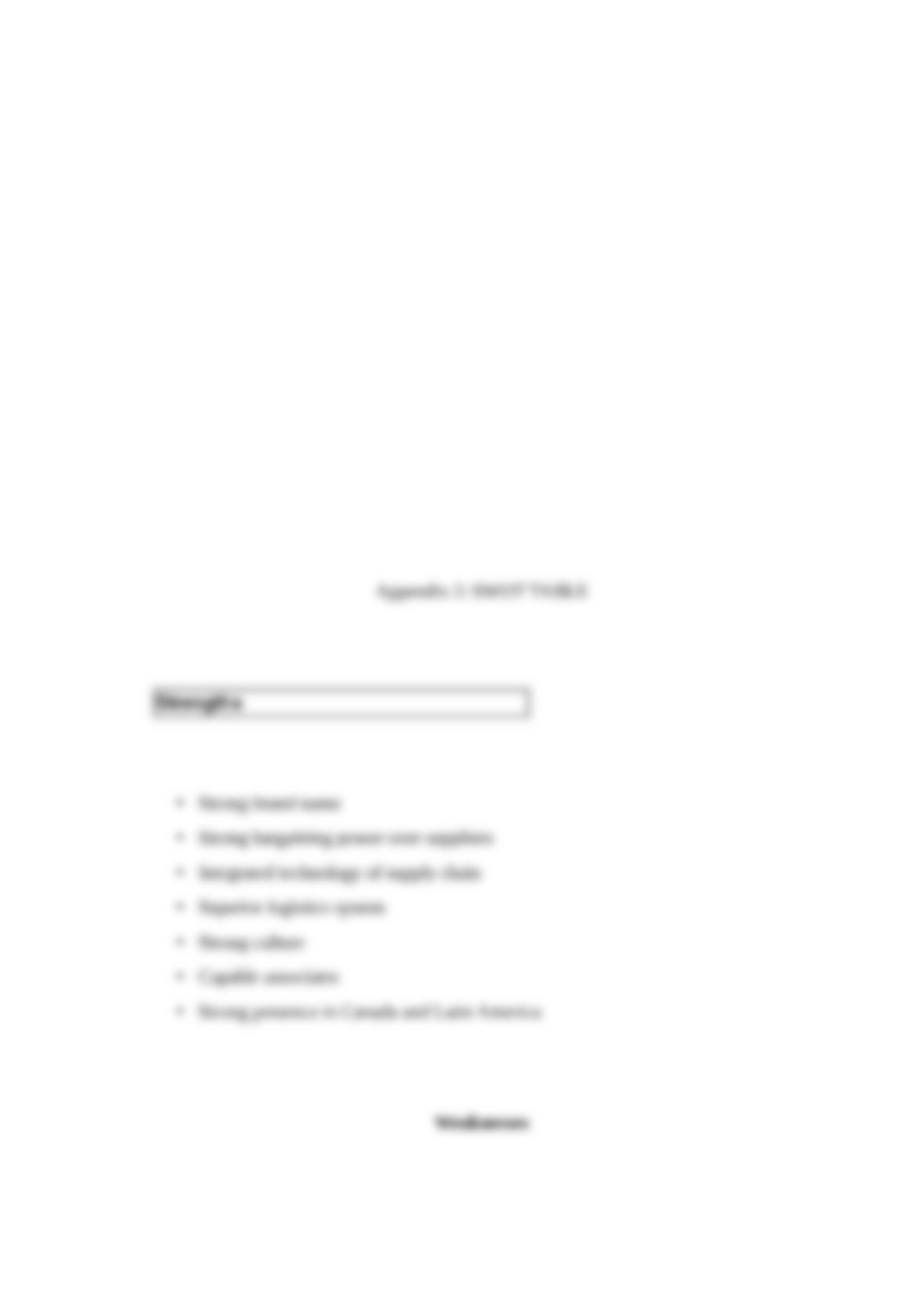
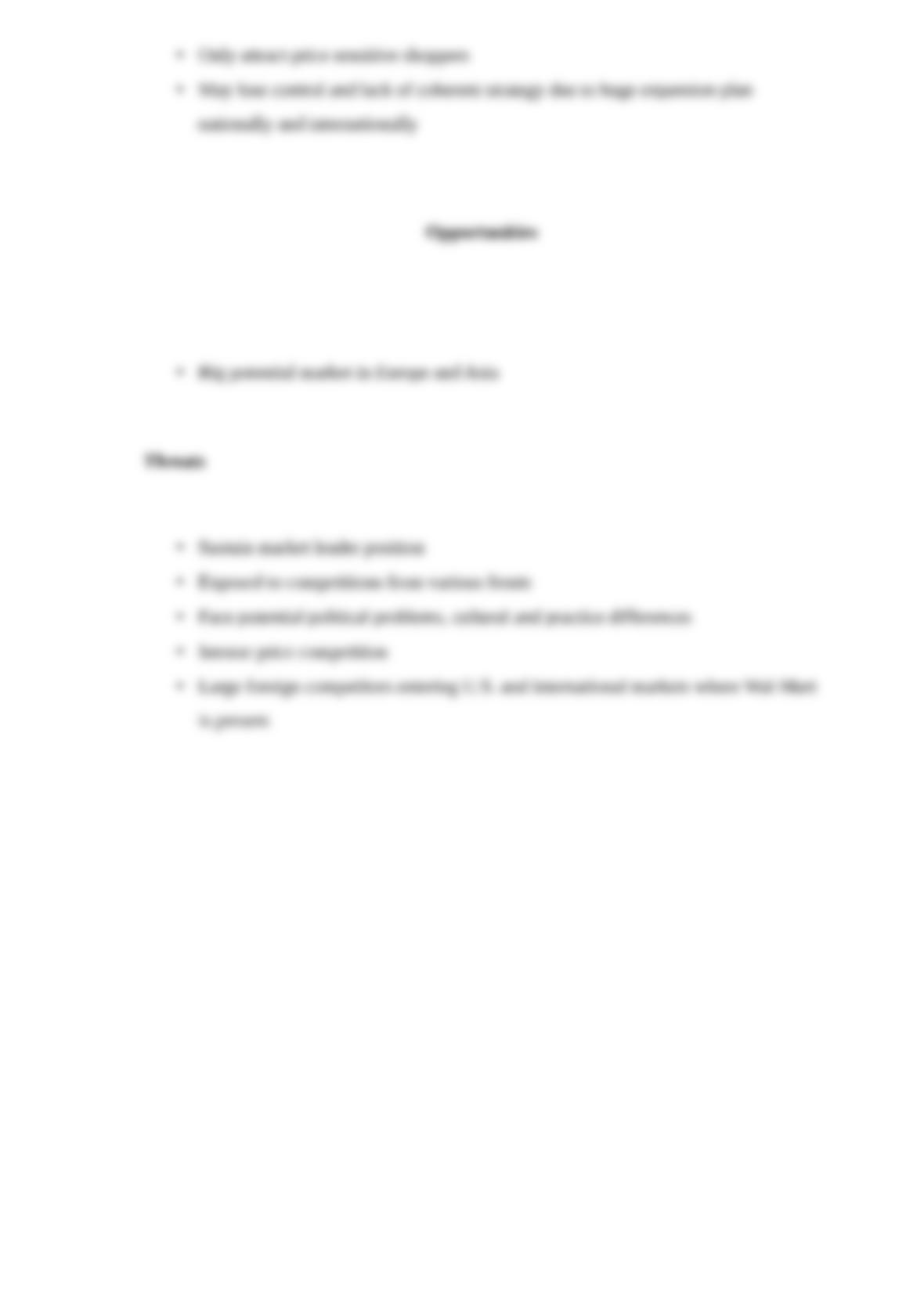
timely to customer demand. Wal-Mart has developed many strengths that help guard its
leading position and open door to many opportunities for expanding the business.
However, it also faces threats from growing too big and in many areas, which makes it
vulnerable to losing control, weakened cooperation among stores and regions, and
competition in multiple fronts.
Wal-Mart should be caution in its growth strategy, especially in the expansion of its
international presence. Although its financial strength, management skills, and operation
efficiency allow it to enter many overseas markets, it should be selective in choosing the
destinations. Wal-Mart can focus on emerging markets where customers are price sensitive
such as China and India in Asia. In Latin America, it should focus on Mexico and a few
key markets that it previously achieves success. In Europe, it can target regions that lack
the presence of large retailers such as Tesco and Carrefoure. Although Wal-Mart’s
common practice of acquiring existing small local chains to enter a market has helped
Wal-Mart lower its market penetration costs and quickly adapt to local market demands
and culture, this practice also raises the issues of diluting corporate culture and weakening
the company’s ability to reinforce coherent management practices and strategy. Therefore,
international expansion should be implemented patiently and carefully.
Over the last four decades, Wal-Mart has achieved significant successes to become the
world’s largest retailer. The company has maintained sustainable growth in a fiercely
competitive U.S. retail market environment. It has been continuously expanding both in
the range of goods and services, and in the number of stores in the U.S. and worldwide.
While this expansion has generated handsome profits for its stakeholders and put the
company in a strong financial position, it has also presented significant challenges for
sustaining growth and performance, and managing a company that is incessantly becoming
larger. Top management now is trying to address whether the same strategy that the
company has been pursuing is suitable for maintaining and strengthening its current
growth rate and market position, as well as for leading the company into the next decade.
This report will present: 1) an analysis of the external environment of the company; 2) a
discussion of the company’s internal resources and capabilities; 3) a diagnosis of the
external and internal factors; and 4) recommendations of how the company should move
forward.
1. 1. External Environment
In this section, an analysis of the Porter’s five forces of the discount retail industry and
Wal-Mart is presented. For each force, the discussion first provides a general overview of
the industry in the U.S., and then focuses on Wal-Mart.
– Potential entrants: the threat of potential entrants is considered low due to the
following reasons:
•Discount retail industry is a highly competitive environment with mostly big
players competing for market shares.
•Price is mainly the key factor for competition.
•Existing companies have established strong and stable supplier networks.
•Wal-Mart has a superior logistics and distribution system, cutting edge technology
to support all phases of its operation, a well-established brand name, a large
number of stores nationwide, and a deep financial resource.
•Wal-Mart also has cost advantage over its competitors due to its large purchase
volume.
Wal-Mart can deter potential entrants.
– Substitutes: the threat of substitute is low.
•Consumers can buy from small mom-and-pop stores or specialty stores, but these
stores do not offer a wide range of products, nor do they offer competitive prices.
•On-line purchase can be a substitute means for shopping; however, it may not be a
good choice for goods that are consumed daily because shipping costs may lead to
higher final prices, and shipping time can delay the need’s fulfillment.
– Industry competition: the competition among existing firms is high because:
•This is a mature industry.
•There are few but large competitors, who dominate the majority of the market.
•Price is the focus of competition, and firms are forced to cut cost to stay
competitive.
– Bargaining power of suppliers: the power of suppliers is low.
•In general, most suppliers rely on retailers to distribute their products to the end
consumers; therefore, the role of retailers in the distribution channels is critical.
•Wal-Mart not only carries a wide range of products, but also possesses thousands of
stores in the U.S. and worldwide. This combination places Wal-Mart in a very
strong negotiation position with suppliers and gives it great flexibility in choosing
and working with a wide range of suppliers and vendors. As stated in the case,
Wal-Mart is “both desired and feared by manufacturers”.
•With a fleet of 4,000 trucks, Wal-Mart also has capability to independently operate
part of its transportation logistics without relying solely on outside vendors.
•Wal-Mart also carries some of its own Great Value private-label products tailored
to local demand.
– Bargaining power of buyers: the power of buyers is considered moderate.
•Switching costs of buyers is low.
•Buyers are price-sensitive. They can be easily lured to competitors to buy products
that are offered at a lower price.
•The differentiation in the products and brands among different discount retail stores
in this industry is low.
•Since most of the products offered are commodity, buyers usually choose the store
that is closest to their home or their workplace for convenient shopping.
•Wal-Mart provides a wide range of products and services, and offers very low
prices. In addition, it has many stores serving different geographical areas. Hence,
it has a large and loyal customer base.
Interest groups such as organized labor unions, environmentalists, and human rights
activists can interrupt the business. When a retailer expands internationally, it can face
political challenges, as well as differences in culture and practices which may support or
deter both the establishment and growth of a company in a country.
In the discount retail industry customers focus on a few elements, including price,
convenient location, range of products, and good service. Therefore, the key success
factors of the industry require that the firms need to: (1) Maintain low cost by having
efficient and effective operations, making bulk purchases from vendors to enjoy volume
discounts, and paying low wages; (2) Create differentiation by having large stores carry a
wide range of products, easy and accessible locations for convenient shopping, and
products that meet local customer preferences and needs; and (3) Fast response to market
demand.
The nature of the external environment of the discount retail industry dictates that potential
entrant firms can only achieve moderate profit. The driving force of the whole industry is
the high competition among rival companies, in which price is the most critical factor. In
order to survive and be profitable, firms have to offer competitive prices. This translates
into high efficiency in operation, low costs of goods sold, and low operating expenses.
The industry may discourage small investors, but because the U.S. is one of the world’s
largest retail markets, it can attract potential investors with strong financial strength,
especially international retail chains, to enter the U.S.
1. 2. Internal resources and capabilities
Wal-Mart’s purpose is revealed in its founder Sam Walton’s statement, “If we work
together, we’ll lower the cost of living for everyone…we’ll give the world an opportunity
to see what it’s like to save and have a better life.” Its mission statement is, “Saving
people money so they can live better”. Its mission statement is very brief and broad, but it
reflects the purpose of the company and its founder. With the way that mission statement
is written, it can be considered as the company’s vision statement because of its broad
sense.
Wal-Mart’s corporate strategy is to be a low cost leader, which reflects precisely the
purpose of the company’s existence. In the past decade, its strategy has been very
effective and successful. It has been continuously growing in sales revenues and net
profits from 1998 to 2009. Specifically, net sales increased from US$118 billion in 1998
to US$401.2 billion in 2009, and net profit increased from US$3.5 billion in 1998 to
US$13.4 billion in 2009. The company also has a strong balance sheet with ample cash