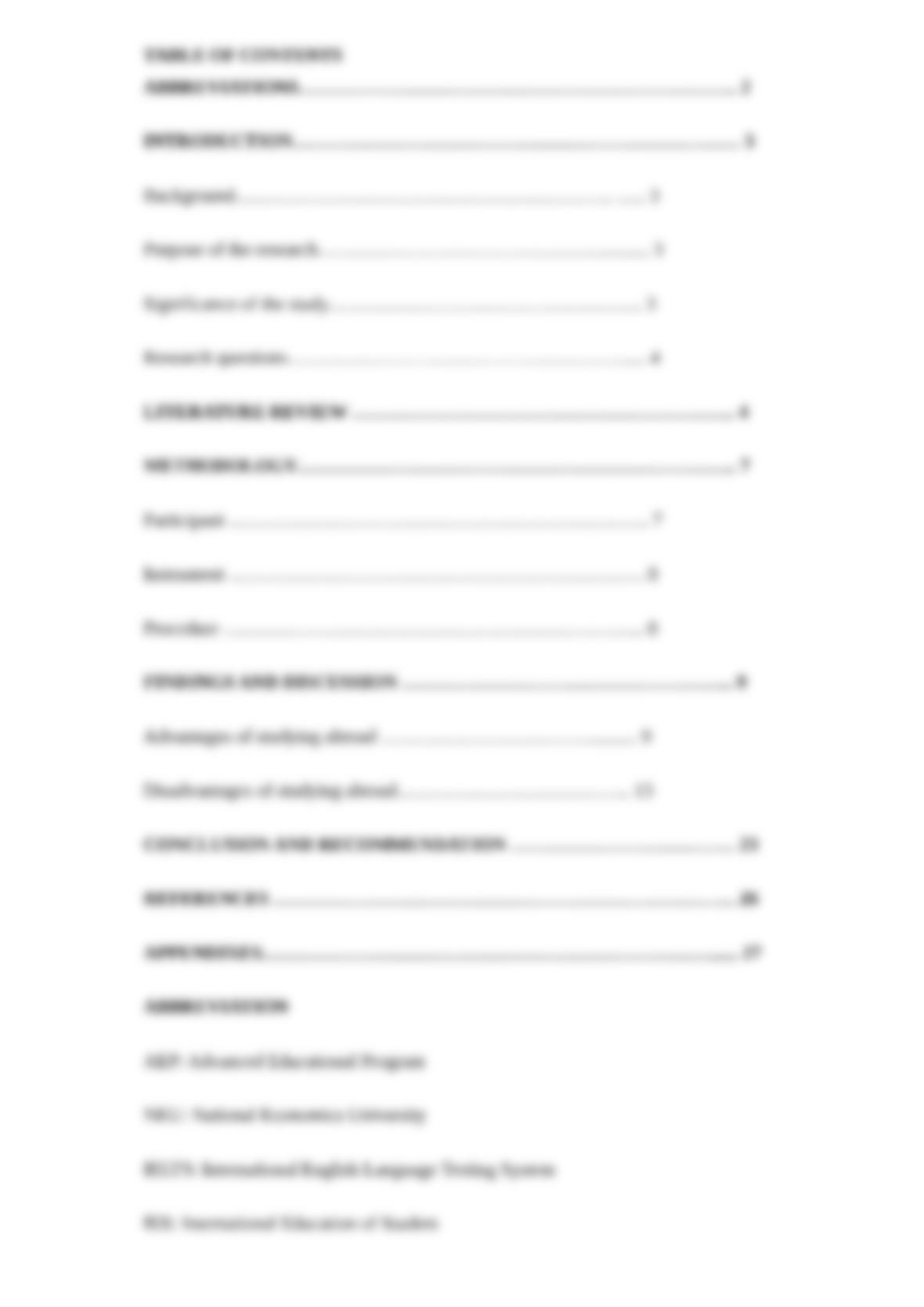
TABLE OF CONTENTS
ABBREVIATIONS…………………………………………………………….. 2
INTRODUCTION……………………………………………………………… 3
Background……………………………………………………. ….. 3
Purpose of the research………………………………………………… 3
Significance of the study…………………………………………… 3
Research questions………………………………………………….. 4
LITERATURE REVIEW …………………………………………………….. 4
METHODOLOGY…………………………………………………………….. 7
Participant ………………………………………………………….. 7
Instrument …………………………………………………………. 8
Procedure ………………………………………………………….. 8
FINDINGS AND DISCUSSION ……………………………………………… 9
Advantages of studying abroad …………………………………….. 9
Disadvantages of studying abroad……………………………….. 13
CONCLUSION AND RECOMMENDATION ……………………………… 23
REFERENCES ………………………………………………………………… 26
APPENDIXES…………………………………………………………………… 27
ABBREVIATION
AEP: Advanced Educational Program
NEU: National Economics University
IELTS: International English Language Testing System
IES: International Education of Student
TOEFT: Test of English as a Foreign Language
INTRODUCTION
Background
According to the report of Ministry of Education and Training, nowadays, there are over
100.000 Vietnamese overseas students in 49 countries, about 90% of which study abroad
financed by their family. This figure increases ten times as much as 10 years ago. The level
of growth in the number of overseas students in the United States even continues to
increase significantly in the two-digit, the highest in the Southeast Asia. In the past time,
studying abroad was a solution for those who could not pass the universitiy entrance exam
in Vietnam, but it now has become a popular trend, as a solution for the deadlock and
deterioration of the education in the country. In the colorful painting of studying abroad
reality, many students success; however, also many others have to bite the bullet because
of their wrong choice. Therefore, the students must consider carefully in oder not to regret.
Purpose of the research
By investigating points of view of AEP students about studying abroad, we wish to
partially help the audience have a clear sight at this popular trend.
Furthermore, we really hope the study can help students make a rational decision whether
or not going abroad.
Significance of knowledge
The research targets to make it clear about the advantages and disadvantages of studying
abroad. Therefore, it may become a base to help parents to understand more about gain and
loss from studying abroad so that they can help their children make a good decision and
prepare carefully beforehand.
Also, the study gives us chance to get more infomation about studying abroad, it is easier
to make up our mind later.
Research quesion
For the purposes above, we decided to do the research to find the answer for the question:
“What are views on studying abroad of AEP students, NEU ?”. To respond for this
question, two included questions below must be completed:
1. What are the advantages of studying abroad?
2. What are the disadvantages of studying abroad?
LITERATURE REVIEW
Studying abroad seems to be a very favourite activitiy nowadays. Studying abroad means
that one goes to another country to further the study career. However, everyone making the
decision of studying abroad does not gives the same reasons, and they also face various
difficulties and gets different benefit after courses. We want to discuss here mor e about the
advantages and disadvantages when a student decide to study abroad by answering the two
big questions:
What are the advantages they may get?
What are the disadvantages they may encouter?
Coming first is the answer for the advantages of studying abroad
An article name “studying abroad, what are reasons to persuade you” on the Giaoduc.net,
lists four advantages of studying abroad. The first one, studying abroad is an investment.
This article said that, almost students who studied in foreign countries can find a job easily,
because they can obtain an advantage over others with a foreign qualification. The
second one is the improvement in English. You have chance to communicate with native
people, and practice your English every time. Thus, you can improve your vocabulary,
your listening skill and speaking considerably in a short time. The next advantage is to
change the way you work. Studying with new method, such as student – centred method,
you are the main object, teachers are just guiders, so you can learn how to approach,
analyze, synthesize or solve a problem. The final advantage is to make you more
independent. Obviously, you have to take care of yourself and do every personal work
yourself. Through that, you will become more mature.
Besides, from a survey of IES, there are also four main advantages. The first one is
personal development. An overwhelming majority of respondents gained this advantage. It
helps them to increase self-confidence, change their world view positively or play a role as
a motivation of maturity. The second one is academic commitment. Many people said that
studying abroad enhanced interest in academic study, many others said that it influenced
subsequent educational experiences, and even reinforced responsibility to foreign language
study. The next advantage is intercultural development. Most of the students said that they
better understood their own cultural values and got many friends of many foreign
countries. The final advantage is a better career prospect. The survey stated that about 76%
students asked said that studying abroad acquired skill sets that influenced career path,
62% said that it ignited an interest in a career direction pursued after the experience.
What are the disadvantages the students may encounter?
Study abroad is not always a smooth road, it’s prickly with many disadvantages in many
aspects of the students’ life. The first to mention is the extreme difference in culture,
lifestyle. Bochner (1986) has studied overall on the psychology of overseas students and
gives us a comprehensive view on the impact of this on students. He emphasized the
cultural
barriers that the students confront with not only when they’re in the foreign country, but
also when they finish courses and come to the hometown.The students cannot immediately
integrate into a new culture. They encounter new norms, harbits and customs. Things that
can be accepted in their own country are perhaps be forbidded here. Accidentally, they are
isolated or get into troubles. They are gradually involved in temptations and bad relations.
When returning hometown, many cannot immediately adapt and indeliberately become
“foreigners”.
Additionally, Lorraine (2007) illustrates difficulties in terms of language and new studying
methods. The study indicates that language is the core problem for overseas students, and
is the main source of strain for students especially in acquiring sufficient linguistic
competence in writing work. Study abroad is not just to move to another country and
complete courses, it requires many tradeoffs. Many students are intensely impacted by the
new culture. There are two different cultures simultaneously existing inside them;
therefore, they have to equip enough knowledge of cross-cultural adaptation.
Berry (1984) also discovered that an obstacle that many students only realize when they
penetrate into a new studying environment is academic environment. The paper figures out
that Asian students have more difficulty in dealing with situations related to close
interpersonal relationship, with people of different status and in establishing friendships.
The study named loneliness and international students has conducted with 200 interviews
with students and find out that two thirds of the them had experienced problems of
loneliness or isolation. It is a reasonable state when these students are at loss of contact
with families and friends.
Another aspect of disadvantage is financial problems. There are debates on the amount of
money payed on fee and the outcome of that investment. An article on
vietnamnet.vn, Dang (2011) sets out many real cases. Most of the parents mentioned are

rich and they want their children to be independent, to approach professional studying
environment and to have chance to further their study when they have failed the university
entrance exam.
In general, studying abroad is receiving much of people’s interest. Different authors may
come with opposite opinions but it is worth considering if you have intention to become an
oversea student. We hope that in the following parts when we discuss more on the three
main questions, the research will be useful for the students and the parents in their decision
– making on studying abroad.
METHODOLOGY Participants
Population of the research is AEP students .The sudents in Advanced Program is entirely
taught and they also learn in English, in advanced teaching methods together with modern
equipment. The students approach good curriculum that is equivalent to the other
universities in the region. Ability of English and stable specialized knowledge are
incentives for them to care more about studying abroad. Thus, we believe that AEP
students can make the outcome of research more exact than others. The rsearch’s location
is limited in AEP, NEU. Despite the bound of the location, AEP in NEU is highly ranked
by Ministry of Education and Training, simultaneously a big number of postgraduate
students have good certificates and want to study higher.
Instrument
The leading technique used in doing the research is the questionnaire. We collect
infomation from wide sample, not personal interview. A questionnaire can explore general
views, if that is a matter of interest.
The questionnaire has ten questions supporting the two research questions. We delivered
120 copies to AEP students and only 100 returned. Besides, delivering it directly to their
hands, the other tool that the we used to collect data was through facebook. The
questionnaire was posted in facebook of some groups of AEP students.