sustainability
Article
Vietnamese Consumers’ Preferences for Functional
Milk Powder Attributes: A Segmentation-Based
Conjoint Study with Educated Consumers
Trong Phan, Phil Bremer and Miranda Mirosa *
Department of Food Science, University of Otago, Dunedin 9016, New Zealand;
trong.phan@postgrad.otago.ac.nz (T.P.); phil.bremer@otago.ac.nz (P.B.)
*Correspondence: miranda.mirosa@otago.ac.nz
Received: 11 June 2020; Accepted: 24 June 2020; Published: 29 June 2020
Abstract:
This paper investigated Vietnamese consumers’ preferences for functional milk
powder products to determine if there were differences in market segments. A Qualtrics
survey and a 1000minds choice-based conjoint survey were completed by 272 participants,
predominantly 18-30-year-old males with high education levels and above average incomes. Firstly,
general perceptions of the use of functional foods to maintain health were determined, with results
revealing that participants believed in the benefits the foods claim to provide. Secondly, participants’
tradeoffs for specific extrinsic functional milk powder attributes were determined by examining the
relative importance they placed on a range of attributes. Participants prioritized a quality stamp
attribute and preferred that this was obtained from an international certification body. Finally,
a two-step cluster analysis and multinomial logistic regression was used to profile the participants
and analyze relationships between socio-demographic data and the four resulting segments (i.e., Food
Safety Concerned, Price Sensitive, Premium Product Focused, and Nutrition Focused). The largest of
these segments was Food Safety Concerned (46.3%) with males significantly less likely than females
to be in this segment. Given the limited literature on Vietnamese consumers’ decision-making
processes, this study is an important contribution to this topic, as well as providing information about
market opportunities.
Keywords:
food quality and safety labels; conjoint analysis; milk powder; functional food;
consumer preference
1. Introduction
After almost four decades of war, Vietnam is undergoing radical change and development.
Improved education and higher income levels have coincided with a shift in the Vietnamese market,
from basic food products to heathier, more nutritious alternatives [
1
]. According to Euromonitor 2020,
the health and wellness category saw a good performance in 2019, with this linked to several strong
long-term trends. Within the overall health and wellness category, fortified/functional food is by far the
most popular area [
2
]. Demand for high-value dairy products is high. According to the Vietnam Dairy
Association, the revenue from the Vietnamese dairy sector reached USD 4.7 billion in 2018, with an
average growth rate of 12.7% per year from 2010–2018 [
3
]. While the lower range of the market is the
domain of a few key producers, the upstream market for nutritious products is highly fragmented,
providing plenty of opportunities for foreign investors. In 2020, two thirds of the Vietnamese milk
market was supplied by foreign companies. Likewise, the Vietnamese functional food market is largely
dominated by foreign brands [
3
]. Given that demand is expected to rise sharply for high value dairy
products, especially products that are novel and healthy, it is worthwhile for companies to obtain good
consumer insights into this promising market.
Sustainability 2020,12, 5258; doi:10.3390/su12135258 www.mdpi.com/journal/sustainability
Sustainability 2020,12, 5258 2 of 16
Consumer research is well established in Western markets and much has been published on the
factors that influence the purchasing decisions of Western consumers [
4
,
5
]. However, little is known
about the decision-making processes occurring for Vietnamese consumers when deciding whether
to purchase a product. Interestingly, several studies have explored how Vietnamese consumers rank
various types of functional milk powder and their attitudes toward these products [6–8].
A limitation of much of the literature to date that deals with Vietnamese consumers’
decision-making processes and purchasing behaviors is that consumers in this market are treated
as homogenous when of course, in reality, consumers do not have similar preferences, nor do they
prioritize attributes in the same way. The key theoretical contribution of this study is that it builds
on previous work by going one step further, taking a market segmentation approach to profile the
different groups of consumers in the functional milk powder market. It therefore explores Vietnamese
consumers’ perceptions to determine which group of consumers is more interested in high nutritional
value and which prefers a premium product, for example. As such, the current study also works to aid
future research on Vietnamese consumers and their perceptions about functional food products.
Specifically, the objectives of this study are fourfold: (1) to determine the general perceptions of
the use of functional foods to maintain health; (2) to discover which attributes Vietnamese consumers
prioritize when choosing a functional milk powder product; (3) to segment consumers based on
how they prioritize attributes to identify different preferences for product attributes; and (4) to
profile the participants and analyze relationships between socio-demographic data for each of the
resulting segments.
This paper consists of four sections, with the first section organized into three subsections.
Section 1.1 offers some background information to further outline the theory underpinning this study,
which concerns how consumers make trade-offs between health and safety attributes and other
product attributes when making purchasing decisions. Section 1.2 offers a general overview of conjoint
analysis. Section 1.3 provides a more detailed discussion about the credence attributes and extrinsic
cues influencing functional milk powder purchase decision making. The materials and methods are
outlined in Section 2, the results are presented and discussed in Section 3, and the paper concludes in
(Section 4) by summarizing the theoretical and practical contributions and implications of this study.
1.1. Overview of the Methodological Framework
To better understand how consumers negotiate trade-offs and their underlying decision-making
processes, the current study uses a well-known technique called conjoint analysis. Although conjoint
analysis is a psychological method, it is widely used by consumer food scientists to investigate
consumers’ preferences for a product’s attributes and the trade-offs occurring owing to competing
attributes. In this approach, the researcher presents the alternative attributes using either a full profile
or a factorial design. Part-worth utilities indicate the level of importance of each attribute [
9
] and this
information can be used to develop consumer choice simulators, which subsequently enable researchers
to better predict consumer decisions based on how they prioritize different attribute levels [10].
1.2. Conjoint Analysis and Choice-Based Conjoint Analysis
Conjoint analysis is a generic term adopted by consumer scientists to describe ways of simulating
consumers’ preferences for food and beverage products. The theoretical foundations of conjoint
analysis include Lancaster’s Consumer Demand Theory [
11
], which suggests that consumers derive
value or ‘utility’ from consuming a product’s attributes, and Random Utility Theory [
12
], which models
consumer choice amongst substituted product alternatives.
The conjoint method is widely used in consumer food science fields with applications in product
innovation and development, market segmentation, and purchase decision simulation [
13
]. With its
extensive history and wide application, conjoint analysis has progressively developed to form three
distinct methods, these being traditional, adaptive, and choice-based [
9
]. Choice-based conjoint
analysis focuses on choices instead of ratings or rankings of product concepts like the traditional and
Sustainability 2020,12, 5258 3 of 16
adaptive methods do. Consumers are shown a set of products on the screen and asked to choose which
product they would purchase [
14
]. The current study uses the choice-based method to determine how
important the extrinsic attributes are for Vietnamese participants when making purchasing decisions
about functional milk powder.
1.3. Credence Attributes and Extrinsic Cues
Credence attributes (such as animal welfare assurance, environmental stewardship,
organic production, or country of origin) and extrinsic cues (such as brand name, price, nutritional label,
precautionary label) influence purchase decisions. In the context of milk purchases, it has been reported
that important determinants include price, accessibility, being free from allergens [
15
], health claims
such as nutrient and other function claims [
16
], packaging and brand image [
17
]. Such attribute/cue
selection and prioritization processes are heterogeneous among different market segments and such
decisions making processes are culturally embedded [18].
The most common way for the producer to relay extrinsic product attribute information to
consumers is through product labelling. Labels can provide extrinsic cues to infer product quality,
which in turn, set consumer expectations and influence attitudes and behaviors related to food purchase
satisfaction and future purchase decisions [
19
]. Owing to the nature of the product packaging process,
the extrinsic attributes of functional milk powder products are tied exclusively to labelling and product
packaging. Not only does the information on product labels connect and attest to the information
in advertisements, but product labels also help to attract consumers by providing them with the
information they feel is necessary and essential to them [20,21].
A study by Pham [
22
] reported that Vietnamese consumers’ purchase decisions are greatly
influenced by factors such as brand, country of origin, nutrition, and the safety of the product. Another
study published in 2015 reported that Vietnamese consumers ranked food safety and health as the
two most important categories, followed by price [
23
]. A third study also reported that health
played an important role in determining how Vietnamese consumers respond to new products [
24
].
Other studies have also suggested that Vietnamese consumers are willing to pay more for quality,
nutritional products [
1
,
7
,
22
,
25
,
26
]. A specific (fresh) milk study reported that that there were five key
determinants affecting student decision making: product quality, fair price, product promotion and
customer services, product convenience, and the reference group’s attitude to the brand [27].
The high value that Vietnamese consumers place on food safety and nutrition stems from a general
distrust of the domestic food safety system [
28
]. The Vietnamese market has been confronted with a
range of food safety issues including a high prevalence of food-borne illnesses (mainly from microbial
pathogens, followed by toxin and chemical contamination) as well as high levels of toxic residues with
food additives, pesticides, and antibiotics exceeding the maximum residue limits [
29
]. This lack of
trust in the food system means that Vietnamese consumers are cautious about new products, including
functional food products and product claims [
7
,
8
]. In response, a certified quality, safety control and
country of origin stamp was designed, based on market research [
22
,
30
] and other reports in the
literature highlighting the need for certification on labels [
20
]. A subsequent study of Vietnamese trust
in food safety indicators and cues has shown that consumers trust signals provided by food suppliers
more than by the government [21].
Regarding nutrition, the attribute “fat content” was chosen as an attribute to evaluate how
important non-fat products are in comparison to other factors. Many markets are undergoing a
reduced fat product trend and the fat content is becoming more important in many countries [
31
].
Thus, the current study measures how Vietnamese consumers make trade-offs between the fat content
attribute and other attributes.
Therefore, credence and extrinsic health and safety attributes, such as quality control stamps,
nutritional content, and fat content, were chosen to evaluate how consumers trade offbetween these
and other important qualities, such as price and country of origin.

Sustainability 2020,12, 5258 4 of 16
2. Materials and Methods
2.1. Research Location and Participant Requirements
Data was collected from an online survey. The selection criteria were Vietnamese citizens currently
living in Vietnam, over 18 years of age who had either used functional milk powder products or had
an interest in using such products in the future. To gain a range of participants broadly representative
of online users in Vietnam, recruitment was via social media websites.
2.2. Design of the Survey
The survey consisted of two sections. The first section included a demographic and opinion
questionnaire, with questions surrounding the attitudes and beliefs of Vietnamese consumers towards
functional food and milk powder products. The questions required participants to express their level
of agreement using the commonly used five-point Likert scale [
32
,
33
]. Participants were asked for
their opinion on popular statements and beliefs using questions obtained from previous studies [
6
,
24
].
The survey also asked where participants purchased or would purchase functional milk powder,
the likelihood of purchase, and the frequency of use in comparison to other products. In the second
section of the survey, participants completed a choice-based conjoint survey, to evaluate how important
Vietnamese consumers rate credence and extrinsic health and safety attributes when purchasing
functional milk powder products compared to other attributes.
The five attributes and eleven levels (Table 1) used in the current study were selected based on the
findings from previous studies [
7
,
18
,
22
,
23
]. The survey took approximately 10–15 min to complete.
It was originally written in Vietnamese and then translated to English. To address language concerns,
a pilot study was used to gather participant feedback for improvements.
Table 1.
Attributes and levels of functional milk powder (ranked lowest to highest) used in the conjoint
survey design.
Attribute Level
Quality and safety control stamp
No stamp
Vietnamese quality stamp
International quality stamp
Nutritional content value
Low
Medium
High
Country of origin
Domestic product
Asian origin, excluding Korea and Japan
Western origin, including Japan and Korea
Price
High
Medium
Low
Fat content Fat
Non-fat
The conjoint survey used 1000minds, an internet-based software implementing Potentially All
Pairwise Rankings of all Possible Alternatives (PAPRIKA) to collect data [
34
]. Participants were
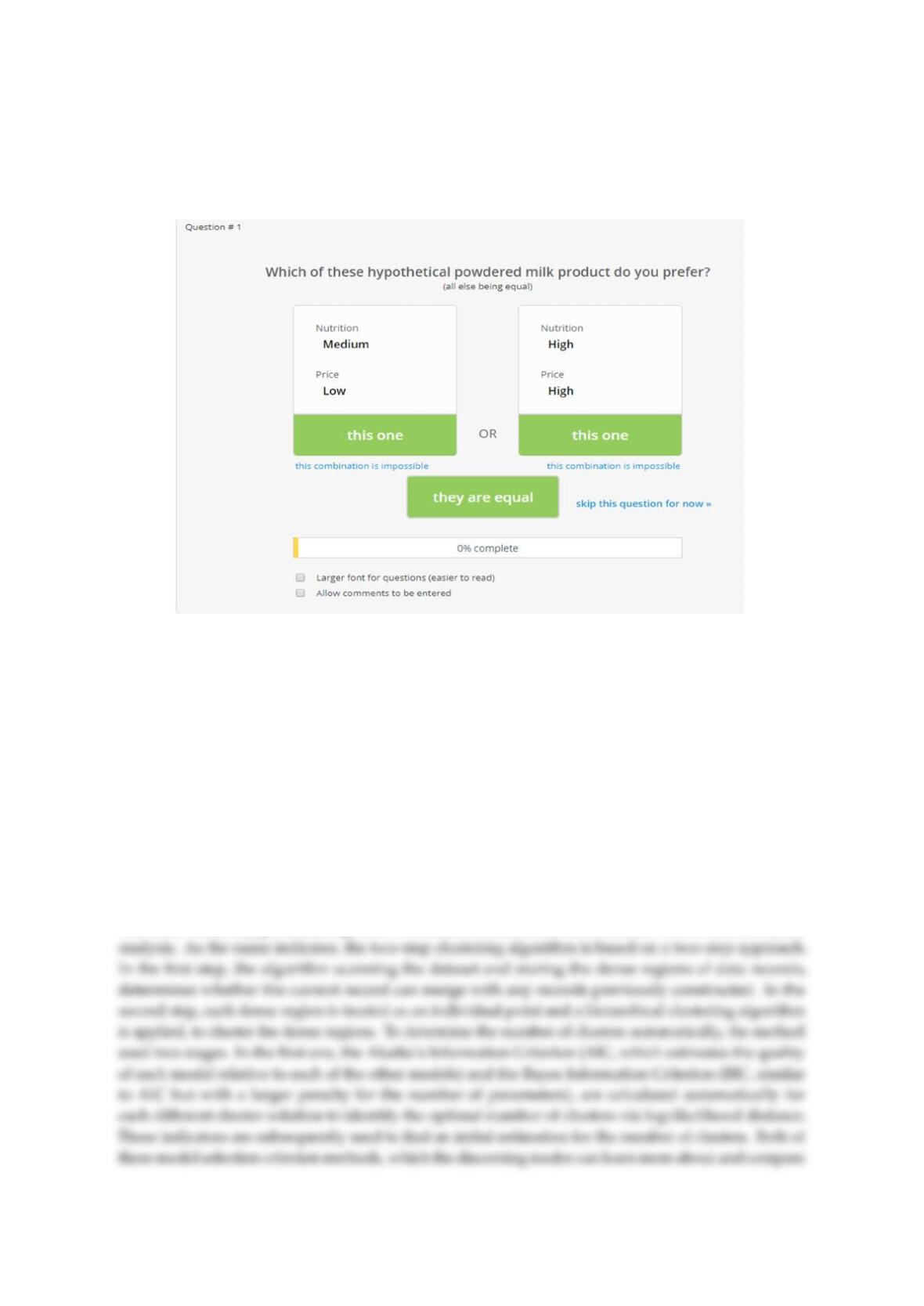
shown a pair of hypothetical powdered milk products, each of which had two attributes at different
levels (Figure 1) and asked “Which of these hypothetical powdered milk products do you prefer
(with all else being equal)?” The number of questions required to complete the survey varied, based
on the participant’s choices, as with each selection, the 1000minds software recognized all other
hypothetical products that could be ranked pairwise via transitivity and eliminated them from the
survey. For example, if a participant prioritizes product A over product B and then he/she prioritizes B
Sustainability 2020,12, 5258 5 of 16
over C, then—by transitivity—A is prioritized over C and the question ranking the last pair of products
is eliminated [
34
]. This procedure ensures participants are asked the minimum number of trade-off
questions possible.
Sustainability 2020, 12, x FOR PEER REVIEW 5 of 16
eliminated [34]. This procedure ensures participants are asked the minimum number of trade-off
questions possible.
Figure 1. Translated example of a pairwise ranking question (a screenshot from 1000minds software).
The actual was presented to participants in Vietnamese.
All participants agreed to complete the surveys voluntarily. Before commencing the surveys,
participants were asked to read an information sheet, accessible via an URL (Qualtrics), which described
how the survey would present participants with pairs of hypothetical concepts. The sheet was embedded
in the first demographic survey, however; participants had to go through screening questions and repeat
this first step when entering the second survey. Ethical approval for this study was granted by the
University of (blinded for review), Human Ethics Committee (reference number: 17/04B).
2.3. Statistical Analysis
The 1000minds software was used to calculate each consumer’s part-worth utility, using
mathematical methods based on linear programming. Further technical details are provided in
Hansen and Ombler’s paper [34]. In addition, the two-step cluster analysis, developed by [35], was
Figure 1.
Translated example of a pairwise ranking question (a screenshot from 1000minds software).
The actual was presented to participants in Vietnamese.
All participants agreed to complete the surveys voluntarily. Before commencing the surveys,
participants were asked to read an information sheet, accessible via an URL (Qualtrics), which described
how the survey would present participants with pairs of hypothetical concepts. The sheet was embedded
in the first demographic survey, however; participants had to go through screening questions and
repeat this first step when entering the second survey. Ethical approval for this study was granted by
the University of (blinded for review), Human Ethics Committee (reference number: 17/04B).
2.3. Statistical Analysis
The 1000minds software was used to calculate each consumer’s part-worth utility,
using mathematical methods based on linear programming. Further technical details are provided
in Hansen and Ombler’s paper [
34
]. In addition, the two-step cluster analysis, developed by [
35
],
was used to identify potential segments of consumers, based on the attributes’ levels in the conjoint