1
NEW RIVER COMMUNITY & TECHNICAL COLLEGE: ENGLISH 101 COMPOSITION
Prof. Julia Jackson Fall 2020
Email: jjackson@newriver.edu Phone: 304-647–6577
Alternate Email (for time-sensitive matters): jjack003@gmail.com
Office Hours:
Mondays
11am-12:30pm; 6-7pm
Tuesdays & Thursdays
2-5pm
Wednesdays
11am-12:30pm
CRN/Sec: 11530/101
Required Text:
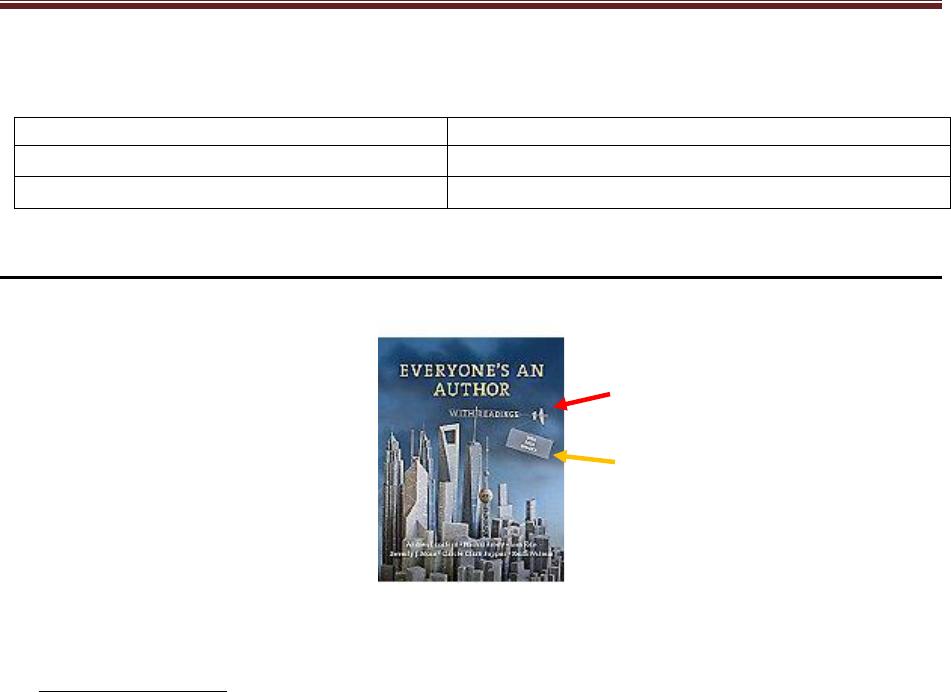
Everyone’s an Author with 2016 MLA Update: with Readings. Ed. Andrea Lunsford, et al.
2nd Edition. WW Norton. (ISBN: 0-393-61746-7)
Notes on the text:
• You will need your textbook by Tuesday, 9/8—so you have some time to obtain
your text if you wish to purchase it inexpensively online.
• Make sure you search for your texts by ISBN, to ensure you purchase the proper
edition. There’s a number of different texts with the same name; you want the
one WITH READINGS and WITH 2016 MLA UPDATE. 13-digit ISBN: 9780393617467
• E-books are not permitted, excepting special circumstances.
REQUIRED COURSE MATERIALS
MS Word
Mozilla Firefox (Some of the school website’s features don’t work with other
browsers)
A PDF viewer, such as Adobe Reader
Anti-virus software, such as AVG
USB flash drive or an account such as Google Drive, to back up important files
Pens & highlighters
A binder with at least 4 file folders
Post-It notes
A weekly day planner (you can print one out from a template in Word or using
timeanddate.com, or purchase one to suit your tastes)
A notebook or loose-leaf paper
A printer (preferred), or a second device to view files while completing classwork
2
You are also expected to check your school email daily.
Supplies & textbooks will need to be posted as a photo to Blackboard on or before 9/8.
If you don’t yet have MS Word: Students are entitled to a free version of Office 365, by
using their student email. (Office 365 includes other software, such as Excel.) Go to:
https://products.office.com/en-us/student/office-in-education or simply do a web
search for “student Microsoft 365.” You have the option to download the software, or
use it in your browser; it is recommended that you download it.
I can recommend Brother laser printers and Lenovo tablets/laptops for products that
are reliable and inexpensive. (Brother and Lenovo aren’t paying me to say this.)
Amazon’s Fire tablets are another good inexpensive option. If your budget is tight, you
can buy a Chromebook that will function as a laptop for about $200. A number of
retailers also offer discounts for college students (Lenovo, Best Buy, NewEgg, and Apple
are a few).
COURSE DESCRIPTION:
Practice in the techniques of effective writing and reading, stressing rhetorical methods and
patterns of organization necessary for clear, correct, and lively presentation of ideas and
information.
1. ACT Reading Main score of 18
2. or “S” in ENGL 098
3. or COMPASS Reading score of 75 or above
AND
1. ACT English Main score of 18
2. or “S” in ENGL 099
3. or COMPASS Writing score of 70 or above
COURSE STUDENT LEARNING OUTCOMES
At the conclusion of this course, the successful student will be able to:
1. Demonstrate clear and accurate use of the language, including language
development, syntax, mechanics, and varied types of expression. (NCTE 1)
2. Analyze errors in Standard Written English by means of revision and editing of multiple
drafts. (NCTE 1, 2)
3. Employ varied types of writing: for example, expository, persuasive, and descriptive.
(NCTE 1, 2)
4. Employ varied styles of writing: showing awareness of audience and purpose. (NCTE 1, 5)
(NCTE 3, 7)
5. Read a variety of expository prose as an integral part of the course. (NCTE 3, 4)
6. Analyze essays demonstrating understanding of methods of development, types of
writing and use of language (exposition, persuasion, etc.) and styles of writing (formal,
informal, point-of-view). (NCTE 2)
7. Analyze use of language in mass media (persuasion, propaganda, stereotypes, etc.),
demonstrating critical thinking skills about the relationship between the language of non–
print media and cultural attitudes. (NCTE 2, 6)
Grades:
Essays (40% total: 10% each, except for Essay #3, which is 20%)
Midterm & Final (20% total: 10% each)
Quizzes (15%)
Discussion Board & Assignments (25%)
Grades are calculated by weight, not by total points. A 69.5% is the lowest passing
grade.
Important Deadlines & Dates:
8/28: Last day for schedule adjustment (Add/drop)
8/30: Essay #1 Partial Draft (20 pts.)
9/6: Essay #1 Final
9/7: Labor Day: No Classes
9/8: Textbook & supplies deadline (5 pts.)
9/13: Essay #2 Guided Prewriting (20 pts.)
9/20: Essay #2 Draft (20 pts.)
9/27: Essay #2 Final
10/4: Midterm
10/11: Essay #3 Proposal (20 pts.)
10/19-11/6: Current student registration for Spring 2021. See your advisor!
10/25: Essay #3 Outline (20 pts.)
11/6: Last day to drop with a W