Teaching case
Peak experiences and strategic IT
alignment at Vermont Teddy Bear
Janis L Gogan, Mark O Lewis
Bentley University, Waltham, Massachusetts, USA
Correspondence:
JL Gogan, Bentley University, Waltham, Massachusetts, USA.
Tel: þ781 891 2098;
Fax: þ781 891 2949;
E-mail: jgogan@bentley.edu
Abstract
In winter 2010 Bob Stetzel, the new Chief Information Officer (CIO) at Vermont Teddy Bear
(VTB), hopes to replace or modernize many of the company’s existing systems and invest
in some new applications. This catalog marketer (via online and print catalogs) offers three
separately managed brands: Vermont Teddy Bear (VTB), PajamaGrams, and Calyx
Flowers. Sales are highly seasonal, with peak volumes at Christmas, Valentine’s Day and
Mother’s Day. Stetzel has spent his first few months on the job cataloging systems and
databases, learning about the ‘spider web’ of middleware connecting various applications
and platforms, and locating employees with expertise to fix them. The company has
survived an economic downturn and several costly strategic missteps. The CEO is seeking
new sources of revenue and ways to leverage their well-known brand, while the CIO needs
to set Information Technology ( IT ) priorities: should they invest in a full-featured Enterprise
Resource Planning (ERP) package or take other steps that would more quickly yield
tangible results? Whatever choice he makes, Stetzel will have to convince the CEO and
the Board of Directors to provide the necessary resources. This case provides students
with an opportunity to place themselves in the shoes of a CIO wrestling with strategic IT
alignment challenges at a time when resources are severely constrained and competitive
rivalry is fierce.
Journal of Information Technology Teaching Cases (2011) 1, 61–70. doi:10.1057/jittc.2011.6;
published online 5 April 2011
Keywords: strategic IT alignment; IT governance; IT planning; e-commerce
Introduction
Bob Stetzel, Vice President of Information Technology (IT)
at Vermont Teddy Bear (VTB), walked a tranquil path from
his car to his Shelburne, Vermont office early one morning
in mid-February 2010. The landscape outside his office, and
the White Mountains beyond, were blanketed in a coating of
fresh snow. Just a few days before, the scene was not tranquil
at all; a small army of nearly 2000 temporary employees had
descended on the company’s multi-building campus to help
process and pack gifts ordered by tens of thousands of
customers for delivery to their sweethearts for Valentine’s
Day. Bob and his seven person IT organization had worked
feverishly behind the scenes, ensuring that the company’s
information systems could handle the surge in orders for
pajamas, custom teddy bears, flowers and other gifts, placed
via telephone, mail-order, and the Web. There were a few
tense moments when the system – comprising a mix of
homegrown and packaged applications from a variety of
vendors, and knit together with middleware – occasionally
‘paused’ when its capacity was strained. Fortunately, his
team – veterans of past Valentine’s Day ‘peak experiences’ –
helped patch things together and ensured that nearly all
orders were processed and delivered on time. Recognizing
that customer retention was an important goal, Stetzel was
relieved that most customers were happy with the service
they received during the Valentine’s rush.
Stetzel had been hired in November 2009 – just in time
for a Christmas rush which included several tense moments
as the systems struggled to handle a surge in orders. He
hoped that before winter 2011 rolled around, his team could
tame the complicated middleware and make progress
toward an efficient, well-organized enterprise IT architec-
ture that could serve as a robust platform for the company’s
changing business requirements and support their long-
term strategic and operational needs. Meanwhile, Stetzel
knew he could expect another frenzy of activity in early
Journal of Information Technology Teaching Cases (2011) 1, 61 – 70
&
2011 JITTC Palgrave Macmillan All rights reserved 2043-8869/11
palgrave-journals.com/jittc/
JIT031
For the exclusive use of W. Robles, 2017.
This document is authorized for use only by Wilson Robles in INFO563ExecF17 taught by Malaga, Montclair State University from September 2017 to March 2018.

May, when orders would peak just before Mother’s Day
(second Sunday in May). Software bugs that had been
identified during the Valentine’s rush needed to be fixed by
members of his team before this next peak experience.
Stetzel also wanted to carve out time in March and April to
sort out his priorities for the IT organization so that the
relatively calm days between June and November (when
there were no major holidays to cause orders to suddenly
surge) could be put to good use modernizing the aging and
complex systems on which the company relied.
What project to do first? Should he oversee the selection
of new enterprise software to replace the accounting
systems responsible for order-entry, sales, and inventory
management? This would replace a lot of problematic
middleware, but at a high cost. Would it be better to focus
on building or buying new supply-chain software to
enhance operational capabilities, enabling raw materials
and finished goods to be more efficiently procured from
vendors around the world? Should the company acquire or
build a Customer Relationship Management (CRM) pack-
age that would help them serve customers well across
multiple product lines (bears, pajamas, flowers, other gifts)
and channels (stores, mail-order, web, telephone)? Stetzel
also wanted to build a new data warehouse and beef up the
business analytics capabilities that were needed for effective
marketing. Clearly, his team could not possibly accomplish
all these things in one 6-month period. Besides, the
company’s cash reserves were quite limited in this tough
economic environment. Difficult choices would need to be
made soon, and a plan devised to get the job done.
As Bob Stetzel mulled over these concerns, CEO
John Gilbert tapped on his door. ‘Do you have a moment,
Bob?
I learned some interesting things at last week’s Toy Fair
(American International Toy Fair, held in New York City)
that might affect our business – and perhaps your
information systems.
Vermont Teddy Bear company background
1981: VTB was founded by John Sortino, who sold teddy
bears from a pushcart in a Burlington, Vermont open-air
mall. The company nearly went bankrupt around 1990, but
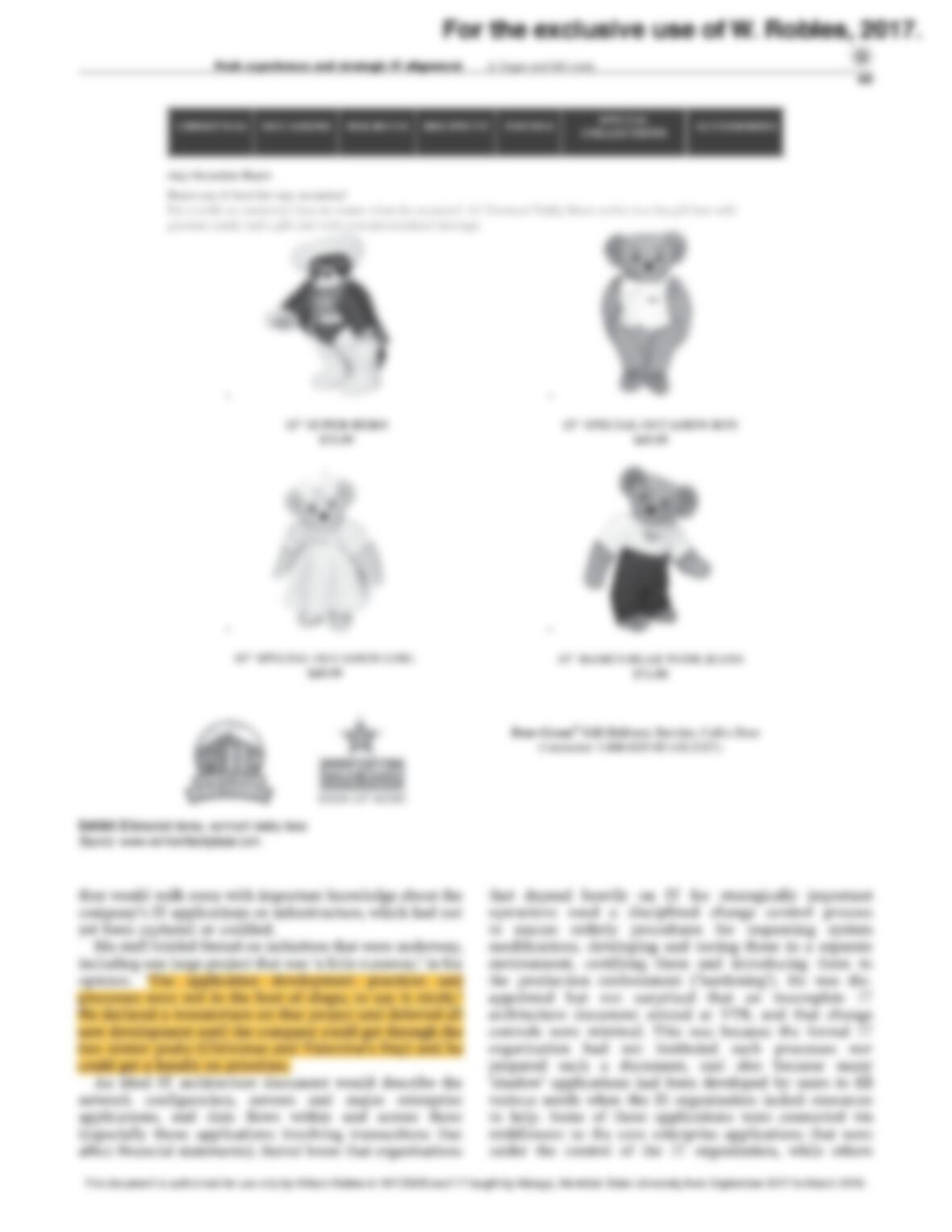
recovered when Sortino introduced a ‘Bear-Gram’ service,
promoted via radio advertisements in the New York City
area. Customers (mostly men buying for wives or
girlfriends) phoned 1-800-829-BEAR to order a ‘persona-
lized’ bear (choosing from several colors of bears and about
100 costumes such as tutus, wedding gowns, fire fighter and
doctor or nurse outfits). The bear was shipped in a
decorated hatbox with ‘air holes’ and a note from a ‘Bear
Counselor.’ The market response to this promotion was
impressive; revenues grew from less than $2 million in 1990
to $17 million in 1993, allowing VTB to raise $10 million in
an initial public offering and earning it a ranking of number
21 in Inc. Magazine’s listing of American’s fastest-growing
public companies.
Despite the initial success of the Bear-Gram service,
numerous challenges threatened the company’s survival.
Although radio advertising and a toll-free phone number
generated lots of orders for teddy bears as gifts for
Valentine’s and Mother’s Day (80% were purchased by
adults for other adults), it was less cost-effective at other
times of the year. In an attempt to induce adults to buy
teddy bears for children throughout the year, the company
began to sell through high-end toy stores such as FAO
Schwarz, department stores such as Bloomingdales, and
more than 200 gift shops. VTB also opened company-
owned stores in New York City and Freeport Maine.
Unfortunately, these expensive moves combined with
construction of a new company headquarters in Shelburne
Vermont, entailed high expenses (leasing space for
company stores cost $600,000 a year), which were not
sufficiently offset by sales.
1997–1999: A new CEO, Elisabeth B Robert, closed the
company stores (except the factory store in Shelburne) and
launched a ‘Make-a-Friend-for-Life’ venture with retailer
Zany Brainy: in-store machines assembled and stuffed
personalized bears (similar to Build-a-Bear Workshops, a
competitor). 1999 sales reached $21.5 million.
2001–2003: 2001 sales reached $37 million. Retail partner
Zany Brain filed for bankruptcy, but Robert was not
worried by this development, since ‘we’re not a retailer;
we’re in the gift delivery service business (Helmich, 2002).
She re-focused VTB on direct marketing via telephone and
website (55% of Bear-Gram orders originated online,
44% by phone). Producing about 450,000 bears per year
in Vermont, VTB continued to target both children and
adults. About 65% of orders were from men, with 30% of
annual sales for Valentine’s Day (February 14). Their biggest
customer was ‘Late Jack,’ an internal moniker describing
men who ordered bears at the last minute instead of buying
flowers or chocolates for girlfriends, wives, or mothers.
To increase sales to women and to generate orders at
other times of the year, VTB developed Gift Bag Boutique
(handbags and gift baskets of food, accessories, and/or
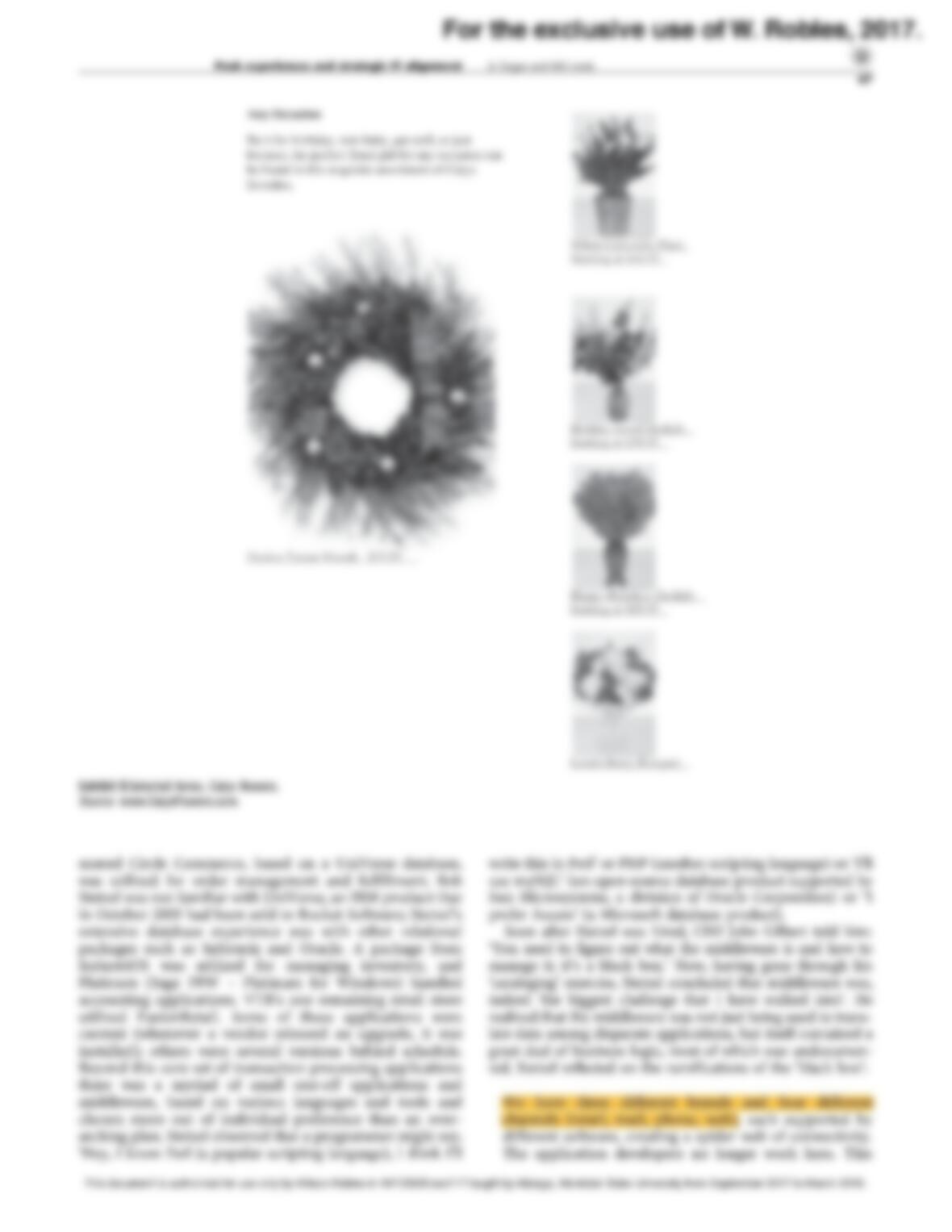
pajamas). In 2003, the company acquired high-end florist
Calyx & Corolla (renamed Calyx Flowers).
2005–2008: VTB reverted to private ownership. Revenues
reached $66 million (Bears led at $31 million, followed by
Flowers at $17.5 million and Pajamas at $14.5 million.
Corporate sales, TastyGram, and other sources contributed
the rest). Pressures intensified from strong competitors
like 1-800-Flowers (which also sells gifts). The marketing
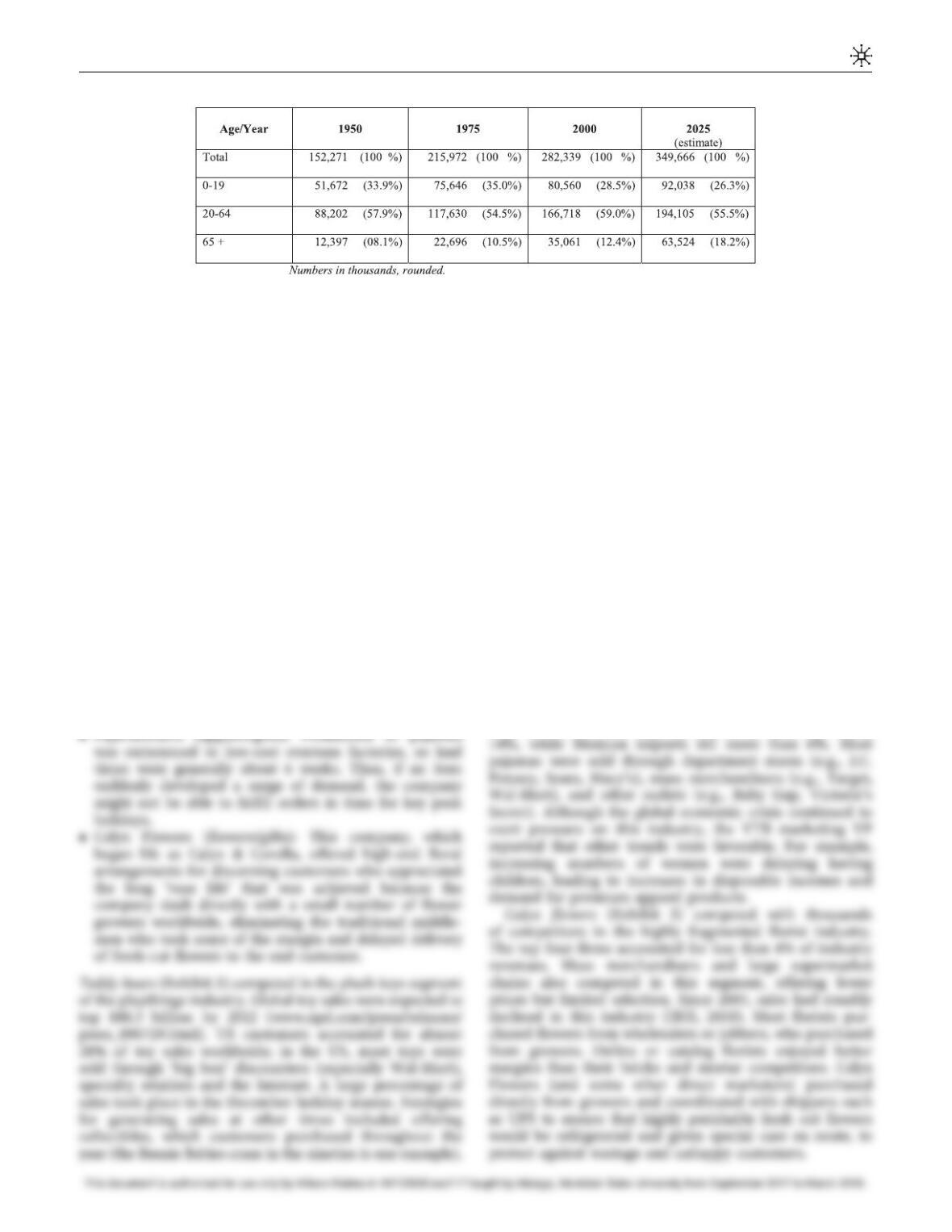
VP expressed concern about demographic trends such as a
drop in the number of young adult males (Exhibit 1). VTB
dropped several product lines. Three remained: Bears,
PajamaGrams, and Calyx Flowers.
Right after Valentine’s Day, 2008, 15 employees were laid
off. In September Elizabeth Robert resigned, a month
before an October stock market crash that reverberated
worldwide. Interim CEO William York, a veteran of LL
Bean and Dell, served during a time of further retrench-
ment. 2008 sales totaled about $75 million.
2009: A January press release announced VTB laid off 35
more employees. VTB retained about 200 employees;
during three peak seasons (Christmas, Valentine’s Day,
Mother’s Day) temporary employees were hired.
In March 2009, John Gilbert joined VTB as its new
CEO, having previously served as Chief Marketing Officer
for TJX Companies and in marketing positions at Dunkin
Donuts, Pepsi, Coca Cola, and elsewhere. In a press release
Peak experiences and strategic IT alignment JL Gogan and MO Lewis
62
For the exclusive use of W. Robles, 2017.
This document is authorized for use only by Wilson Robles in INFO563ExecF17 taught by Malaga, Montclair State University from September 2017 to March 2018.
announcing Gilbert’s appointment as ‘Chief Bear Officer’
Board Chairman Bob Crowley said:
An expert at building great consumer product businesses
and brands, John is a natural choice to help lead Vermont
Teddy Bear’s next chapter of growth and innovation.
Industry background (plush toys, pajamas, flowers)
In 2010, VTB relied on gift sales across its three separately
managed brands, competing in three industries (see also
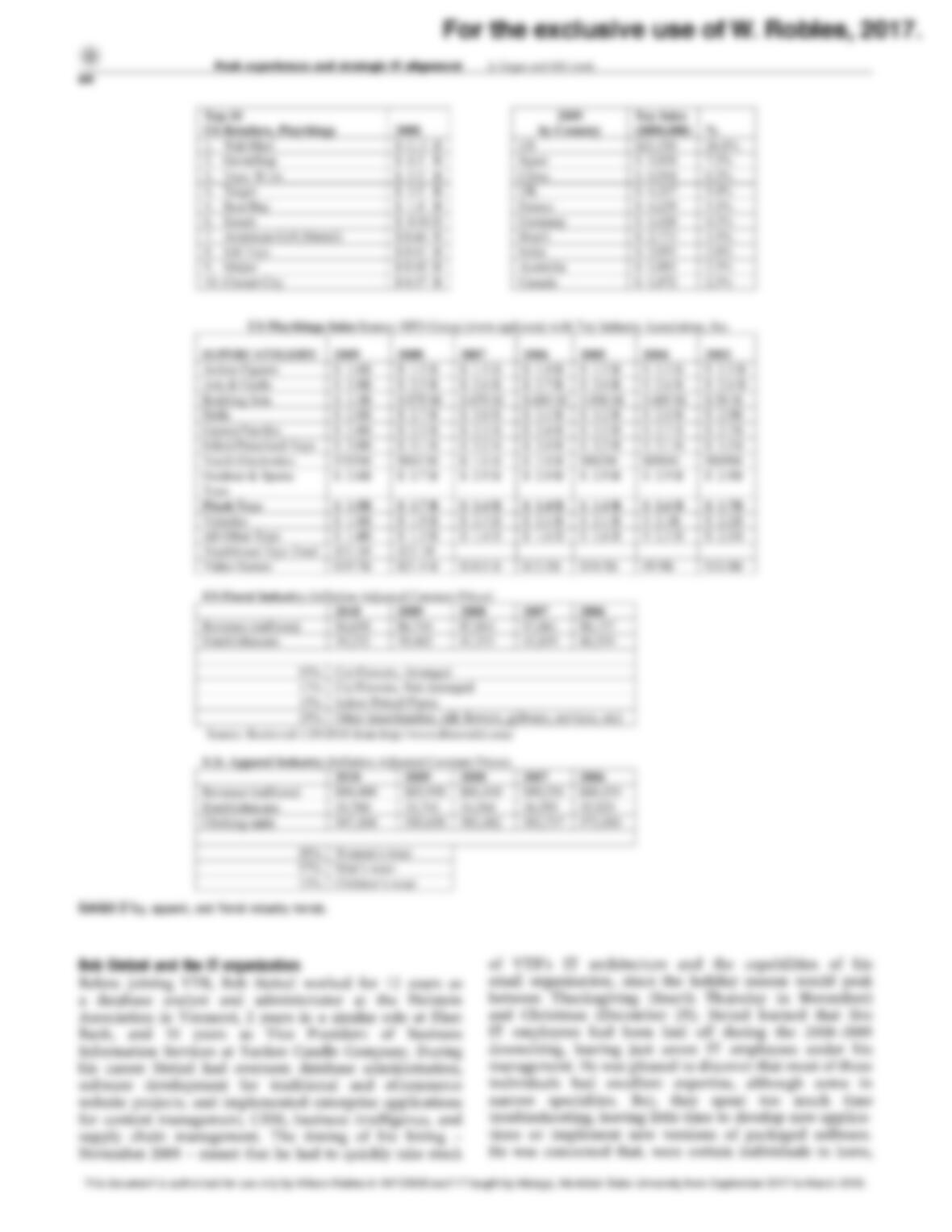
Exhibit 2):
“Teddy Bears (plush toys): A customer could purchase
a stock teddy bear or could custom design one by
selecting the color and outfit from a menu of options. At
peak times, most purchases were for adult gifts; the rest
of the year, purchases were mainly for children. All bears
were produced on the Shelburne campus; fabric and
other raw materials were purchased from vendors
worldwide.
Another tactic was to promote complementary accessories
(e.g., clothing and other accessories for Barbie or American
Girl dolls). A third tactic was to sign licensing deals with
television and movie studios, game makers and others. US-
based Mattel and Hasbro, each with more than $5 billion in
2009 revenues, were the largest toy companies in the world.
China, the world’s toy factory, produced 77% of 2008 US
toy imports – about 20 million toys. Large companies
tended to outsource production to Chinese contractors for
toys with unpredictable forecasts (i.e., this year’s fad), and
to use their own factories (often located in China) to
produce classic toys (those with more predictable demand).
The US Consumer Product Safety Improvement Act
restricted the use of lead paint, phthalates and other
harmful materials in children’s products, and mandated
product testing and documentation requirements. For
example, to support product recalls, every component of
every toy must be traceable to its source.
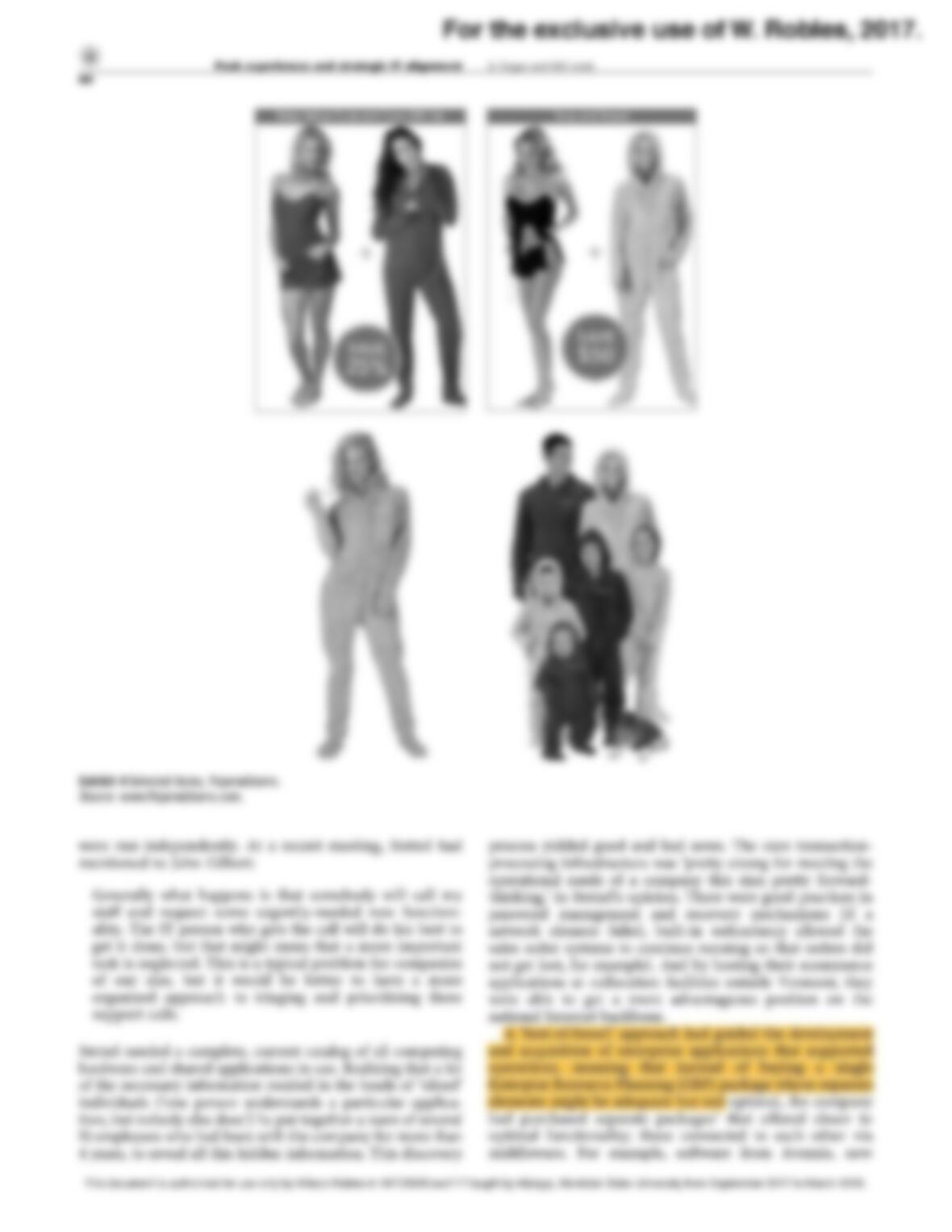
PajamaGrams (Exhibit 4) competed in both the general
gifts category and global apparel industry. China was a
major producer of clothing; between 2002 and 2008 total
imports of men’s clothing from China increased by almost
Exhibit 1 U.S. population by age group, 1950–2050.
Source: Shrestha (2006).
Peak experiences and strategic IT alignment JL Gogan and MO Lewis
63
For the exclusive use of W. Robles, 2017.