Valuation Methods – Financial Analysis
INTRODUCTION TO BUSINESS VALUATION
Valuation – is the analytical process of determining the current
or projected worth of an asset or a company. In placing a value
on a company, an analyst takes into consideration its business
management, the composition of its capital structure, the
prospect of future earnings, and the market value of its assets,
among other metrics.
Valuation concepts
Valuation is based on economic factors, industry variables, an
analysis of the financial statements and the outlook for
individual firm. The purpose of a valuation is to determine the
long-run economic value of a specific company’s common
stock.
Analysis of Financial Statements
1. Ratio analysis – involves conversation of financial
numbers for a firm into ratios. It allows comparison of one
firm to another, since ratios look at relationships inside the
firm. Ratios are divided into five categories, namely:
a. Liquidity ratios – ratios that that show the relationship
of a firm’s cash and other current assets to its current
liabilities.
a-1. Current ratio – it indicates the extent to which
current liabilities are covered by those assets expected
to be converted into cash in the near future. This ratio is
calculated by dividing current assets by current
liabilities.
Current ratio = Current assets__
Current liabilities
a-2. Quick or acid test ratio – this ratio is calculated
by deducting inventories from current assets and
then dividing the remainder by current liabilities.
Quick or acid test ratio = Current assets – Inventories
Current liabilities
b. Asset management ratios – a set of ratios that
measure how effectively a firm is managing its assets.
b-1. Inventory turnover ratio – it shows how many
times the particular asset is “turned over” during the
year. This ratio is calculated by dividing sales by
inventories.
Inventory turnover ratio = Sales__
Inventories
b-2. Days Sales Outstanding (DSO) also known
as Average Collection Period (ACP) – it is calculated
by dividing accounts receivable by the average daily
sales to find how many days sales are tied up in
receivables.
DSO = Receivables__ = Receivables__
Ave. sales per day Annual sales / 365
b-3. Fixed assets turnover ratio – it is the ratio of
sales to net fixed assets. It measures how effectively the
firm uses its plant and equipment.
Fixed assets turnover ratio = Sales____
Net fixed assets
b-4. Total assets turnover ratio – measures the
turnover of all of the firm’s assets; and is calculated by
dividing sales by total assets.
Total assets turnover ratio = Sales___
Total assets
c. Debt Management Ratios – a set of ratios that measure
how effectively a firm manages its debt.
c-1. Debt ratio – the ratio of total debt to total assets;
measures the percentage of funds provided by creditors.
Debt ratio = Total debt_
Total assets
c-2. Times-interest-earned (TIE) ratio – a measure
d. Profitability Ratios – a group of ratios that show the
combined effects of liquidity, asset management, and
debt on operating results.
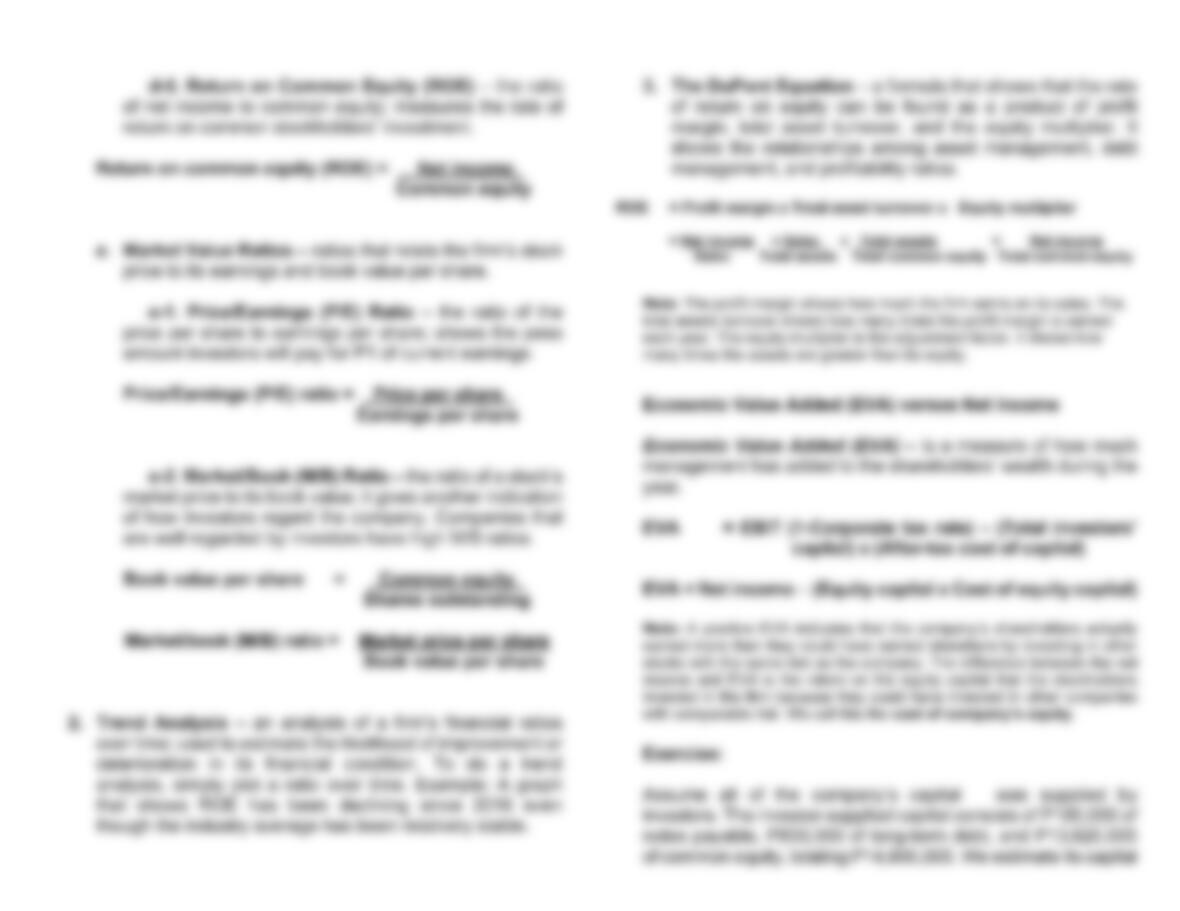
d-1. Operating Margin – this ratio measures
operating income, or EBIT per peso of sales; it is
calculated by dividing operating income by sales.
Operating margin = Operating income (EBIT)
Sales
d-2. Profit Margin – this ratio measures net income
per peso of sales and is calculated by dividing net
income by sales.
Profit margin = Net income
Sales