Page 1 of 14
Linear Optimization / Linear
Programming Notes
Introduction …………………………………………………………………………………………………………………… 1
LP Problems……………………………………………………………………………………………………………………. 2
Low-fat Cake Example ………………………………………………………………………………………………….. 5
Computer Solution Using R …………………………………………………………………………………………… 6
Graphical Solution ……………………………………………………………………………………………………….. 7
Duality in linear optimization………………………………………………………………………………………….. 11
Introduction
The purpose of linear optimization or linear programming is to maximize or minimize a given
numerical function dependent on a set of variables such to certain constraints. Linear
programming, or LP, involves optimizing (either maximizing or minimizing) a linear function by
satisfying a set of linear constraints. These constraints can be equalities or inequalities such as
less than, less than or equal to, etc. In 1947, George Dantzig developed the simplex method for
solving linear programming problems. World War II had ended in 1945 but there was still
considerable interest in the complex logistics of troop and resource movements. These were
some of the early problems that linear programming sought to address. The use of the word
programming was meant to mean planning rather than computer programming, although today
I think it is more ubiquitous.
There are a few “common” components of an LP problem. LP problems have a objective
function, i.e. the numerical function to be optimized. LP problems have decision variables that
relate to decisions that can be made in the context of the LP problem. Decision variables can
be controlled. LP problems have parameters, i.e. input data that cannot be controlled but
directly influence the solution of the problem. LP problems have constraints. These
constraints, or restrictions, impose conditions on the problem and its solution.
To minimize the following text I’ll drop the designation linear optimization and/or linear
programming and simply refer to our discussion as one on LP problems. Note that I’m only
including linear problems but that nonlinear optimization certainly exists and is very important.
Page 2 of 14
I also will not cover integer programming in this document. But that area of optimization also
comprises an important set of problems to consider.
LP Problems
Let’s consider a simple example that we can help us understand what LP problems are, look like
and that we can refer back to as we get deeper into the details of optimization. This example is
from Prof. Alexandra Seco’s lecture in Linear Programming at the Polytechnic Institute of Leiria
in Leiria, Portugal. You can search for Alexandra Seco and Linear Programming to obtain a copy
of Prof. Seco’s entire PowerPoint presentation. Let’s consider a nutritionist that is developing a
recipe for a low-fat cake.
The fat recipe is obtained through the use of butter and vegetable oil. The butter has 6
grams of unsaturated fat and 1 gram of saturated fat per soup spoon, while vegetable
oil contains 1 gram of unsaturated fat and 4 grams of saturated fat per soup spoon. The
recipe must contain at least 34 grams of unsaturated fat and 44 grams of saturated fat
and no more than 25 soup spoons fat will be used. Formulate the problem, given that
you want to minimize the calories recipe and knowing that the butter has 100 calories
per spoon, while the vegetable oil has 115 calories per spoon.
Prof. Alexandra Seco, 2016, Linear Programming
As we discussed in class we need to identify our decision variables. In this case we need to find
the number of spoons of butter and the number of spoons of vegetable oil to use in the recipe.
Let’s just designate these 𝑥1 and 𝑥2 respectively. And, we need to define our objective
function. What we want to do is to minimize the calories in our recipe given the number of
calories in butter and vegetable oil. So, our objective function is:
𝑀𝑖𝑛: 100𝑥1+115𝑥2
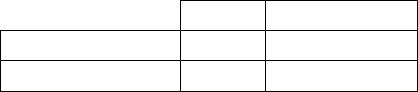
We can also create a table of the amount of saturated and unsaturated fat for butter and
vegetable oil as follows:
Butter
Vegetable oil
Unsaturated fat
6
1
Saturated fat
1
4
From our problem statement we can identify several constraints. For example there are
restrictions for saturated and unsaturated fat as follows:
Page 3 of 14
𝑈𝑛𝑠𝑎𝑡𝑢𝑟𝑎𝑡𝑒𝑑 𝑓𝑎𝑡: 6𝑥1+ 𝑥2 ≥34
𝑆𝑎𝑡𝑢𝑟𝑎𝑡𝑒𝑑 𝑓𝑎𝑡: 𝑥1+4𝑥2 ≥44
There is also a constraint associated with the maximum number of soup spoons or tablespoons
of fat as follows: 𝑥1+ 𝑥2 ≤25
And of course we have the normal nonnegativity constraints:
𝑥1 ≥0, 𝑥2≥0
Therefore, our overall LP problem is: 𝑀𝑖𝑛: 100𝑥1+115𝑥2
subject to (or s.t.): 6𝑥1+ 𝑥2 ≥34
𝑥1+4𝑥2 ≥44
𝑥1+ 𝑥2 ≤25
𝑥1 ≥0, 𝑥2≥0
Just as an aside I’d like to mention that any LP problem can be reduced to the canonical form
which is: 𝑀𝑖𝑛: 𝑧= 𝑐1𝑥1+ 𝑐2𝑥2+ ⋯+ 𝑐𝑛𝑥𝑛
s.t.: 𝑎11𝑥1+ 𝑎12𝑥2+ ⋯+ 𝑎1𝑛𝑥𝑛 ≥ 𝑏1
𝑎21𝑥1+ 𝑎22𝑥2+ ⋯+ 𝑎2𝑛𝑥𝑛 ≥ 𝑏2
⋮
𝑎𝑚1𝑥1+ 𝑎𝑚2𝑥2+ ⋯+ 𝑎𝑚𝑛𝑥𝑛 ≥ 𝑏𝑚
𝑥1,𝑥2,…,𝑥𝑛 ≥0
So, in the canonical form our LP problem has an objective function:
𝑀𝑖𝑛: 𝑧= 𝑐1𝑥1+ 𝑐2𝑥2+ ⋯+ 𝑐𝑛𝑥𝑛
with: decision variables 𝑥1,𝑥2,…,𝑥𝑛; coefficients of the objective function 𝑐1,𝑐2,…,𝑐𝑛;
technical coefficients 𝑎11,𝑎12,…,𝑎1𝑛, 𝑎21,𝑎22,…,𝑎2𝑛, 𝑎𝑚1,𝑎𝑚2,…,𝑎𝑚𝑛; independent terms
(constraint values) 𝑏1,𝑏2,…,𝑏𝑚; constraints ∑𝑎𝑖𝑗𝑥𝑗 ≥ 𝑏𝑖 (𝑖=1,2,…,𝑚)
𝑛
𝑗=1 ; as well as the
nonnegativity constraints 𝑥𝑗 ≥0,(𝑗=1,2,…,𝑛). It should be obvious that all this will lead us
to developing a system of linear equations upon which we can work some matrix magic. But
before we move on let’s just look at a couple different forms LP problems can be presented in.
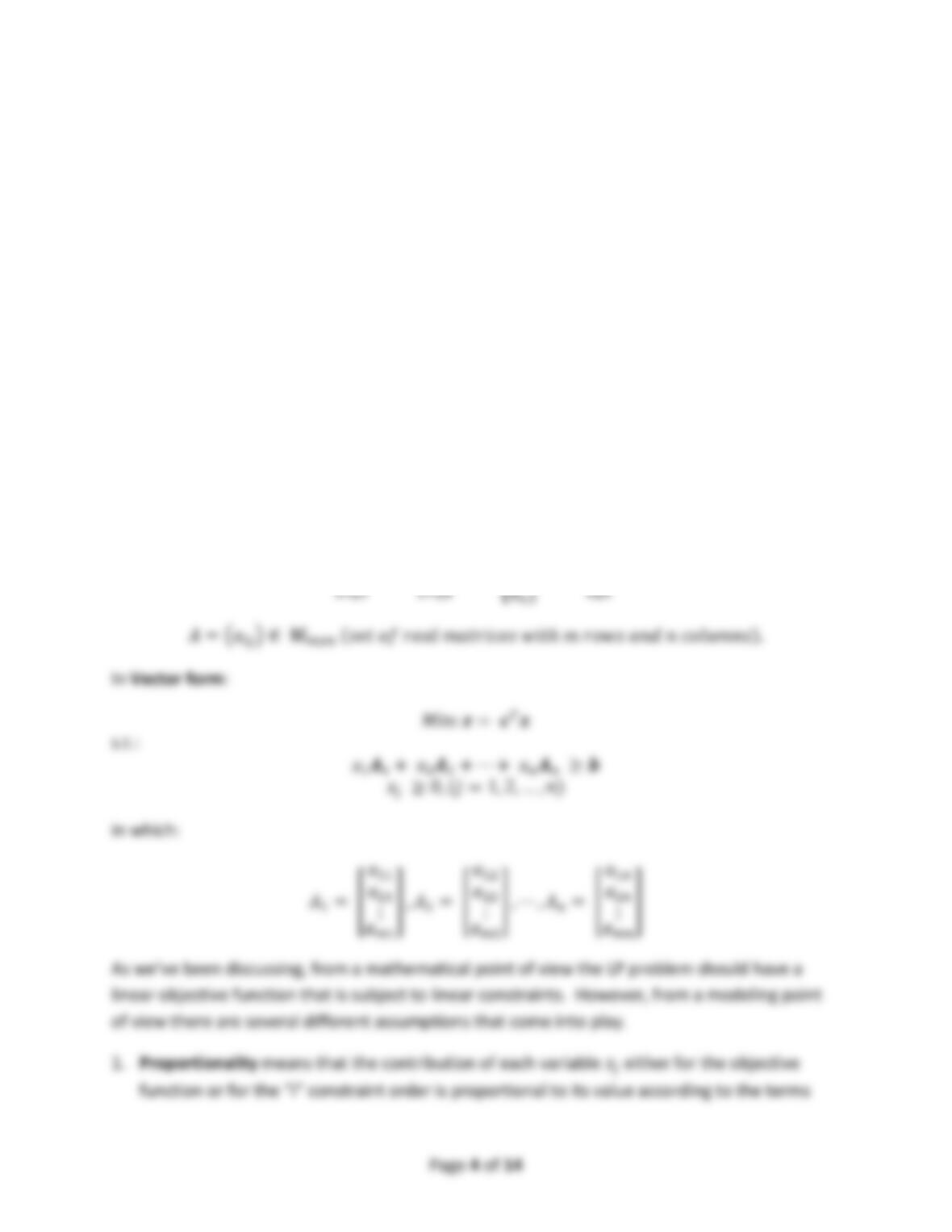
In Cartesian form:
𝑀𝑖𝑛: 𝒛= ∑ 𝑐𝑗𝑥𝑗
𝑛
𝑗=1
s.t.: ∑𝑎𝑖𝑗𝑥𝑗 ≥ 𝑏𝑖 (𝑖=1,2,…,𝑚)
𝑛
𝑗=1
𝑥𝑗 ≥0,(𝑗=1,2,…,𝑛)
In Matrix form: 𝑀𝑖𝑛:𝒛= 𝒄𝑇𝒙
s.t.: 𝐴𝒙 ≥𝒃
𝒙 ≥𝟎
in which:
𝒄= [𝑐1
𝑐2
⋮
𝑥2
⋮
𝑏2
⋮
0⋮0],𝑎𝑛𝑑