This case study is made available to you with compliments of URBAN COMPANY through ICON – IIM Bangalore. Further posting, copying or distribution is
strictly prohibited.
| 1
August, 2021
Urban Company
Introduction
Urban Company (formerly UrbanClap) is Asia’s largest home services platform, present across
India, Australia, Singapore, UAE and KSA. Started in November 2014, UC helps customers book
reliable home services – i.e., beauty treatments, massages, appliance repair, plumbing,
carpentry, painting, cleaning etc. With a highly trained and skilled fleet of 30,000+ service
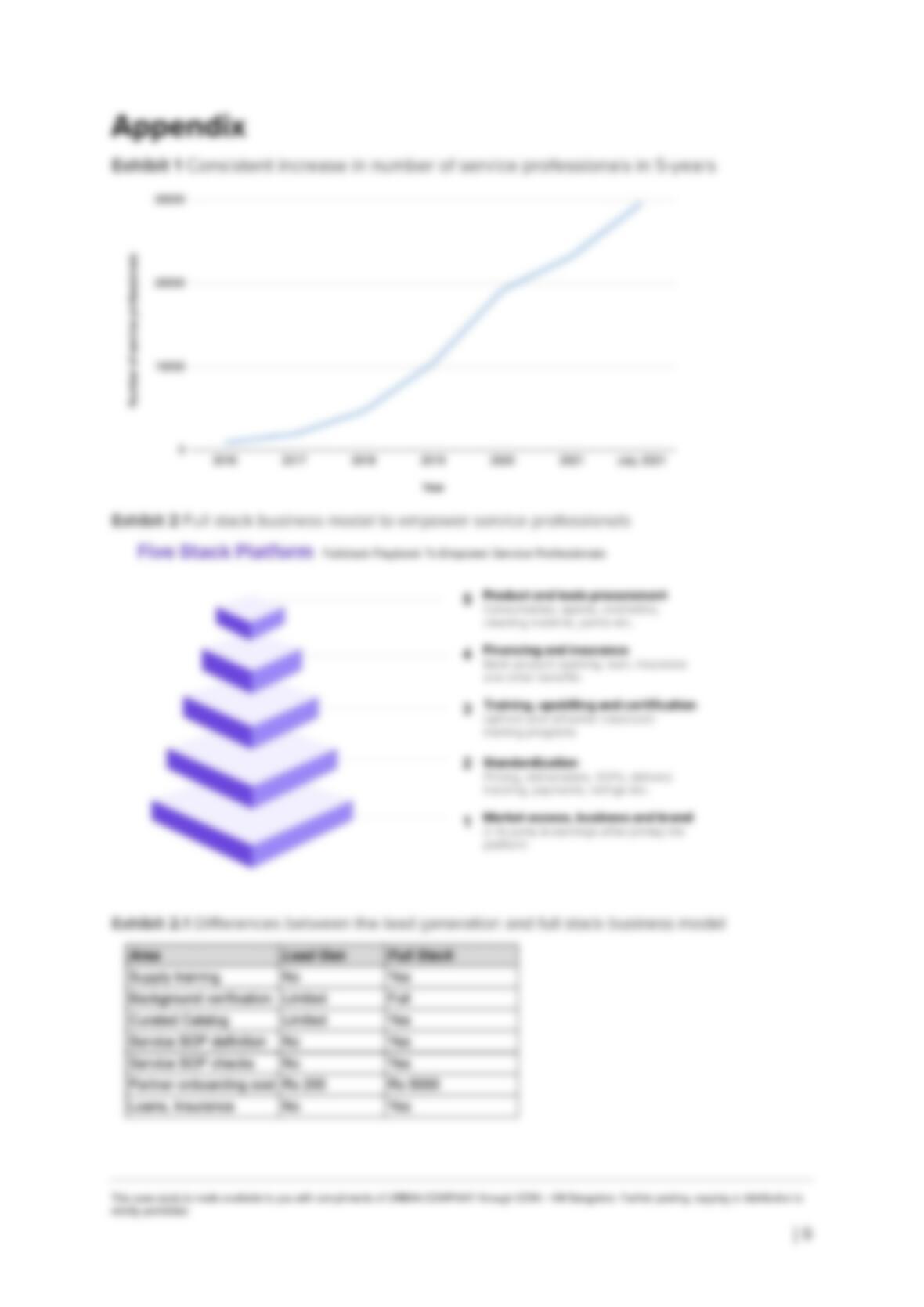
professionals (See Exhibit 1 for the consistent increase in service pros in 5–years), UC has
already expanded to 30 cities and served over 5 million customers.
The three founders – Abhiraj Singh Bhal, Raghav Chandra, Varun Khaitan launched UC after
previous failed attempts at starting up. Abhiraj and Varun were batchmates at IIT Kanpur, and
they met Raghav through the entrepreneurial community in Delhi in 2014 and decided to work
together. The trio were determined to disrupt the market. “We knew that the country was at
the cusp of change, and we should not only be the part of that change but should also be
leading it,” Khaitan said. “We should be creating the companies of the future that will transform
the country.”
History of Urban Company
Lead Gen business model
In 2014, Urban Company (then UrbanClap) acted primarily as an intermediary between service
providers and customers. It charged the service professionals for listing them on its platform
and conducted background verification and qualification checks on them. They listed service
professionals across 50+ categories e.g., cleaning, repair, event planning, photography, tutor
services etc. Any consumer could simply choose a provider of their preference in their searched
category.
However, the founders felt that this business model was not entirely solving the problems of
the home service market in India. “Our model was an improvement over open marketplaces
like JustDial, but not a substantial improvement,” Bhal said.
First major pivot: Lead generation to Full stack
The home service providers in India often did not have certification standards and were not
adequately professional (i.e., turning up late for appointments, overcharging etc.). To counter
these and other inherent concerns with the home service delivery market in India, over the next
two years, the founders led the first major pivot for UC – from lead generation to a full stack
model – a fully curated and controlled marketplace (See Exhibit 2 for features of the company’s

This case study is made available to you with compliments of URBAN COMPANY through ICON – IIM Bangalore. Further posting, copying or distribution is
strictly prohibited.
| 2
full–stack model). UC recruited freelance service providers after a rigorous process (background
checks, skill tests, interviews) and trained them.
The full–stack model enables these professionals to become micro–entrepreneurs by helping
them in 5 key areas – Market Access, Standardization of services, training and upskilling,
financing and insurance, products and tools (See Exhibit 2.1 for key differences between the
lead generation and full–stack model). This helps service professionals become more organized
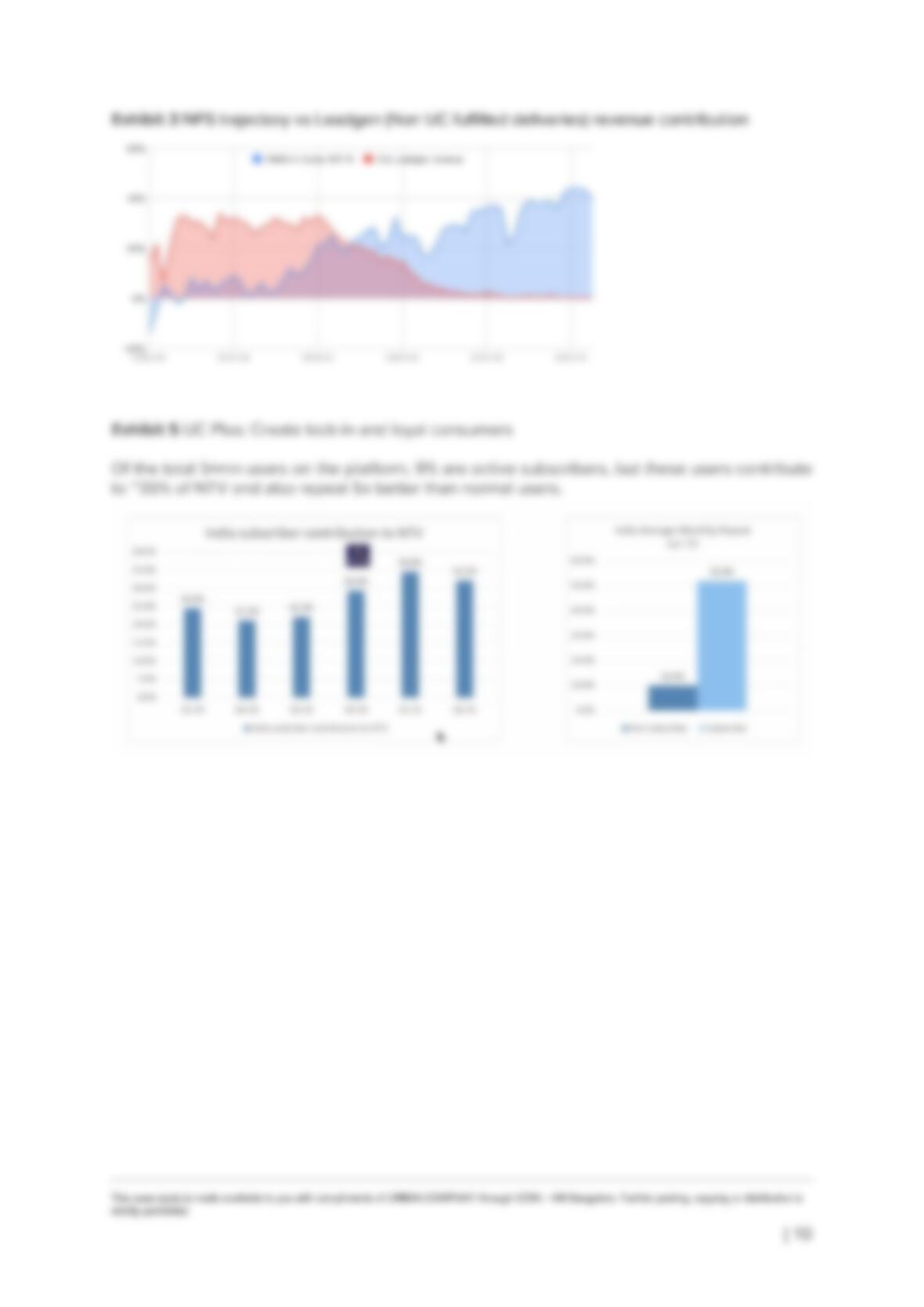
and multiplies their earnings. It also enabled UC to pivot from a high margin, low NPS lead
generation business to high NPS, low margin fulfillment business. (See Exhibit 3 for NPS
trajectory vs Leadgen (Non UC fulfilled deliveries) revenue contribution).
In the complete full–stack categories like Salon for Women, Salon for Men, Spa and AC the
selection criteria of service providers is very stringent and <~30% of the applicants get to join
the in–house UC training program. Most of the applicants get rejected based on their hard skills
and soft skills during the initial screening. As the training program at UC is a finishing school for
applicants who have previous experience in their fields, this helps to put a check on quality
from the very beginning. The selection criteria have been defined after multiple iterations and
being tracked very closely by the supply on–boarding team. UC has also invested heavily in
creating training center infrastructure across the geographies. There are dedicated full–time
trainers with UC for every category and regions to take the training sessions.
UC also provides kits to the service providers just after their in–house training is complete. The
kits include all the tools and products required to perform a set of curated services that are
listed on the UC customer app. These kits are costly for most of the service providers to pay
upfront, e.g., one time kit for Salon for Women professionals is ~30k. UC has tie–ups with
underwriters and loan agencies who can provide loans and open bank accounts for these
partners. Some partners with extremely poor CIBIL scores are forced to drop–off because of
this check. Once all the applicants pass the complete training program including the provider
app training, they are ready to serve the customers with their own mobile shop in place. It was
during this transformation that their mission statement of ‘empowering millions of service
professionals across the world to deliver service experiences at home like never seen before’
was developed.
Once the service provider is live on the platform, she gets leads (booking from the customers)
from the nearby area and can accept the booking by paying UC credits
1
which they need to buy
in advance from their partner app. These UC credits act as a mode of paying the commission
(~20%) upfront to UC. The customers can pay online or cash for the service and the lump sum
payment to the service provider gets credited in their bank account thrice a week. This keeps
the flow of money simple and faster for the partners. The partners can also buy/replenish their
products/tools from the partner app using the UC credits and UC gets the order delivered to
their doorstep without any hassle. This is just like an in–house e–commerce platform for the
partners.
Once the partners are live, they are also tracked based on their ratings and reviews and if they
fall below a certain threshold, they get re–trained on their areas of improvement. All of the above
features were not available in the lead generation model and the quality controls in full–stack
helped UC in getting the NPS on a growing trajectory.
1
1 UC credit = Rs. 10 in India
If the booking gets cancelled, then the UC credits get back to the partner UC wallet.

Current Business Lines
Beauty Business
The main categories of Beauty services at Urban Company are Salon for Women, Men’s
Grooming and SPA. Currently, the beauty business contributes to ~45% of the overall business.
This share used to be >50% in the pre–covid world.
Salon for Women and SPA got hit significantly during the 1st and the 2nd wave of Covid–19.
Since these were high touch categories, the YoY growth for beauty was muted in the last couple
of years led by multiple lockdowns and lack of need for beauty services by the consumers.
The silver lining for the beauty business was the phenomenal growth of the Men’s Grooming
category which saw ~8x growth in a short period ~6 months after the first lockdown in India.
This category had ample amount of demand when the Men’s behaviour temporarily shifted to
getting a hygienic haircut at home instead of going to a nearby salon. Salon (for women) took
>3 years to see a similar level of growth.
Nevertheless, with the expansion of Salon Classic (for women), a more pocket friendly version
of the original salon (for women) offering, and multiple new initiatives like Hair services for
women and Nails, the beauty business managed to cross it’s Q4’19 revenue in Q4’20.
Average earnings of the Salon for Women and SPA service providers on the platform is
significantly higher (~2x) than what they were earning before joining Urban Company. While the
average earning of most of the Men’s grooming partners is ~1.3x of their earning before joining
the platform.
Homes Business