Company Analysis
U n i t e d A i r l i n e s C o r p o r a t i o n
Kamran Hameed
University of Kansas, Lawrence, KS
7/2/2010
©
Kamran Hameed 2010
Reference: Hameed, K (2010). Company Analysis – United Airlines Corporation. Lawrence, Kansas. WordPress.com
Hameed
P a g e | 2
Table of Contents
Background and History ….…..….……………...……...….…..….……………...……...….… 3
Organizational Definition …………………...……...….…..….……………...……...….…..… 5
Share of Market and Revenue & Profit History ….……………...……...….…..….……… 6
Share of Market ….………...……...….…..…....…………...……...….…..…....……...….… 6
Revenue & Profit History …………...….…..….……………...……...….…..….………….. 6
Stock Market Performance …...…....……...…...……...….…..…....……...….…..….……… 7
Current Stock Market Performance ….……………...……...….…..….……………...…… 8
Current Performance Verses Industry .……...….…..…....…………...……...….…..…..... 8
SWOT Analysis (Datamonitor, 2010) ….…..….……………...……...….…..….………….. 9
Strengths …...….…..….……………...……...….…..…....…………...……...….…..…....…… 9
Weaknesses …..…..….……………...……...….…..….……………...……...….…..….……. 10
Opportunities ……...….…..….……………...……...….…..….……………...……...….…... 11
Threats …..……...….…..….……………...……...….…..….……………...……...….…..…... 12
Corporate and Business Level Strategies …..…...……...….…..….……………...……... 13
Corporate Level Strategy ….……………...……...….…..….……………...……...….…... 13
Business Level Strategy ..…....……...….…..….……………...……...….…..….………… 13
Company Organization …...….……………...……...….…..…....…………...……...….…... 14
Works Cited …….……………...……...….…..….……………...……...….…..….…………….. 16
APPENDIX I .…...….…..…...….…..…....……...….…..….……………...……...….…..…... 18
APPENDIX II …..…..…....……...….…..….………..…....……...….…..….……………...…. 19
APPENDIX III …..…………...……...….…..….……………...……...….…..….…………….. 20
Appendix IV .……………...……...….…..…....…………...……...….…..…....……...…...…. 21
APPENDIX V…..…...….…..…....……...….…..….……………...……...….…..….………… 22
APPENDIX VI ..………..…....……...….…..….……………...……...….…..….…………….. 23
Hameed
P a g e | 3
United Airlines is the fourth largest airline in the United States and one of the largest airlines in
the world. United’s history dates back to the beginning of the aviation history. The purpose of
this paper is to inform the reader about United Airline. I have done many hours of extensive
research on United Airlines and have gathered data from many credible websites, United’s
databases; airline industry analysis, telephone interviews with United’s media relation and
investor relation departments; and the analysis of overall market. In addition to the company’s
background and history, which dates back to 1929; I am to inform you that United Airlines does
not have vision, mission, and value statements. Instead, the company has the “Focus on Five”
approach. I have also included United’s share of market, which is currently at 10.4%.
United’s revenue and profit history includes the revenues and income for the last ten years.
Stock market performance section explains the last five years’ and current stock market
performance of the company.
Currently, United is the fourth in the airline industry with $3.5 billion in market capitalization.
United’s SWOT analysis show the company’s strengths, weaknesses, opportunities and threats
in relation to VRIO analysis and Significance/Probability analysis. Corporate and business level
strategies section mentions where the company is competing; how it is competing, what
strategies it is using to attain differentiation and cost-leadership among its competitors.
Company organization briefly explains the structure of the company. Prognosis section explains
how the company will perform within the next five years.
Background and History
United Airlines, based in Chicago, Illinois is one of the largest airline companies in the world. If
approved by the U.S. government, the merger with the Continental Airline would make United
Airlines as the world’s largest airline company. The new United Airlines would surpass Delta
Airlines – currently the largest airline company in the world – in aircraft fleet, and passenger
revenues. (United Airlines Press Release, 2010).
In 1929, Boeing Airplane Company and Pratt & Whitney joined forces to form United Aircraft
and Transportation Corporation. (History Central, 2004). The initial purpose of this company
was to transport mail to various cities via air. On July 1, 1931, the holding company established
an operating division and changed the name to United Air Lines. (Century of Flight, 2010).
In 1934, U.S. Congress enacted Air Mail Act. (Century of Flight, 2010). The Air Mail Act of
1934 banned the common ownership of airline manufacturers and airline companies.
(Wikipedia, 2010). The company was split into three: United Technologies, Boeing Airplane,
and the United Air Lines. By the time of its split, United had already introduced its complete
coast-to-coast service across America. The coast-to-coast service included routes from New
York to San Francisco and Los Angeles with major stops in Salt Lake City, Omaha, Chicago,
and Cleveland.
United Air Lines played a significant role during World War II. United-trained ground crews
modified airplanes for use as bombers, and transported mail, material, and passengers in support
of the war effort. (Wikipedia, 2010). The airline transported almost 200,000 tons of men and
Hameed
P a g e | 4
materials over 21 million miles In May 1942, it began service to Alaska and across the Pacific
Ocean. (Century of Flight, 2010).
On June 1961, United merged with Capital Airlines making it the world’s largest commercial
airline. The merger gave United the access to the routes covering the entire United States. In
1968, the company reorganized and renamed as UAL Corporation. United Airlines became as
its wholly own subsidiary.
United remained a major domestic carrier through the 1970s. The Deregulation Act of 1978
incurred great losses to the company. United had to pull out of many domestic routes that were
subsidized by the government. United finally got access to the international routes when it
acquired landing rights from now-defunct Pan American Airways, in 1985. In addition, United
also bought Pan American Airways’ Pacific Division to gain access to Asia-Pacific markets.
(United, 2010). In 1987, company briefly changed its name to Allegis. The change in name was
to reflect the company’s ownerships in non-airline related businesses. However, the name
changed was short lived. The company changed its name back to UAL Corporation in May
1988. (Wikipedia, 2010)
During 1990s, UAL expanded dramatically. The company purchased Pan Am’s routes to
London Heathrow Airport and directly negotiated with the UK government to fly to Heathrow
from Chicago. In 1992, United expanded further by acquiring Pan Am’s routes to Latin
America and Caribbean. Nonetheless, the aftermath of Gulf War and increased competition
from the low-cost careers led to losses of USD $332 million in 1991 and USD $957 million in
1992. In 1997, United co-founded the Star Alliance with many U.S. and international carriers to
gain protection from the U.S. Antitrust Laws. In 2000, UAL aimed to acquire one of its rivals,
U.S. Airways. However, the deal collapsed due to the lack of support from the US government
and employees. (United, 2010).
The terrorists’ attacks of September 11, 2001, draw a major blow to the airline industry;
especially, United Airlines. Coupled with the dotcom bust, increasing oil prices, competition
from the low cost carriers such as Southwest and Frontier and low revenues, the company lost
USD $2.14 billion in 2001. The company tried to secure USD $2 billion loan from the
government. However, the government rejected United’s application to secure additional
revenues. In 2002, company declared Chapter 11 bankruptcy protection. (United, 2010).
Since declaring Chapter 11 protection, United has taken many cost saving measures. Fuel
saving program, code sharing with international airlines, closing of its domestic subsidiary
Ted®, cancellation of feeder contracts with regional airlines, cancellation of its employee
pension plan, lowering employee wages and securing additional loans from various financial
institutions has helped United Airlines exiting from Chapter 11 bankruptcy. (Wikipedia, 2010)
As of 2010, United has announced merger with the world’s fourth largest airline, Continental.
Pending government approval, the new company will be named “United Airlines”. However,
United Airlines will lose its red and blue “U” logo and instead will use Continental’s blue globe
logo. The company’s new slogan will be “Let’s Fly Together.” However, no changes will be
made until the merger closes, which is expected near the end of 2010. (United Airlines, 2010).
Hameed
P a g e | 5
Currently, United’s mainline fleet consists of 360 “narrowbody” and “widebody” aircrafts.
Average age of mainline fleet is thirteen years. In addition, United Express fleet consists of 292
aircrafts. Approximately 40% of United’s capacity is deployed in international markets; 60% in
domestic markets. Furthermore, United employs 46,602 people in various capacities. United
also earns its revenues from cargo services, catering services and company owned hotels.
(United Airlines, 2010).
NAICS classifies United as “Air Transportation Company” with code 481000. The code for
“scheduled passenger air transportation” is 481111. United Airlines is currently listed on
NASDAQ stock exchange with ticker symbol UAUA. For further information, please refer to
the United Fact Sheet attached at the end of this document.
Organizational Definition
After an extensive research and numerous phone calls to United’s media relations department,
the author is still unable to obtain the mission, vision, and value statements for the United
Airlines. Nonetheless, the author was able to find a statement on company’s annual report that
resembles with company’s mission, vision, and values. The statement declares:
“The Company characterizes its business approach as “Focus on Five,” which refers to
a comprehensive set of priorities that focuses on the fundamentals of running a good airline:
one that runs on time, with clean planes and courteous employees, delivers industry-leading
revenues and competitive costs, and does so safely. The goal of this approach is to enable
United to achieve best-in-class safety performance, exceptional customer satisfaction and
experience and industry-leading margin and cash flow. Building on this foundation, United
aims to regain its position in key metrics reported by the U.S. Department of Transportation
(“DOT”) as well as higher revenue driven by services, schedules and routes that are valued by
the Company’s customers.” (United Airlines Corporation, 2010).
From the above statement, one can safely deduce that United’s mission is to run a company that
operates its service on time with clean planes and courteous employees, delivers industry-
leading revenues and competitive costs. It does all that with safety as a priority.
Furthermore, United envisions itself to be a company with best-in-class safety performance,
exceptional customer service, and an industry leader in profit margin and cash flow. United’s
values are safety, provide schedules and routes that are valued by its customers, and to operate
within the confines of the U.S. Department of Transportation.
Share of Market and
Revenue
Share of Market
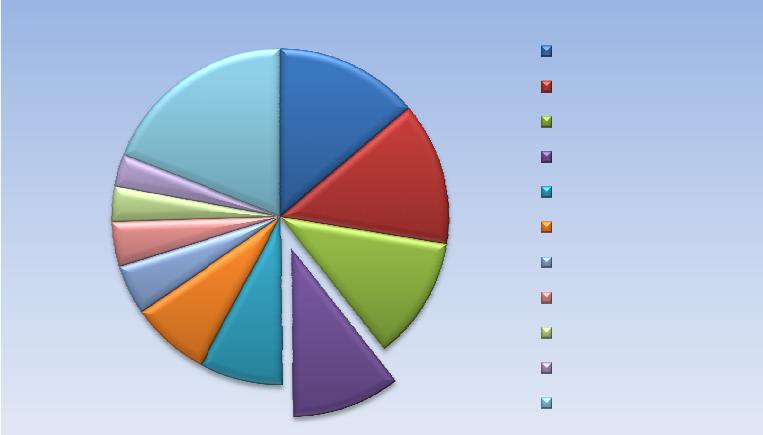
United Airlines is the fourth largest U.S. carrier
March 2010, United’s current market share based on Revenue Passenger Miles is 10.4%.
(Research and Innovative Technology Administration (RITA), 2010)
are Delta/Northwest, Southwest, American, US Airways, Frontier, JetBlue, and Alaska.
United’s market share along with its main competitors is shown in Fi
Revenue & Profit
History
United earns its revenues from four segments; namely, mainline, regional affiliate, cargo, and
other.
“Other” segment includes earnings from Mileage P
services, and interests. However, United uses the first two segments for reporting purposes.
(United Airlines Corporation, 2010)
of re
venues from mainline passengers, 19% from regional affiliate passenger, 3% from cargo,
and 5% from other resources.
Airline industry is cyclical. It relies heavily on economy and seasonality. United i
exception. F
rom the deregulation in 1978 until 2000, United was a profitable company.
However, o
ver the last ten years, United incurred losses every year with the exception of 2007.
In 2007, United earned profit of $359 million.
ten years are shown in Figure 2 below.
7.60%
4.80%
4.30%
3.40%
3.10%
19%
Revenue
& Profit History
United Airlines is the fourth largest U.S. carrier
based on Revenue Passenger Miles
March 2010, United’s current market share based on Revenue Passenger Miles is 10.4%.
(Research and Innovative Technology Administration (RITA), 2010)
. United’s top competitors
are Delta/Northwest, Southwest, American, US Airways, Frontier, JetBlue, and Alaska.
United’s market share along with its main competitors is shown in Fi
gure 1.
Figure 1 – Airline Industry-Market Shares
History
United earns its revenues from four segments; namely, mainline, regional affiliate, cargo, and
“Other” segment includes earnings from Mileage P
lus®, United Services
services, and interests. However, United uses the first two segments for reporting purposes.
(United Airlines Corporation, 2010)
. For the period ending December 2009, United earned 73%
venues from mainline passengers, 19% from regional affiliate passenger, 3% from cargo,
(United Airlines, 2010).
Airline industry is cyclical. It relies heavily on economy and seasonality. United i
rom the deregulation in 1978 until 2000, United was a profitable company.
ver the last ten years, United incurred losses every year with the exception of 2007.
In 2007, United earned profit of $359 million.
The revenues and net i
ncome (loss) for the last
ten years are shown in Figure 2 below.
13.80%
13.80%
11.80%
10.40%
8.00%
7.60%
19%
American
Southwest
Delta
United
US Airways
Continental
Northwest
JetBlue
AirTran Corporation
Alaska
Other
Hameed
P a g e | 6
based on Revenue Passenger Miles
. As of
March 2010, United’s current market share based on Revenue Passenger Miles is 10.4%.
. United’s top competitors
are Delta/Northwest, Southwest, American, US Airways, Frontier, JetBlue, and Alaska.
gure 1.
United earns its revenues from four segments; namely, mainline, regional affiliate, cargo, and
lus®, United Services
– maintenance
services, and interests. However, United uses the first two segments for reporting purposes.
. For the period ending December 2009, United earned 73%
venues from mainline passengers, 19% from regional affiliate passenger, 3% from cargo,
Airline industry is cyclical. It relies heavily on economy and seasonality. United i
s no
rom the deregulation in 1978 until 2000, United was a profitable company.
ver the last ten years, United incurred losses every year with the exception of 2007.
ncome (loss) for the last
American
Southwest
US Airways
Continental
Northwest
AirTran Corporation
Hameed
P a g e | 7
Year
2000
2001
2002
2003
2004
2005
2006
2007
2008
2009
Revenue $
19,352 16,138 14,286 13,724 16,391 17,379 17,882 19,852
20,194 16,335
Net
Income $
50
(2
,
145)
(3
,
212)
(2
,
808)
(1,721)
(21
,176)
22,851
359
(5,354)
(628)
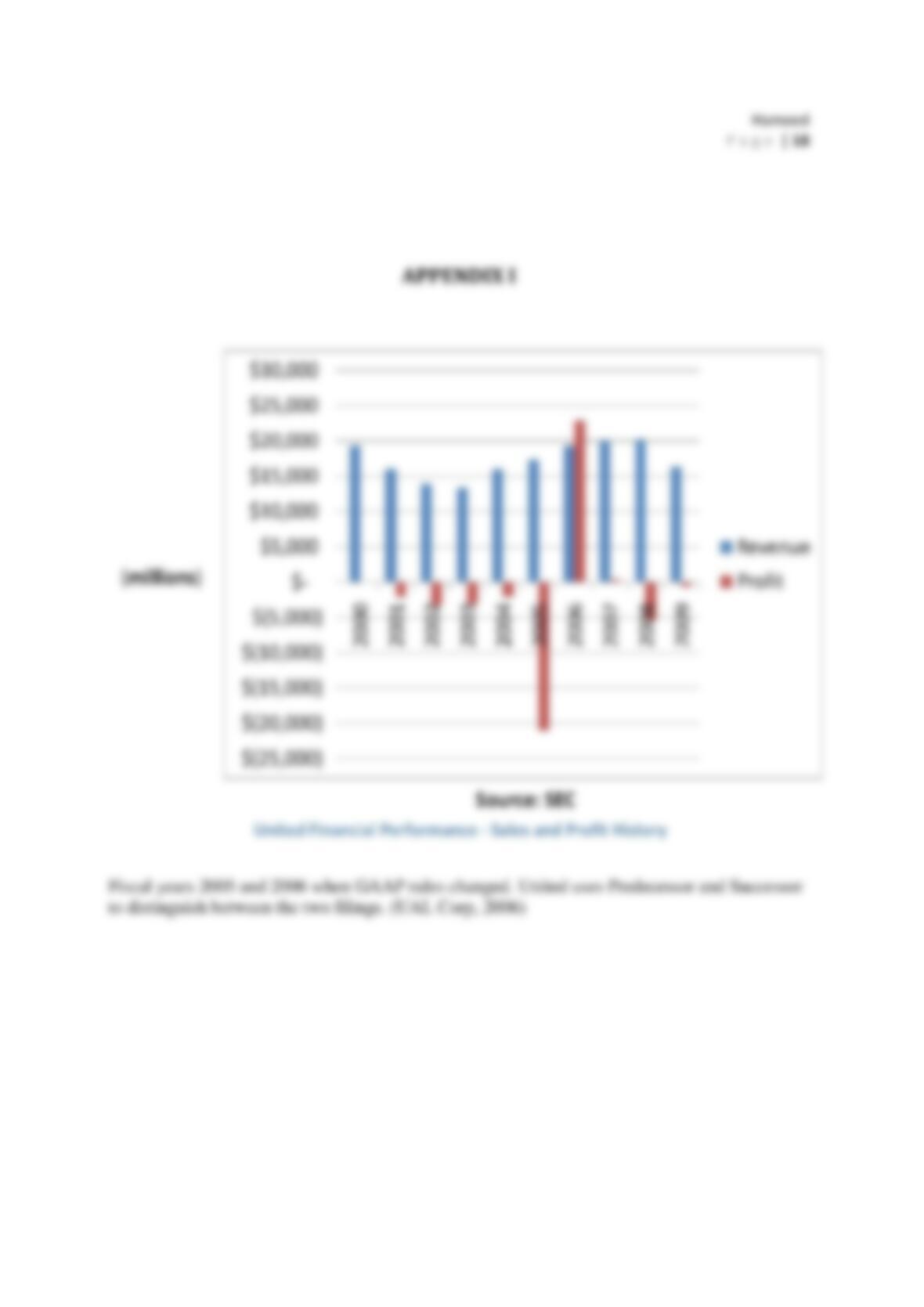
Figure 2 – United – 10 Year Revenue & Income History (in millions)
Many factors contributed towards United’s losses over the last ten years. In 2001, United was
one of the two companies that were used in September 11 attacks, which resulted in low
consumer confidence specifically in United and American Airlines and airline travel in general.
In 2002, United filed for Chapter 11 bankruptcy.
United’s revenue steadily rose from 2004 to 2008. However, United incurred losses due to high
interest rates payments, increased fuel prices, and recession. During 2007-08 year, United’s fuel
expense increased 59% to $3.1 billion, which resulted in net loss of $5.3 billion. On the other
hand, during the 2008-09 fiscal year, United incurred high fuel costs due to hedging in the
previous year. United hedged fuel at $104 a barrel speculating that fuel prices will rise. Instead,
fuel prices decreased to $34 a barrel resulting in $586 million in fuel hedge loss and $628