Unit 8
WEIGHING NET PRESENT VALUE
AND OTHER CAPITAL BUDGETING
CRITERIA
– CHAPTER 13
Cornett, Adair & Nofsinger (2017).
“Finance: Applications and Theory”, 4th
Edition. McGraw Hill Education.

•Using TVM concepts, we have studied
the valuation of bonds and stocks.
•Using TVM concepts, we can also
evaluate projects to see if they add
value to the company.
•Projects can be as simple as the
purchase of real assets in the form of
capital equipment to create value for
the company.
Capital Budgeting (Project Evaluation)

Capital Budgeting Process
•Step 1: Estimation of cash flows (inflows
and outflows) relevant to a project.
•Identifies incremental cash flows directly
attributable to new project.
•Estimates the following:
•how much cash outflows each project will
need.
•how much cash inflows the project will
generate
•the exact timing of these outflows and inflows.

•Step 2: Calculate the cost of capital
(i.e. investors’ required return, details
will be discussed in later lectures) for a
project.
•Step 3: Evaluation of the feasibility of
the project based on capital
budgeting methods.
Capital Budgeting Process

Capital Budgeting Techniques
•Capital Budgeting / Project Evaluation
Methods :
•Payback (PB)
•Discounted Payback (DPB)
•Net Present Value (NPV)
•Internal Rate of Return (IRR)
•Modified Internal Rate of Return (MIRR)
•Profitability Index (PI)

Payback
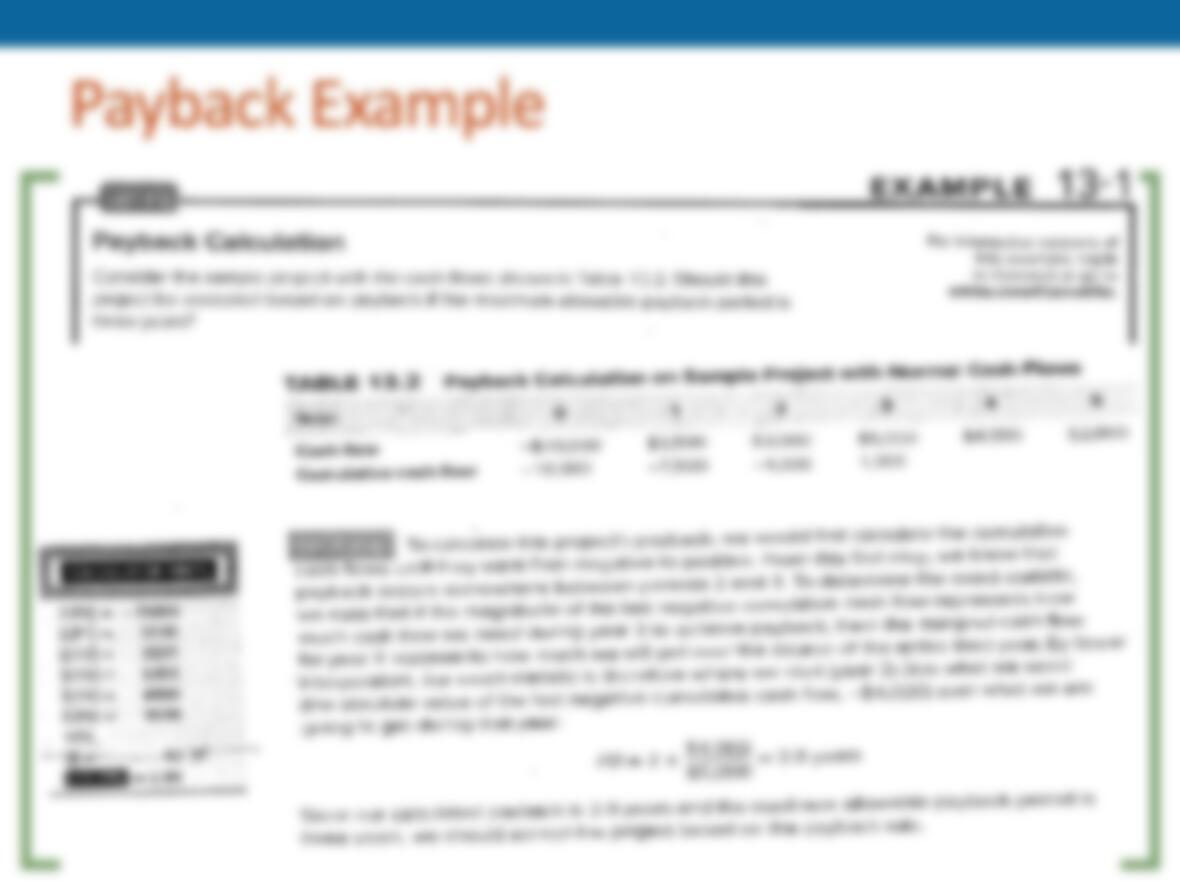
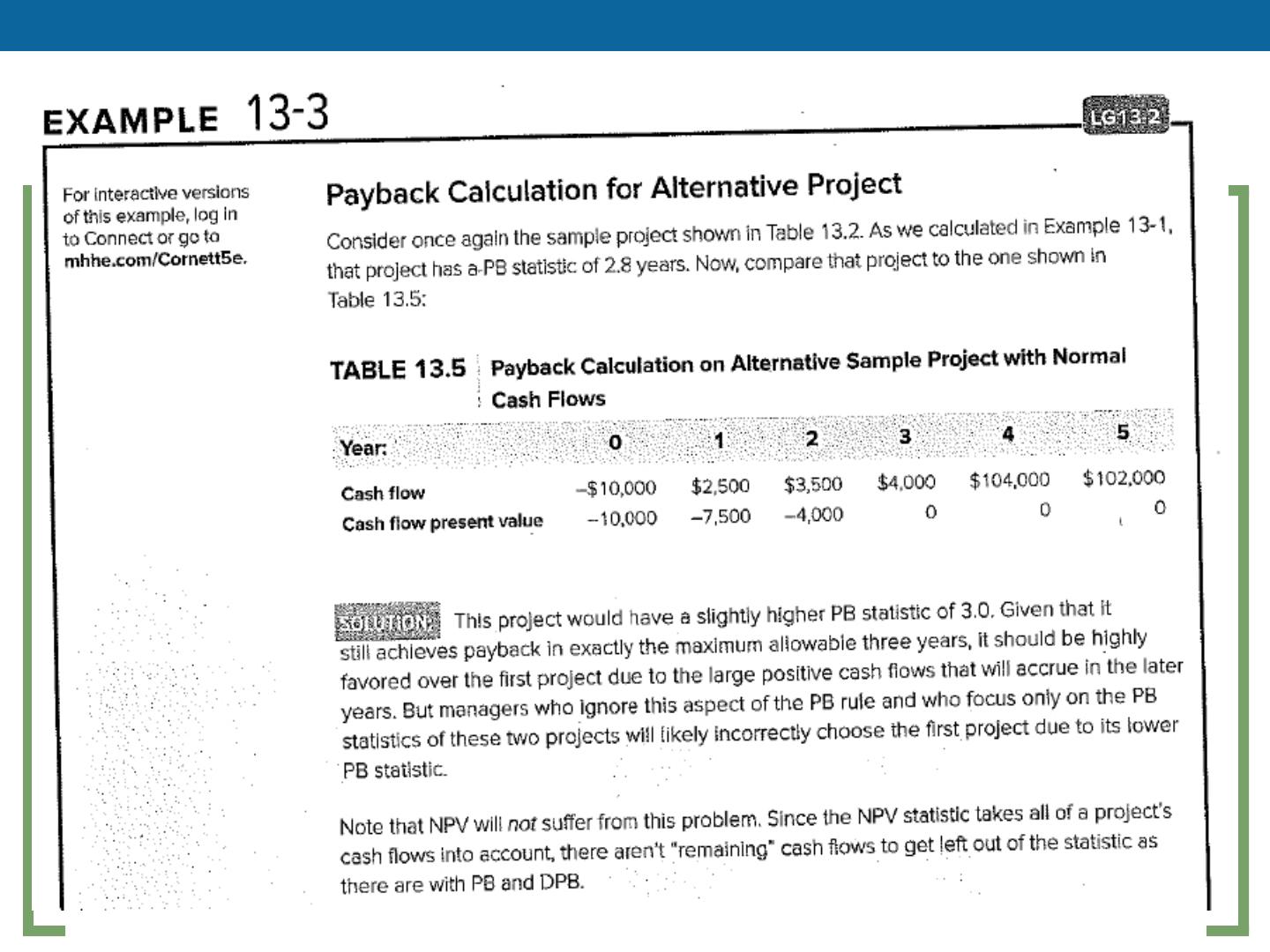
•Payback statistic (PB)
•Measure how long it takes to recoup the project
costs from future cash flows.
•Equivalent to a break-even calculation for costs
of financing new project.
Payback Benchmark
•Benchmark can vary.