0
Introduction:
The term “unemployment” can be tricky and often confusing, but it certainly includes people who
are waiting to return to a job after being discharged. However, it does not anymore encompass
individuals who have stopped looking for a job in the past four weeks due to various reasons such
as leaving work to pursue higher education, retirement, disability, and personal issues. Even people
who are not actively seeking a job anywhere but actually want to find one are not considered
unemployed.
Interestingly, people who have not looked for a job in the past four weeks but have been actively
seeking one in the last 12 months are put into a category called the “marginally attached to the labor
force.” Within this category is another category called “discouraged workers,” which refers to
people who have lost all their hope of finding a job.
The above so many details and exclusions make many people think that unemployment is
ambiguous and the rate does not accurately reflect the real number of unemployed people. So, it’s
also a good idea to look at the word “employment”, defined by the Bureau of Labor Statistics (BLS)
as individuals aged 16 and older who have recently put hours into work in the past week, paid or
otherwise, due to self-employment.
What is unemployment?
Unemployment Is a word that refers to people who are employable and seeking a job but are
unable to find a job. In addition, it’s those people that are available for jobs in the workforce or pool
of people who don’t have an appropriate job. Usually measured by the rate of unemployment which
divides the number of unemployed by the total number of people in the workforce, unemployment
is one of the indicators of an economy’s status.
Types of Unemployment:

1
Structural unemployment: This was caused by a lack of skills
between
the unemployed and the jobs available. Structural unemployed is caused by economic changes,
such as deindustrialization, which leaves some unemployed workers unable to find work in new
industries that require different skills. Even during periods of strong economic growth, this happens.
It is a form of aggregate demand (AD) and not insufficient supply-side unemployment. Structural
unemployment reduction policies include retraining and geographical subsidies. Fiscal or monetary
policy to boost AD in solving structural unemployment will be ineffective.
Frictional unemployment: Is another form of economic unemployment. It is the period of time
between jobs when a worker searches for or transitions from one job to the next. Within an
economy, frictional unemployment is often present to some degree. This occurs when there is a
mismatch between the workers and the jobs. Skills, salary, work time, location, seasonal industries,
attitude, taste and other factors may be linked to the mismatch. Frictional unemployment is affected
by voluntary work decisions based on the valuation of each individual’s own work and how that
compares with current wage rates, as well as the time and effort needed to find a job.
Cyclical unemployment: Is a type of unemployment that occurs when the economy has
insufficient aggregate demand to provide jobs for those who want to work. In an economy, demand
for most of the goods falls, less production is needed and fewer workers are needed. The number of
unemployed individuals is higher than the number of job vacancies with cyclical unemployment.
Three labor market indicators:
The census bureau calculates three indicators of the state of the labor market. They are
• The unemployment rate: The amount of unemployment is an indicator of how hardly
people who want jobs can find them. The unemployment rate is the percentage of
unemployed people in the labor force.
• The employment to population ratio: The number of working-age people employed is an
indicator of both the availability of jobs and the degree of match between sills and jobs. The
employment to population rate is the percentage of people of working age who have job.
• The labor force participation rate: the number of people in the labor force is an indicator
of the willingness of people of working age to take jobs. The labor force participation
rate is the percentage of the working age population who are members of the labor force.
2
Unemployment in South Africa:
A survey of 1,800 South African people by pan-African research institution Afro barometer was
carried out in August and September 2018, delving into what they considered to be the
government’s most significant challenges. A hefty 62 percent of respondents said that reducing
unemployment should be the most crucial issue, well ahead of other serious issues such as crime,
housing, and education.
South Africa is increasingly facing a reckoning when it comes to the country‘s swelling number of
unemployed people. During the final quarter of 2019, the release of a handful of reports has given
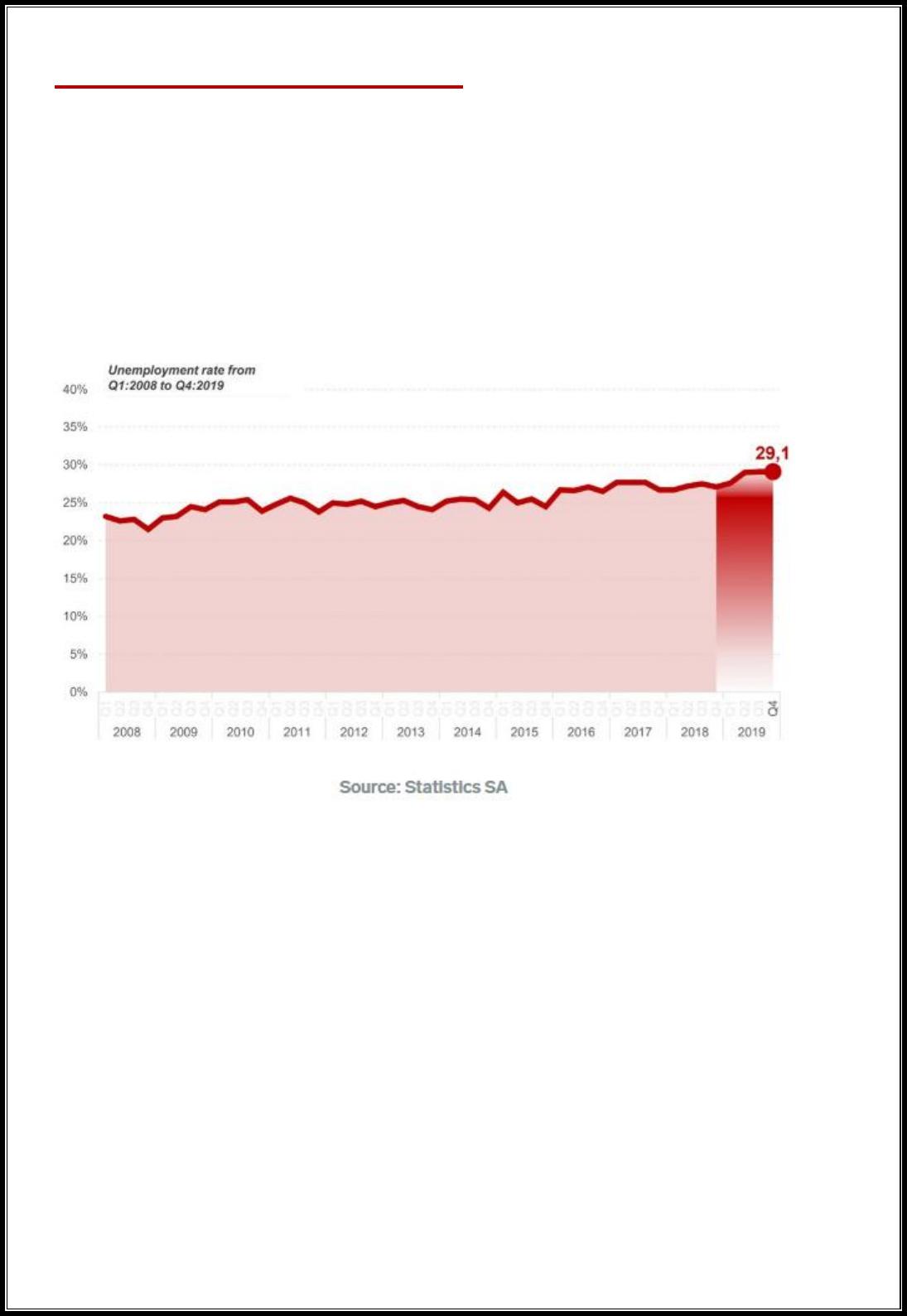
the country much to reflect on, as unemployment surges to record figures. In late October, the
Quarterly Labor Force Survey (QLFS) for the third quarter of Statistics South Africa (Stats SA)
showed that unemployment increased 0.1 percent from the previous quarter to 29.1 percent, the
highest level recorded since the survey started back in 2008.
Internationally, the 29.1% unemployment rate in South Africa ranks as the worst of all major economies in
the world, and comfortably so, with Nigeria ranking second with 23.1% and Turkey ranking
third with 14.0%. And as far as the BRICS countries are concerned, of which South Africa reflects the Sof
that acronym, the country’s rate is far below that of its fellow members — more than double that of Brazil at
11.6% and far worse than India (8.5%), Russia (4.6 %) and China (3.6 %).
A net total of 28,000 jobs were shed between the second and third quarters, equivalent to a 0.3%
decline. Job losses were felt in industries almost across the board, with both the manufacturing and
construction sectors shedding 12,000 jobs each from the previous quarter, and the community–
services sector losing 11,000 jobs. As such, 6.7 million people in total are now officially
unemployed out of an active labor force of 23.1 million, while a further 15.5 million of the working
population are not considered to be economically active.
Moreover, the numbers leave plenty to be desired over a longer timeframe. Unemployment has
risen in South Africa in the last ten years by 4.6%, in the last five years by 3.7% and in the last year
alone by 1.5%. And going back even further reveals just how deep-seated employment woes in
South Africa have become. Recently the government published a report chronicling South Africa ‘s
25 years of progress since it became a democracy.

3
Citing data from Stats SA, the report shows that back in 1994, 8.9 million people in the country
were employed, while unemployment officially ran at 20%, although this measure did not take into
account the Bantustan territory that was initially established during the time of apartheid for black
inhabitants. By the end of 2018, the number of people employed had almost doubled to 16.5 million
people, representing 28.5 % of the population. And yet unemployment figures worsened during the
period. As the report notes, although the economy grew by 2.8%on average between 1994 and
2018, “it has not been able to absorb the number of people needing employment”.
But perhaps most sobering of all is that black workers in the country experience an unemployment
rate around four times worse than that of their fellow white citizens. According to the Statistician
General, black unemployment in 2017 was at 31%, while for Indians/Asians and whites, it was
11.6% and 6.7% respectively. Black women faced the worst prospects, with an unemployment rate
of 34.5%, slightly more than the 31.3% recorded for black men. Black South Africans also have
“worse employment outcomes” as well as “the lowest wages when they are employed”, while white
citizens earn “substantially higher wages than all other population groups”. As such, the report
characterises the labor market in South Africa as having “heavily racialized inequality”, although
unemployment among the white population has also started to creep up, albeit at a lower rate vis-à-
visother population groups.
To compound matters, many believe that the official 29.1% figure is in fact underestimating the true
jobless rate in South Africa. In order to be counted as officially unemployed by Stats SA, one must
be actively looking for work. Those who don’t want to gain employment, therefore, are not counted
as unemployed, as they are not considered economically active. But when using an expanded
definition of unemployment, which includes this cohort of people as well as those who have given
up on meaningful efforts to find a job, the unemployment rate rises to a whopping 38.5%. This
underlines the extent of the problem in South Africa: the number of workers who are discouraged
and have given up on gaining employment has become too big to ignore and highlights just how
dire the situation has truly become.
“It’s desperate,” George Glynos, head of research and analytics at ETM Analytics, explained to
local publication Business Maverick. “Structural rigidities stand in the way of any meaningful
growth and employment.” A similar view is held by Marique Kruger, an economist for the Steel and
Engineering Industries Federation of Southern Africa (SEIFSA), who in light of the poor annual
GDP (gross domestic product) growth for the third quarter of just 0.1 percent recently observed that
the decline in employment for the same period “correlates with structural challenges faced by South
Africa’s industrial production”.
But why is this case? For one, the report cites the “inability of the economy to create jobs coupled
with the high-level entry requirements and the skills mismatch” as reasons for persisting structural
unemployment. Part of the reason can also be attributed to the population growth rate, which has
outpaced economic growth during the 25-year period.
Further explanations have been posited recently. Vimal Ranchhod, professor of economics at the
University of Cape Town’s School of Economics and the acting director of the Southern Africa
Labor and Development Research Unit (SALDRU), recently remarked that labor demand in the
country has not sufficiently adapted to the vast pool of unskilled labor that’s available. And Mr.
Ranchhod points to three specific factors that explain this:
1. South Africa’s “low–trust” society creates costly bureaucracy and labor disputes, which in turn makes
employers more risk-averse to hiring less qualified candidates. Again, this has the effect of suppressing
employment levels.
2. A lack of competition in too many industries, caused by major players that dominate their respective
markets. As such, small firms are prevented from easily entering such markets, which in turn limits job
creation.
3. Investors are wary of anything that might hamper their overall returns, including “threats to property rights,
social and political instability, and perceived levels of corruption”. And if investors are unwilling to invest in
South Africa, generating new employment opportunities becomes much tougher.
Stimulating growth and attracting investment also continues to remain somewhat elusive. As Ms
Kruger recently acknowledged, if economic growth in South Africa remains subdued, it will
continue to pose a “serious challenge” to solving the unemployment crisis. “Business and investor
confidence will continue to decline, thus constricting economic activities and job creation.”
So, what can be done to alleviate the problem? Mr. Ranchhod urges the development of a “high–
quality educational sector that is accessible to everyone” as a priority. “We need to address
widespread poverty, as it limits human development. We need to find a way for firms and labor to
cooperate better. Finally, we need a dynamic and innovative economy where people are sufficiently
rewarded for experimentation and risk-taking.”
On the investment side, some progress is being made at least. Private-sector fixed-investment
spending increased by 11 percent during the third quarter, thus registering the second consecutive
quarter of growth, That said, government-investment spending has fallen for the seventh
consecutive quarter, with capital expenditures being squeezed by the government’s debt-interest