1
– 1 –
TEACHING NOTE
CASE 8
Under Armour’s Strategy in 2016
Overview
Founded in 1996 by former University of Maryland football player Kevin Plank, Under Armour was the
originator of sports apparel made with performance-enhancing fabrics—gear engineered to wick moisture
from the body, regulate body temperature, and enhance comfort regardless of weather conditions and
activity levels. It started with a simple plan to make a T-shirt that provided compression and wicked perspiration
off the wearer’s skin, thereby avoiding the discomfort of sweat-absorbed apparel. Under Armour’s innovative
synthetic performance fabric T-shirts were an instant hit.
Nearly 20 years later, with 2015 revenues of $3.9 billion, Under Armour had a growing brand presence in the
roughly $70 billion multi-segment retail market for sports apparel, active wear, and athletic footwear in the
United States. Its interlocking “U” and “A” logo was almost as familiar and well-known as industry-leader
Nike’s swoosh. Heading into 2016, Under Armour had an estimated 16 percent share of the United States market
for sports apparel (up from 12.7 percent in 2012 and 11.1 percent in 2011). In the synthetic performance apparel
segment—a market niche with estimated U.S. sales close to $7 billion in 2015—Under Armour’s market share
was thought to exceed 35 percent.
However, across all segments (sports apparel, active wear, and athletic footwear) of the $250 billion global
market in which the company competed, Under Armour still had a long way to go to overtake the two long-
time industry leaders—Nike and The adidas Group. In fiscal 2015, Nike had U.S. sales of $11.3 billion and
global sales of $30.6 billion, and it dominated both the U.S. and global markets for athletic footwear. In the
United States, Nike’s share of athletic footwear sales approached 60 percent (counting its Nike-branded footwear
and sales of its Jordan and Converse brands) versus Under Armour’s less than 3 percent share. Nike’s 2015
global sales of athletic footwear were $18.3 billion (over 1 million pairs per day), dwarfing Under Armour’s
2015 global footwear sales of $678 million. Germany-based The adidas Group—the industry’s second-ranking
company in term of global revenues—had 2015 global sales of €16.9 billion (equivalent to about $18.8 billion),
which included athletic footwear sales of €8.4 billion ($9.3 billion) and sports apparel sales of €7.0 billion ($7.7
billion).
Despite having global sales much smaller than its two global rivals, Under Armour was gaining ground and
making its market presence felt. In North America, Under Armour had recently overtaken adidas to become the
second largest seller of sports apparel, active wear, and athletic footwear. Under Armour’s 2015 North American
sales of $3.56 billion were over 15 percent greater than The Adidas Group’s 2015 North American sales of €2.75
billion (equivalent to about $3.03 billion). Moreover, Under Armour was growing at a faster percentage rate than
both its bigger rivals. From 2010 through 2015, Under Armour’s sales revenues grew at a compound annual rate
of 30.1 percent. Nike’s revenues from Nike Brand products during its most recent 5 fiscal years (June 1, 2010-
May 31, 2015) grew at an 11.75 percent compound rate. Total revenues of The adidas Group grew at a compound
rate of 7.1 percent during 2010-2015. But because Under Armour’s revenues were much smaller than those of
Nike and The Adidas Group, its faster percentage rate of revenue growth did not translate into bigger revenue
gains in absolute dollar terms. Under Armour’s global revenues grew by just under $880 million in 2015. Nike’s
How Big a Factor Can the Company Become in the $250
Billion Global Market for Sports Apparel and Footwear?
Case 8 Teaching Note Under Armour’s Strategy in 2016
2
global revenues in 2015 were $2.8 billion above the 2014 level, more than three times greater than UA’s dollar
increase in revenues. The adidas Group’s 2015 revenue gain of €2.4 billion (about $2.66 billion) was three times
bigger than UA’s dollar increase in revenues. So, in term of dollar revenues, Under Armour fell further behind
Nike and The adidas Group in 2015. Consequently, it would take many years, if ever, for Under Armour’s
revenues to approach those of Nike, which touted itself as a growth company and was led by top executives who
were intent on preserving Nike’s standing as the global market leader.
Nonetheless, founder and CEO Kevin Plank believed Under Armour’s potential for long-term growth was
exceptional for three reasons: (1) the company had built an incredibly powerful and authentic brand in a relatively
short time, (2) there were significant opportunities to expand the company’s narrow product line-up and brand
name appeal into product categories where it currently had little or no market presence, and (3) the company was
only in the early stages of establishing its brand and penetrating markets outside North America. Plank’s revenue
objectives for Under Armour were global sales of $7.5 billion in 2018 and $10 billion in 2020. If these objectives
were met and if Under Armour’s strategy proved powerful enough to sustain a revenue growth rate of 20 percent
or more for another 5 to 10 years thereafter, then Plank’s vision of Under Armour becoming a major player on
the global stage would be fulfilled.
Suggestions for Using the Case
This freshly-updated case should generate considerable student interest and provoke a lively, interesting class
discussion. Under Armour is rapidly expanding its market presence in performance sports apparel, growing a
base of loyal customers for its product offerings, and becoming a much stronger market contender vis-à-vis both
Nike and The adidas Group.
The Under Armour case is probably best assigned after you have covered Chapters 1-7, but it can be successfully
used after students have read just Chapters 3, 4, and 5. It is definitely a good case for drilling students in the tools
of analysis covered in Chapters 3 and 4. The material in Chapters 5 and 6 is pertinent to student identification and
assessment of Under Armour’s strategy and competitive approaches. And, with Under Armour’s accelerating
efforts to enter a growing number of foreign markets, the material in Chapter 7 regarding competing in foreign
markets comes into play as well.
The Under Armour case provides an opportunity for class members to evaluate industry and competitive
conditions, think strategically about Under Armour’s resources and capabilities versus those of its main rivals,
do a weighted competitive strength assessment of Under Armour versus Nike and The adidas Group, crunch
some numbers in the financial exhibits, and make action recommendations regarding Under Armour’s future
course of action.
There is enough material in this case and enough opportunities to drill students in applying the concepts and
analytical tools in Chapters 3 and 4 to fill two class periods should you opt to devote this much class time to
covering the case thoroughly.
Videos for Use with the Under Armour Case. There are two videos you can show (or let students view on
their own) when having class discussion of the Under Armour case:
A 2:35-minute 2015 video entitled “Under Armour’s Game Plan.” It can be accessed at https://www.
youtube.com/watch?v=i4S08VwUMgw.
A 2:21-minute 2016 video interview of Kevin Plank aired on CNBC titled “How Under Armour
Overcame Its Underdog Odds / How I Made It.” It can be accessed at https://www.youtube.com/
watch?v=Q3VO2pGMIok.
Links to the two videos are also posted in the instructor resources section of the Connect Library.
Our recommendation would be to show the Kevin Plank video interview at the beginning of the class period and
to show the first video just prior to asking class members for what 3-4 top priority issues do Kevin Plank and
Under Armour management need to address—question 9 in the Assignment Questions section below.
Case 8 Teaching Note Under Armour’s Strategy in 2016
3
The Connect-based Exercise for the Under Armour Case. We developed an exercise for Under Armour
for inclusion in the publisher’s Connect™ Management web-based assignment and assessment platform
because:
The case ties tightly to many of the topics covered in Chapters 3 through 7.
One of the purposes of the case exercises is to drill students in applying the concepts and analytical tools
discussed in the chapters to the circumstances posed in the cases.
This particular Connect-based exercise concerns the following ten questions:
1. What is your assessment of the strength of competitive pressures stemming from rivalry among Under
Armour, Nike, and Adidas-Reebok (The adidas Group)?
2. What is your assessment of the strength of competitive pressures stemming from the threat of entry of
new competitors into the North American market for performance sports apparel?
3. What is your assessment of the strength of competitive pressures stemming from substitutes for
performance sports apparel?
4. What is your assessment of the strength of competitive pressures stemming from suppliers to the
marketers of performance sports apparel?
5. What is your assessment of the strength of competitive pressures stemming from the buyers of
performance sports apparel in North America?
6. What is the collective strength of the five competitive forces facing Under Armour, Nike, and Adidas-
Reebok in the North American market for performance sports apparel?
7. Does Under Armour have any core competencies and, if so, what are they?
8. Does Under Armour have any resource strengths or competitive capabilities that qualify as a distinctive
competence?
9. Which one of the five generic competitive strategies discussed in Chapter 5 most closely approximates
the competitive approach that Under Armour is employing?
10. What is impressive about Under Armour’s financial performance during the 2011-2015 period (as shown
in case Exhibit 1)?
It should take class members roughly 60 minutes to complete the exercise, assuming they have done a conscientious
job of reading the case and absorbing the information it contains. All of the questions are automatically graded,
and the grades are automatically recorded in your Connect grade book, which makes it easy for you to evaluate
each class member’s ability to apply many of the concepts and analytical methods in Chapters 3-7.
What to Tell Students in Preparing the Under Armour Case for Class. To give students guidance in
what to do and think about in preparing the Under Armour case for class discussion, we strongly recommend
two things:
1. Have class members complete the Connect-based exercise for the Under Armour case in the event
you have adopted the Connect software for your course.
OR
2. Provide class members with assignment questions and insist that they prepare good notes/answers to
these questions before coming to class. Our recommended assignment questions for the Under Armour
case are presented in the next section of this TN. You may wish to have the class concentrate their
attention on a subset of these questions, depending on how you want to handle the class discussion.
Covering all of the assignment questions will likely require two class periods.
Case 8 Teaching Note Under Armour’s Strategy in 2016
4
To facilitate your use of assignment questions and making them available to students, we have posted
a file of the Assignment Questions contained in this teaching note in the instructor resources section
of the Connect Library. (You should be aware that there is a set of assignment questions posted in the
Connect Library for each of the cases included in the 21th edition.) In all instances, these assignment
questions correspond to the assignment questions in the teaching note for the case.
In our experience, it is quite difficult to have an insightful and constructive class discussion of an assigned case
unless students have conscientiously have made use of pertinent core concepts and analytical tools in preparing
substantive answers to a set of well-conceived study questions before they come to class. In our classes, we
expect students to bring their notes to the study questions to use/refer to in responding to the questions that
we pose. Moreover, students often find that a set of study questions is useful in helping them prepare oral
team presentations and written case assignments—in addition to whatever directive question(s) you supply for
these assignments. Hence, we urge that you provide students with assignment questions—either those we have
provided or a set of your own questions—for all those aspects of a case that you believe are worthy of student
analysis or that you plan to cover during your class discussion of the case.
Utilizing the Guide to Case Analysis. If this is your first assigned case, you may find it beneficial to have
class members read the Guide to Case Analysis that follows Case 31. The content of this Guide is particularly
helpful to students if your course is their first experience with cases and they are unsure about the mechanics of
how to prepare a case for class discussion, oral presentation, or written analysis.
Suggested Assignment Questions for an Oral Team Presentation or Written Case Analysis. We
definitely recommend use of the Under Armour case for written assignments and oral team presentations. Our
suggested assignment questions are as follows:
■ Under Armour CEO Kevin Plank has employed you as a consultant to assess the company’s overall
situation and recommend a set of actions to improve the company’s future prospects. Please prepare
a report to Mr. Plank that includes (1) an evaluation of competitive forces in the global market for
performance sports apparel and accessories, (2) an assessment of Under Armour’s strengths, weaknesses,
opportunities and threats, (3) an evaluation of Under Armour’s financial performance as shown in case
Exhibit 1, (4) a weighted competitive strength assessment of Under Armour, Nike, and The adidas
Group using the methodology in Table 4.4, and (5) a set of action recommendations that clearly define
the course of action Under Armour should pursue. Your report should be 5-6 pages, plus it should
include an assortment of charts, tables, and exhibits to support your analysis and recommendations.
■ Prepare a brief report to Under Armour CEO Kevin Plank outlining the 3-4 top priority issues that Under
Armour management needs to address and the actions you think Kevin Plank should initiate to address
these issues and steer Under Armour into an even stronger position to challenge Nike’s leadership
position. Your report should contain detailed and convincing reasons in support of each one of your
recommendations. It is imperative that the support offered for each of your recommendation be based on
(a) conclusions drawn from application of the concepts and analytical tools discussed in Chapters 3 and
4 and (b) the content of Chapters 5-7 regarding strategic moves that may be suitable for Under Armour
in building a stronger competitive position vis-à-vis Nike and The adidas Group.
Assignment Questions
1. How strong are the competitive forces confronting Under Armour, Nike, and The adidas Group? Do a five-
forces analysis to support your answer.
2. Does Under Armour have any core competencies and, if so, what are they?
3. Does Under Armour have any resource strengths or competitive capabilities that qualify as a distinctive
competence?
4. What does a SWOT analysis reveal about the overall attractiveness of Under Armour’s situation?
Case 8 Teaching Note Under Armour’s Strategy in 2016
5
5. What are the key elements of Under Armour’s strategy?
6. Which one of the five generic competitive strategies discussed in Chapter 5 most closely approximates the
competitive approach that Under Armour is employing?
7. What is impressive about Under Armour’s financial performance during the 2011-2015 period (as shown in
case Exhibit 1)?
8. How does Under Armour’s competitive strength compare against that of Nike and The adidas Group? Do
a weighted competitive strength assessment using the methodology presented in Table 4.4 in Chapter 4 to
support your answer. Based on your assessment and calculations, does Under Armour have a net competitive
advantage or disadvantage in competing against Nike and The adidas Group?
9. What 3-4 top priority issues do Kevin Plank and Under Armour management need to address?
10. What recommendations would you make to Under Armour CEO Kevin Plank? At a minimum, your
recommendations should cover what to do about each of the top priority issues identified in question 9.
Teaching Outline an d Analysis
1. How strong are the competitive forces confronting Under Armour, Nike, and The adidas
Group? Do a five-forces analysis to support your answer.
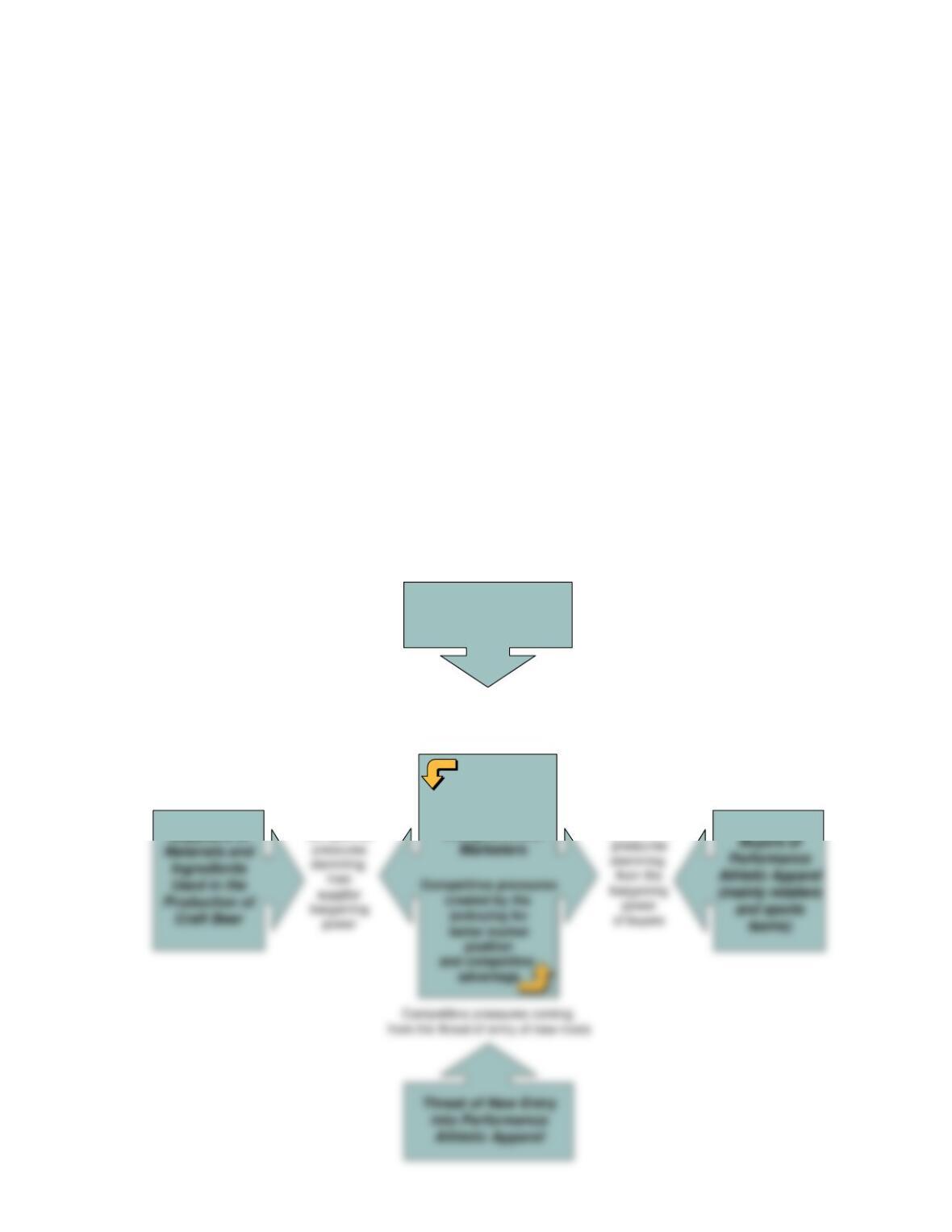
Below is a representative five-forces model of competition for the performance sports apparel industry:
Competitive
Competitive
Substitutes for
Performance
Athletic Apparel
Competitive pressures coming from
the market attempts of sellers in
other industries to win buyer patronage
away performance athletic apparel
Rivalry among
Performance
Sports Apparel
Designers and