1. My assessment of Under Armour’s performance downturn in the 4th quarter of 2016 was
due to the challenges and disruptions in North American retail. Chairman Kevin Plank
had a high outlook for the company’s success in the 3rd quarter of 2016, but the demand
in North America for Under Armour was weakening. People were starting to find other
brands besides UA and the company’s revenue was taking a hit because of it.
2. Under Armour, Nike, and Adidas are three of the most known athletic brands worldwide.
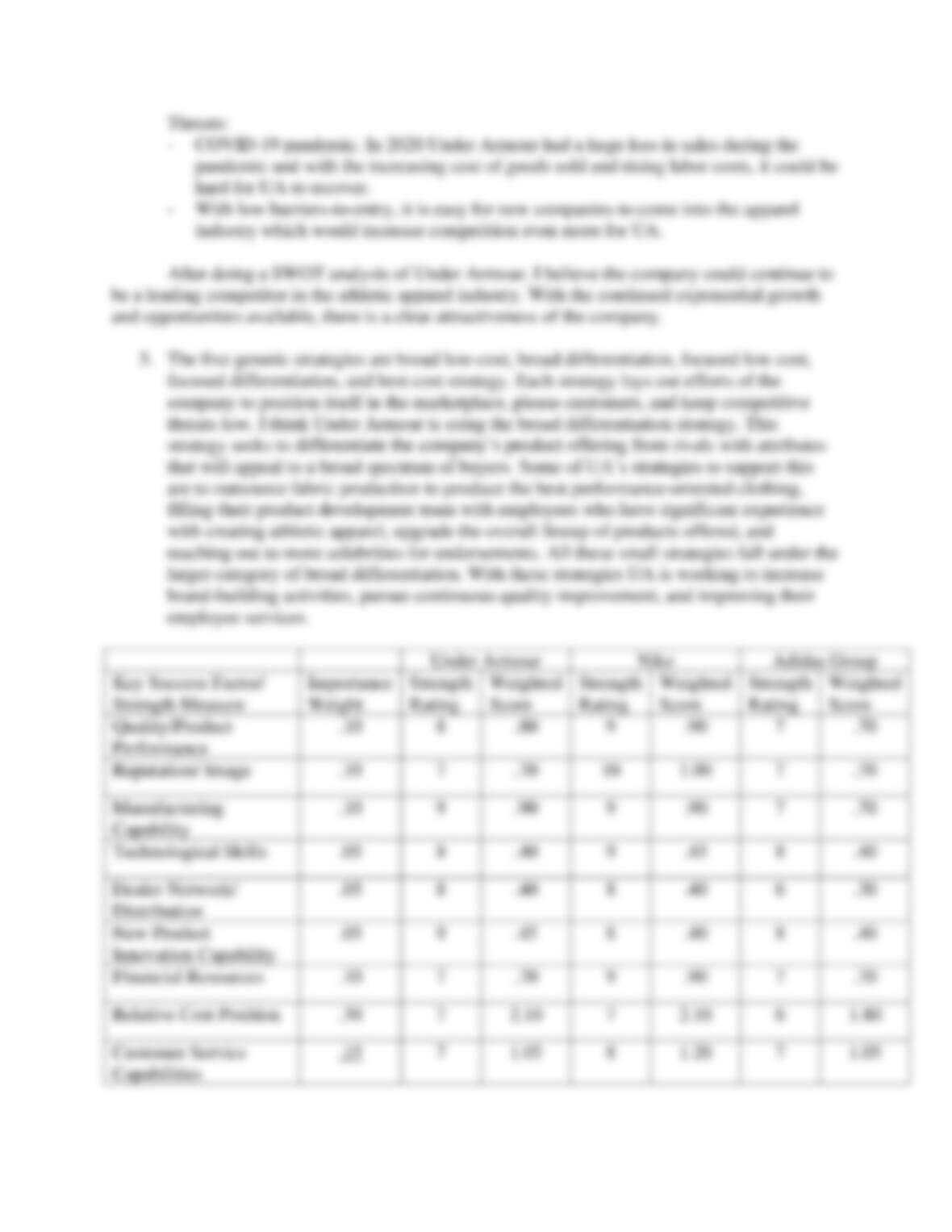
In the athletic apparel market, it is easy to compete because there are low barriers to
entry. The three companies were able to share the market with UA having a 14.7% share,
Nike with 27%, and Adidas at 7.4%. While these apparel companies are able to share the
market enough to make a large profit, it is still hard for new entrants to come into this
business. Under Armour, Nike, and The Adidas Group have made themselves into huge
name brands with a large customer loyalty. For a new athletic company to come in, it
would be very difficult to become as well known as them. Also, Exhibit 4 in the textbook
shows all the brands competing in the sports apparel market, proving how high the
competition is. While the barrier of entry is low, it would be hard for a new company to
come in and reach the level of Nike, Adidas, or Under Armour. The power of suppliers in
this industry is high because of how many different companies there are competing.
Larger buyers are able to get cheaper prices because they are ordering in large quantities.
But UA is still expensive because of the special materials and fabrics they need to buy
from their suppliers. This brings in the power of customers. In the athletic apparel
industry, customers have a wide range of options, so it is easy for them to find a similar
product for much less. Therefore, Under Armour needs to make products that customers
are willing to spend the extra money on. UA chooses to spend extra money on sponsoring
big name athletes to represent their brand and grow the brand recognition, so customers
continue to buy their apparel. The threat of substitutes still affects Under Armour as you
can see with all of the competition they have. While UA does use special sweat wicking
fabric that attracts many athletes, Nike and The Adidas Group have been able to make
their own versions of specialty fabric for less. Before Under Armour took their downturn,
they were more expensive and “higher end” than brands like Nike and The Adidas
Group, but there became too many substitutes for UA’s brand.
3. Yes, Under Armour does have resource strengths and competitive capabilities that qualify
as a distinctive competence. I believe their biggest distinctive competence is their product
quality. UA products are manufactured with advanced specialty fabrics made by third
parties. The company’s product development team works very closely with the fabric
suppliers to make sure the products designed fit UA’s standards. Their development team
is also very experienced in the athletic apparel industry, which gives their company an
upper hand in the market. By outsourcing fabric production, it gave UA more time to
focus on upgrading performance, styling, and appeal of existing products. By having such
a strong production team and process this gives a high value to the company because they
can fend off threats from the environment.
The value and rarity of Under Armour are very similar. Since they have such a valuable
production process that uses specialized materials it also gives them the strength of being
rare. Their products are designed to “change with the athlete” they have clothing that
dries faster, keeps you warm, and shoes that track your workout for you. With products
like Charged Cotton, Cold Gear, and UA HOVR it is complicated for other companies to
find the resources to make materials like this, so I would say Under Armour has rare
resources
While their materials and quality are rare, other companies like Nike and The Adidas
Group have been able to find substitutes to make their own versions of UA’s gear. For
example, Nike made their own version of shoes that track your workout and have been
able to find a way to make sweat wicking fabric called Dry Fit. At one point Under
Armour was a leading company in athletic apparel and paved the way for others but as
technology advanced other companies have been able to imitate some of their products,
but not all.
I do think Under Armour has exploitability because they do take advantage of their
resources and capabilities. Their global presence has grown with sales of $621 million in
EMEA countries in 2019. Their CEO, Kevin Plank, is the reason why the company has
been so successful in the past. He was once an athlete, so he knows what athletes want
and need across the world. With his leadership sales in Europe, Asia, and Latin America
accounted for 27.6% of Under Armour’s total net revenues in 2019. I would say the
company is using their resources to capitalize on the market.
4. Strengths: