Decorating the Corpse of Constantinople in Tyrian Purple.
David Rayahin
World History I
Dr. Nicholas Ganson
November 13, 2014!

Rayahin 1
“All the people look like princes. The Second Rome is a glittering city of miracles.
Everybody is dressed in silk, purple and beautiful embroidery.”
1
Benjamin of Tudela
It wouldn’t take longer than a few minutes on Google to find stories upon stories of
wealth and opulence from the time of the Byzantines in Constantinople, in fact, society as a
whole whole was characterized in four words, “Imperial dignity,” “magnificence,” “opulence,”
and “prosperity.” In today’s western society, it’s a widely accepted fact that our social status is
2
heavily determined by our clothes. In the United States, the President wears the finest suits gifted
to him by companies with legacies reaching hundreds of years and the First Lady wears only the
most prestigious designer dresses. In Byzantium, an almost identical site is to be seen, where all
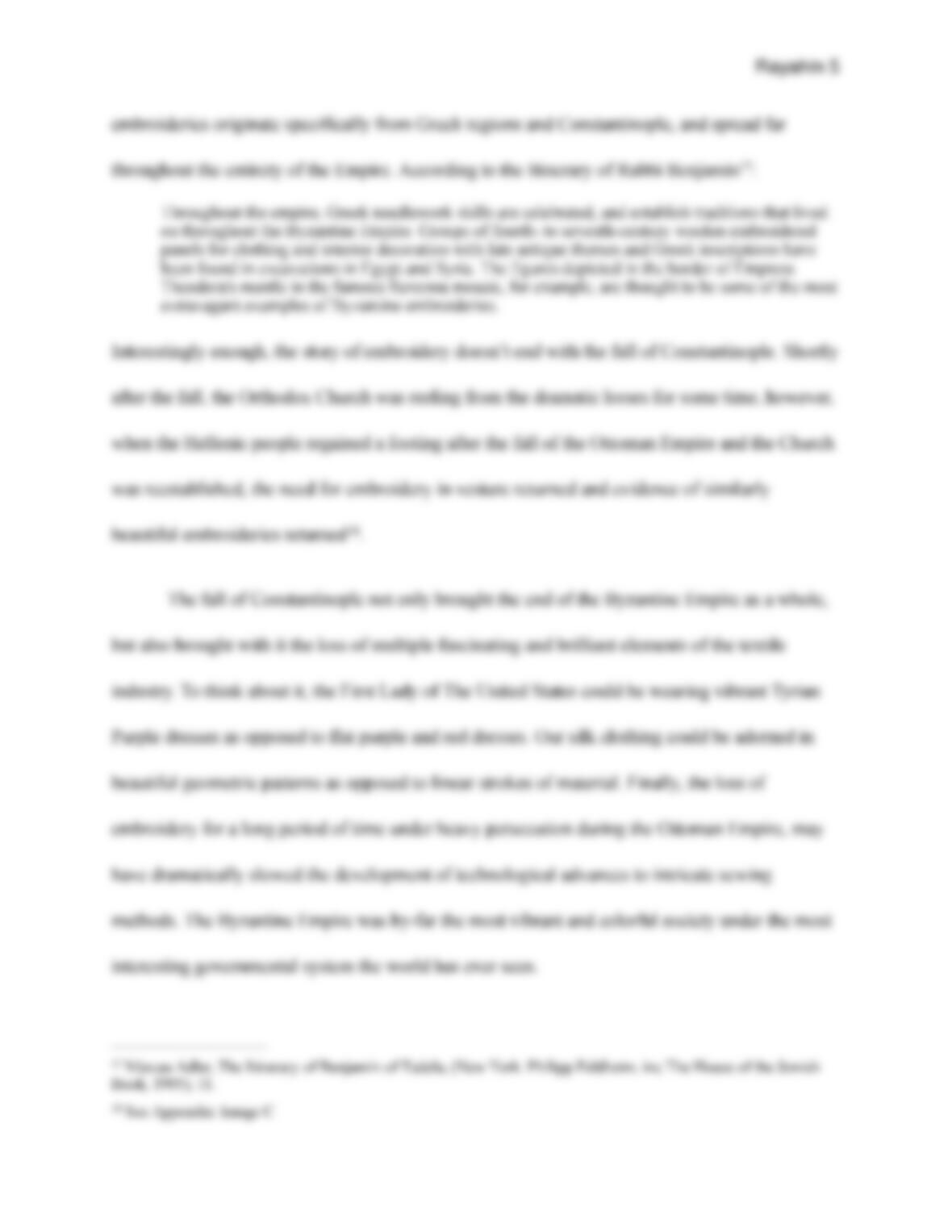
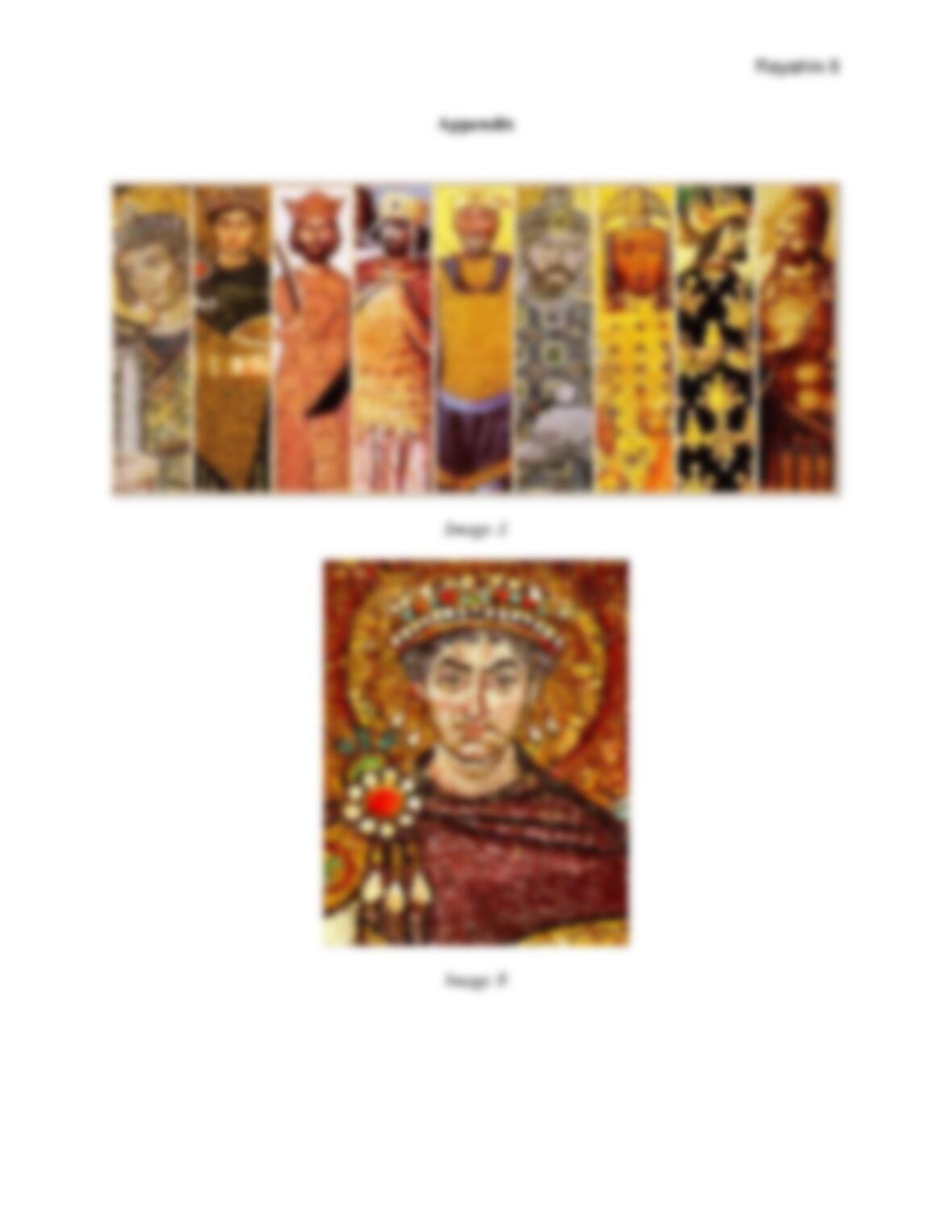
depictions of Byzantine Emperors show them adorned in beautiful materials and colors, such as
3
exquisite silks and Tyrian Purple. Since the gradual fall of Constantinople, the global textile
industry has never been the same, because of the loss of many important specialized trades such
as Tyrian Purple dyeing, the silk trade and weaving.
The most dramatic loss to the textile industry at the fall of Constantinople was Tyrian
Purple. This dyestuff was reserved exclusively for royalty, and found it’s origins from the days of
Phoenicia. One of the most significant mentions of Tyrian or “true” Purple biblically is in the !
Marcus Adler, The Itinerary of Benjamin of Tudela, (New York: Philipp Feldheim, inc The House of the Jewish
1
Book, 1905), 11.
Edwin Pears, The Fall of Constantinople Bring the Story of the Fourth Crusade, (New-Street Square, London:
2
Spottiswoode and Co., 1885), 182.
See Appendix: Image A
3

Rayahin 2
Protoevangelium of James, the most divine manifestation of God Himself on earth involves
Tyrian Purple :
4
And the true purple and the scarlet fell to the lot of Mary, and she took them, and went away to her
house…And Mary took the scarlet , and span it. And then she took the pitcher, and went out to fill
5
it with water. And, beheld, a voice saying: Hail, you who hast received grace; the Lord is with you;
blessed are you among women!…And she went away, trembling, to her house, and put down the
pitcher; and taking the purple, she sat down on her seat, and drew it out. And, behold, an angel of
the Lord stood before her, saying: Fear not, Mary; for you have found grace before the Lord of all,
and you shall conceive, according to His word. And she hearing, reasoned with herself, saying:
Shall I conceive by the Lord, the living God?
The story tells that the Mother of God’s lot was of Tyrian Purple (royalty), and as she wove the
immaculate thread on earth, God was weaving himself within her womb from The Kingdom. The
development of Tyrian Purple is told to have stemmed from the Phoenicians around 1500BC. In
the August/September 1960 Issue of Saudi Aramco’s World Magazine, the story is as follows :
6
One day while Hercules was strolling along the shores of Phoenicia with a nymph he loved, named
Tyrus, his dog, who was running beside them, came upon a Murex trunculus, with head protruding
from its trumpet-like shell. The dog quickly devoured the shellfish and came away with a mouth
stained brilliant purple. Enraptured by the tint, Tyrus claimed a robe of that same striking shade as
the price Hercules would have to pay for her hand. Hercules, being Hercules, was able to gather